

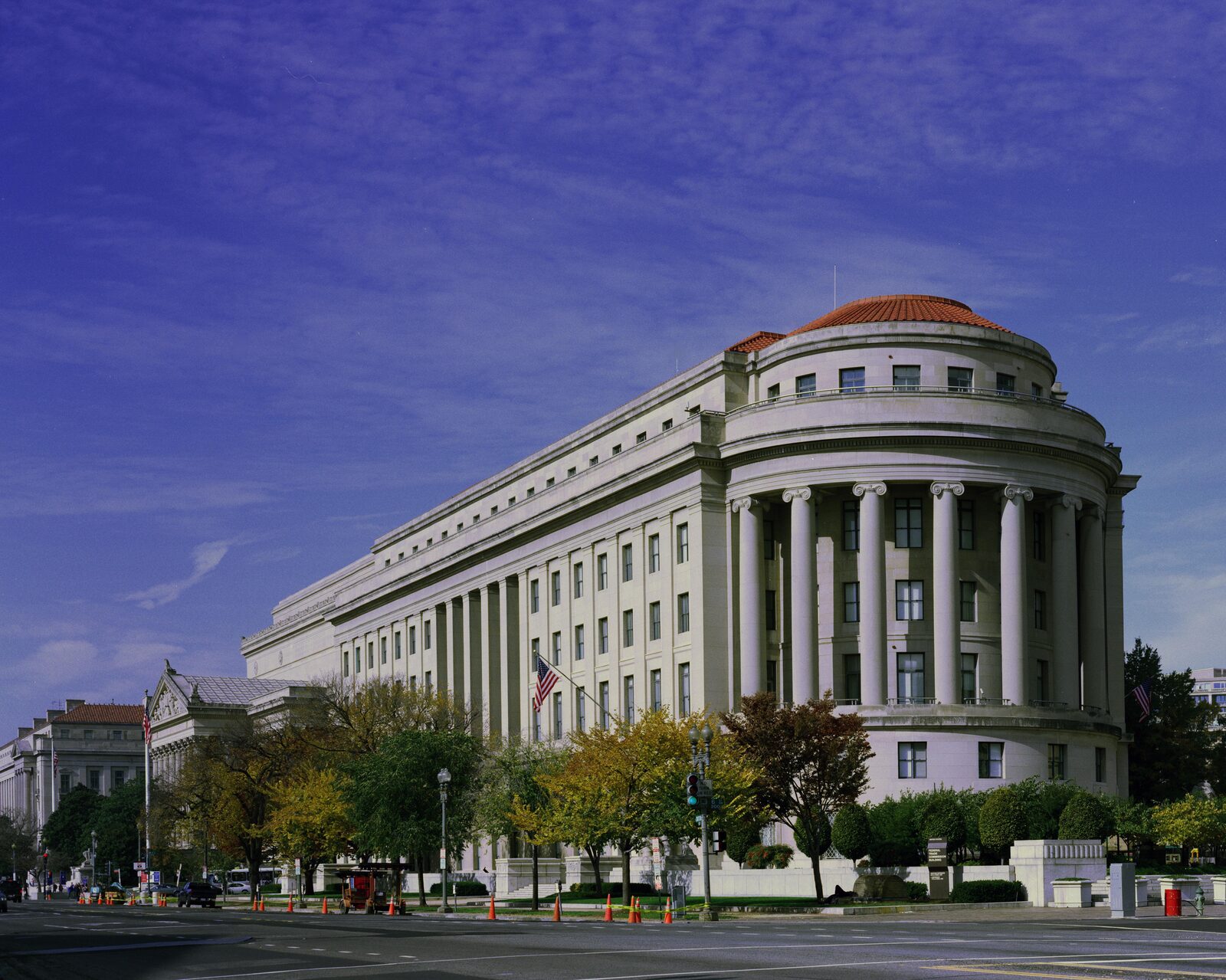
Federal Register Watch is The Investigative Journal’s daily survey of the rules, proposals, and notices that shape how Washington governs. This edition draws on the Federal Register’s July 7, 2026 filings and the most recent completed issue, dated July 6, which carried 137 documents from 47 agencies.
A single theme runs through this week’s most consequential filings: agencies across the government are using the summer rulemaking season to redraw the boundary between federal and state authority — over artificial intelligence, airline consumers, employment law, and critical minerals. Below are eight actions worth watching, followed by shorter items on the beats The Investigative Journal tracks most closely.
1. FTC moves to police ‘suppression of accuracy’ in AI systems
The Federal Trade Commission is publishing a proposed policy statement on July 7 asserting that companies which quietly “steer” the outputs of their artificial-intelligence systems away from what users request — and toward undisclosed objectives — may be committing deceptive acts under Section 5 of the FTC Act. The 15-page statement, docketed as Matter No. P264200, was directed by Executive Order 14365, “Ensuring a National Policy Framework for Artificial Intelligence,” which President Trump signed on December 11, 2025.
The Commission’s central argument is that consumers reasonably expect AI systems to aim for truthful, accurate answers, and that a developer who covertly alters outputs — whether for ideological reasons or to satisfy a state statute — can mislead them. The statement singles out state measures such as Colorado’s Artificial Intelligence Act, contending that a state law compelling an AI firm to distort accurate output “is impliedly preempted to the extent it conflicts with” the FTC Act. The Commission is careful to distinguish this conduct from “hallucinations,” the inadvertent errors that it says do not, by themselves, raise Section 5 concerns.
The document indicates that companies can avoid liability through “clear and conspicuous” disclosures that they prioritize objectives other than accuracy, though it cautions such disclaimers cannot be buried in terms of service. Public comments are due July 31, 2026, at regulations.gov under docket FTC-2026-0859. The proposal is likely to draw responses from state regulators, civil-liberties groups, and AI developers over the reach of federal preemption and the First Amendment questions the Commission itself acknowledges are “orthogonal” to its analysis.
2. CMS proposes 2027 Medicare payment rates for home health and hospital outpatient care
The Centers for Medicare & Medicaid Services released two of its marquee annual payment proposals within 24 hours. The Calendar Year 2027 Home Health Prospective Payment System proposed rule, published July 6, updates payment rates and case-mix weights for home-health agencies, proposes a temporary behavior adjustment, and seeks comment on a home-health-specific wage index. Comments are due August 31, 2026.
Following on July 7 is the far larger Hospital Outpatient Prospective Payment and Ambulatory Surgical Center proposed rule, the annual vehicle through which CMS sets outpatient rates, quality-reporting requirements, and coverage policies affecting thousands of hospitals and surgical centers. Together the two proposals will govern billions of dollars in Medicare spending and are among the most heavily lobbied documents the agency issues each year.
For patients, providers, and investors alike, the fine print matters: adjustments to case-mix weights, low-utilization thresholds, and durable-medical-equipment policy can shift reimbursement by hundreds of millions of dollars. Interested parties should consult each rule’s DATES section for the applicable comment deadline and submit through regulations.gov.
3. Justice and Homeland Security codify drone-defeat authority for local police
In a joint interim final rule, the Departments of Justice and Homeland Security established the framework implementing the SAFER SKIES Act, which authorizes state, local, tribal, and territorial law-enforcement and correctional agencies to conduct counter-unmanned-aircraft-system (C-UAS) operations. The 51-page rule took effect July 1, 2026, and the Departments are accepting public comment on the framework.
The rule sets up a two-tiered certification structure — one tier for detection and warning, a second for active mitigation — and addresses authorized technologies, spectrum coordination, airspace approval, real-time notification to air-traffic control, mitigation reporting, and privacy protections. It marks a significant expansion of the authority to track and, in some cases, disable drones, which until now has been tightly held by a handful of federal agencies.
Because the measure hands new surveillance-adjacent powers to state and local agencies, its privacy and civil-liberties provisions will bear close scrutiny. The Investigative Journal will track how the certification and reporting requirements are implemented, and whether the promised privacy safeguards are enforced in practice.
4. EEOC rescinds 1979 affirmative-action guidelines
The Equal Employment Opportunity Commission published a final interpretive rule on July 6 rescinding its 1979 “Guidelines on Affirmative Action Appropriate Under Title VII of the Civil Rights Act of 1964” and removing them from the Code of Federal Regulations. The Commission states that the guidelines are “inconsistent with the statutory language,” were not supported by Supreme Court precedent when issued, and have not accounted for four decades of subsequent case law.
The guidelines had provided a framework under which employers could undertake voluntary affirmative action to remedy the underrepresentation of women and minorities. Their removal aligns the EEOC’s regulatory posture with recent Supreme Court decisions constraining race-conscious decision-making, and continues a broader realignment of federal anti-discrimination policy. As an interpretive rule, the rescission does not carry a public comment period.
5. Commerce opens a Section 232 national-security probe of coal imports
The Commerce Department’s Bureau of Industry and Security is publishing a notice confirming that the Secretary of Commerce initiated an investigation on June 29, 2026, into the national-security effects of imports of anthracite coal and metallurgical bituminous coal. The probe proceeds under Section 232 of the Trade Expansion Act of 1962 — the same authority the administration has used for steel, aluminum, and other goods — and expressly contemplates “whether additional measures, including tariffs or quotas, are necessary to protect national security.”
The notice frames anthracite and metallurgical coal as critical inputs for domestic steelmaking, and asks the public to weigh in on domestic capacity, import concentration, foreign subsidies, and the risk that foreign nations could “weaponize their control over supplies.” The comment window is unusually short: submissions are due 14 days after publication — roughly July 21, 2026 — via regulations.gov under docket BIS-2026-0298.
Section 232 investigations are a recurring feature of the administration’s trade agenda, and their outcomes can reshape supply chains and prices well beyond the commodity under review. The Investigative Journal will follow the record for evidence on which foreign suppliers the inquiry targets.
6. EPA finalizes air-toxics standards for wood-products plants
The Environmental Protection Agency published a final rule on July 6 amending the National Emission Standards for Hazardous Air Pollutants for the Plywood and Composite Wood Products source category. The rule sets maximum-achievable-control-technology limits for a slate of pollutants including formaldehyde, methanol, acrolein, and mercury emitted by facilities that are major sources of hazardous air pollutants.
According to the rule, the amendments resolve a 2007 partial court remand of the agency’s original 2004 standard and respond to a petition for reconsideration of the 2020 residual-risk and technology review. For the plywood, particleboard, and fiberboard industries, the emission limits and work-practice standards will drive compliance investments at kilns and process units nationwide. The rule’s effective date and any compliance deadlines are specified in its DATES section.
7. DOT extends its pause on airline-refund rules for renumbered flights
The Department of Transportation is publishing a notification of enforcement discretion on July 7 that extends, for one year, its decision not to enforce a provision of the 2024 airline-refund rule that treats a flight given a new number as a “cancelled flight” entitling passengers to a refund. The pause now runs through July 7, 2027.
DOT says airlines demonstrated that renumbering is often a routine logistical step — for example, switching between mainline and regional service — that causes “no inherent harm” to passengers, and that the extension gives the department time to finish a pending rulemaking (“Refund III”) redefining what counts as a cancellation. Officials stress that the discretion is “temporary and strictly limited”: standard refund obligations still apply whenever a renumbered flight also involves a significant change or delay, such as a schedule shift of three or more hours domestically, an airport change, or a downgrade in class of service.
The move is a measured rollback of one slice of the Biden-era refund framework rather than a wholesale repeal, and consumer advocates and airlines are likely to press competing views when the underlying Refund III proposal advances.
8. DEA moves to place kratom-derived compounds in Schedule I
The Drug Enforcement Administration filed two notices of intent on July 6 signaling temporary Schedule I control of several compounds derived from kratom. One targets 7-hydroxymitragynine above a specified threshold; a companion notice covers mitragynine pseudoindoxyl and the synthetic analogues MGM-15 and MGM-16.
If finalized, the temporary orders would subject anyone who manufactures, distributes, imports, exports, researches, or possesses the substances to the controls and criminal penalties that attach to Schedule I — the most restrictive category under the Controlled Substances Act. The action lands amid a contentious national debate over concentrated 7-hydroxymitragynine products, which some public-health officials say are far more potent than raw-leaf kratom, and which industry advocates argue should be regulated rather than banned. The Investigative Journal will monitor whether the DEA’s scientific and medical findings are published alongside the scheduling orders.
On The Investigative Journal’s beats
Trade and China. The U.S. International Trade Commission is publishing notices in its antidumping and countervailing-duty reviews, including one covering passenger vehicle and light-truck tires from China — part of the long-running enforcement docket on Chinese imports that TIJ follows closely.
The federal workforce. The Office of Personnel Management is issuing a rule on performance appraisal for General Schedule, prevailing-rate, and certain other employees — the latest in a series of civil-service changes reshaping how federal employees are evaluated and managed.
Guns and the regulatory rollback. The Bureau of Alcohol, Tobacco, Firearms, and Explosives proposed easing paperwork for firearms applications, allowing applicants to submit a photo ID in place of passport-style photographs and a single fingerprint card. Comments are due October 5, 2026.
Labor and preemption. The Federal Aviation Administration proposed a rule declaring that federal duty- and rest-period rules preempt state meal-and-rest-break requirements for flight crews, citing the Airline Deregulation Act. Comments are due September 4, 2026.
Immigration and money. The Treasury Department is publishing a notice setting the interest rate paid on cash deposited to secure ICE immigration bonds — a small but telling data point on the machinery of immigration enforcement.
Farm policy. The Agriculture Department finalized a rule establishing the Organic Certification Cost Share Program for 2025 and beyond, funded through fiscal 2031 by the One Big Beautiful Bill Act — a reminder of how sweeping budget legislation filters down into everyday program rules.
Foreign policy. A presidential determination on assistance to Venezuela, issued under the Trafficking Victims Protection Act of 2000, appeared in the July 6 issue.
Methodology and sourcing
Every item above is drawn directly from documents published in, or filed for publication with, the Federal Register, the official daily journal of the United States government. Document numbers, effective dates, and comment deadlines are taken from the filings themselves; where a comment deadline was not fixed in the version reviewed, that is noted. Readers can verify each entry through the linked Federal Register document and submit comments through the referenced regulations.gov dockets. Nothing here constitutes legal advice.