

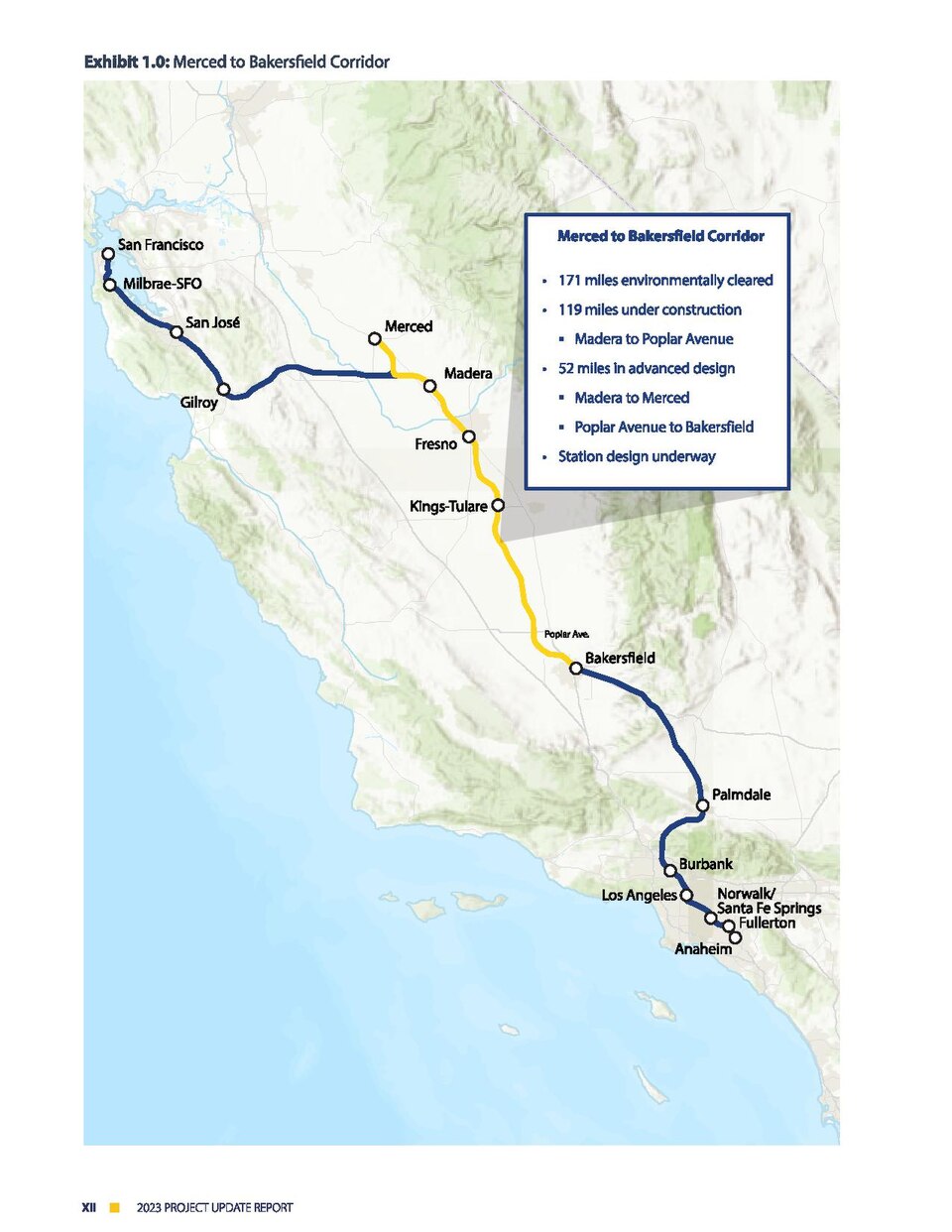
In November 2008, California voters approved Proposition 1A, authorizing $33 billion for an 800-mile high-speed rail system connecting San Francisco and Los Angeles. The promise was bold: trains traveling at 220 miles per hour, a completed system by 2020, and a transformative investment in the state’s infrastructure. Nearly two decades later, not a single mile of operational high-speed rail track has been laid. The project’s cost estimate has ballooned to between $126 billion and $135 billion. The projected completion date for even a truncated initial segment has been pushed to 2032 at the earliest. And the federal government, exasperated by years of missed deadlines and broken commitments, terminated $4.2 billion in previously awarded grants in July 2025.
The California High-Speed Rail Authority has become a case study in how large-scale public infrastructure projects can go catastrophically wrong when political ambition outpaces institutional competence. The 171-mile Initial Operating Segment from Merced to Bakersfield — a fraction of the originally promised system — is now estimated to cost $36.7 billion, according to the Authority’s 2026 draft business plan. That single segment exceeds the entire $33 billion budget that voters approved for the full San Francisco-to-Los Angeles line. The per-mile construction cost for the Central Valley segment has reached approximately $207 million, compared to the original system estimate of roughly $41 million per mile.
Change Orders and Contractor Chaos
The financial details are staggering. Dragados Flatiron Joint Venture, the contractor responsible for the 65-mile Fresno-to-Bakersfield segment, has accumulated 597 change orders totaling $2.32 billion as of November 2025, representing 62 percent of the contractor’s original $1.2 billion contract value. In January 2026, the Authority approved a single settlement change order of $537.3 million — the largest in project history — bringing the contractor’s total change orders to approximately $2.8 billion. Across all three major contractors, change orders have reached nearly $6 billion, according to data compiled by Representative Vince Fong of California.
The California State Auditor’s 2018 report on the project found that “flawed decision making and poor contract management have contributed to billions of dollars in cost overruns.” The Authority had begun construction in the Central Valley in October 2013 despite being aware of unmitigated risks, including insufficient land acquisition, unresolved utility relocations, and unfinalized stakeholder agreements. The auditor found that $4 million had been paid to regional contractors without documentation that work had been completed. The Authority had no system for tracking administration and pre-construction costs as required by state law.
As of April 2026, the project has spent between $13.8 billion and $15.7 billion. Eighty miles of guideway — the track bed structure, not actual rail — have been completed out of the 119-mile Central Valley segment. Fifty-nine of 93 planned civil structures have been finished. These are not insignificant accomplishments, but they represent a fraction of what was promised and have been achieved at a cost that makes the project one of the most expensive per-mile infrastructure investments in the world.
The Trainset That Never Came
Perhaps the most emblematic failure is the trainset procurement process. The Authority began procurement in 2013, alongside Amtrak. As of February 2026 — thirteen years later — no trainsets have been procured. The Authority missed its October 2024 deadline, then a rescheduled July 2025 deadline. The Federal Railroad Administration cited this failure as one of nine distinct areas where the Authority had failed to meet its commitments, triggering the termination of $4.2 billion in federal grants. An additional $175 million in federal funds was rescinded in August 2025, including $89.6 million designated for the Merced Extension.
The project’s defenders argue that infrastructure of this scale is inherently difficult and that cost overruns are common in mega-projects worldwide. There is some truth to this. But the California High-Speed Rail project has exceeded even the most pessimistic projections of cost escalation and schedule slippage. The 2008 business plan was described by congressional critics as “very theoretical,” lacking specifics on financing, engineering, and implementation. Each subsequent business plan has revised costs upward and timelines outward, creating a pattern of institutional dishonesty that has eroded public trust.
The CBS 60 Minutes investigation in February 2026 brought national attention to the project’s failures, highlighting the $126 billion price tag and the absence of operational track. Governor Newsom, who once promised to scale back the project to a more realistic scope, announced in February 2026 that temporary freight tracks were being laid at a Southern Railhead facility in Kern County to support construction material delivery. This was presented as progress. It is, in fact, a construction logistics measure, not a step toward passenger service.
The Accountability Vacuum
The deeper problem is structural. The California High-Speed Rail Authority operates with minimal legislative oversight and has resisted meaningful accountability measures at every turn. Environmental review alone consumed over $765 million. The Authority’s board, appointed by the governor and legislative leaders, has approved successive budget increases and timeline extensions without consequence. No senior official has been fired or held personally accountable for the billions in cost overruns.
California taxpayers are now committed to a project that cannot be completed with available funding, cannot meet any reasonable timeline, and cannot demonstrate that it will ever achieve the ridership projections used to justify its construction. The state’s Legislative Analyst has warned that the temporary nature of federal stimulus combined with flat property tax growth puts local governments at financial risk — a warning that applies with particular force to a project that has consumed billions in state bond funds with no revenue in sight.
The California High-Speed Rail project is not merely a boondoggle. It is a monument to the institutional pathologies that afflict large-scale governance in the most progressive state in the nation: an unwillingness to set realistic expectations, an inability to manage complex contracts, a reflexive hostility toward accountability, and a political culture in which admitting failure is more dangerous than perpetuating it. The $33 billion promise of 2008 has become a $128 billion lesson in why voters should be deeply skeptical when their government tells them that this time, the ambitious plan will work.