

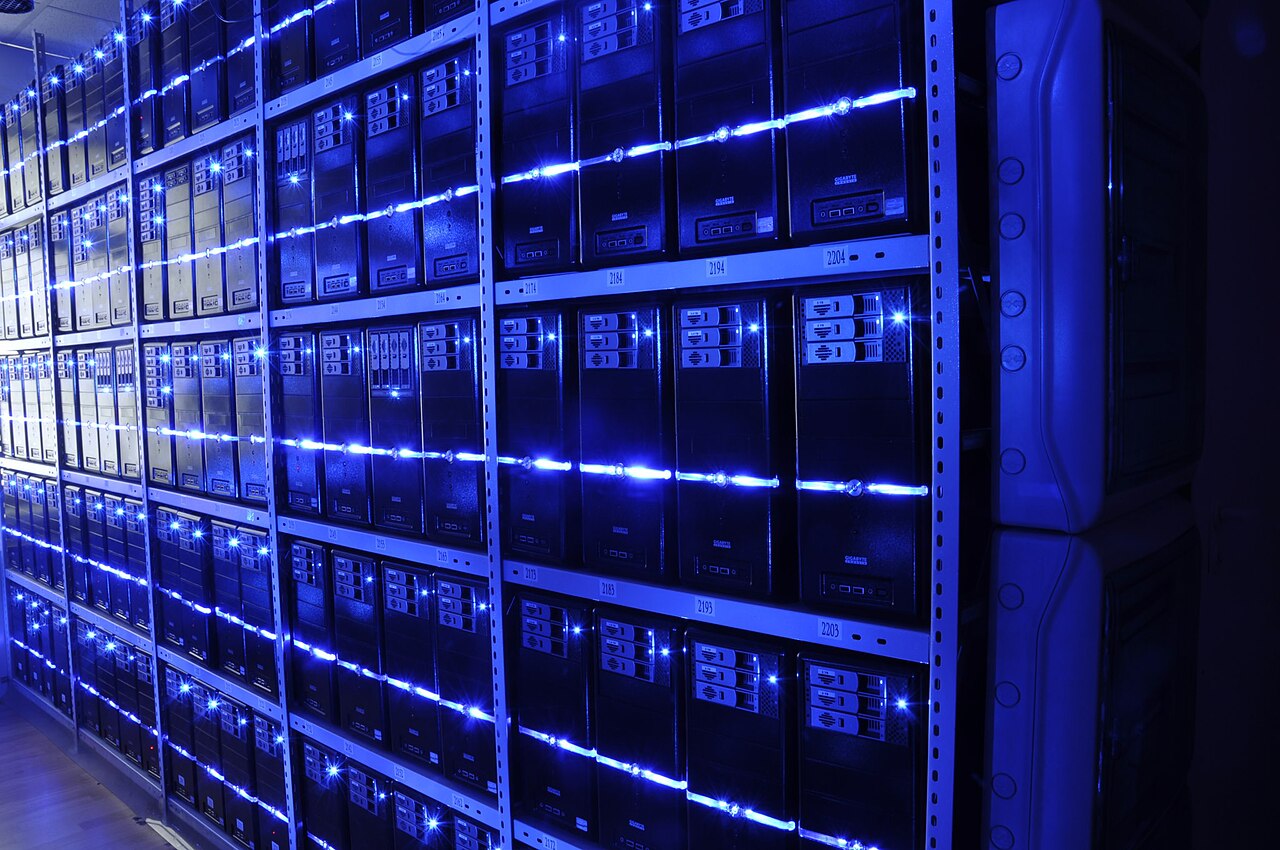
Google consumed 6.4 billion gallons of water in 2023, with 95 percent of that total — 6.1 billion gallons — drawn by its data centers. A single Google facility in Council Bluffs, Iowa consumed one billion gallons in 2024, making it the company’s thirstiest operation worldwide. Meta’s water usage rose 51 percent between 2020 and 2024, from 3,726 megaliters to 5,637 megaliters — enough to supply more than 13,000 homes for a year. Microsoft reported that 42 percent of its water consumption came from areas the company itself classified as experiencing “water stress.” These figures, drawn from the companies’ own sustainability reports, represent a crisis that Silicon Valley would prefer to discuss in the abstract language of environmental stewardship rather than the concrete terms of municipal water infrastructure.
The scale of the problem is growing exponentially. U.S. data centers consumed an additional 211 billion gallons of water indirectly through electricity generation in 2023, according to analysis cited by Reuters. North American data centers are projected to use nearly one trillion liters in 2025 — equivalent to the annual water demand of New York City. Nearly 80 percent of Google’s AI data center water consumption in the United States came from drinking water sources, a detail that the company does not prominently feature in its environmental messaging. The artificial intelligence boom has dramatically accelerated the demand for computing power and, consequently, for the water required to cool the servers that provide it.
Where the Water Goes
The geography of data center construction tells its own story. Roughly two-thirds of data centers built since 2022 have been located in water-stressed regions, according to a Bloomberg News analysis. Arizona, where groundwater depletion has become a political flashpoint, hosts an expanding cluster of hyperscale data centers from Amazon, Microsoft, and Google. In Spain’s Aragon region, where water scarcity is a generational concern, all three companies are expanding despite significant local opposition. The pattern is driven by economics rather than hydrology: data centers are sited where electricity is cheap, tax incentives are generous, and fiber-optic connectivity is available, with water availability treated as a secondary consideration.
The irony is sharp enough to cut. Google, Microsoft, and Meta have all made aggressive public commitments to water stewardship and environmental sustainability. Google has pledged to be “water positive” by 2030, replenishing more water than it consumes. Microsoft has made a similar commitment. Yet neither company provides site-specific water consumption data that would allow communities to assess the actual impact of facilities within their jurisdictions. More than a dozen institutional investors have pressured Amazon, Microsoft, and Google for greater water disclosure, and several multibillion-dollar data center projects have been abandoned following community opposition — a rare instance of local resistance successfully challenging corporate expansion plans.
The AI Multiplier
The artificial intelligence revolution has transformed this from a growing concern into an urgent one. Training a large language model requires massive computational resources sustained over weeks or months, generating heat that must be dissipated through cooling systems that, in most facilities, rely on evaporative water use. Every ChatGPT query, every AI-generated image, every automated customer service interaction draws incrementally on water resources that were allocated to data centers based on pre-AI demand projections. The companies building these facilities have been remarkably vague about the water implications of AI workloads, a silence that grows more conspicuous as the demand for AI computing capacity shows no sign of plateauing.
The companies involved are not breaking any laws. Water rights in the United States are governed by a patchwork of state and local regulations, and data centers have generally been welcomed by municipalities eager for the tax revenue and jobs they bring. But the cumulative effect of dozens of hyperscale facilities drawing billions of gallons from aquifers and municipal systems represents a resource allocation decision that is being made without meaningful public deliberation. The communities hosting these facilities often lack the technical expertise to evaluate the long-term hydrological impact, and the companies have no legal obligation to provide that analysis.
What is needed is transparency — genuine, site-specific, independently verified transparency about water consumption, water sourcing, and the projected impact of facility expansion on local water systems. The sustainability reports that Google, Microsoft, and Meta publish annually are exercises in corporate communication, not instruments of accountability. They aggregate data at levels that obscure local impacts, employ proprietary methodologies that resist external verification, and frame water consumption as a challenge being managed rather than a cost being externalized. Until the communities that provide the water have access to the same information that corporate boards use to make expansion decisions, the hidden water crisis of Big Tech will remain hidden by design.
Sources: Harvard DEI Research | McKinsey Diversity Reports | SHRM | Project Implicit | Conference Board