

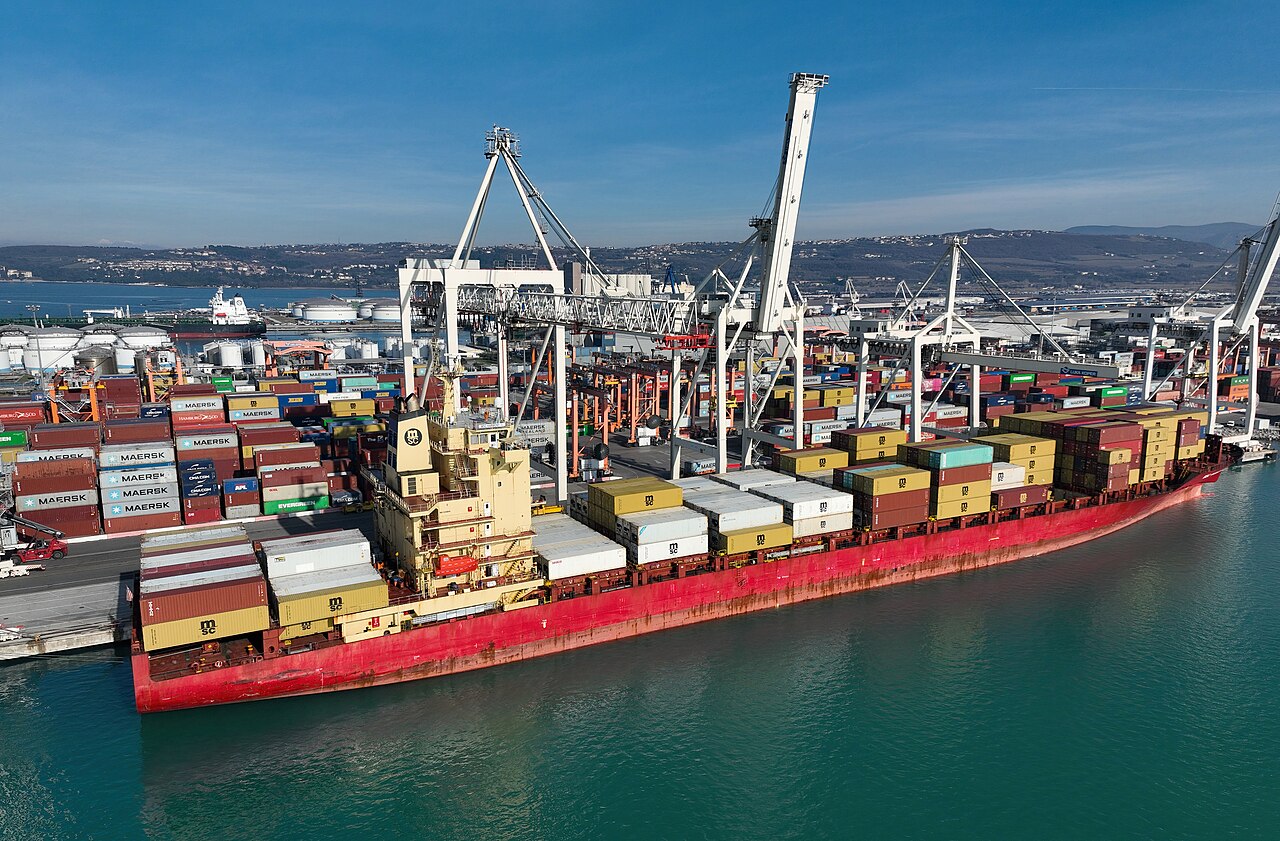
While Washington debates domestic policy, COSCO Shipping and China Merchants Port Holdings are building a network of strategic port infrastructure across seven Western Hemisphere nations. An OSINT investigation into the deals, the dollars, and the geopolitical implications.
Image directive: Create a map visualization showing Chinese port investments across Latin America (Peru, Brazil, Panama, Jamaica, Bahamas, Mexico) using data points from this article. Alternatively, source a public domain satellite image of the Chancay port construction from a US government satellite imagery database.
The Chancay Gambit
In the port city of Chancay, Peru — roughly 50 miles north of Lima — COSCO Shipping Ports Ltd. is building what it calls the “Shanghai of South America.” The numbers are substantial: a 60% equity stake acquired from Volcan Compañia Minera S.A.A., with an initial investment of $1.2 to $1.3 billion for the first construction phase alone. When completed, the deep-water facility will accommodate vessels requiring a 16-meter draft and handle one million containers annually.
Chancay is designed to be the primary exit point for Peruvian mineral exports to China, bypassing existing ports and creating a direct logistics corridor between South American resource extraction and Chinese industrial demand. It is the crown jewel of a broader strategy that has seen Chinese state-owned enterprises establish operational positions in ports across seven Western Hemisphere countries: the Bahamas, Brazil, Jamaica, Mexico, Panama, Peru, and the United States.
The Full Portfolio
The scope of Chinese maritime investment in the Americas goes far beyond Peru. In Brazil, China Merchants Port partnered with MPort to invest 1.5 billion Brazilian reais — approximately $280 million — in expanding the Paranaguá Container Terminal, one of Brazil’s largest and most strategically important ports. Brazil’s National Secretary of Ports, Alex Avila, publicly endorsed the investment, confirming the terminal’s status as a national priority.
In Panama, COSCO has operated at the Manzanillo International Terminal, Colon Container Terminal, and the Pacific-side Port of Balboa — effectively controlling infrastructure at both ends of the Panama Canal. The geopolitical significance of this position cannot be overstated. While Panama’s Supreme Court annulled the 1997 concession in January 2026 and COSCO suspended Balboa operations in March 2026, the intervening years of Chinese operational control at the canal’s Pacific terminus raised serious questions about supply chain security that went largely unexamined.
Congressional testimony from February 2025, examining “the PRC’s Strategic Port Investments in the Western Hemisphere,” documented additional unsuccessful Chinese investment attempts in Argentina (Ushuaia), Brazil (São Luis, São Francisco), Canada (Quebec), El Salvador (La Unión), and Panama (Isla de Margarita-Colón). The pattern is clear: where one bid fails, another follows.
Smart Ports, Surveillance Concerns
The infrastructure investments carry implications beyond simple commerce. Chinese-operated ports increasingly incorporate “Smart Port” technology — networks of sensors, software systems, and data collection infrastructure that manage everything from container tracking to vessel scheduling. Security analysts have raised concerns that these digital systems could enable surveillance of shipping patterns, cargo manifests, and naval movements, or potentially disrupt port operations during a geopolitical crisis.
The Carnegie Endowment for International Peace has documented how Chinese port operators collect vast amounts of data on global shipping flows — information with both commercial and strategic intelligence value. When a Chinese state-owned enterprise operates the port through which a nation’s critical imports and exports flow, the leverage is not hypothetical.
The Environmental Toll
In Peru, environmental concerns have emerged around the Chancay port project’s impact on Amazon rainforest deforestation and agricultural commodity extraction. The Environmental Investigation Agency has reported on how Chinese demand for Peruvian minerals and agricultural products, facilitated by improved port infrastructure, accelerates deforestation and ecological degradation in the Amazon basin. The irony is bitter: Beijing’s Belt and Road environmental pledges coexist with infrastructure projects that drive exactly the kind of ecological destruction those pledges claim to prevent.
Washington’s Absence
Throughout 2022 and 2023, as these investments were being finalized and construction accelerated, the American foreign policy establishment was largely focused on other priorities. The AidData Global Chinese Development Finance Dataset tracks hundreds of billions in Chinese overseas infrastructure investment, yet Congressional attention to Western Hemisphere port acquisitions remained sporadic at best.
The strategic calculus is straightforward. Control of port infrastructure provides China with economic leverage over host nations dependent on trade flows, intelligence collection capabilities on regional shipping patterns, potential disruption capability during geopolitical crises, and preferential access to critical mineral and agricultural exports. Every port concession signed while Washington was looking elsewhere represents a long-term strategic position that will be difficult and expensive to counter.
The question is not whether China’s port strategy in the Americas matters. The question is whether the United States will recognize its significance before the network becomes irreversible.
Eduardo Bacci is an investigative journalist at The Investigative Journal. Data sources include AidData Global Chinese Development Finance Dataset, Congressional testimony records, Carnegie Endowment analysis, and maritime trade publications.