

Waste management filings and EPA regulatory documents reveal a growing environmental hazard hiding in plain sight: early-generation solar panels reaching end-of-life are filling desert landfills with cadmium, lead, and other toxic materials — with no national recycling framework and a regulatory vacuum that the solar industry prefers not to discuss.
The Coming Wave
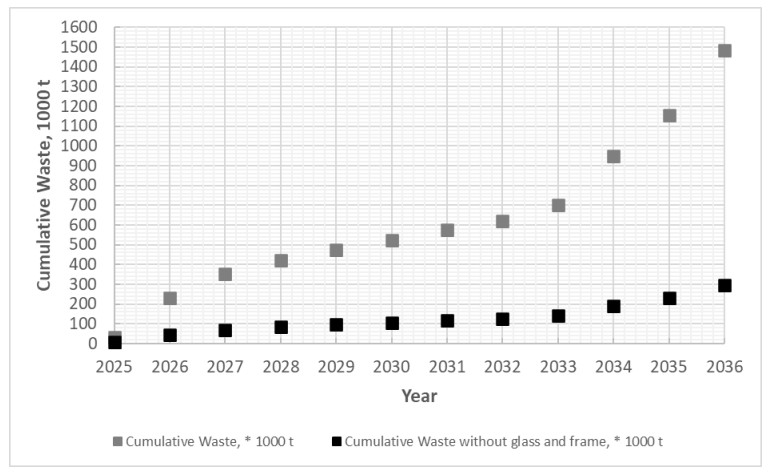
America’s first major wave of solar panel installations — deployed in the early 2000s and 2010s with 25-to-30-year expected lifespans — is approaching end of life. Rice University’s Baker Institute estimates that by 2030, the United States could produce over one million tons of solar panel hazardous waste. By 2050, the volume will be several times that figure. Globally, cumulative photovoltaic panel waste is expected to reach 1.7 million tons by the early 2030s.
The panels contain materials that are classified as hazardous under federal regulations: lead solder connecting cells, cadmium telluride in thin-film panels (roughly 40% of new U.S. panels contain cadmium telluride), copper, antimony, and chromium. When panels crack, degrade, or are improperly disposed of, these materials can leach into soil and groundwater.
The Regulatory Vacuum
Under the Resource Conservation and Recovery Act, end-of-life solar panels that fail toxicity tests are classified as hazardous waste — triggering disposal requirements that are expensive and complex. But the regulatory framework wasn’t designed for the volume of waste that the solar industry is about to produce, and enforcement at the state level is inconsistent.
The EPA has been weighing whether to classify solar panels as “universal waste” — a designation that would simplify handling requirements while still ensuring proper disposal. California has taken the lead at the state level, but most states lack specific regulations for solar panel disposal. Hawaii has state universal waste regulations for solar panels. The rest of the country is operating in a patchwork of general hazardous waste rules that weren’t designed for this waste stream.
The Recycling Fiction
The solar industry frequently cites recycling as the answer to the waste problem. And on paper, the recycling potential is significant: by 2035, recycled materials from retired PV panels could provide over 50% of the silver needed for new panels, plus 30% of the aluminum, silicon, and glass. The economic case for a robust recycling infrastructure is real.
The problem is that the infrastructure doesn’t exist at scale. Much of Europe, Japan, and the United States are still in the research and development phase for solar panel recycling. There is no national recycling framework in the United States. The cost of recycling a panel currently exceeds the value of recovered materials for most panel types. And the logistics of collecting, transporting, and processing millions of panels from rooftops and solar farms across the country present challenges that no company has yet solved at commercial scale.
The Desert Disposal Problem
In the absence of economical recycling, the default destination for dead solar panels is the landfill. In California and Nevada — states with the largest installed solar capacity — waste management facilities are receiving increasing volumes of solar panel waste. Desert landfills, where land is cheap and regulation is light, are becoming the de facto disposal solution for an industry that markets itself on environmental virtue.
Standard leaching tests conducted on disposed panels indicate release of lead and cadmium into surrounding soil — exactly the kind of environmental contamination that solar energy is supposed to help prevent. The tests’ results vary based on panel type, age, and disposal conditions, but the direction is clear: solar panels in landfills are not inert. They degrade, they leach, and they contaminate.
The Industry’s Silence
The solar industry’s public communications focus overwhelmingly on installation growth, cost reduction, and carbon displacement. End-of-life management receives minimal attention in corporate sustainability reports, investor presentations, or policy advocacy. The industry has successfully lobbied against strict disposal mandates in multiple states, arguing that premature regulation would increase costs and slow adoption.
The argument has a familiar ring: the same logic that fossil fuel companies used for decades to defer environmental accountability. Externalize the costs. Delay the reckoning. Let future generations deal with the waste. The technology is different. The strategy is the same.
Eduardo Bacci is an investigative journalist at The Investigative Journal. Data sources include EPA hazardous waste regulations, Baker Institute research, and NIH peer-reviewed solar waste studies.