

By Eduardo Bacci — The Investigative Journal
WASHINGTON — The Justice Department opened the second half of 2026 with a dense run of enforcement announcements, headlined by a $600 million corporate resolution with two of the largest names in Chinese e-commerce and a cluster of national-security and transnational-crime cases tied to the administration’s Homeland Security Task Force. This edition of DOJ Watch reviews seven notable actions drawn from Department press releases dated June 30 through July 2, spanning consumer-protection settlements, cartel and gang prosecutions, health-care and benefits fraud, international money laundering, and bankruptcy enforcement.
Every case below is sourced to the Department’s own filings and press statements. Charging documents describe allegations that remain unproven; where a defendant has pleaded guilty or been sentenced, that is noted explicitly. Readers should treat indictments and complaints as accusations, not findings.
1. Alibaba and Alipay US agree to pay $600 million over illegal-pharmaceutical sales
In the marquee action of the week, Alibaba Group Holding Limited and its U.S.-based payment processor, AUS Merchant Services Inc. — formerly known as Alipay US — entered a non-prosecution agreement on July 1 to pay a combined $600 million, resolving Justice Department allegations that they failed to prevent merchants from selling and importing illegal pharmaceuticals, controlled substances, listed chemicals, and pill presses into the United States through the Alibaba.com and AliExpress.com platforms. According to the Department, it is the largest monetary settlement in the history of the District of Rhode Island.
Alibaba admitted that, between January 2016 and December 2024, it failed to stop roughly 80,000 product sales involving imports into the United States, including List I and II chemicals and pharmaceutical counterfeiting equipment, with a combined gross merchandise value exceeding $200 million. Federal agents made more than 40 undercover purchases during the investigation. AUS separately admitted that its anti-money-laundering controls failed to catch payments routed on behalf of some of those merchants between January 2020 and December 2023. Under the agreement, Alibaba will pay a $125 million criminal penalty and forfeit $200 million, while AUS will pay an $85 million penalty and forfeit $190 million; both firms agreed to enhance compliance and continue cooperating.
“Companies operating online marketplaces — whether based in the United States or abroad — must implement appropriate safeguards to prevent bad actors from exploiting their platforms,” said Assistant Attorney General Brett A. Shumate of the Civil Division. The significance for accountability reporting is the platform-liability theory itself: the Department treated a marketplace operator and its payment affiliate as responsible for what third-party sellers moved across their systems. That framing, if extended, has implications for every large e-commerce and payments company. Read the DOJ release.
2. Two senior United Cartels figures charged with narco-terrorism
A federal grand jury in the District of Columbia returned an indictment charging Juan Jose “Juanjo” Farias Mendoza, 31, and Israel “Papo” Vega Farias, 37, both of Tepalcatepec, Michoacan, described by the Department as high-ranking members of the Michoacan-based United Cartels. The charges, announced July 2, include conspiracy to manufacture and distribute methamphetamine for importation into the United States, providing material support to a foreign terrorist organization, and firearms offenses involving machine guns and destructive devices. If convicted, both men face maximum penalties of life in prison.
The material-support count is the notable legal feature. The State Department designated the United Cartels — also known as Cárteles Unidos — as both a Foreign Terrorist Organization and a Specially Designated Global Terrorist on February 20, 2025, and prosecutors are now using that designation to charge cartel figures under terrorism-support statutes historically reserved for groups such as al-Qaeda. The Department said the two defendants are, respectively, the son and nephew of the cartel’s top leader, Juan Jose Farias Alvarez, known as “Abuelo,” whom prosecutors previously charged. The case is being handled by the Criminal Division’s Money Laundering, Narcotics and Forfeiture Section with the U.S. Attorney’s Office for the Eastern District of Tennessee. The defendants are presumed innocent. Read the DOJ release.
3. Eight alleged Tren de Aragua members charged in Texas and Illinois
The Department announced charges on July 2 against eight alleged members of Tren de Aragua (TdA), a Venezuelan transnational gang designated a foreign terrorist organization, across the Northern Districts of Illinois and Texas. In Illinois, a criminal complaint charges Josue Pacheco Torres, 26, Julian Pachano, 19, and Kleiver Monasterio Briceno, 20, with a kidnapping conspiracy and a kidnapping that resulted in death; according to the complaint, a man was abducted near a Chicago park on May 18 and later found dead. In Texas, a grand jury indicted five men — Hector Asdrubal Garcia Zuniga, 36; Carlos Luis Zambrano Bolivar, 27; Jhonny Jesus Martinez Serrano, 31; Jhonatan Nahin Toro Gonzalez, 23; and Ehiker Alexander Morales Mendoza, 39 — on racketeering charges involving murder, kidnapping, and other violent offenses tied to an August 2024 incident.
If convicted, the defendants face up to life in prison, and five of them face the possibility of the death penalty, according to the Department. The Department stated that since January 20, 2025, it has charged more than 300 TdA members and associates across 28 districts. Officials framed the cases in political terms — Acting Attorney General Todd Blanche and FBI Director Kash Patel both tied the defendants’ presence in the country to prior border policy, while U.S. Attorneys Andrew Boutros and Ryan Raybould emphasized local public-safety gains. TIJ reports those characterizations as attributed statements; the underlying court documents describe conduct that has not been proven, and all defendants are presumed innocent. Read the DOJ release.
4. Georgia nurse practitioner sentenced in $136 million Medicare scheme
Jean Wilson, 54, a licensed nurse practitioner from Richmond Hill, Georgia, was sentenced on June 30 to 120 months in prison and ordered to pay $66 million in restitution for her role in a telemedicine fraud scheme. Court records show that between 2017 and 2019 Wilson owned two telemedicine companies that paid illegal kickbacks to obtain signed orders for orthotic braces and prescription drugs for Medicare beneficiaries who did not need them, then sold those orders to marketing companies for roughly $90 per beneficiary. The Department said the scheme generated more than $136 million in false claims to Medicare, of which the program paid over $66 million.
Wilson pleaded guilty in March 2024 to conspiracy to commit wire fraud and health-care fraud, so the underlying liability is settled rather than alleged. Prosecutors highlighted an unusual detail: after her indictment, Wilson marketed herself as a health-care compliance consultant and authored books on the subject, including one warning readers that “some entities and individuals will try to use you as a way to make them millions.” Her husband was previously sentenced to seven years for related conduct. The case underscores continued Justice Department focus on telemedicine and durable-medical-equipment billing, an area that has produced repeated strike-force prosecutions. Read the DOJ release.
5. Romanian brothers plead guilty in multistate SNAP-skimming scheme
Marian Ovidiu Dumitru, 37, and Catalin Dumitru, 39, both Romanian citizens residing unlawfully in the United States, pleaded guilty on July 2 to wire fraud in the Western District of North Carolina. According to court records, between July 2024 and August 2025 the brothers were part of an identity-theft ring that used skimming devices at ATMs and fuel pumps to steal data from electronic benefit transfer cards, defrauding Supplemental Nutrition Assistance Program accounts in New Jersey, Massachusetts, and other states of more than $760,000.
Prosecutors said the defendants loaded stolen data onto counterfeit cards and used them to buy bulk goods — coffee, candy, energy drinks, and baby formula — at warehouse clubs for resale, including more than $15,600 at a store in Gastonia and over $19,000 in Pineville, North Carolina. Each faces a maximum of 20 years in prison; sentencing has not been scheduled. The Department noted the case is part of the National Fraud Enforcement Division, a unit stood up on April 7 to support a whole-of-government fraud task force. EBT skimming has become a significant driver of benefits losses nationally, and the case is a useful data point on how these rings operate across state lines. Read the DOJ release.
6. Chinese national pleads guilty in cartel money-laundering case
Wenshen Xu, 52, a Honduras-based Chinese national extradited from Guatemala, pleaded guilty on June 30 in the Eastern District of Virginia to conspiring to import cocaine, money laundering, and providing material support to a foreign terrorist organization — specifically the Cártel de Jalisco Nueva Generación (CJNG). According to court documents, Xu used a transportation network across Latin America to move multi-kilogram cocaine loads and, with co-conspirators, imported more than 450 kilograms into the United States while helping launder over $22 million using cryptocurrency, trade-based methods, and encrypted communications.
Xu is scheduled to be sentenced on October 15 and faces a mandatory minimum of 10 years and a maximum of life. The case illustrates a pattern investigators have flagged repeatedly: the growing role of Chinese money-laundering networks in servicing Mexican cartels, now prosecuted under the same material-support-to-terrorism theory applied in the United Cartels indictment above. The prosecution was handled by the Criminal Division’s Money Laundering, Narcotics and Forfeiture Section with the U.S. Attorney’s Office for the Eastern District of Virginia. Read the DOJ release.
7. Iowa developer waives $17.7 million bankruptcy discharge
On the civil-enforcement side, Jeffrey Garth Ewing of Iowa agreed to waive the bankruptcy discharge of more than $17.7 million in debts following an investigation by the Justice Department’s U.S. Trustee Program, the Department announced July 2. The Bankruptcy Court for the Southern District of Iowa approved the voluntary waiver on June 15, meaning Ewing remains liable for the debts and creditors may continue to pursue him.
Ewing, who developed senior-housing communities across the Midwest, filed a Chapter 7 case in January 2025 after earlier Chapter 11 filings were dismissed. Investigators in the Trustee Program’s Des Moines office found evidence that he had transferred nearly $400,000 to companies he controlled to shield the funds from creditors, relying in one instance on a promissory note he admitted backdating. The action is not a criminal case, but it reflects an active line of Trustee Program enforcement against asset-shielding in bankruptcy; the office secured a similar discharge waiver in an $8.4 million matter earlier this year. Read the DOJ release.
Cases TIJ is watching
Three threads from this week merit deeper reporting. First, the Alibaba–Alipay resolution raises questions worth pursuing: why the Department chose a non-prosecution agreement over charges, how the anti-money-laundering failures at a U.S.-licensed payment processor went undetected for years, and whether the platform-liability theory will be applied to other large marketplaces. Second, the expanding use of material-support-to-terrorism charges against drug organizations — visible in both the United Cartels indictment and the CJNG-linked guilty plea — represents a doctrinal shift that follows the 2025 terrorist designations of several cartels; its constitutional and practical limits will be tested in court. Third, the newly created National Fraud Enforcement Division, which surfaced in two of this week’s cases, is a new institution whose docket and priorities TIJ will track as it scales.
The Justice Department’s U.S. Trustee Program pattern of high-dollar discharge-waiver actions is a quieter but recurring story about how affluent debtors attempt to move assets beyond the reach of creditors. We will continue monitoring the Department’s press releases, U.S. Attorney announcements, and federal court dockets, and will follow the cases above through their next procedural milestones.
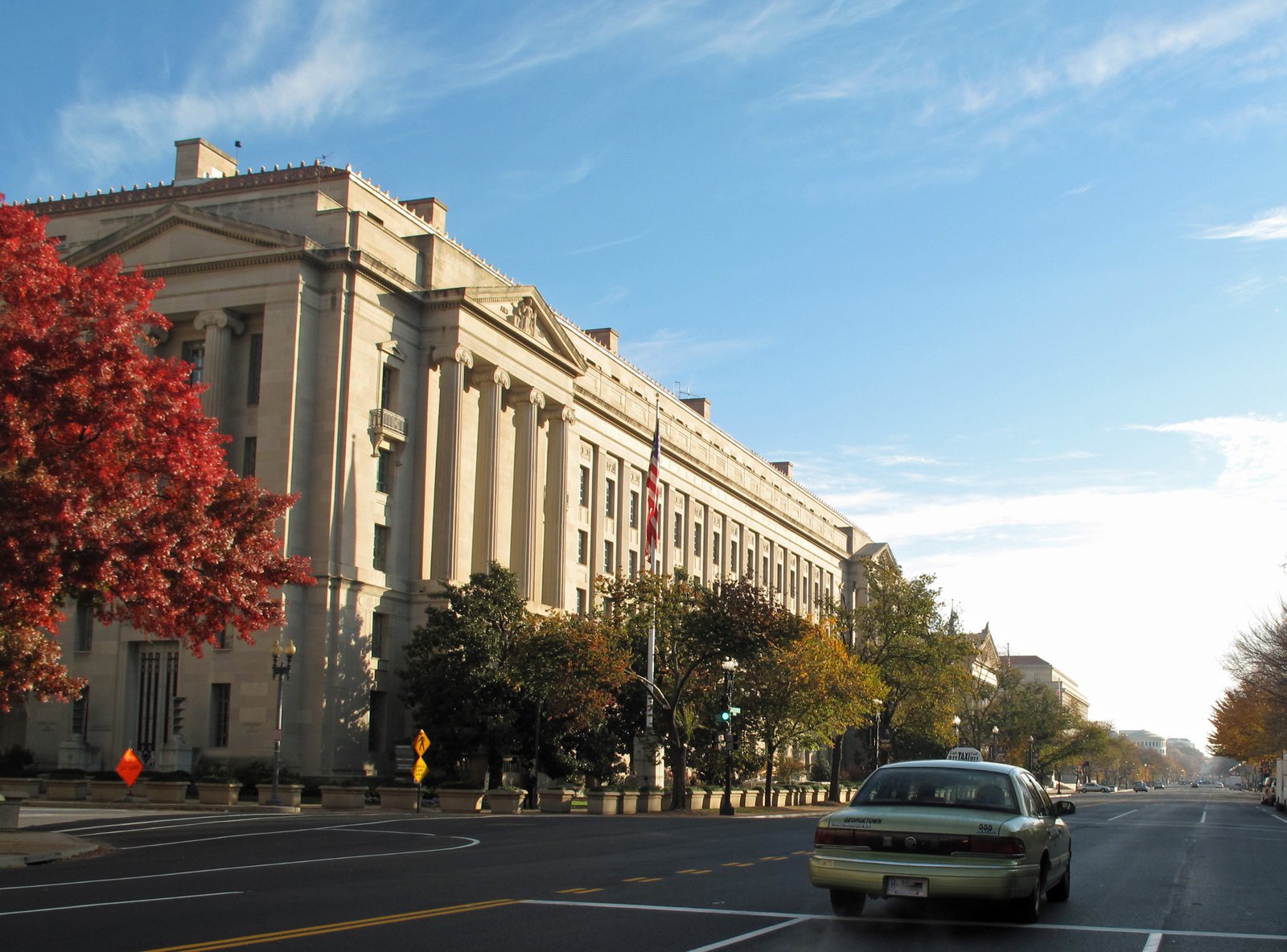
Sources: All facts in this digest are drawn from U.S. Department of Justice press releases and associated court filings published between June 30 and July 2, 2026, each linked above. Charges described in indictments and complaints are allegations; defendants are presumed innocent unless and until proven guilty. Featured image: U.S. Department of Justice headquarters, Voice of America (public domain).