

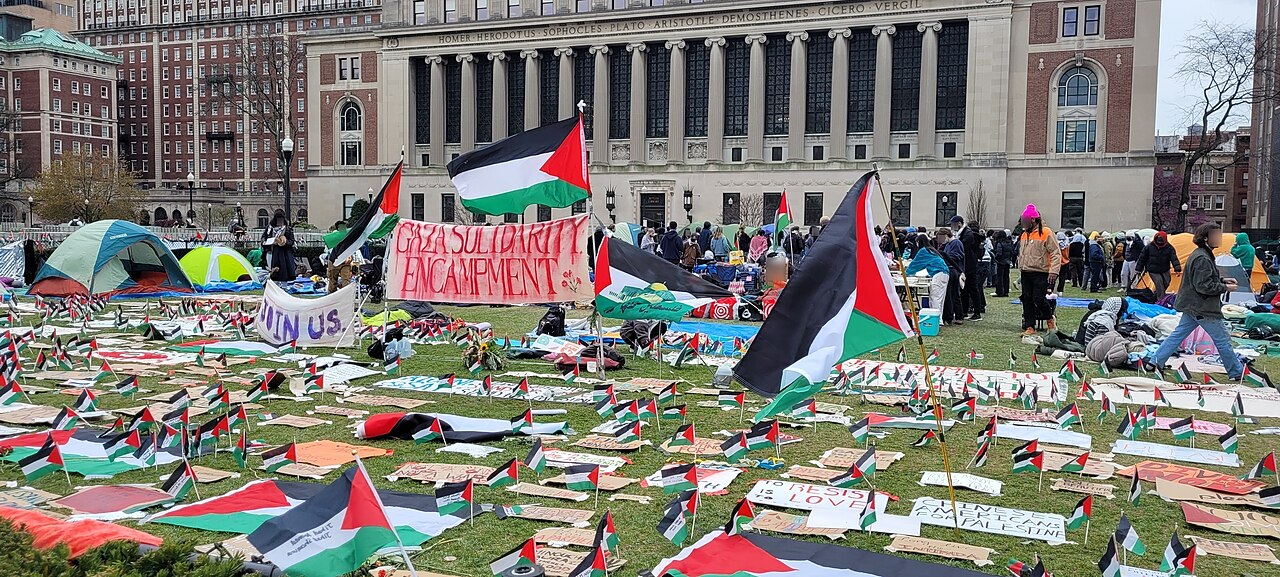
Grant databases, IRS 990 filings, and foundation records reveal a financial network connecting major progressive donors to the student organizations that orchestrated university disruptions across the country. The tents weren’t spontaneous — they were funded.
The Spring Offensive
In April and May 2024, pro-Palestinian encampments erupted on university campuses from Columbia to UCLA, from Harvard to the University of Wisconsin-Madison. The protests were presented as spontaneous expressions of student conscience — organic movements arising from moral outrage over the conflict in Gaza.
But grant databases and foundation records tell a different story. The organizations at the center of the encampments — particularly Students for Justice in Palestine chapters — had been receiving foundation funding for years. The infrastructure was pre-built. The money was already flowing. The October 7 attacks and subsequent Israeli military operations in Gaza provided the catalyst, but the organizational capacity was already in place.
The Grant Trail
IRS Form 990 filings from 2020 through 2022 reveal a constellation of grants flowing to organizations affiliated with the campus protest movement. Rockefeller Philanthropy Advisors directed $80,000 in 2021 and $90,000 in 2022 to SJP-affiliated entities. The Elias Foundation contributed $3,500 in 2020 and $55,000 in 2021. The Common Counsel Foundation gave $25,000 in 2021. The Groundswell Fund added $20,000 in 2021.
More striking were grants from mainstream financial institutions’ charitable arms. Morgan Stanley Global Impact Fund directed $50,000 to SJP-related organizations in 2021. Fidelity Investments Charitable Gift Fund — a donor-advised fund that shields individual donors’ identities — contributed $17,000 in 2021. The Bafrayung Fund gave $15,000 in both 2020 and 2021. The Community Foundation for Greater Atlanta added $15,000 in 2020. Grassroots International contributed $10,000 in 2020.
The Dark Money Layer
Beyond direct grants, the campus protest movement benefited from a broader ecosystem of progressive dark money. The Sixteen Thirty Fund — the primary political spending vehicle of the Arabella Advisors network — received $300,000 from the NEA. The North Star Fund provided funding to organizations connected to the protest movement in 2021-2022. The Sparkplug Foundation, run by the Gelman family, provided additional support.
Politico’s May 2024 analysis identified donor networks connected to the Soros, Rockefeller, and Pritzker families as significant funders of organizations involved in the campus protests. The funding didn’t flow directly from billionaires to tent encampments — it moved through layers of intermediary organizations, donor-advised funds, and fiscal sponsors designed to create distance between the funders and the funded.
The Professional Infrastructure
At the University of Wisconsin-Madison, SJP negotiated a formal agreement with university administration to end its Library Mall encampment in May 2024. The agreement included university recognition of SJP’s right to engage in shared governance on investment principles — a sophisticated outcome that reflected professional legal and organizational support far beyond typical student activism.
The professional infrastructure extended to legal defense, media strategy, and logistics. Encampments across multiple campuses used strikingly similar tent configurations, banner designs, and messaging — suggesting coordination and resource-sharing at a national level. National SJP provided organizational frameworks that local chapters implemented with local adaptations.
The Accountability Question
Foundation-funded political advocacy is legal. Donor-advised funds that shield donor identities are legal. Student organizations receiving grants from progressive foundations are engaging in constitutionally protected activity. None of this is disputed.
What is disputed is the narrative. When university administrators, media commentators, and politicians describe the encampments as spontaneous expressions of student conscience, they are omitting a material fact: the organizations that orchestrated the disruptions had been receiving professional-grade funding for years, from some of the most sophisticated progressive donor networks in the country.
Students participated voluntarily and in many cases from genuine conviction. But the organizational infrastructure they relied on — the legal support, the logistics, the media strategy, the negotiating expertise — was not spontaneous. It was purchased.
Eduardo Bacci is an investigative journalist at The Investigative Journal. Data sources include IRS Form 990 filings, ProPublica Nonprofit Explorer, foundation grant databases, and Politico donor network analysis.