

DOJ Watch is The Investigative Journal’s daily digest of federal enforcement activity, built entirely from primary Department of Justice press releases and charging documents. Every figure below is drawn from the public record and linked to its source. Where a case is an indictment or complaint, the defendants are presumed innocent unless and until proven guilty.
The first federal enforcement cycle of July 2026 was dominated by a nine-figure corporate resolution against two of the world’s largest technology companies, a wave of charges tied to designated foreign terrorist organizations, and a series of fraud prosecutions coordinated through the Justice Department’s new National Fraud Enforcement Division. Below are seven notable actions announced between June 30 and July 2, 2026, followed by additional matters that warrant continued scrutiny.
1. Alibaba and Alipay US agree to pay $600 million over illegal pharmaceutical sales
The largest single action of the cycle came on July 1, when Alibaba Group Holding Limited and its U.S.-based payment processor, AUS Merchant Services Inc. (formerly Alipay US), entered non-prosecution agreements to pay a combined $600 million to resolve Justice Department allegations that they failed to prevent merchants from selling and importing illegal pharmaceuticals, controlled substances, listed chemicals, and pill presses into the United States through Alibaba.com and AliExpress.com. According to the Department’s announcement, the resolution is the largest monetary settlement in the history of the U.S. Attorney’s Office for the District of Rhode Island.
Court records indicate Alibaba admitted that, between January 2016 and December 2024, it failed to prevent roughly 80,000 product sales involving imports into the United States, with a combined gross merchandise value exceeding $200 million. Federal investigators conducted more than 40 undercover purchases of pharmaceuticals and counterfeiting equipment that were illegal to import. AUS, a subsidiary of Ant International, admitted that its anti-money-laundering program failed to prevent some Alibaba merchants from using its payment and settlement services to facilitate the prohibited sales. Under the agreements, Alibaba will pay a $125 million criminal penalty and forfeit $200 million, while AUS will pay an $85 million penalty and forfeit $190 million.
The Justice Department credited both companies for cooperation, remedial measures, and acceptance of responsibility, and both agreed to enhance their compliance programs. “Companies operating online marketplaces — whether based in the United States or abroad — must implement appropriate safeguards to prevent bad actors from exploiting their platforms,” said Assistant Attorney General Brett A. Shumate of the Civil Division. The settlement signals continued federal appetite for holding e-commerce and digital-payment intermediaries liable for third-party conduct on their platforms — a theme with significant implications for the broader online-marketplace economy.
2. Two senior United Cartels figures charged with narco-terrorism
On July 2, the Justice Department announced that a federal grand jury in the District of Columbia had indicted Juan Jose “Juanjo” Farias Mendoza, 31, and Israel “Papo” Vega Farias, 37, both of Tepalcatepec, Michoacán, Mexico, and described as high-ranking members of the United Cartels. The Michoacán-based organization, also known as Cárteles Unidos, was designated a Foreign Terrorist Organization and Specially Designated Global Terrorist by the State Department on February 20, 2025.
Prosecutors allege both men are close relatives — the son and nephew — of the cartel’s top leader, Juan Jose Farias Alvarez, known as “Abuelo,” who was previously charged as part of a multi-agency effort to dismantle the group. Both defendants are charged with conspiracy to manufacture and distribute methamphetamine for importation into the United States, providing material support to a foreign terrorist organization, and firearms offenses involving machine guns and destructive devices. If convicted, each faces a maximum sentence of life in prison.
The Justice Department describes the United Cartels as one of the world’s most significant methamphetamine producers, with a U.S. distribution network reaching Dallas, Houston, Atlanta, Kansas City, Sacramento, Los Angeles, Denver, and Chicago. The case, investigated by Homeland Security Investigations, is part of the Homeland Security Task Force initiative. An indictment is merely an allegation, and both defendants remain outside U.S. custody as fugitives; they are presumed innocent.
3. Eight alleged Tren de Aragua members charged in Texas and Illinois
Also on July 2, the Department unsealed charges in the Northern Districts of Illinois and Texas against eight alleged members of Tren de Aragua (TdA), the Venezuelan prison-gang-turned-transnational organization that has been designated a foreign terrorist organization. The charges span murder, kidnapping resulting in death, racketeering, and firearms offenses.
In Chicago, a criminal complaint charges Josue Pacheco Torres, 26; Julian Pachano, 19; and Kleiver Monasterio Briceno, 20, with a kidnapping conspiracy that allegedly resulted in the death of a man abducted near Meyering Park in May. In the Northern District of Texas, a grand jury returned racketeering charges against five defendants — Hector Asdrubal Garcia Zuniga, 36; Carlos Luis Zambrano Bolivar, 27; Jhonny Jesus Martinez Serrano, 31; Jhonatan Nahin Toro Gonzalez, 23; and Ehiker Alexander Morales Mendoza, 39 — in connection with kidnappings and a murder allegedly committed in August 2024.
According to the Department, defendants in both districts face up to life in prison, and five face the possibility of the death penalty. The Department stated it has federally charged more than 300 TdA members and associates across 28 districts since January 2025. The complaints and indictment are allegations only, and every defendant is presumed innocent unless proven guilty beyond a reasonable doubt.
4. Chinese national pleads guilty to cocaine trafficking and material support to CJNG
In a case blending narcotics, money laundering, and terrorism charges, Wenshen Xu, 52, a Honduras-based Chinese national extradited from Guatemala, pleaded guilty on June 30 to conspiring to import cocaine into the United States, conspiring to launder drug proceeds, and providing material support to the Cártel de Jalisco Nueva Generación (CJNG), a designated foreign terrorist organization.
According to court documents, Xu used a transportation network with access to airstrips, armored cars, and couriers to move multi-kilogram cocaine loads, and he and his co-conspirators imported more than 450 kilograms of cocaine into the United States. The network also coordinated the laundering of more than $22 million in proceeds from cocaine and fentanyl sales, using cryptocurrency transfers, trade-based money laundering, and encrypted communications. Xu was arrested in Guatemala City in July 2025 and extradited in January. He is scheduled to be sentenced on October 15 and faces a mandatory minimum of 10 years and a maximum of life. Unlike the two cases above, this is a conviction by guilty plea rather than a pending allegation.
5. Telemedicine owner sentenced to 10 years in $136 million Medicare fraud
On June 30, the owner of two telemedicine companies was sentenced to 120 months in prison and ordered to pay $66 million in restitution for a scheme to fraudulently bill Medicare for medically unnecessary equipment and drugs. Jean Wilson, 54, of Richmond Hill, Georgia — a licensed nurse practitioner — had pleaded guilty in March 2024 to conspiracy to commit wire fraud and health care fraud.
Court records show Wilson and others paid illegal kickbacks to medical providers to sign orders for orthotic braces and prescriptions for Medicare beneficiaries who did not need them, then sold those orders to marketing companies for roughly $90 per beneficiary. In all, the conspiracy submitted more than $136 million in false claims to Medicare, of which the program paid over $66 million. In a detail that drew notice from prosecutors, Wilson later held herself out as a health-care compliance consultant and authored books on the subject — including one warning readers that “some entities and individuals will try to use you as a way to make them millions.” The case was prosecuted through the Criminal Division’s Health Care Fraud Strike Force Program.
6. Romanian brothers plead guilty to multistate SNAP skimming scheme
Two Romanian brothers unlawfully present in the United States, Marian Ovidiu Dumitru, 37, and Catalin Dumitru, 39, pleaded guilty on July 2 to wire fraud for their roles in an identity-theft ring that defrauded Supplemental Nutrition Assistance Program (SNAP) benefits across multiple states. According to court records, between July 2024 and August 2025 the ring stole more than $760,000 by using skimming devices at ATMs and fuel pumps to capture data from electronic benefit transfer (EBT) cards.
The stolen data was loaded onto counterfeit cards and used to buy bulk goods — coffee, candy, energy drinks, and baby formula — at membership warehouse clubs for resale. Prosecutors said the scheme victimized more than 10 individuals, some of whom suffered substantial hardship. Each brother faces up to 20 years in prison. The prosecution, brought in the Western District of North Carolina, is part of the Justice Department’s National Fraud Enforcement Division, created in April 2026 to target fraud against federal benefit programs.
7. Iowa developer surrenders $17.7 million bankruptcy discharge after trustee probe
Rounding out the cycle is a civil enforcement action from the Department’s U.S. Trustee Program. Jeffrey Garth Ewing of Iowa agreed to waive his bankruptcy discharge of more than $17.7 million in debts after a trustee investigation found he had transferred nearly $400,000 to companies he controlled to shield the funds from creditors. The bankruptcy court for the Southern District of Iowa approved the voluntary waiver on June 15, leaving Ewing liable for his debts.
Ewing, who developed senior housing communities across the Midwest, filed Chapter 11 cases in March 2024 that were dismissed a month later, then filed a Chapter 7 liquidation in January 2025. Investigators found that loans he claimed to have made to three of his businesses lacked documentation except for one promissory note that Ewing admitted backdating, and that he retained control of companies he asserted were owned by his adult children. “Debtors who seek to defraud their creditors also attack the integrity of the bankruptcy system,” said Acting U.S. Trustee Mary Jensen of Region 12. The matter is a civil resolution rather than a criminal charge.
Cases warranting deeper investigation
Several adjacent matters from the same window merit continued reporting. On June 29, a federal jury in the District of Nevada convicted three alleged MS-13 members of nine murders, kidnapping, and racketeering — a verdict that, alongside the TdA and United Cartels charges, illustrates how heavily current federal violent-crime enforcement is organized around foreign-terrorist-organization designations. On June 26, two men with alleged ties to Tren de Aragua were sentenced in an ATM “jackpotting” malware conspiracy, a reminder that these networks increasingly blend street violence with sophisticated cyber-enabled theft.
The fraud docket also bears watching. The Alibaba resolution follows a March 2026 settlement in which Adobe agreed to a $150 million resolution over alleged subscription-cancellation practices — evidence of a sustained federal push on consumer-facing digital platforms. Meanwhile, the newly created National Fraud Enforcement Division is now the Department’s connective tissue across benefit-fraud cases, and its aggressive posture — including June lawsuits against several states to compel the release of SNAP data — raises federalism and data-governance questions TIJ will continue to examine. The Investigative Journal will track sentencings and any appeals as these matters proceed.
Methodology: This digest is compiled from official U.S. Department of Justice press releases and charging documents published between June 30 and July 2, 2026. Dollar figures, charges, and case status reflect those records as of publication. Indictments and complaints are allegations; defendants are presumed innocent unless and until convicted. Parties named in pending matters are entitled to a right of reply, which The Investigative Journal will publish upon request.
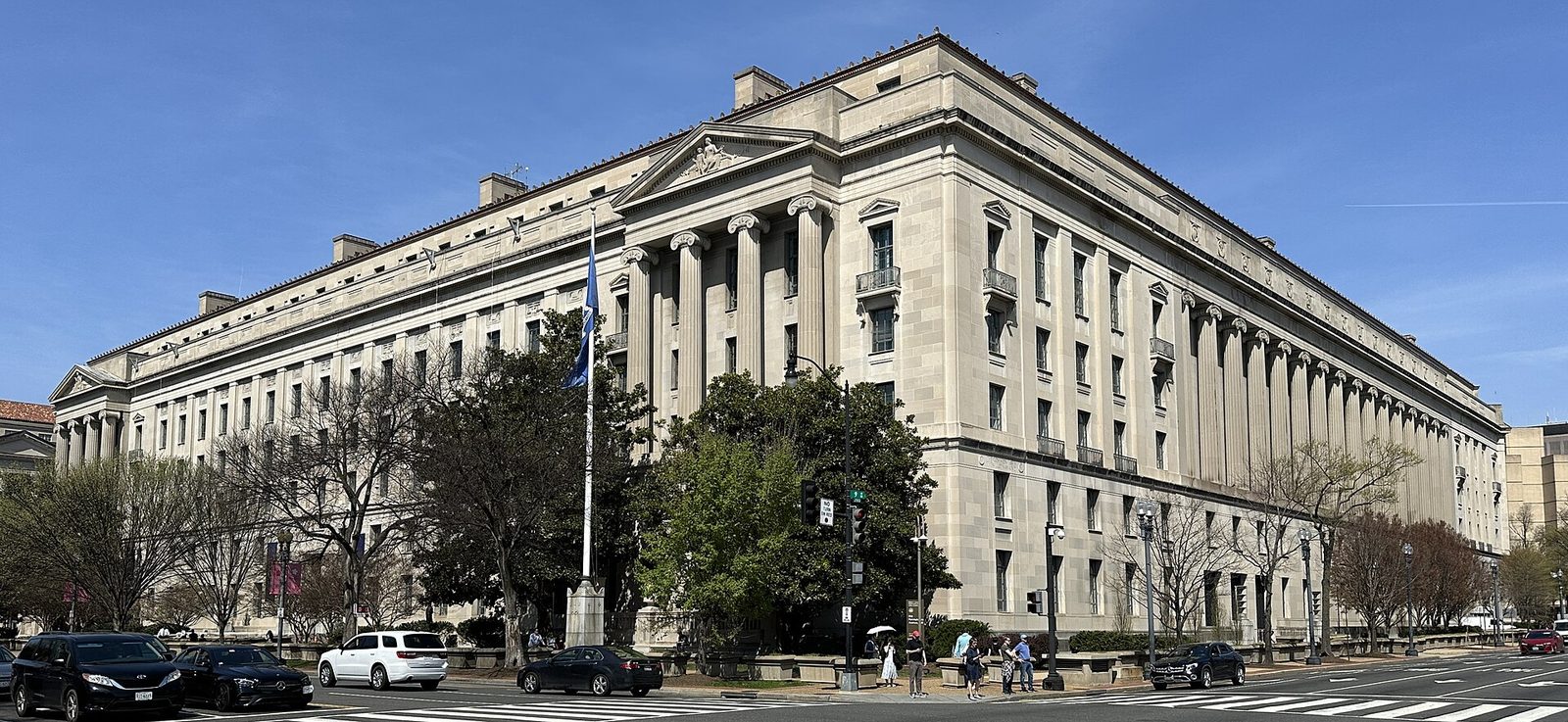
Featured image: Robert F. Kennedy Department of Justice Building, Washington, D.C. Photo by APK via Wikimedia Commons, licensed under CC BY 4.0.