

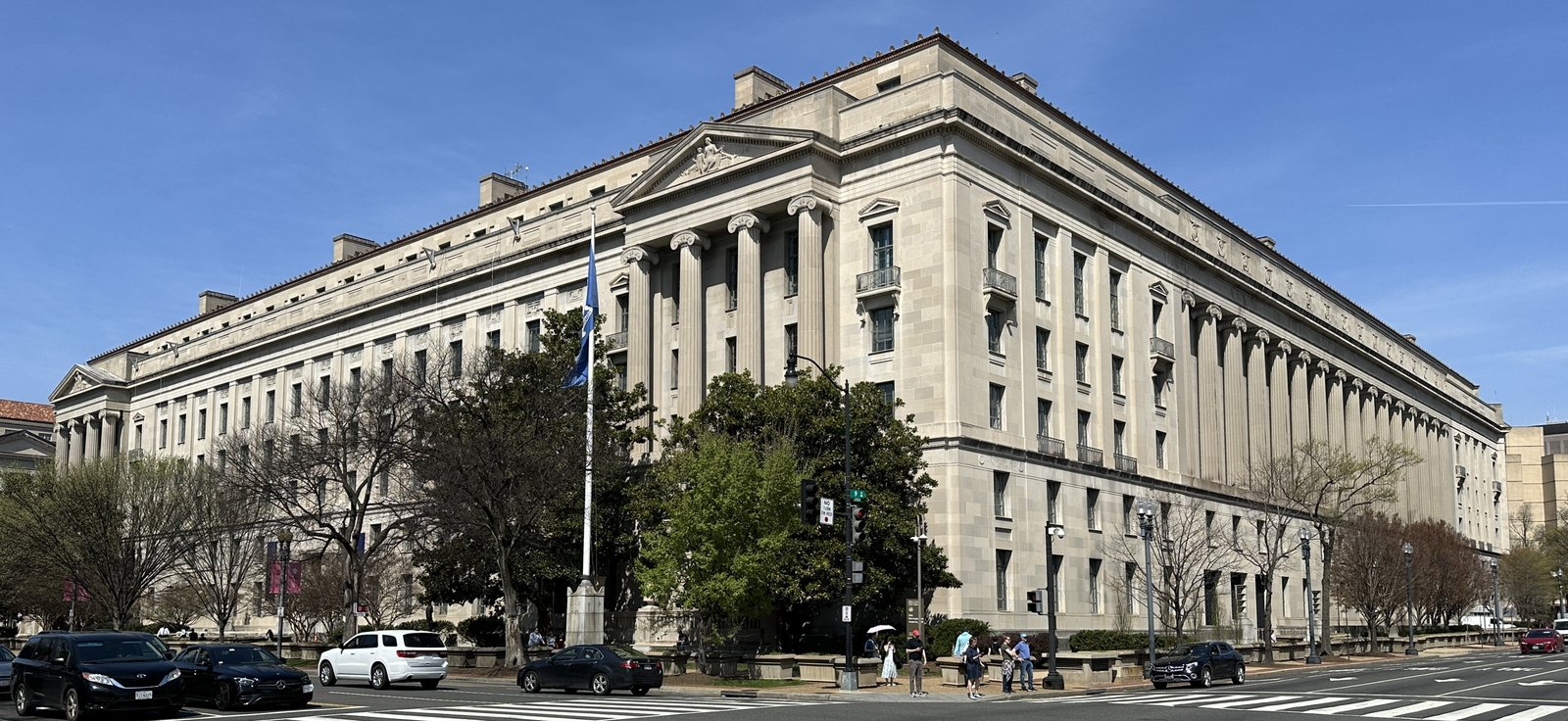
The Justice Department opened July with a run of enforcement actions that stretched from a record corporate settlement in Rhode Island to the extradition of an alleged cybercriminal from Finland, alongside a wave of transnational-crime indictments filed over the Fourth of July weekend. The cases summarized below were drawn from Department of Justice press releases and court filings published between July 1 and July 6, 2026. Each is linked to its source document, and readers should note that indictments and criminal complaints are allegations only; defendants are presumed innocent unless and until proven guilty.
Taken together, the week’s filings reflect three enforcement priorities that records suggest the Department is currently pressing hardest: e-commerce and payment-platform accountability, the designation of drug cartels and transnational gangs as foreign terrorist organizations, and the pursuit of cyber actors operating from overseas jurisdictions. Below, TIJ tracks eight notable actions and flags several that merit a closer look.
Alibaba and Alipay US agree to pay $600 million over illegal-product sales
In the single largest monetary resolution in the history of the District of Rhode Island, Alibaba Group Holding Limited and its U.S.-based payment processor, AUS Merchant Services Inc. — formerly Alipay US — entered a non-prosecution agreement on July 1 to pay a combined $600 million to resolve allegations that they failed to prevent merchants from selling and importing illegal pharmaceuticals, controlled substances, listed chemicals, and pill presses into the United States through the Alibaba.com and AliExpress.com platforms.
According to the agreement, Alibaba admitted that between January 2016 and December 2024 it failed to prevent roughly 80,000 product sales involving U.S. imports of restricted items, with a combined gross merchandise value exceeding $200 million. Federal investigators conducted more than 40 undercover purchases of pharmaceuticals and counterfeiting equipment that were illegal to import. AUS, for its part, admitted that its anti-money-laundering compliance program failed to fully incorporate certain wire-transfer data, allowing some transactions from high-risk jurisdictions to go undetected. In at least one instance, the filings state, a merchant continued selling prohibited products after AUS had investigated and reported it.
Under the terms, Alibaba agreed to pay a $125 million criminal penalty and forfeit $200 million, while AUS agreed to pay an $85 million penalty and forfeit $190 million; both firms committed to enhanced compliance and continued cooperation. The Department credited the companies’ remedial measures and cooperation. The significance here is twofold: the resolution signals continued DOJ willingness to hold foreign-owned platforms accountable under the Federal Food, Drug, and Cosmetic Act, and it establishes a benchmark figure that future e-commerce settlements will likely be measured against.
Alleged “Scattered Spider” member extradited from Finland
The Department announced on July 1 that Peter Stokes, 19, a dual U.S.-Estonian citizen, had been arrested in Finland and extradited to the United States to face conspiracy, computer-intrusion, and fraud charges in the Northern District of Illinois. A criminal complaint unsealed the same week alleges Stokes is tied to the cyber group known as Scattered Spider — also tracked as “Octo Tempest,” “UNC3944,” and “0ktapus.”
Prosecutors allege the group has been involved in more than 100 network intrusions resulting in over $100 million in ransom payments. According to the complaint, Stokes and co-conspirators breached a luxury jewelry retailer’s systems in May 2025 and demanded roughly $8 million in cryptocurrency; the company evicted the intruders and paid no ransom but still absorbed at least $2 million in losses. Stokes was arrested by Finnish authorities in April under an Interpol Red Notice and made an initial court appearance in Chicago, where he was ordered detained.
The case is being handled as part of Operation Riptide, an FBI campaign the Department describes as its sustained response to cyber-enabled fraud, which it says cost Americans more than $20 billion in reported losses last year. For TIJ readers, the extradition is a data point worth watching: it reflects the Department’s growing reliance on international cooperation to reach cybercriminals who operate beyond U.S. borders. The allegations remain unproven.
Eight alleged Tren de Aragua members charged in Texas and Illinois
Over the holiday weekend, the Department announced charges against eight alleged members of Tren de Aragua (TdA), the Venezuelan-origin gang designated a foreign terrorist organization, across the Northern Districts of Illinois and Texas. The charges span kidnapping, racketeering involving murder, and firearms offenses.
In the Illinois complaint, three defendants are accused of a May 2024 conspiracy to kidnap and murder a man on Chicago’s South Side; court documents state the victim was found bound and fatally shot in an abandoned building. In Texas, a grand jury returned racketeering charges against five defendants tied to an August 2024 kidnapping in which one victim was allegedly murdered. Several defendants face the possibility of life imprisonment, and prosecutors indicate the death penalty is available for some. The Department stated it has federally charged more than 300 TdA members and associates across 28 districts since January 2025.
These prosecutions sit at the intersection of immigration enforcement and the FTO-designation strategy, and the aggressive charging posture — including potential capital exposure — makes them a bellwether for how the designation is being operationalized in violent-crime cases. As with all pending matters, the indictment and complaint are allegations, and every defendant is presumed innocent.
Two United Cartels leaders charged with material support to a terrorist organization
A federal grand jury in the District of Columbia indicted Juan Jose “Juanjo” Farias Mendoza, 31, and Israel “Papo” Vega Farias, 37 — described as high-ranking members of the Michoacán-based United Cartels — on charges of methamphetamine trafficking, providing material support to a foreign terrorist organization, and firearms offenses. The Department noted the pair are, respectively, the son and nephew of the cartel’s top leader, Juan Jose Farias Alvarez, known as “Abuelo.”
The United Cartels, also known as Cárteles Unidos, was designated a Foreign Terrorist Organization and Specially Designated Global Terrorist in February 2025. Prosecutors describe the organization as one of the world’s most significant methamphetamine producers, with a U.S. distribution network spanning Dallas, Houston, Atlanta, Kansas City, Sacramento, Los Angeles, Denver, and Chicago. The investigation, filings indicate, began with a methamphetamine seizure outside Knoxville, Tennessee, and grew into a multi-agency effort; both defendants face maximum penalties of life in prison if convicted. The indictment is an allegation.
Willow Bridge settles algorithmic rent-pricing claims
On July 6, the Antitrust Division filed a proposed settlement with Willow Bridge Property Company LLC, one of the nation’s largest landlords, resolving claims that it participated in a scheme to set rents using competitors’ sensitive data through RealPage’s pricing algorithms. The agreement builds on earlier proposed settlements with RealPage Inc. and landlords Cortland, Greystar, and LivCor in the same Middle District of North Carolina action.
If approved under the Tunney Act, the consent decree would bar Willow Bridge from using anticompetitive pricing algorithms that draw on competitors’ data, from sharing competitively sensitive information, and from attending RealPage-hosted meetings of competing landlords; it would also require cooperation against remaining defendants. Data shows the case is part of a broader Antitrust Division push against algorithmic coordination in housing — an area where TIJ has noted rising enforcement activity, and one with direct consumer-affordability stakes. Because it is a proposed settlement, the allegations have not been adjudicated, and a public-comment period will precede any final judgment.
Romanian brothers plead guilty in multistate SNAP skimming scheme
Two Romanian nationals residing unlawfully in the United States, Marian Ovidiu Dumitru, 37, and Catalin Dumitru, 39, pleaded guilty to wire fraud on July 2 in the Western District of North Carolina. Unlike the pending matters above, guilty pleas are admissions of conduct.
According to court records, between July 2024 and August 2025 the brothers were part of an identity-theft ring that defrauded SNAP programs in New Jersey, Massachusetts, and other states of more than $760,000. Prosecutors say the group used skimming devices at ATMs and fuel pumps to steal electronic benefit transfer (EBT) card data, loaded the information onto counterfeit cards, and bought bulk goods — coffee, candy, energy drinks, and baby formula — at warehouse clubs for resale. The filings describe more than $34,000 in such purchases at two North Carolina warehouse clubs alone. Each defendant faces a maximum of 20 years in prison; sentencing has not been scheduled. The case is part of the Department’s National Fraud Enforcement Division effort.
Iowa developer waives $17.7 million bankruptcy discharge
In a civil matter, Iowa senior-housing developer Jeffrey Garth Ewing agreed to waive his bankruptcy discharge of more than $17.7 million in debts following an investigation by the Department’s U.S. Trustee Program. The bankruptcy court for the Southern District of Iowa approved the voluntary waiver on June 15, meaning Ewing remains liable and creditors may pursue payment.
The USTP’s investigation found evidence that Ewing had transferred nearly $400,000 to companies he controlled to shield the funds from creditors between two bankruptcy filings. According to the Program, the purported loans lacked documentation except for one promissory note that Ewing admitted backdating, and he retained control of businesses he had claimed were owned by his adult children. The outcome illustrates the USTP’s civil toolkit for policing bankruptcy abuse short of criminal charges — a quieter but consequential form of enforcement that records suggest the Program has used repeatedly in recent months.
Cases that warrant deeper TIJ investigation
Several late-June actions form important context for the week’s filings and merit follow-up reporting. The Department’s sentencing of a telemedicine company owner in a $136 million Medicare fraud scheme underscores the continuing scale of health-care fraud losses, a theme reinforced by the record 2026 National Health Care Fraud Takedown announced earlier this summer. Separately, the Department’s lawsuits against Kentucky, Pennsylvania, Michigan, and Minnesota over their refusal to share SNAP data raise federalism and data-privacy questions that intersect directly with the benefit-fraud prosecutions summarized above.
Finally, the June seizure of backend infrastructure tied to the Cambodia-based Huione Group, described by the Department as a money-laundering conduit for cyber-enabled fraud, connects the Scattered Spider extradition to a wider campaign against the financial plumbing of online crime. TIJ will continue tracking these threads. All information above is drawn from public Department of Justice records; where matters remain pending, the charges are allegations and defendants are presumed innocent.