

DOJ Watch is The Investigative Journal’s daily review of federal enforcement activity, drawn from the public record of the U.S. Department of Justice, its component divisions, and United States Attorney’s Offices.
The Department of Justice closed the first full week of July with a broad enforcement sweep spanning corporate compliance failures, health care fraud, antitrust action in the housing market, and violent transnational crime. A $600 million resolution with Alibaba Group and its U.S. payment affiliate set the tone, but the week’s docket also produced multi-year prison sentences for a digital-health executive, a decade-long bank fraudster, and a member of an online extremist network that targeted children. This edition reviews seven notable actions announced between July 1 and July 8, each drawn from the Department’s public filings, and closes with the threads that merit deeper reporting.
Alibaba and Alipay US pay $600 million over illicit-pharma sales
Alibaba Group Holding Limited and its U.S.-based payment processor, AUS Merchant Services Inc. (formerly Alipay US), entered a non-prosecution agreement to pay $600 million to resolve allegations that they violated the Federal Food, Drug, and Cosmetic Act by failing to prevent merchants from selling and importing illegal pharmaceuticals, controlled substances, listed chemicals, and pill presses through the Alibaba.com and AliExpress.com platforms, the Department announced on July 1. Records indicate Alibaba admitted that, between January 2016 and December 2024, it failed to stop roughly 80,000 product sales into the United States, with a combined gross merchandise value exceeding $200 million. Federal agents conducted more than 40 undercover purchases during the investigation.
Under the agreement, Alibaba agreed to a $125 million criminal penalty and $200 million in forfeiture, while AUS agreed to an $85 million penalty and $190 million in forfeiture. First Assistant U.S. Attorney Charles C. Calenda for the District of Rhode Island called it “the largest monetary settlement in the history of the District of Rhode Island.” Assistant Attorney General Brett A. Shumate of the Civil Division said companies operating online marketplaces “must implement appropriate safeguards to prevent bad actors from exploiting their platforms.”
The resolution is significant for two reasons: it extends platform liability under the FDCA to a foreign e-commerce giant, and the AUS component — involving a U.S.-licensed money-services business that routed dollar payments offshore — drew in the FDIC Office of Inspector General and IRS Criminal Investigation, signaling an anti-money-laundering dimension that may not be fully closed.
Digital-health founder sentenced in $90 million Adderall scheme
Ruthia He, founder and former CEO of California-based telehealth company Done Global Inc., was sentenced on July 7 to six years in prison and a $1 million fine for orchestrating a scheme that used the company’s platform, compensation structure, and clinical protocols to unlawfully distribute more than 37 million pills of Adderall and defraud insurers of over $12.3 million. Co-defendant David Brody, Done’s former clinical president, received two years and a $1 million fine. Both were convicted at trial in November 2025.
According to court documents, the defendants paid clinicians as much as $60,000 per month to sign prescriptions, capped initial ADHD evaluations at half the length of a typical exam, and used an “auto-refill” feature that kept stimulants flowing to patients — in some cases through involuntary psychiatric holds or after patients had died. Prosecutors said He later moved operations to China, researched non-extradition countries, and used disappearing-message apps to obstruct the investigation. Assistant Attorney General Colin M. McDonald of the National Fraud Enforcement Division called it “a clear warning to every digital health boardroom.”
The case is the first sentence secured by the Department’s newly formed West Coast Strike Force and is one of the most aggressive applications yet of controlled-substance law to a subscription-based telehealth model — a business structure that expanded rapidly during the pandemic-era loosening of remote-prescribing rules.
California man gets 78 months in $39 million bank fraud
Gary Topolewski, 64, of Northridge, California, was sentenced on July 7 to 78 months in prison and three years of supervised release, and ordered to pay more than $19.4 million in restitution and $21.8 million in forfeiture, for a nearly decade-long scheme that defrauded seven financial institutions of roughly $39 million. Filings indicate Topolewski submitted false commercial loan applications through purported companies — Topolewski America Inc., Morrison Knudsen Services Inc., and Metal Jeans Inc. — claiming the funds would purchase industrial earth-moving equipment.
Instead, prosecutors in the District of Nevada said, he diverted the proceeds to buy properties and to make “Ponzi-like” payments, using newer loans to pay down older ones and adopting aliases, including the stolen identity of a victim, and names resembling established construction firms. Topolewski pleaded guilty to one count of bank fraud in December 2025. The FBI Las Vegas Field Office investigated. The case illustrates how long a well-disguised commercial-lending fraud can persist before collapsing under its own weight.
Justice Department settles with landlord Willow Bridge over algorithmic pricing
The Antitrust Division filed a proposed settlement on July 6 with Willow Bridge Property Company LLC, resolving claims that the Dallas-based manager coordinated rents with competitors using RealPage pricing algorithms and shared competitively sensitive data. The settlement builds on prior proposed resolutions in the same Middle District of North Carolina action against RealPage Inc. and landlords Cortland Management, Greystar Management Services, and LivCor — making Willow Bridge the fifth operator to settle.
If approved after the Tunney Act’s 60-day public-comment period, the consent decree would bar Willow Bridge from using anticompetitive algorithms that draw on competitors’ data, from sharing sensitive information with rivals, and from attending RealPage-hosted meetings of competing landlords. Associate Attorney General Stanley Woodward said companies “cannot share sensitive data and manipulate AI tools or algorithms to produce market aligned pricing.” Because these are civil claims resolved by settlement, the allegations have not been tested at trial. The action is among the clearest signals to date that federal enforcers view algorithmic price-setting as a live antitrust frontier.
Two United Cartels leaders charged with narco-terrorism
A federal grand jury in the District of Columbia returned an indictment against Juan Jose “Juanjo” Farias Mendoza, 31, and Israel “Papo” Vega Farias, 37, both of Tepalcatepec, Michoacan, and described as high-ranking members of the United Cartels, the Department announced on July 2. Prosecutors say the two are the son and nephew, respectively, of the cartel’s top leader, Juan Jose Farias Alvarez, known as “Abuelo.” The State Department designated the United Cartels a Foreign Terrorist Organization and Specially Designated Global Terrorist in February 2025.
Both defendants are charged with conspiracy to manufacture and distribute methamphetamine for importation into the United States, providing material support to a foreign terrorist organization, and firearms offenses involving machine guns and destructive devices. If convicted, each faces up to life in prison. The investigation traces to a methamphetamine seizure outside Knoxville, Tennessee, and a later interdiction of more than 950 kilograms of methamphetamine and fentanyl near Atlanta. An indictment is an allegation; both defendants are presumed innocent unless and until proven guilty.
Eight alleged Tren de Aragua members charged in Texas and Illinois
The Department announced charges on July 2 against eight alleged members of Tren de Aragua (TdA), a Venezuelan transnational gang designated a Foreign Terrorist Organization, in the Northern Districts of Illinois and Texas. In Chicago, three defendants face a kidnapping conspiracy and a kidnapping resulting in death tied to the May 18 abduction and killing of a man whose body was found in an abandoned building. In North Texas, a grand jury indicted five defendants on racketeering charges involving murder, kidnapping, and other violent offenses connected to an August 2024 kidnapping.
Several defendants face the possibility of a life sentence, and prosecutors said five could be eligible for the death penalty. The Department states it has charged more than 300 TdA members and associates across 28 districts since January 20, 2025. The cases reflect a strategy of applying terrorism-organization and racketeering frameworks to street-level gang violence. The complaints and indictments are allegations; all defendants are presumed innocent unless and until proven guilty.
San Antonio man gets 40 years in ‘764’ child-exploitation network case
Alexis Aldair Chavez, 19, of San Antonio, was sentenced on July 8 to 40 years in prison, lifetime supervised release, and $10,000 in restitution for racketeering and acts relating to the sexual exploitation of children. Court documents identify Chavez as an administrator of the “8884” network, tied to the broader “764” nihilistic violent extremist movement, whose members coerce vulnerable people — often minors — into self-harm, sexual acts, and violence. He pleaded guilty in December 2025 to racketeering and to distribution and possession of child sexual abuse material.
Assistant Attorney General for National Security John A. Eisenberg said such groups “target children as part of their broader mission to spread terror,” and the case was prosecuted by the National Security Division’s Counterterrorism Section alongside the Western District of Texas under Project Safe Childhood. The prosecution underscores how the Department has come to treat these decentralized online networks as a national-security priority rather than ordinary cybercrime — a classification with significant implications for how future cases are charged and resourced.
What warrants a closer look
Three threads stand out for deeper TIJ investigation. First, the RealPage algorithmic-pricing litigation continues to widen: Willow Bridge is now the fifth landlord to settle, and the Antitrust Division has paired it with parallel actions such as the Cal-Maine egg-benchmark case. A full accounting of which operators remain in litigation, and of the estimated overcharges to renters, would clarify the real-world stakes of AI-driven price coordination.
Second, the Done Global sentence is the first from the West Coast Strike Force, a new health-care-fraud unit spanning Northern California, Arizona, and Nevada. Whether other subscription-prescription telehealth platforms face similar scrutiny is a story worth tracking as remote-prescribing rules evolve. Third, the Alibaba resolution’s payments component — involving Alipay US as a licensed money-services business moving funds offshore — and the related wave of bank-secrecy and financial-fraud actions point to sustained pressure on financial-system gatekeepers.
TIJ will continue to monitor the pending cartel and Tren de Aragua indictments through adjudication. As always, charges that have not been proven in court remain allegations, and defendants and their counsel are entitled to a right of reply, which this publication will note and incorporate as matters develop.
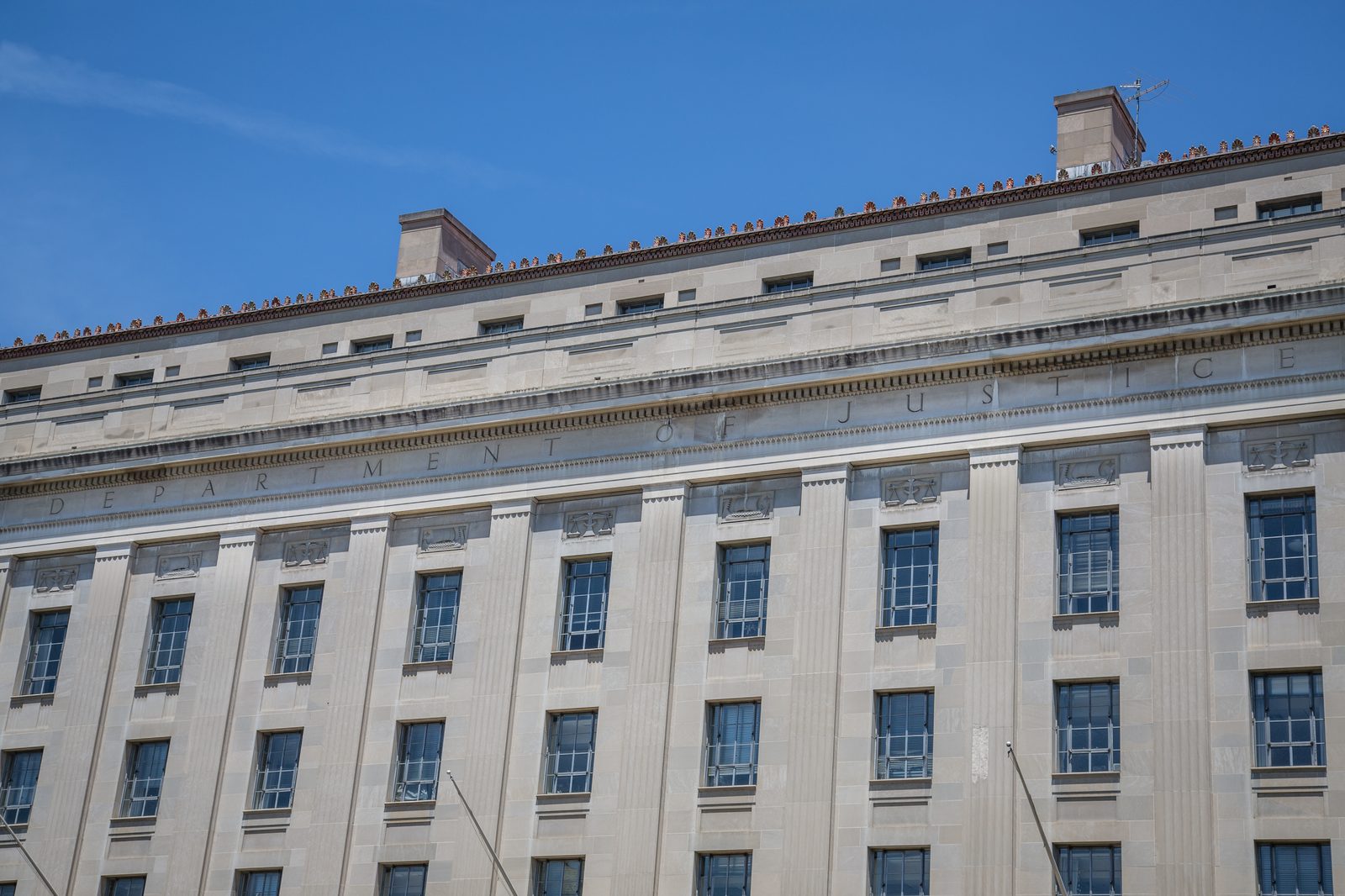
Sources: All factual claims in this digest are drawn from official U.S. Department of Justice press releases and public court filings linked inline above. Featured image: U.S. Department of Justice headquarters, Washington, D.C., photo by Tony Webster via Wikimedia Commons, licensed under CC BY 2.0.