

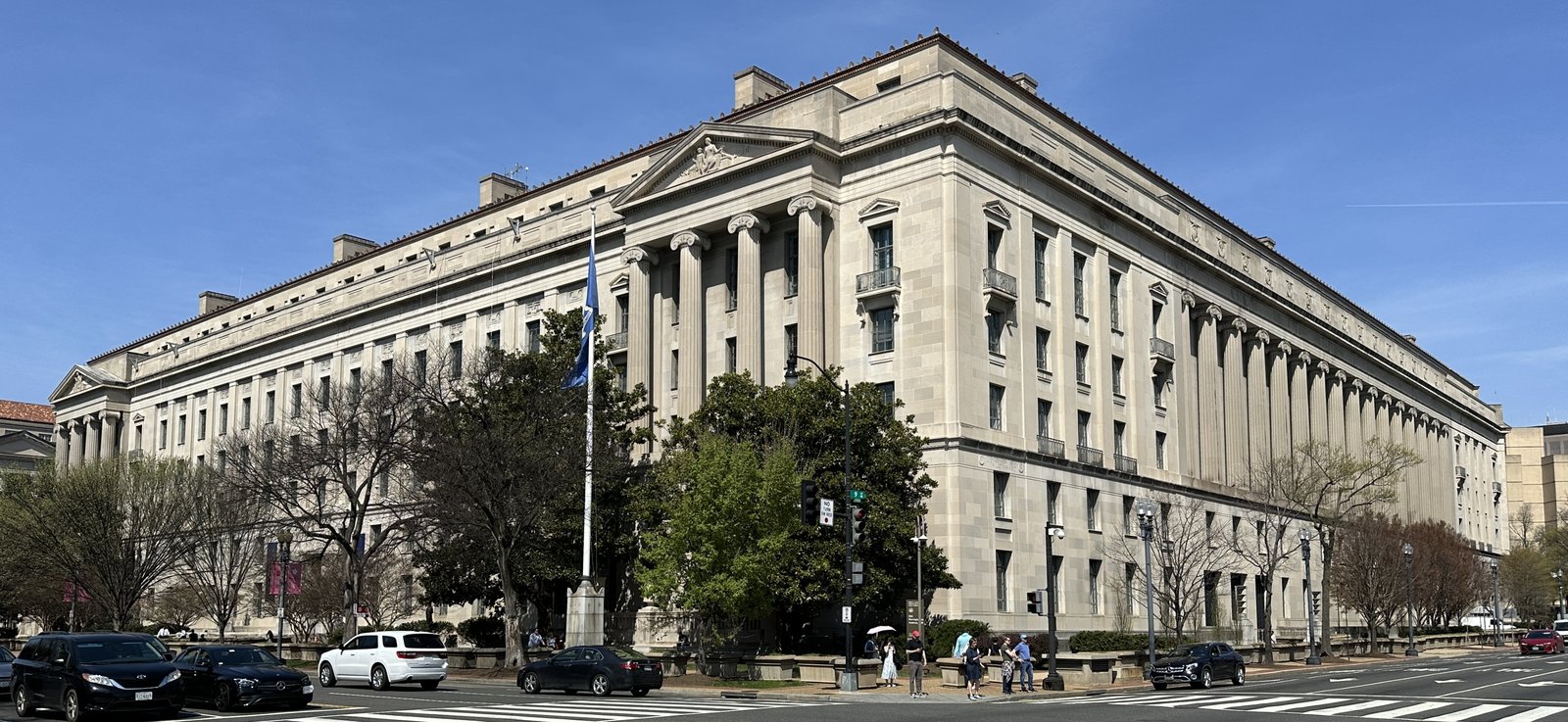
The U.S. Department of Justice closed the week of July 13 with a dense slate of enforcement activity, unsealing charges and announcing settlements that spanned transnational money laundering, health-care fraud, human smuggling, trade fraud, tax offenses and public-integrity violations. The actions, drawn from press releases the department issued on July 16 and 17, 2026, offer a snapshot of where federal prosecutors are concentrating resources — and of the enforcement infrastructure now referenced routinely in case announcements, including a Task Force to Eliminate Fraud and a new National Fraud Enforcement Division.
The following digest summarizes eight notable matters. Where cases remain pending, the charges are allegations and defendants are presumed innocent unless and until proven guilty. Civil settlements described below resolve contested allegations without any admission or determination of liability. Every claim is sourced to the department’s public releases, which are linked throughout.
1. A $43 million laundering network tied to online investment scams
Two New York residents made their initial appearance in federal court in Brooklyn on July 16 on charges of conspiring to launder proceeds of cyber-enabled investment fraud, according to a Justice Department announcement. Prosecutors allege that Zhuoying Chen, 27, of Brooklyn, and Haojie Zhang, 38, of Queens, managed a network of more than a dozen people who opened roughly 140 bank accounts in the names of about 45 shell companies to move at least $43 million in scam proceeds, then coordinated with China-based co-conspirators to transfer the money abroad.
The indictment describes a now-familiar mechanism: perpetrators cultivate trust with victims over messaging apps or social media, steer them toward bogus investment platforms that display fake profits, then drain their funds — the pattern commonly described as “pig butchering.” The charge of conspiracy to commit money laundering carries a maximum penalty of 20 years in prison. The FBI, Homeland Security Investigations, IRS-Criminal Investigation and the U.S. Postal Inspection Service investigated.
Records suggest the case is significant less for any single defendant than for what it reveals about the financial plumbing behind online fraud that targets Americans. The department cautioned that an indictment “is merely an allegation,” and both defendants are presumed innocent. (DOJ Release No. 26-794.)
2. A Massachusetts drugmaker pays $4.66 million over alleged kickbacks
EyePoint Pharmaceuticals agreed to pay the United States $4,657,463 to resolve False Claims Act allegations that it induced ambulatory surgery centers to buy and dispense DEXYCU, an injectable treatment for inflammation following cataract surgery, the Civil Division announced July 17. Filings indicate the alleged conduct ran from the drug’s 2019 commercial launch through early 2023.
According to the department, EyePoint operated an “Assurance Program” that reimbursed surgery centers when insurers denied or underpaid DEXYCU claims, and it allegedly supplied excessive free samples — arrangements the government contends functioned as unlawful kickbacks. The company entered a five-year corporate integrity agreement with the Department of Health and Human Services’ inspector general and will pay an additional sum to participating states. The resolution settles a whistleblower suit brought under the False Claims Act’s qui tam provisions; the relator will receive approximately $792,000.
The matter is a routine but instructive example of health-care fraud enforcement, which the department has repeatedly identified as a priority. As the department noted, the claims “are allegations only,” and there has been “no determination of liability.” (DOJ Release No. 26-798.)
3. The final defendant pleads guilty in a 2021 smuggling tragedy that killed more than 50
Tomas Quino Canil, 38, a Guatemalan national extradited to the United States in 2025, pleaded guilty to human-smuggling charges tied to the December 2021 crash of a tractor-trailer in Chiapas, Mexico, that had been packed with at least 160 migrants, the Criminal Division and the Southern District of Texas said. More than 50 people died, including unaccompanied children, and over 100 were injured.
With Quino Canil’s plea, all six defendants charged in the conspiracy have now admitted their roles, closing what U.S. Attorney Aaron Reitz called “one of the deadliest human smuggling tragedies in recent memory.” Court documents describe a scheme in which migrants paid smugglers to be moved from Guatemala through Mexico to the United States; one co-conspirator allegedly coached adults and minors on scripts to recite to immigration officials to secure their release. Quino Canil faces a maximum of life in prison and will be sentenced at a later date.
The case, prosecuted through the department’s Joint Task Force Alpha, underscores the continued federal focus on transnational smuggling networks. Because Quino Canil has entered a guilty plea, his admission of guilt is established rather than merely alleged; a federal judge will set his sentence after weighing the sentencing guidelines. (DOJ Release No. 26-802.)
4. A federal court strips citizenship from a Bosnia war-crimes suspect
On July 17, the U.S. District Court for the Eastern District of Tennessee entered an order revoking the naturalized citizenship of Sead Miljkovic, also known as Sead Dukic, who the Civil Division said concealed his identity to enter the United States in 1996 and naturalize in 2007. The court found he had illegally procured citizenship because he lacked the “good moral character” the law requires, based on false statements to government officials.
According to the department, Miljkovic was a former member of the security forces of the short-lived Autonomous Province of Western Bosnia and was the subject of a 2007 Bosnian arrest warrant and an INTERPOL Red Notice. The Red Notice alleges that in June 1994 he and accomplices beat twelve civilians with wooden bats and confined them in a morgue for five days without light or water. Filings indicate Miljkovic consented to the judgment revoking his citizenship. He has not yet appeared before a Bosnian court, and the underlying war-crimes allegations remain untested in that forum. (DOJ Release No. 26-804.)
5. A Dallas seafood wholesaler is fined $250,000 for mislabeling salmon
Seafood Supply Co. was sentenced July 17 to pay a $250,000 fine after pleading guilty to two counts under the Lacey Act, the Energy and Natural Resources Division announced. According to court documents, the company falsified the country of origin of salmon it sold between January 2020 and February 2022, labeling less-expensive Chilean salmon as product from Scotland or other European countries.
The company was also placed on three years’ probation and ordered to adopt an environmental compliance plan; the department noted it has operated under new leadership since the time of the violations. The National Oceanic and Atmospheric Administration investigated as part of “Operation Upstream Diligence,” and the division framed the prosecution within a broader Trade Fraud Task Force created to counter tariff evasion and mislabeling that the department says harms domestic industry, consumer confidence and national security. Because the matter concluded with a guilty plea and sentence, the findings are established. (DOJ Release No. 26-799.)
6. Justice Department sues Maryland over in-state tuition for illegal immigrants
In a civil action filed July 16, the department challenged Maryland laws that extend in-state tuition and financial aid to individuals without lawful immigration status, arguing they conflict with federal law and discriminate against U.S. citizens who do not receive the same benefits. Officials said the suit is the department’s 13th such challenge.
Associate Attorney General Stanley Woodward said the policy costs Maryland taxpayers “roughly $9M for just one academic year,” while Assistant Attorney General Brett Shumate framed the litigation as protecting citizens from being treated as “second-class.” The department said four comparable suits — in Texas, Kentucky, Oklahoma and Nebraska — have already produced orders enjoining similar laws, while cases remain pending in states including Illinois, Minnesota, Virginia, California, New Jersey, Kansas, Massachusetts and Rhode Island.
The complaint sets out contested legal claims that Maryland will have the opportunity to answer; nothing has been decided on the merits. The breadth of the multistate campaign makes it a notable through-line in the department’s civil docket. (DOJ Release No. 26-790.)
7. A former intelligence-community executive settles a revolving-door claim
Deirdre Walsh, former chief operating officer of the Office of the Director of National Intelligence, agreed to pay a $20,000 civil penalty to resolve allegations that she violated post-employment “cooling off” restrictions, the Civil Division said July 10. The government alleged that within a year of leaving ODNI, Walsh — then working for a government contractor — contacted an ODNI employee about a roughly $18 million request for equitable adjustment, conduct it said breached 18 U.S.C. § 207(c).
Federal law bars senior former officials from lobbying their former agencies for one year after departure. The Intelligence Community’s inspector general investigated jointly with the department. As with other civil resolutions, the claims “are allegations only,” and there was “no determination of liability.” The modest penalty notwithstanding, the case is a reminder that revolving-door restrictions remain subject to enforcement. (DOJ Release No. 26-762.)
8. A Miami accountant is charged over false returns for a shipping-company CFO
Luis E. Gonzalez Jr., a Miami-based CPA, was arraigned in mid-July on a charge of aiding the filing of a false tax return, the National Fraud Enforcement Division and the Southern District of Florida said. According to a criminal information, Gonzalez prepared returns for a shipping business and members of the family that owned it, and allegedly filed false returns that collectively underreported millions of dollars in income across tax years 2021 through 2023.
The single count carries a maximum of three years in prison, plus potential supervised release, restitution and monetary penalties. The charge is one of several tax-preparer prosecutions the department has announced in recent days, alongside similar matters involving accountants in Hoboken and an Idaho man indicted for tax evasion. The case remains pending, and Gonzalez is presumed innocent. (DOJ Release No. 26-803.)
What TIJ is watching
Three threads merit closer reporting. First, the department confirmed July 16 that Abdikerm Eidleh was transferred from Somalia to Minnesota to face charges in the sprawling “Feeding Our Future” pandemic-nutrition fraud — a case that has already produced dozens of convictions and ranks among the largest COVID-relief fraud prosecutions in the country. Its international dimension warrants sustained attention.
Second, the 13-state litigation campaign over in-state tuition for illegal immigrants is quietly reshaping the law on state benefits and federal preemption. The outcomes deserve tracking beyond the department’s own win-loss framing, including how courts weigh the competing statutory arguments. Third, the $43 million laundering indictment is a window into the industrial-scale online-scam ecosystem, whose cross-border money movement continues to outpace enforcement.
TIJ will continue to monitor these dockets. All figures, dates and characterizations above are drawn from the Justice Department’s public releases linked throughout; pending allegations should be read as allegations, and civil settlements as resolutions carrying no admission of liability.
Compiled by Eduardo Bacci for The Investigative Journal. Sources: U.S. Department of Justice, Office of Public Affairs press releases (Nos. 26-762, 26-790, 26-794, 26-798, 26-799, 26-802, 26-803, 26-804).