

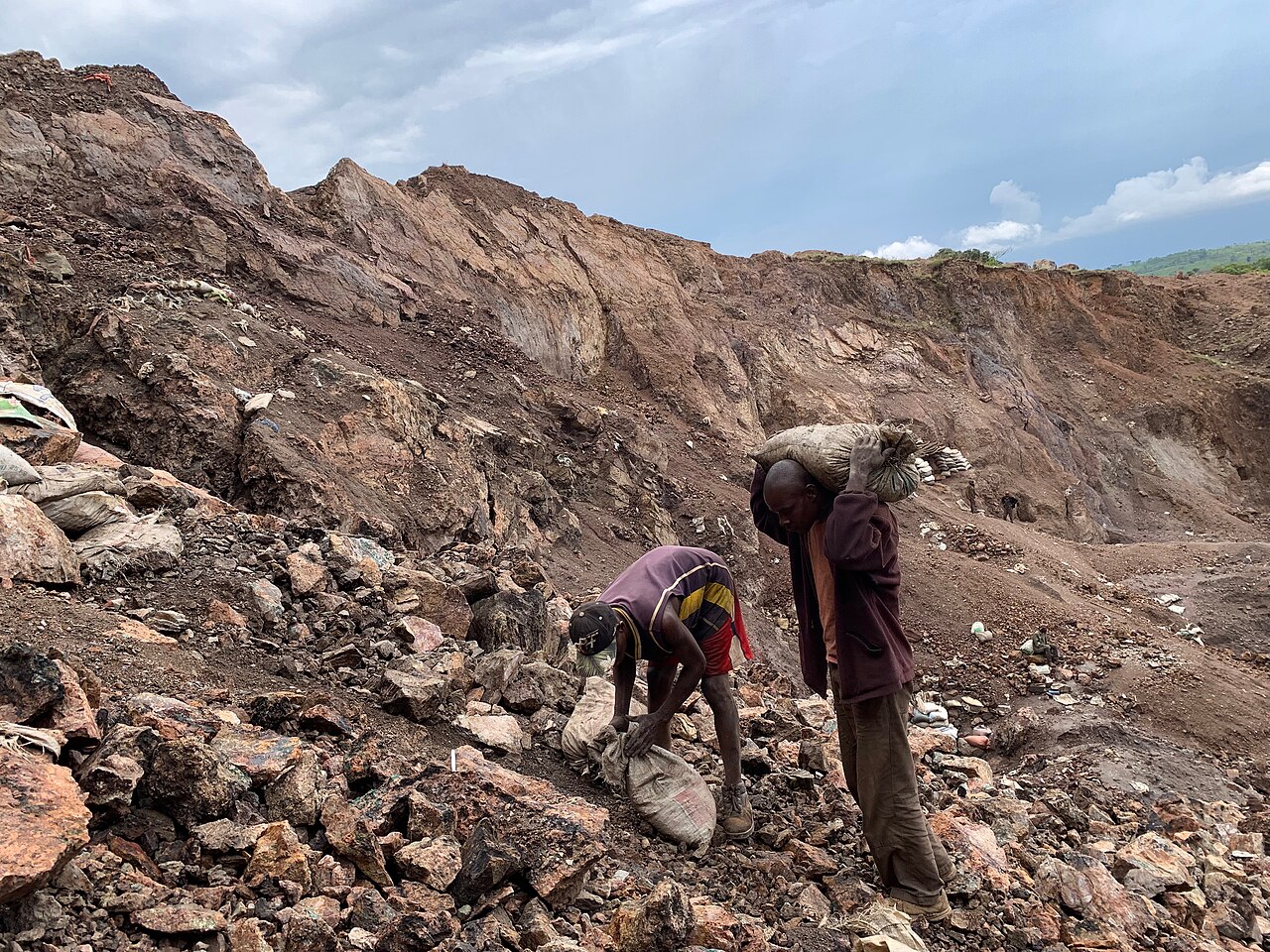
When American consumers drive their gleaming new electric vehicles off the dealership lot, they are assured they are doing their part for the planet. The marketing is polished, the messaging immaculate: zero emissions, clean energy, a brighter future. What those consumers are almost never told is that the batteries powering their vehicles depend on a mineral extracted under conditions that would horrify them — cobalt, pulled from the earth by some of the poorest and most exploited people on the planet, including tens of thousands of children.
The Democratic Republic of Congo produced 76.6 percent of the world’s mined cobalt in 2024, according to the Cobalt Institute’s annual market report — roughly 220,000 tonnes out of a global total of 287,050. This is not a minor input. Cobalt is essential to the lithium-ion batteries that power electric vehicles, smartphones, and laptops. And the DRC’s dominance in this market means that virtually every major automaker on Earth has a supply chain that runs through one of the most unstable, corrupt, and dangerous countries in Africa.
The human cost of that supply chain has been documented for nearly a decade, yet remarkably little has changed. Amnesty International’s landmark 2016 report, “This is What We Die For,” found children as young as seven working twelve-hour days in artisanal cobalt mines in the Katanga region. UNICEF has estimated that approximately 40,000 children work in DRC cobalt mines. Artisanal miners — the men, women, and children who dig by hand without safety equipment — earn between one and two dollars per day. The International Labour Organization identified over 6,200 children working in mines in Haut-Katanga and Lualaba provinces alone in its 2024 assessment.
The Corporate Veil
The major automakers have responded to these revelations not with meaningful structural change, but with the modern corporation’s preferred tool: the sustainability report. Tesla struck a deal with the Swiss mining giant Glencore in 2020 to buy cobalt directly from Congo mines, framing the arrangement as a commitment to responsible sourcing. Ford has conducted supplier audits and funds a pilot program in the DRC that it describes as promoting “responsible mineral sourcing.” General Motors has claimed its batteries no longer rely on DRC-sourced cobalt, though industry analysts have questioned this assertion given the opacity of battery supply chains.
The reality is that cobalt is fungible. Once the mineral leaves an artisanal mine and enters the commercial supply chain, it is mixed, processed, and shipped through intermediaries that make tracing its origin extraordinarily difficult. A 2019 class action lawsuit filed against several automakers and technology companies alleged direct complicity in child labor exploitation in the DRC. The suit named Apple, Google, Dell, Microsoft, and Tesla, arguing that these companies had specific knowledge of the conditions under which their cobalt was mined and failed to act.
What makes the situation even more troubling is the degree of Chinese control over the cobalt pipeline. China controls approximately eighty percent of global cobalt refining capacity, meaning that even cobalt mined under relatively better conditions in the DRC is overwhelmingly processed through Chinese facilities before reaching Western manufacturers. The Chinese company CMOC produced 114,000 tonnes from its two DRC mining sites in 2024 alone — thirty-one percent above its stated capacity. Chinese interests now control an estimated seventy to eighty percent of industrial cobalt mines in the Congo, creating a strategic chokepoint that should concern American policymakers far beyond the ethical dimensions of child labor.
The Demand Engine
The pressure on Congo’s cobalt reserves is only intensifying. Electric vehicle batteries accounted for 43 percent of global cobalt demand in 2024, according to the Cobalt Institute, and that figure rises to 61 percent when all battery applications are included. Global EV battery demand grew to more than 950 gigawatt-hours in 2024, an increase of 25 percent over the previous year. Projections suggest total cobalt demand could reach 400,000 tonnes by the early 2030s.
This exponential growth in demand is being driven in significant part by government mandates. The Biden administration’s push for electric vehicle adoption, backed by billions in Inflation Reduction Act subsidies, created powerful market incentives to scale EV production as rapidly as possible. The European Union has moved to ban the sale of new internal combustion vehicles by 2035. These policy decisions have enormous downstream consequences for the people of the DRC, yet the politicians championing them rarely acknowledge the human cost embedded in their clean energy timelines.
The concentration of supply presents a structural vulnerability that the market cannot easily resolve. The Herfindahl-Hirschman Index for cobalt production exceeds 5,000 globally and 9,200 in Africa — well above the 2,500 threshold that economists use to define a highly concentrated market. This means that cobalt supply is susceptible to political disruption, regulatory changes, or operational failures in a single country where armed conflict, corruption, and governance failures are endemic.
The Uncomfortable Truth
None of this is to suggest that electric vehicles are inherently wrong or that the transition away from fossil fuels is misguided. But there is something deeply dishonest about a political and corporate establishment that wraps itself in the language of environmental virtue while remaining willfully blind to the suffering that makes its green ambitions possible. The DRC is the ninth-poorest country in the world by per capita GDP. Nearly three-quarters of its population lives below the international poverty line of $2.15 per day. More than seven million Congolese are internally displaced — ten percent of the world’s displaced population.
These are the people whose labor undergirds the clean energy transition. They do not appear in Super Bowl advertisements for electric trucks. They are not mentioned in corporate sustainability pledges or government press releases about emissions targets. They exist in the supply chain’s shadow, invisible and expendable.
The Cobalt Institute, the industry’s own trade body, acknowledges that 82 percent of refined cobalt was assessed under responsible sourcing frameworks in 2024. But assessment is not reform. Audits are not accountability. And the gap between what corporations say about their supply chains and what actually happens in the mines of Katanga remains vast. Until American consumers, policymakers, and corporate leaders are willing to confront that gap honestly, the clean energy revolution will continue to be built, in part, on the backs of children earning a dollar a day in the world’s most dangerous mines.