

UPDATE (Aug. 9, 2026): On Aug. 6, the Senate Agriculture Committee rejected a five-year farm bill on a 10–11 vote in a dispute over this provision. Chairman John Boozman’s draft would have delayed cost-sharing to fiscal 2029 for most states and fiscal 2030 for the highest-error states; committee Democrats, led by Sen. Amy Klobuchar, argued that structure preserves the disparity described below and pressed for an equal two-year delay for all states. The committee recessed rather than adjourned, and Boozman said the panel would likely vote on the bill again after the August recess.
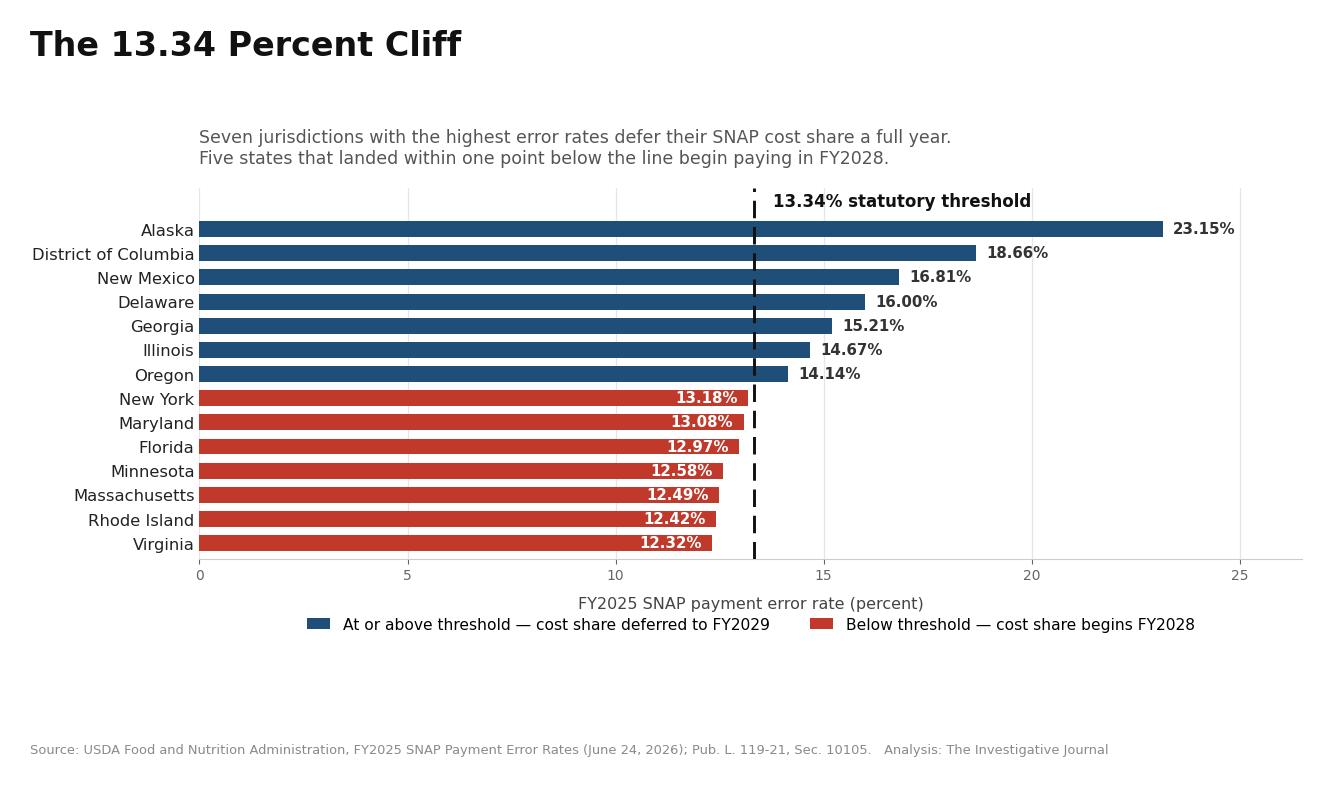
Chart: The Investigative Journal, from USDA Food and Nutrition Administration FY2025 SNAP payment error rates and Pub. L. 119-21, Sec. 10105.
An Investigative Journal analysis of federal payment data and the text of Public Law 119-21 finds that a late-added provision in last year’s budget reconciliation law creates a sharp financial cliff at a payment error rate of 13.34 percent — and that seven jurisdictions on the wrong side of it will defer roughly $1.72 billion in obligations that six better-performing states must begin paying a year earlier.
When the U.S. Department of Agriculture published its annual Supplemental Nutrition Assistance Program payment error rates on June 24, Maryland’s number looked like progress. The state had cut its rate from 18.98 percent in fiscal 2023 to 13.64 percent in fiscal 2024 to 13.08 percent in fiscal 2025 — an improvement of nearly six percentage points in two years, according to USDA’s published error-rate tables.
That improvement is now expected to cost Maryland money. Under the cost-sharing formula Congress enacted in Section 10105 of Public Law 119-21, a state whose fiscal 2025 error rate multiplied by 1.5 reaches 20 percent — an error rate at or above roughly 13.34 percent — has its cost-share obligation deferred from fiscal 2028 to fiscal 2029. Maryland finished at 13.08. It missed the deferral by 0.25 of a percentage point.
Illinois finished at 14.67 percent — a worse rate than Maryland’s by more than a point and a half — and qualified for the deferral.
The provision that produces this result is titled, in the statute itself, “State quality control incentive.”
What the statute says
Section 10105 amends Section 4(a) of the Food and Nutrition Act of 2008 to end the arrangement under which the federal government paid 100 percent of SNAP benefit costs. Beginning in fiscal 2028, the law sets a state’s share according to its payment error rate: zero below 6 percent, 5 percent for rates between 6 and 8 percent, 10 percent for rates between 8 and 10 percent, and 15 percent for rates at or above 10 percent.
Those brackets are graduated. The delay provision is not. The statutory text at clause (iii) reads: “If, for fiscal year 2025, the payment error rate of a State multiplied by 1.5 is equal to or above 20 percent, the implementation date under clause (i) for that State shall be fiscal year 2029.” A parallel clause keyed to fiscal 2026 pushes implementation to fiscal 2030.
The arithmetic sets the break point at 13.3333 percent. Because USDA reports rates to two decimal places, the practical dividing line falls between 13.33 percent — which multiplied by 1.5 yields 19.995, below the trigger — and 13.34 percent, which yields 20.01 and clears it. One hundredth of a percentage point separates a state that begins paying in fiscal 2028 from one that does not.
The provision is widely known in state agencies as the “Alaska carveout.” Niki Kozlowski, who directs the Income Support Division at New Mexico’s Health Care Authority, told Source New Mexico that she and her staff use that term, based on reporting that Alaska’s senators conditioned their support for the bill on additional time for their state, which carries the nation’s highest error rate. Alaska’s fiscal 2025 rate was 23.15 percent.
Who cleared the line, and who did not
TIJ compared every jurisdiction in USDA’s fiscal 2025 payment error rate table against the statutory trigger. Seven cleared it: Alaska at 23.15 percent, the District of Columbia at 18.66, New Mexico at 16.81, Delaware at 16.00, Georgia at 15.21, Illinois at 14.67 and Oregon at 14.14. Each defers its cost share to fiscal 2029.
Using benefit-issuance figures compiled by the Food Research & Action Center in its state-by-state cost-shift table, those seven jurisdictions defer a combined $1.72 billion in fiscal 2028 obligations — Illinois alone accounts for $668.4 million and Georgia for $526.7 million. That figure is consistent with FRAC’s own note that the roughly $11.1 billion national total falls to approximately $9 billion once deferring states are excluded.
Six states landed within a single percentage point below the line: New York at 13.18 percent, Maryland at 13.08, Florida at 12.97, Minnesota at 12.58, Massachusetts at 12.49 and Rhode Island at 12.42. All six fall in the top bracket and owe 15 percent of benefit costs beginning in fiscal 2028. For the five largest programs among them — New York, Maryland, Florida, Minnesota and Massachusetts — combined exposure on FRAC’s figures is roughly $2.92 billion.
The clearest pairing is New York and Illinois. New York’s error rate was 13.18 percent; Illinois’s was 14.67. On FRAC’s projections New York owes about $1.15 billion in fiscal 2028 while Illinois, with the higher error rate, owes nothing that year. Maryland’s projected benefit cost shift is $221.2 million; the state’s own Family Investment Administration has estimated its total future SNAP penalty exposure at more than $240 million annually, according to Maryland Matters.
Hawaii illustrates the same pattern across a longer horizon. USDA’s fiscal 2023 table recorded a Hawaii error rate of 20.94 percent. The fiscal 2024 table put it at 6.68 percent — a drop of more than 14 points in a single year, among the largest improvements any state has recorded. Hawaii’s fiscal 2025 rate was 10.92 percent, placing it in the 15 percent bracket with no deferral. Sen. Brian Schatz has publicly cited his state’s experience as evidence that the provision penalizes improvement.
A documented behavioral response
Whether states have altered their conduct because of the cliff is the harder question, and the public record supports a narrower claim than the arithmetic might invite. In one state, an agency head has described the calculation on the record.
Kozlowski told Source New Mexico in December 2025 that her division had been on track to bring New Mexico’s error rate below 10 percent by 2026, and that the effort was deliberately paced after the law passed. Dropping below the threshold before October 2026, the outlet reported, could expose the state to as much as $153 million in cost-sharing obligations. Kozlowski described the resulting posture as a “balancing act,” and said of the holding pattern: “It doesn’t feel, I don’t know, comfortable. It feels like we should still be working on it. So I think my status is that we are still working on it, but we’re taking a more strategic, streamlined approach.” Her division simultaneously sought roughly $28 million from the legislature for caseworkers and a new IT system — spending intended to reduce errors, on a timetable shaped by the statute.
Two states whose rates moved sharply in the opposite direction cleared the threshold. Illinois went from 11.56 percent in fiscal 2024 to 14.67 in fiscal 2025, a deterioration of 3.11 points. Delaware went from 12.37 to 16.00, a deterioration of 3.63 points. USDA’s tables record the movement but say nothing about its cause, and no public document reviewed for this article establishes that either state’s rate rose by design. Error rates are volatile, and quality-control samples are small. The point is not that these states acted deliberately — it is that the statute rewards the outcome regardless of the reason.
Maryland’s own auditors examined a version of this question and could not resolve it. The Office of Legislative Audits, in its July 15 report on the Department of Human Services’ Family Investment Administration, disclosed that it received a fraud, waste and abuse hotline referral alleging “that DHS management may have intentionally manipulated the error rate to enable the State to defer the increased State contribution for SNAP costs imposed by the One Big Beautiful Bill Act of 2025.” Auditors were unable to substantiate the allegation and wrote that their review “did not identify any matters that warranted a referral to the Office of the Attorney General’s Criminal Division.” The allegation is unproven and should be treated as such. A separate whistleblower claim reported by Fox Baltimore has not been adjudicated. TIJ notes both for the record and draws no conclusion from either.
The dispute over the underlying policy
Criticism of the carveout does not map onto the usual dividing lines, and the cost-share policy it modifies has serious defenders.
Writing for the American Enterprise Institute in July, Angela Rachidi called the cost share “a blunt but necessary tool” for improving program integrity. She notes that the fiscal 2025 national error rate of 10.62 percent remains far above the 6.6 percent average recorded from 2017 through 2019, and argues that proposals to delay the requirement in the coming farm bill “risk reducing access to nutrition assistance for eligible low-income households or increasing costs to taxpayers.” Rachidi also makes a point that limits how far the cliff finding can be pushed: the deferral is temporary. States that qualify face the obligation in fiscal 2029 or fiscal 2030, calculated on their fiscal 2027 rates. The carveout shifts timing, not liability.
The Cato Institute reaches a sharper conclusion about the provision while endorsing the policy it modifies. In a March analysis, Romina Boccia and Tyler Turman wrote that states are “exploiting a last-minute carveout” and urged Congress to eliminate it outright, arguing that “no state should be exempt from that arrangement.”
Opponents of the cost share reject the premise. FRAC argues that payment error rates are an unstable and misleading basis for allocating billions in state liability, noting that the measure counts underpayments to eligible households alongside overpayments and captures administrative mistakes rather than fraud. In its FY2025 tables USDA reports both components separately: nationally, underpayments accounted for 1.33 points of the 10.62 percent total. FRAC has also flagged the parity problem directly, writing that the exception risks “perversely incentivizing states to maintain higher error rates to postpone their cost-share obligations.”
USDA has framed the overall picture as a state accountability failure. Announcing the rates, Agriculture Secretary Brooke L. Rollins said they were “further proof that state accountability is severely lacking in SNAP,” and the department reported that the fiscal 2025 rate represents $10.1 billion in improper payments nationwide, counting both overpayments and underpayments.
Seven weeks left on the clock
The immediate significance of this analysis is a deadline. Fiscal 2026 ends September 30, 2026 — roughly seven weeks from publication. Under clause (iii)(II), a state whose fiscal 2026 error rate reaches 13.34 percent has its implementation date moved to fiscal 2030, skipping two years rather than one. For a state in Maryland’s position, with a projected annual benefit cost shift above $221 million, the difference between finishing fiscal 2026 just above the line and just below it is worth roughly twice that figure.
Every state agency knows approximately where its rate stands well before USDA publishes. As Rachidi notes, states “should roughly know their FY2026 payment error rate in the next few months,” even though official release will not come until next summer. The measurement window closes before the public sees a number.
Nothing in the public record establishes that any state other than New Mexico has slowed integrity work to stay above the line, and the volatility of these rates means year-to-year movement rarely admits a single explanation. But the incentive is not in dispute. It is written into the statute, it is legible to every state budget office in the country, and it points in the wrong direction for the next seven weeks.
Congress can resolve the question in the pending farm bill by striking clause (iii), by converting the cliff into a graduated phase-in, or by leaving it in place. What the record now shows is that a provision Congress titled a quality control incentive currently offers its largest financial reward to the jurisdictions with the least accurate payments — and imposes its earliest cost on six states that came within one percentage point of the same relief.
Sources and documents: Public Law 119-21, Sec. 10105 (govinfo); USDA FNA, FY2025 SNAP Payment Error Rates; FY2024 Payment Error Rates; FY2023 Payment Error Rates; USDA press release 0082.26; USDA SNAP Quality Control; FRAC state cost-shift table; FRAC analysis of Sec. 10105; AEI, Angela Rachidi; Cato Institute, Boccia and Turman; Source New Mexico; Maryland Office of Legislative Audits report, July 15, 2026; Maryland Matters.
Methodology: TIJ applied the statutory formula at Sec. 10105(a)(2)(B)(iii) to each jurisdiction in USDA’s published FY2025 payment error rate table. Dollar figures for projected state benefit cost shifts are FRAC’s, derived from FY2025 benefit issuance; TIJ’s aggregation of those figures is its own. Cost-share percentages reflect the brackets in the statute. Projections assume FY2028 benefit levels equal to FY2025 and will change as caseloads and benefit costs change.
Editorial notes: This analysis rests entirely on published records — statutory text, federal payment data, state audit reports and prior published reporting. Statements by state officials are quoted from those published sources; TIJ did not separately solicit comment from the agencies named, and none of the officials quoted here were asked to respond to this analysis. Agencies, officials and organizations named are invited to submit responses or corrections through our contact page, and this article will be updated to reflect any substantiated response. Where a matter is an allegation or an unsubstantiated referral rather than a finding, it is identified as such. No conclusion is drawn about the intent of any state agency or official.