

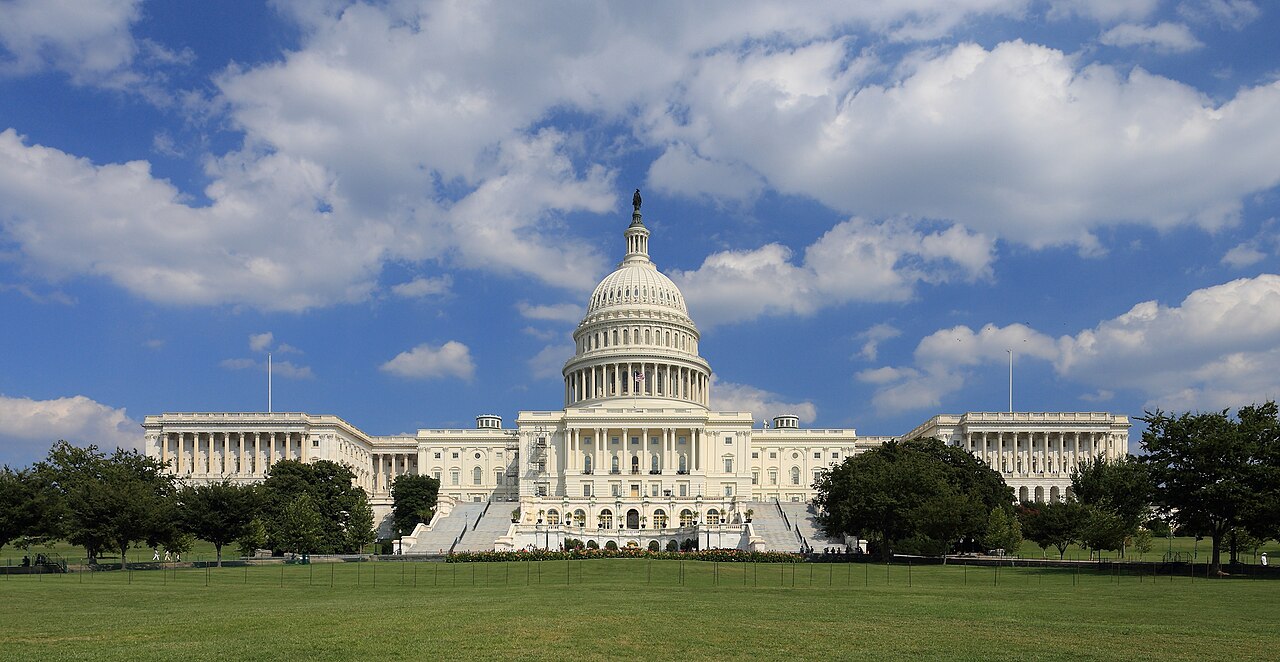
The Senate worked deep into the early hours of Saturday, August 8, before gaveling out for the August recess, clearing a stopgap funding bill, a sweeping Russia sanctions package, and a new attorney general in a single marathon session. The House left Washington in late July. With both chambers now out until September, this edition of Capitol Watch reviews the final flurry of floor action, the oversight work continuing through the recess, and the deadlines waiting on the other side. Every item below is drawn from official vote records, committee releases, and public documents, linked throughout.
Senate passes December 11 funding bridge, 90-6
The Senate’s last legislative act before recess was passage of H.R. 6500, the vehicle for a continuing resolution funding the government through December 11. The vote was 90-6, with one senator voting present, according to the Senate floor wrap-up. Cloture on the substitute amendment offered by Appropriations Chair Susan Collins had been invoked 91-6 a day earlier.
According to an office release from Sen. Kevin Cramer (R-N.D.), the measure is a clean CR that also extends surface transportation programs and carries adjustments for WIC, shipbuilding accounts, and the Disaster Relief Fund. One notable rider fight: Sen. Ted Budd (R-N.C.) offered an amendment to strike Section 2019, a provision relating to hemp policy; the Senate tabled the amendment 61-32, leaving the provision in place.
The bill now returns to the House, which passed its own, different stopgap — H.R. 9770, running through December 4 — on a 220-205 vote on July 21, per the House Appropriations Committee. Reconciling the two versions is now the central item on the September calendar: current-year funding lapses September 30, and the House does not return until after Labor Day. The 90-6 Senate margin suggests broad cross-party support for avoiding a shutdown ahead of the midterms, but the House vote count in July was far more partisan, and the chamber’s concurrence is not automatic.
Russia sanctions bill clears 86-11, carrying Graham’s name
On Friday the Senate passed H.R. 5334, the legislative vehicle for the Lindsey O. Graham Sanctioning Russia Act of 2026, by a vote of 86-11 under a 60-vote threshold. The official Senate vote record describes the measure as sanctions legislation “championed by the late Senator Lindsey O. Graham,” who died last month; the bill’s passage was widely framed by members of both parties as a tribute to the South Carolina Republican, NPR reported.
The package would impose primary and secondary sanctions on Russia and, according to press analyses of the text, authorize tariffs of up to 100 percent on imports from countries that make major purchases of Russian oil and gas or facilitate sanctions evasion. That secondary-duties provision drew the sharpest floor challenge: an amendment from Sen. Rand Paul (R-Ky.) to strike it was rejected 32-64. The eleven no votes on final passage comprised ten Democrats and Paul, per the Senate Press Gallery tally.
Because the Senate amended the House-passed vehicle, the bill must return to the House for a concurrence vote, and trade-press reporting indicates the House path remains unsettled. The 86-vote supermajority, however, is a significant data point for veto-proof margins should the measure reach the President’s desk in its current form.
Blanche confirmed attorney general, 50-49, after 4 a.m. vote
In a vote held after 4 a.m. Saturday, the Senate confirmed Todd Blanche of Florida as Attorney General of the United States, 50-49, on nomination PN1078. Cloture was invoked by the same one-vote margin. According to NBC News, Republicans Susan Collins of Maine and Lisa Murkowski of Alaska joined all Democrats in opposition.
Blanche, who previously served as President Trump’s personal defense attorney and as deputy attorney general, had been acting attorney general since April, when press accounts indicate the President dismissed Pam Bondi from the post. The confirmation gives the Justice Department its first Senate-confirmed leader in four months, a period in which the department has faced continuing congressional document demands, including in the House Oversight Committee’s review of the federal government’s handling of the Jeffrey Epstein and Ghislaine Maxwell investigations. How the department manages its production obligations to Congress under permanent leadership is a question this publication will continue to track.
A conveyor belt of confirmations: 74 nominees en bloc
Before turning to Blanche, the Senate on Friday confirmed 74 nominations en bloc, 51-47, under the terms of S.Res. 817, an executive resolution authorizing grouped consideration of Executive Calendar nominees that was itself adopted 50-47 on July 30. Earlier in the week, the chamber confirmed Erica Schwartz as Director of the Centers for Disease Control and Prevention, 51-44.
The en bloc mechanism is efficient — one roll call standing in for dozens — but it also means individual nominees receive no dedicated floor vote of their own. For accountability reporting, the practical effect is that scrutiny of these officials shifts almost entirely to committee records and post-confirmation oversight. The full list of the 74 confirmed positions is available through the Congress.gov nominations database.
Voter ID bill blocked as election-year lines harden
The final roll call of the session was a failed cloture vote on the motion to proceed to S. 5271, a bill to amend the Help America Vote Act of 2002 to require voters to provide photo identification. The 52-46 tally fell short of the 60 votes needed. With the November midterms now under three months away, records suggest this vote was designed at least in part to put senators on the record on election administration — a theme readers should expect to recur when the chamber returns.
PFAS reporting fight ends in a 48-50 near-miss
A less-noticed vote from Wednesday deserves attention: the Senate rejected, 48-50, a motion to proceed to S.J.Res. 187, a Congressional Review Act resolution disapproving the EPA rule that modified the start of the submission period for PFAS reporting and recordkeeping under Section 8(a)(7) of the Toxic Substances Control Act. The practical stakes: the underlying EPA rule adjusts when companies must begin reporting data on per- and polyfluoroalkyl substances, and the two-vote margin indicates meaningful cross-party interest in the reporting timeline. The data companies eventually submit under this rule will be a primary source for environmental accountability reporting, so the schedule matters beyond Beltway procedure.
Defense bill in limbo; CBO prices the Navy’s new battleship at $275 billion
The FY2027 National Defense Authorization Act remains stalled. As the Congressional Research Service documents, the House passed its version 216-212 on July 22, while the Senate companion, S. 4784, has yet to reach the floor after a failed cloture vote in mid-July. Trade press reporting indicates members are conducting informal conference talks over the recess, with a reconciled measure possible in the fall.
Budget context arrived August 5, when the Congressional Budget Office estimated that building 15 of the Navy’s planned nuclear-powered battleships would cost about $275 billion in 2026 dollars through 2056 — roughly $23 billion for the first ship and an average of $18 billion for each that follows. CBO’s report also examines the strain the program would place on the shipbuilding industrial base, a finding directly relevant to the shipbuilding adjustments carried in the new CR.
Oversight doesn’t recess: Epstein review, a Fifth Amendment invocation, and a GAO fraud report
Committee investigations continue while the floor is dark. In late July, the House Oversight Committee released the transcript of its interview with former White House counsel Kathryn Ruemmler, part of the committee’s ongoing review of the federal government’s investigations of Jeffrey Epstein and Ghislaine Maxwell, and Chairman James Comer issued a statement after Dr. Anthony Fauci invoked the Fifth Amendment in a committee proceeding. The committee has conducted more than a dozen transcribed interviews and depositions in the Epstein review to date, with additional witness appearances expected in the fall.
On the fiscal side, the committee highlighted a Government Accountability Office report on fraud in federally funded, state-administered programs. And in a transparency development that cleared both chambers with little fanfare, the Senate passed by unanimous consent H.R. 2069, the Stop Secret Spending Act, which requires federal agencies to disclose “other transaction agreement” spending on USAspending.gov in the same manner as contracts and grants. Filings indicate OTAs have allowed billions of dollars in awards to escape standard public disclosure; the bill now heads to the President.
The week ahead — and the September wall
Both chambers are in recess, with pro forma sessions expected. The binding commitments already on the calendar, per the Senate wrap-up: a cloture vote on the motion to proceed to S. 4668, the Protect College Sports Act governing athlete name-image-likeness deals, between September 15 and September 23; and a Senate vote no later than October 2 on H.Con.Res. 89, a War Powers Resolution measure directing the removal of U.S. forces from hostilities with Iran — a follow-on to the 49-50 discharge vote that failed July 30. Layered on top: House action on the Senate-passed CR before funding lapses September 30, the House concurrence question on the Russia sanctions bill, and NDAA conference work.
On the TIJ accountability beat
Three threads from this digest feed directly into our investigative portfolio. First, the Stop Secret Spending Act, if signed, will surface a new tranche of OTA spending data on USAspending.gov — a dataset we will mine for previously unreported awards. Second, the en bloc confirmation of 74 officials in a single vote means committee questionnaires and financial disclosures are now the principal public record on those officeholders; we will be reviewing them. Third, the Justice Department’s document productions to congressional committees under newly confirmed Attorney General Blanche — including in the Epstein review — offer a measurable test of executive-branch responsiveness to oversight, and the record so far is a matter of public filings we will continue to examine.
This digest is compiled from official public records, including Senate roll call votes, Congress.gov, committee releases, and CBO publications, with supplementary attribution to contemporaneous press reporting where noted. Corrections and responses from any party referenced are welcome and will be published. Featured image: U.S. Capitol, by Martin Falbisoner, CC BY-SA 3.0, via Wikimedia Commons.