

The Investigative Journal’s daily review of federal enforcement activity. Every item below is drawn from Justice Department press releases and the court records they describe; links to primary documents appear throughout and are collected at the end of this digest.
The Justice Department closed last week with a run of announcements touching nearly every corner of its enforcement portfolio: a new conviction in what the department describes as the largest health care fraud case it has ever prosecuted, a consumer-protection penalty against one of the country’s largest retailers, a guilty plea in a $43 million abusive tax shelter scheme, civil rights findings against California’s women’s prisons, and a criminal pollution indictment in Puerto Rico. Behind the individual cases, the department’s new National Fraud Enforcement Division put its priorities in writing — a memorandum signaling where federal fraud prosecutors intend to concentrate resources in the year ahead. Here is what moved between August 12 and August 14, and why it matters.
Operation Gold Rush claims its 16th conviction
An Ohio man pleaded guilty on Aug. 13 to laundering approximately $3.4 million in health care fraud proceeds on behalf of a foreign-based criminal organization, the Justice Department announced. According to court documents cited in the release, Eldar Zarbavel, 45, of Pepper Pike, opened Northeast Ohio bank accounts for Royce Medical Supply LLC, a Florida durable medical equipment company through which the organization submitted $1.42 billion in false claims to Medicare and private insurers between July 2022 and July 2024. The Centers for Medicare and Medicaid Services suspended reimbursement on nearly all of those claims, but some were paid, and filings indicate Zarbavel moved roughly $3.4 million of the proceeds in mid-2024 at the organization’s direction.
The plea is part of Operation Gold Rush, the investigation into a Russia-based transnational organization that prosecutors say orchestrated a multi-billion-dollar scheme against Medicare and private insurers — the largest health care fraud case ever prosecuted by the department, according to the release. Thirty-five people have been charged to date; Zarbavel is the 16th convicted. Charging documents allege the organization used nominee owners armed with false sale and corporate registration documents to open accounts, then siphoned funds to shell companies and overseas banks — in some cases, the department says, coordinating directly with associates employed inside the banks.
Zarbavel pleaded guilty to one count of money laundering, faces a statutory maximum of 20 years, and is scheduled for sentencing on Dec. 16. The significance is hard to overstate: the case is a template for how foreign criminal organizations exploit the apparent legitimacy of insurance reimbursements to move stolen money through the U.S. banking system.
Amazon to pay $2.25 million over identity-theft records
A federal court in the District of Columbia entered a stipulated order against Amazon.com Inc. resolving allegations that the company violated the Fair Credit Reporting Act, the department said Friday. The government’s complaint, filed after an FTC referral, alleged Amazon failed to provide identity theft victims with records of transactions made in their names — records the statute requires within 30 days of a request.
Under the order, Amazon will pay a $2.25 million civil penalty and must provide such records free of charge within 30 days, subject to verification, and post a notice on its website telling victims how to request them. “Consumers whose identities have been stolen should not face unnecessary red tape when they investigate how their identities were misused and seek to clear their names,” said Assistant Attorney General Brett A. Shumate of the Civil Division. The penalty is modest by Amazon’s scale, but the injunctive terms create ongoing, enforceable obligations — and a compliance record that could matter in any future FCRA dispute.
The Fraud Division puts its priorities on paper
Assistant Attorney General Colin M. McDonald of the National Fraud Enforcement Division released a memorandum on the division’s enforcement priorities on Aug. 13, framing its mission as prosecuting fraud “no matter its size or complexity.” The release cites Government Accountability Office estimates that the federal government loses between $233 billion and $521 billion annually to fraud, with other models running higher.
The division, created April 7 as part of a reorganization of the department’s fraud-fighting components, supports the administration’s government-wide task force on fraud elimination, according to department releases. The memo matters as a roadmap: white-collar defense practices and compliance officers will read it closely for signals about which sectors — health care, procurement, tax, and pandemic-era programs among them — face the most prosecutorial attention. The week’s docket, heavy on health care and tax fraud, suggests the division is already executing on that mandate.
$43 million tax shelter promoter pleads guilty
Larry C. Conner, 69, of Frisco, Texas, pleaded guilty on Aug. 12 to conspiring to defraud the IRS by promoting an abusive trust tax shelter, according to the department. Court documents indicate that from at least February 2018 through September 2023, Conner marketed a structure of purported “non-grantor” trusts and a so-called private family foundation through The Business Solutions Group, charging clients $25,000 to $50,000 and admitting he continued despite repeated warnings from attorneys and accountants that the shelter was illegal. He also admitted using the scheme himself to evade taxes on about $5.2 million of income.
Prosecutors say Conner and his co-conspirators caused false returns sheltering approximately $156 million in income, for a tax loss of roughly $43 million. The broader network has largely been dismantled: co-promoter Timothy McPhee is serving 151 months; four others were convicted at a five-week trial in May and June and face sentencing in January 2027. Conner faces up to five years at his Jan. 26, 2027 sentencing. IRS Criminal Investigation handled the case, which stands as one of the larger promoter prosecutions of the abusive-trust genre in recent years.
Tampa smuggling network: guilty plea in ESTA fraud conspiracy
A Cuban national living in Tampa pleaded guilty on Aug. 13 to alien smuggling, asylum fraud, and money laundering charges tied to an organization that prosecutors say moved thousands of Cuban nationals into the United States, per the department’s release. Filings indicate Yuniel Lima-Santos, 31, and co-conspirators advertised on social media, filed hundreds of fraudulent Electronic System for Travel Authorization applications using fake addresses and fabricated documents, and falsely claimed clients held European citizenship — Cuban nationals are not eligible for the ESTA program.
The organization charged clients between $1,500 and $40,000, at times chartering private planes, and records suggest Lima-Santos moved more than $600,000 internationally between 2021 and 2024, using a Florida shell company to conceal the funds’ origins. The release also states he admitted helping a co-defendant bring Cuban women into the country to work in strip clubs to pay off smuggling debts — an allegation that edges the case toward trafficking territory. Twelve people were charged in a superseding indictment; Lima-Santos faces up to 20 years. The case illustrates how document fraud against CBP’s visa-waiver screening systems has become core infrastructure for smuggling networks.
CRIPA findings: California women’s prisons
The Civil Rights Division announced it has reasonable cause to believe that the California Department of Corrections and Rehabilitation and two facilities — the Central California Women’s Facility in Chowchilla and the California Institution for Women in Chino — violate the Eighth and Fourteenth Amendments by failing to protect female prisoners from sexual abuse by staff. Investigators reported a longstanding pattern of staff sexual misconduct, failed confidential reporting channels, improper investigations, and weak accountability, along with inadequate implementation of the Prison Rape Elimination Act.
“California’s Department of Corrections and Rehabilitation knew of repeated incidents of sexual assault and harassment against female prisoners, and failed to protect them,” said Assistant Attorney General Harmeet K. Dhillon. The department gave the state notice of minimum remedial measures — expanded camera coverage, confidential reporting, strengthened investigative protocols — and stated that if officials do not satisfactorily respond within 49 days, the Attorney General may sue under the Civil Rights of Institutionalized Persons Act. These are findings, not adjudicated conclusions; CDCR’s formal response was not yet part of the public record reviewed for this digest.
Second Amendment settlement with the LA County Sheriff
The department announced a settlement with the Los Angeles County Sheriff’s Department over its firearm carry-permit procedures, resolving a lawsuit that alleged applicants waited an average of more than nine months for permits. According to the release, the sheriff’s department cut waiting times after the suit was filed — adding processing software and personnel — and is now in compliance with statutory deadlines, aligning its procedures with the Supreme Court’s Bruen decision.
The case is an early product of the Civil Rights Division’s Second Amendment Section, which enforces the amendment alongside the Police Pattern or Practice Act and Executive Order 14206. The department characterized the outcome as a win for county residents and for the Second Amendment. For local governments, the message is practical: permit-processing backlogs are now federal litigation risk.
Criminal Clean Water Act charges in Puerto Rico
An indictment unsealed Aug. 12 charges Ganaderos Borges Inc., a Naguabo, Puerto Rico slaughterhouse, and four individuals — including the company’s president and operator — with conspiracy and four counts of violating the Clean Water Act, the department announced. The indictment alleges that from August 2018 through at least September 2025, the defendants used a submersible pump and hose to discharge untreated waste — animal blood, tissue, feces, grease, and disinfectant — from a retention lagoon into a creek flowing to the Caribbean Sea near Tropical Beach, allegedly to avoid millions of dollars in annual waste-removal costs.
“The conduct alleged here sacrifices public health for economic gain, and it is a crime,” said Adam Gustafson of the department’s Energy and Natural Resources Division. The charges are allegations; the defendants are presumed innocent unless and until proven guilty. The seven-year alleged duration and the involvement of individual employees, not just the corporation, mark this as an aggressive use of criminal environmental enforcement.
On TIJ’s radar
Several threads from this week warrant deeper reporting. First, the bank-insider dimension of Operation Gold Rush: charging documents state the organization “coordinated directly with associates employed at the banks,” but the institutions and employees involved remain largely unidentified in public releases — a gap worth closing, given that 19 of 35 charged defendants have yet to be convicted. Second, the 49-day CRIPA clock now running against California: whether Sacramento negotiates a consent framework or forces litigation will test how the Civil Rights Division balances its traditional institutional-conditions work against its newer priorities. Third, the Fraud Division’s priorities memo deserves a close read against actual charging patterns over the next two quarters — the GAO’s $233-521 billion fraud-loss estimate implies a prosecution gap that no single division can plausibly close. Finally, the Ganaderos Borges trial in Puerto Rico bears watching as a measure of how far individual-accountability theories in environmental prosecutions will stretch.
Sources and primary documents
- DOJ: Ohio Man Pleads Guilty to Laundering Health Care Fraud Proceeds (Aug. 14, 2026)
- DOJ: Amazon Agrees to $2.25 Million Settlement and Injunction (Aug. 14, 2026)
- DOJ: AAG McDonald Issues Memorandum on Fraud Enforcement Priorities (Aug. 13, 2026)
- DOJ: Tax Shelter Promoter Pleads Guilty to Conspiring to Defraud the IRS (Aug. 13, 2026)
- DOJ: Cuban National Pleads Guilty in Alien Smuggling and Money Laundering Conspiracy (Aug. 13, 2026)
- DOJ: California Women’s Prisons CRIPA Findings (Aug. 13, 2026)
- DOJ: Justice Department and LA County Sheriff’s Department Settle Lawsuit (Aug. 13, 2026)
- DOJ: Meat Processing Plant and Employees Charged Under the Clean Water Act (Aug. 12, 2026)
- DOJ Newsroom — All News
Editorial note: This digest summarizes public records. Charges described in pending cases are allegations, and defendants are presumed innocent unless and until proven guilty. Guilty pleas and jury verdicts are noted as such. Responses from defense counsel and named institutions were not available in the public materials reviewed at press time; parties wishing to respond may contact The Investigative Journal.
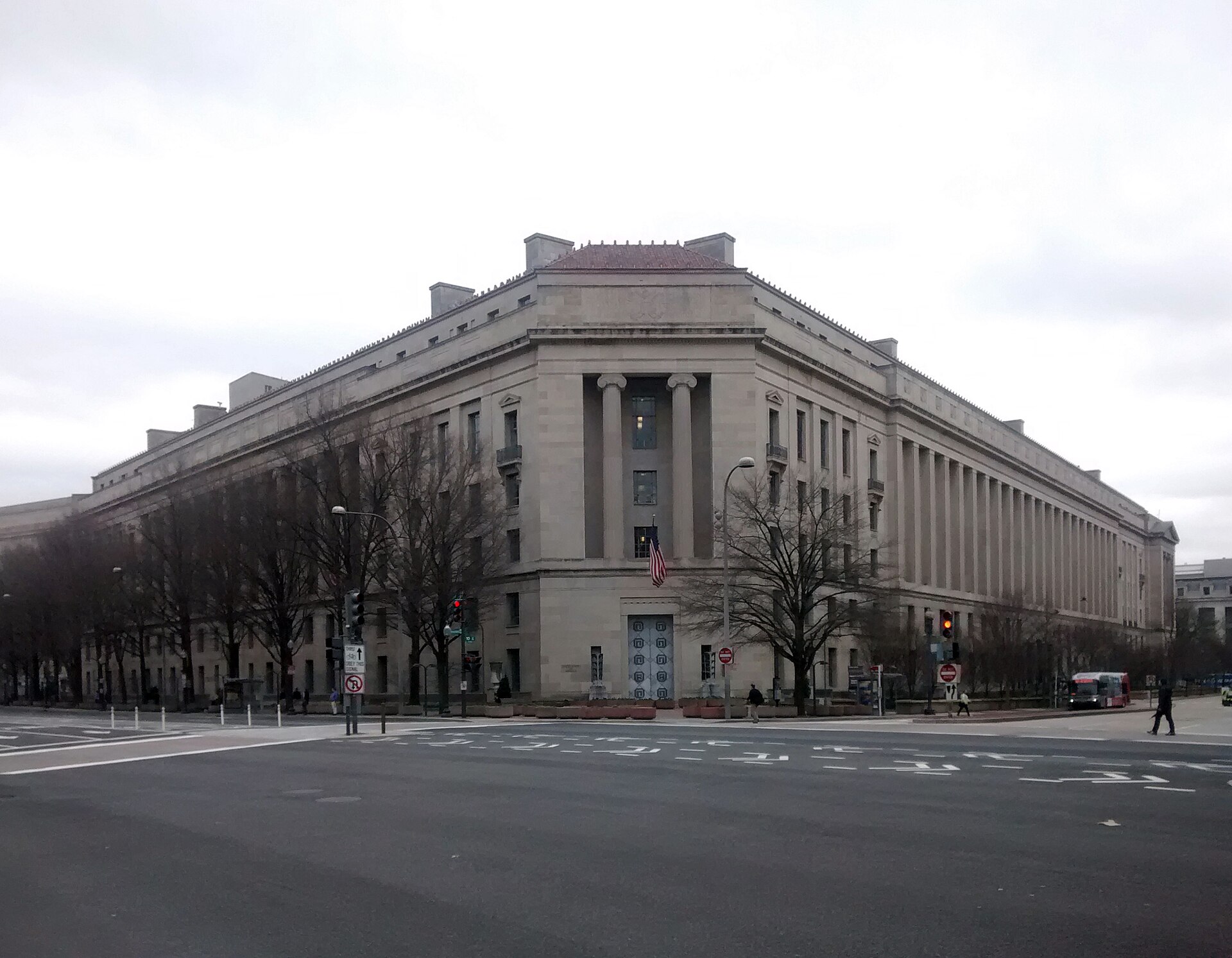
Featured image: The Robert F. Kennedy Department of Justice Building, Washington, D.C. Photo by Gunnar Klack via Wikimedia Commons, licensed under CC BY-SA 4.0.