

The Capitol is quiet this week, but the September calendar is anything but. With both chambers in recess and the Senate meeting only in brief pro forma sessions, the record Congress left behind in early August — two competing stopgap funding bills, a stalled trillion-dollar defense authorization, and a widening insider-trading probe — now defines the fights lawmakers will walk back into. Here is where the official record stands as of Wednesday, August 19.
1. Dueling stopgaps set up a September funding showdown
The single most consequential item awaiting Congress is the unresolved gap between two continuing resolutions. On August 8, the Senate voted 90-6 to pass a stopgap that would fund the government at fiscal 2026 levels through December 11, according to the National Association of Counties’ legislative analysis. The measure, negotiated by Senate Appropriations Chair Susan Collins (R-Maine) and Vice Chair Patty Murray (D-Wash.), was announced August 3 and cleared the chamber before senators left town, NBC News reported. Collins described the bill as free of poison pills, with what she called necessary adjustments for the SNAP and WIC nutrition programs, disaster relief, and national security accounts.
The House, however, passed a different vehicle before its own departure. H.R. 9770, the Continuing Appropriations Act, 2027, cleared the chamber July 21 on a 220-205 vote — Roll Call 272 — and would extend funding only through December 4. House Appropriations Chairman Tom Cole framed the early action as an effort to take “partisan politics and posturing off the table,” according to the committee’s release. Voting records show Rep. Thomas Massie (R-Ky.) was the lone Republican opposed, while six Democrats crossed over in support.
The two bills differ in more than end dates. The Senate version carries targeted line items and, notably, delays implementation of the Office of Management and Budget’s proposed overhaul of Uniform Guidance — the rulebook governing how federal grants are administered — until December 11, a provision the House’s clean CR does not contain, per the NACo analysis. Murray has said the Senate text also closes fund-transfer loopholes and blocks a White House budget office proposal on grant cancellations. The chambers must reconcile these differences before funding expires September 30. The stakes are familiar: records show 2026 has already seen two lapses, including the 76-day partial shutdown of the Department of Homeland Security that ended April 30 — the longest agency shutdown on record, as NPR reported.
2. Recess by the clock: pro forma sessions keep the Senate technically open
The Senate’s floor activity this week consists of sessions measured in seconds. Under the adjournment schedule published by the Senate Democratic Caucus, the chamber is holding eleven pro forma sessions between August 10 and September 10 — the most recent on Monday, August 17, at 1:30 p.m., and the next scheduled for Thursday, August 20, at 11:30 a.m. Congress.gov floor records show the August 13 session gaveled in at 8:01 a.m. and adjourned 28 seconds later.
The cadence is not accidental. Because the sessions recur every few days, neither chamber’s break reaches the ten-day threshold that the Supreme Court’s 2014 NLRB v. Noel Canning decision identified as the point at which a president’s recess-appointment power becomes available. It is a procedural practice both parties have employed against administrations of the opposite party since 2007; the current schedule keeps that window closed through the Senate’s return on September 14.
3. NDAA stalemate: a $1.15 trillion defense bill without a Senate path
The National Defense Authorization Act for Fiscal Year 2027 remains split across the Rotunda. The House passed its version, H.R. 8800, on July 22 by a narrow 216-212 margin, authorizing roughly $1.15 trillion for national security programs, Breaking Defense reported. The Senate Armed Services Committee advanced its counterpart on an 18-9 vote, per the committee’s June announcement, with Chairman Roger Wicker (R-Miss.) calling the bill “a seminal breakthrough for the American military” and Ranking Member Jack Reed (D-R.I.) crediting its oversight and accountability provisions.
Yet the Senate bill, S. 4784, has not reached a floor vote. Reporting indicates Senate Democrats have declined to provide the votes to proceed, citing objections tied to the Iran conflict and the bill’s spending trajectory. In the meantime, Breaking Defense reported in early August that committee leaders have opened informal pre-conference negotiations with House counterparts — an effort to narrow differences so a reconciled bill could move in the post-election session. The Congressional Research Service is tracking the bill’s progress in its FY2027 NDAA status report, and the Congressional Budget Office has published its cost estimate for H.R. 8800. Congress has enacted an NDAA for more than six consecutive decades; whether that streak survives an election-year floor standoff is now a live question for the fall.
4. Oversight doesn’t recess: the prediction-market probe widens
House Oversight and Government Reform Chairman James Comer’s investigation into alleged insider trading on prediction-market platforms remains among the most active accountability files in Congress. The probe, launched May 22, followed reporting that dozens of accounts placed suspiciously timed wagers hours before undisclosed U.S. and Israeli military operations, and a federal indictment unsealed in April alleging that an Army master sergeant used classified information to generate more than $409,000 in trading profits, CNBC reported. Those court allegations remain unproven, and the defendant is presumed innocent pending trial.
Comer’s letters to Kalshi CEO Tarek Mansour and Polymarket CEO Shayne Coplan sought records on identity verification, geographic restrictions, and suspicious-activity monitoring. The committee has said both platforms are cooperating, and Comer has stated publicly that subpoenas would follow only if document requests stall, according to a release from Rep. Chris Pappas (D-N.H.), who led seven House Democrats in pressing for compulsory process. The bipartisan interest is notable: separate NPR reporting in July found campaign staffers continuing to place election wagers despite platform prohibitions — suggesting the compliance questions at the heart of the probe extend well beyond a single indictment.
5. CBO: ten-month deficit hits $1.8 trillion as tariff refunds bite revenue
The Congressional Budget Office’s Monthly Budget Review released this month estimates the federal deficit reached $1.8 trillion through the first ten months of fiscal 2026 — $169 billion more than the same period last year. July alone produced an estimated $431 billion deficit, though CBO notes that timing shifts pushed August payments into July; adjusted for those shifts, the July figure would be roughly $333 billion.
The revenue side carries the more consequential signal for policymakers. CBO data show July receipts of $334 billion, down $5 billion year-over-year, driven by a sharp decline in net customs duty collections — largely reflecting tariff refunds that followed the Supreme Court’s February ruling on tariff authority. The Committee for a Responsible Federal Budget calculates the rolling twelve-month deficit at $1.9 trillion. Those figures will frame both the December funding negotiations and any lame-duck fiscal package.
6. Crypto market-structure bill tees up the first post-recess floor fight
Before adjourning, the Senate loaded its September calendar. During the August 8 session, cloture was filed on the motion to proceed to H.R. 3633, the Digital Asset Market Clarity Act — the crypto market-structure bill that passed the House 294-134 in July 2025 and was reported out of Senate Banking with a substitute amendment on June 1. Per the published schedule, that cloture motion ripens Tuesday, September 15, at 2:15 p.m., immediately after the chamber’s return.
The sequencing makes the CLARITY Act the first major legislative test of the fall. The Senate’s first roll call, on September 14 at approximately 5:30 p.m., will be a cloture vote on the nomination of Matthew R. Byrne to be U.S. District Judge for the Southern District of Ohio — a signal that judicial confirmations resume immediately alongside the legislative agenda.
7. Letters worth watching
Oversight correspondence continued into the recess from both sides of the aisle. Tracking by the law firm Brownstein Hyatt Farber Schreck’s Congressional Oversight & Investigation Tracker logs a late-July flurry: Sens. Tammy Duckworth and Dick Durbin (D-Ill.) challenged the FAA’s decision to extend Chicago O’Hare’s flight cap; House ranking members Jamie Raskin and Pramila Jayapal demanded ICE agents wear functional body cameras; Reps. Rick Larsen and Greg Stanton pressed the General Services Administration for answers on federal real-estate transactions involving foreign governments; and Sen. Michael Bennet led colleagues urging a crackdown on a Russian crypto sanctions-evasion network. On the majority side, the Oversight Committee’s document demands in its Sixteen Thirty Fund and ActBlue inquiries remain pending. Each of these is an inquiry, not a finding — but collectively they map where investigative energy will concentrate when members return.
The road back: what’s on the schedule
The next Senate pro forma session is Thursday, August 20, at 11:30 a.m., with sessions continuing through September 10. The Senate reconvenes in full on Monday, September 14, at 3 p.m.; the House returns in early September. From there, the calendar compresses quickly: the Byrne cloture vote September 14, the CLARITY Act cloture ripening September 15, and government funding expiring at midnight September 30 — with the House’s December 4 bill and the Senate’s December 11 bill still unreconciled. Committee schedules for the return weeks are posted on Congress.gov’s committee schedule page as they are noticed.
On TIJ’s radar
Several threads from this digest feed directly into The Investigative Journal’s accountability beats. We are watching the document production deadlines in the prediction-market probe and whether cooperation holds without subpoenas; the fate of the Senate CR’s delay of OMB’s Uniform Guidance overhaul, which determines how billions in federal grants are administered and canceled; the revenue drag from post-ruling tariff refunds, which CBO data suggest is materially reshaping the fiscal baseline; and the transparency of the informal NDAA pre-conference, where a trillion-dollar policy bill is being negotiated outside formal committee process. Records requests and follow-up reporting on each are underway.
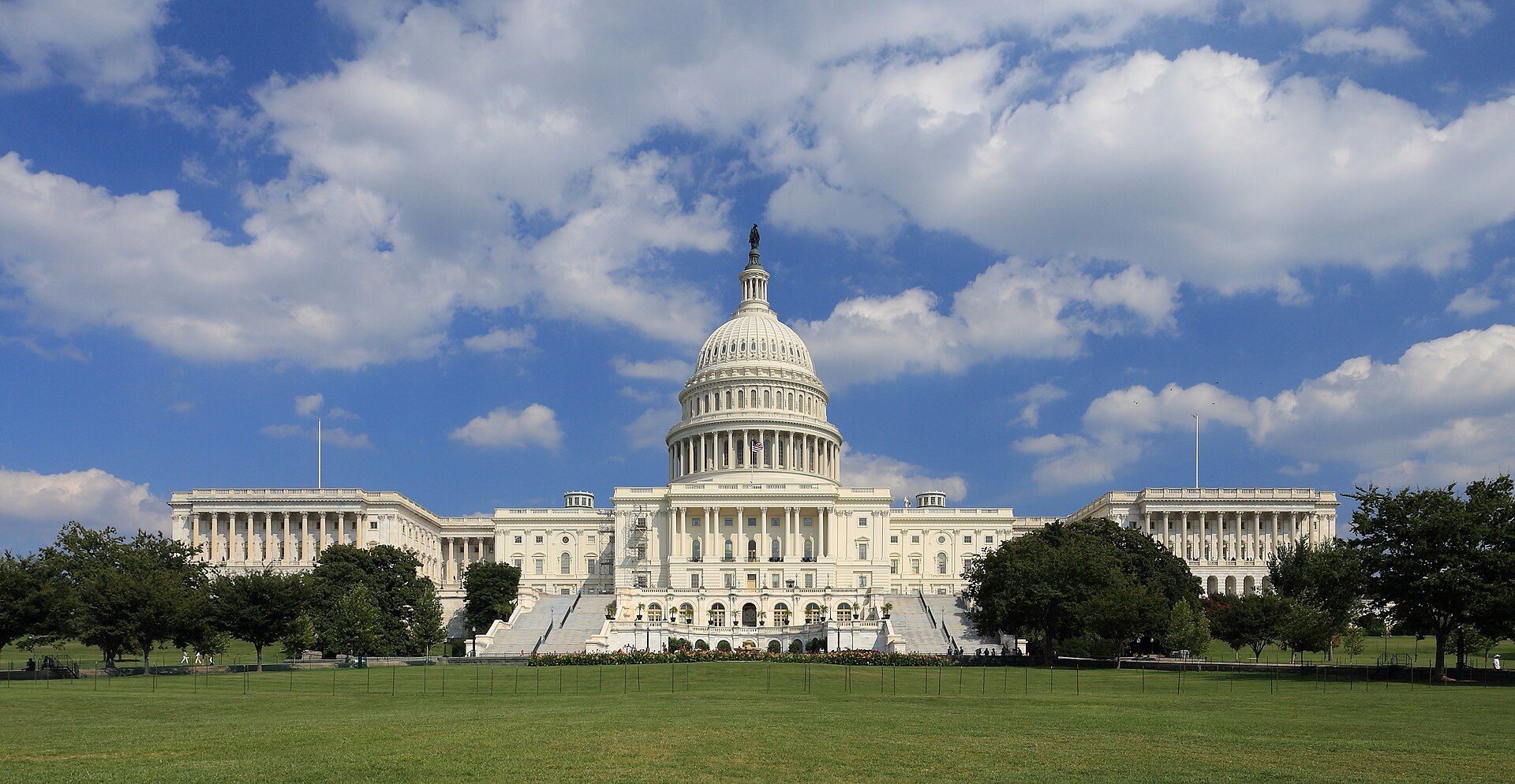
Featured image: The U.S. Capitol, west side. Photo by Martin Falbisoner via Wikimedia Commons, CC BY-SA 3.0.