

SEC Watch is The Investigative Journal’s daily review of notable filings, enforcement actions, and regulatory developments drawn directly from SEC EDGAR and the Commission’s public dockets. Every item below links to the underlying public record.
The Securities and Exchange Commission closed out the week with a burst of activity at the intersection of disclosure and deception: a 38-defendant sweep targeting allegedly fabricated adviser filings, a negligence-based fraud suit against a crowdfunded artificial-intelligence startup, the apparent wind-down of a long-running insider-trading case against a former congressman, and deregistration proceedings against two issuers that have not filed financial reports in nearly three years. On the corporate side, a newly public building-materials giant disclosed an abrupt CFO change, and a national stock exchange asked the SEC to bless a new class of prediction-market-style products. Here is what stood out in the filings.
1. SEC Charges 38 Entities Over Allegedly False Adviser Filings Used to Court Retail Investors
The Commission’s most significant action of the week landed Wednesday, August 27, when it charged 38 entities with making material misrepresentations in Forms ADV filed with the SEC between 2025 and 2026. According to the complaints, filed in the U.S. District Court for the District of Colorado, the defendants allegedly used the Commission’s own filing system to manufacture an appearance of legitimacy as exempt reporting advisers — listing Colorado business addresses where they had no presence, providing phone numbers that were disconnected or belonged to unrelated businesses, and claiming their purported private funds were audited by one of two accounting firms that, per the SEC, appear in no federal or state registry of accountancy firms.
The filings indicate the scheme was industrial in scale: the SEC alleges that many defendants disclosed ownership structures and numerical data identical or nearly identical to a multitude of other purported exempt reporting advisers, and that several connected to the SEC’s filing system from IP addresses tracked to foreign jurisdictions. Some defendants were allegedly marketed on websites displaying fake certificates of SEC registration. “When we find bad actors using fraudulent SEC filings to feign legitimacy with retail investors, we will act decisively to disrupt these operations,” said Laura D’Allaird, chief of the Enforcement Division’s Cyber and Emerging Technologies Unit, in the Commission’s release.
The complaints charge violations of Sections 204(a) and 207 of the Investment Advisers Act and seek permanent and conduct-based injunctions plus civil penalties. Notably, the SEC says it has removed the 38 entities’ filings from its website and credits assistance from the FBI’s Operation Level Up, which targets financial-grooming scams. A companion litigation release (LR-26622) and an investor alert on exempt-reporting-adviser filing scams accompanied the announcement. These are allegations; no court has yet ruled on them.
2. Crowdfunded AI Startup GenesisAI and Co-Founder Sued Over Revenue and Valuation Claims
In a complaint filed August 26 in the Southern District of Florida, the SEC alleges that GenesisAI Corp. and co-founder Archil Cheishvili raised more than $5.3 million from over 4,000 mostly retail investors between December 2019 and December 2024 while negligently misrepresenting the company’s revenue prospects, valuation, and customer demand. Per the complaint, early investor materials projected revenue reaching $250 million by 2024; the company’s actual revenue, records indicate, was roughly $8,000 in 2022, $9,000 in 2023, and $40,000 in 2024 — much of the latter from an email-blast tool rather than the company’s flagship AI marketplace.
The complaint also details a stated valuation that climbed from $7.5 million in 2019 to $204 million by mid-2022 despite the absence of meaningful revenue, and claims of “over 25 partnerships” that the SEC says were in fact non-binding memoranda of understanding. The offerings ran through Regulation Crowdfunding portals and a Regulation A offering, the filings show, and Cheishvili personally sold 12,000 shares for approximately $51,000 in profit in 2022. The company announced in January 2025 that it would cease developing its products, according to the complaint.
Two details merit attention. First, the SEC charged only negligence-based violations of Securities Act Section 17(a)(2) — not scienter-based fraud — a meaningful distinction in how the agency is treating AI-era startup salesmanship. Second, the SEC seeks a three-year officer-and-director bar against Cheishvili, alongside disgorgement and penalties. The litigation release (LR-26619) is on the SEC’s docket; the allegations remain unproven, and no court has entered findings against the defendants.
3. SEC and Former Rep. Stephen Buyer File Joint Stipulation to Dismiss Insider-Trading Case
Quietly noted on the Commission’s litigation docket August 26: a joint stipulation to dismiss and releases, docketed August 24 in the Southern District of New York, in SEC v. Stephen E. Buyer, et al. (Case No. 1:22-cv-06279). The SEC sued Buyer, a former U.S. congressman from Indiana, in July 2022, alleging he traded on nonpublic information obtained through his post-congressional consulting work; he was separately convicted in a parallel criminal case in 2023, according to court records from that period.
The accompanying litigation release (LR-26621) offers limited detail on the terms of the resolution, and the three-page stipulation itself does not spell out any monetary component. That silence is itself notable: how the SEC resolves civil claims that run parallel to completed criminal proceedings — and what consideration, if any, changed hands — is precisely the kind of question the docket does not answer on its own. TIJ has flagged this one for follow-up review of the underlying court file.
4. Two Issuers Dark Since 2023 Face Deregistration Proceedings
The Commission on August 26 instituted administrative proceedings under Exchange Act Section 12(j) — the provision that allows suspension or revocation of a company’s securities registration — against two delinquent filers. AmerInst Insurance Group, Ltd., a Bermuda holding company, has filed no periodic reports since its Form 10-Q for the period ended September 30, 2023, per the SEC’s order. Auto Parts 4Less Group, Inc. (symbol FLES), a Nevada corporation based in North Las Vegas whose shares receive unsolicited quotations on OTC Link, has filed nothing since its 10-Q for the period ended October 31, 2023, the order states.
Both orders allege the companies either ignored delinquency letters from the Division of Corporation Finance or failed to maintain valid addresses on file with the Commission — a baseline disclosure failure. Each respondent has ten days to answer, and the Commission will determine whether to suspend registration for up to twelve months or revoke it entirely. For shareholders, revocation is consequential: it typically extinguishes what remains of a public trading market.
The actions are routine in form but worth watching in aggregate. The SEC announced on August 5 that it had established a Financial Reporting and Accounting Unit within the Enforcement Division, and the cadence of disclosure-delinquency actions in the weeks since suggests reporting compliance remains squarely on the agency’s radar.
5. Amrize’s Same-Day CFO Handoff: Departure “For Personal Reasons,” Successor’s Pay Detailed
Amrize Ltd (NYSE: AMRZ), the North American building-materials company spun off from Holcim in June 2025, disclosed in an 8-K filed under Item 5.02 that CFO Baris Oran informed the company on August 24 he was stepping down for personal reasons, effective the same day. The filing states the departure is not related to any disagreement over the company’s financial controls, reporting, operations, policies, or practices — the standard but load-bearing sentence in any CFO-exit disclosure. Under his employment agreement, Oran’s 12-month notice period runs until August 24, 2027, during which he remains an employee.
The board simultaneously appointed Samuel J. Poletti, the company’s Chief Strategy and M&A Officer and a two-decade Holcim veteran, as CFO. The filing details his package: a $725,000 base salary, a target bonus of 100% of base (200% maximum), additional 2026-cycle performance stock units with an $860,000 grant-date fair value, plus a $100,000 annual housing allowance and $29,000 car allowance under a five-year U.S. assignment agreement running to August 2031. The filing also notes Poletti is not eligible for termination or change-of-control payments under either agreement.
An abrupt, same-day finance-chief transition at a company that has been public for barely fourteen months is the kind of governance event that warrants monitoring, even where — as the filing asserts here — no reporting disagreement is involved.
6. MEMX Asks SEC to Approve “Securities Event Contracts” — Prediction Markets Meet the Options Rulebook
Among the SRO filings published August 24 is a notice of a MEMX LLC proposal (SR-MEMX-2026-25), filed August 11, to adopt a new Chapter 30 of its rules permitting the listing and trading of “securities event contracts” on its options platform. As described in the filing, these are cash-settled, European-style binary options paying a fixed amount based on whether an objectively verifiable event tied to an issuer’s financial performance occurs — for example, whether reported earnings, revenues, or sales meet a specified threshold.
The exchange frames the proposal as a response to the rapid growth of prediction markets on CFTC-regulated venues, arguing that bringing event contracts into the listed-options infrastructure would add exchange surveillance, standardized disclosure, and centralized clearing. The disclosure-integrity questions are obvious and worth public comment: binary contracts keyed directly to earnings figures concentrate the value of material nonpublic information in ways traditional options do not. The SEC is soliciting comments on the proposal; a parallel filing by MEMX for event-contract listing standards appears on the same day’s docket.
On the Radar: Filings That May Warrant Deeper Review
Several additional items from the week’s dockets merit continued attention. The terms behind the Buyer dismissal, noted above, top the list. In the administrative docket, the Commission issued an August 24 order involving The Vanguard Group in File No. 3-22435, a matter in which a proposed plan of distribution to harmed investors was noticed earlier this summer. A proposed distribution plan for Tai Mo Shan Limited (File No. 3-22382), noticed August 20, has a comment window closing in mid-September. And the Commission’s August 19 opinions in the Shineco, Lek Securities, and Evan H. Katz matters offer a window into how the current Commission is deciding contested adjudications.
Finally, the 38-entity false-filing sweep raises a data question TIJ intends to pursue: the SEC’s complaints describe near-identical ownership structures and numbers replicated across dozens of Forms ADV. Cross-referencing the adviser database for filings that share those fingerprints — but were not named Wednesday — is a natural next step for accountability reporting.
Sources and methods: This digest is based on documents published by the U.S. Securities and Exchange Commission at SEC.gov and filings retrieved from the EDGAR system, each linked above. Allegations in SEC complaints and orders instituting proceedings are unproven unless a court or the Commission has entered findings. Cases described as pending remain pending. Named parties who wish to respond to any item may contact The Investigative Journal, and substantive responses will be published.
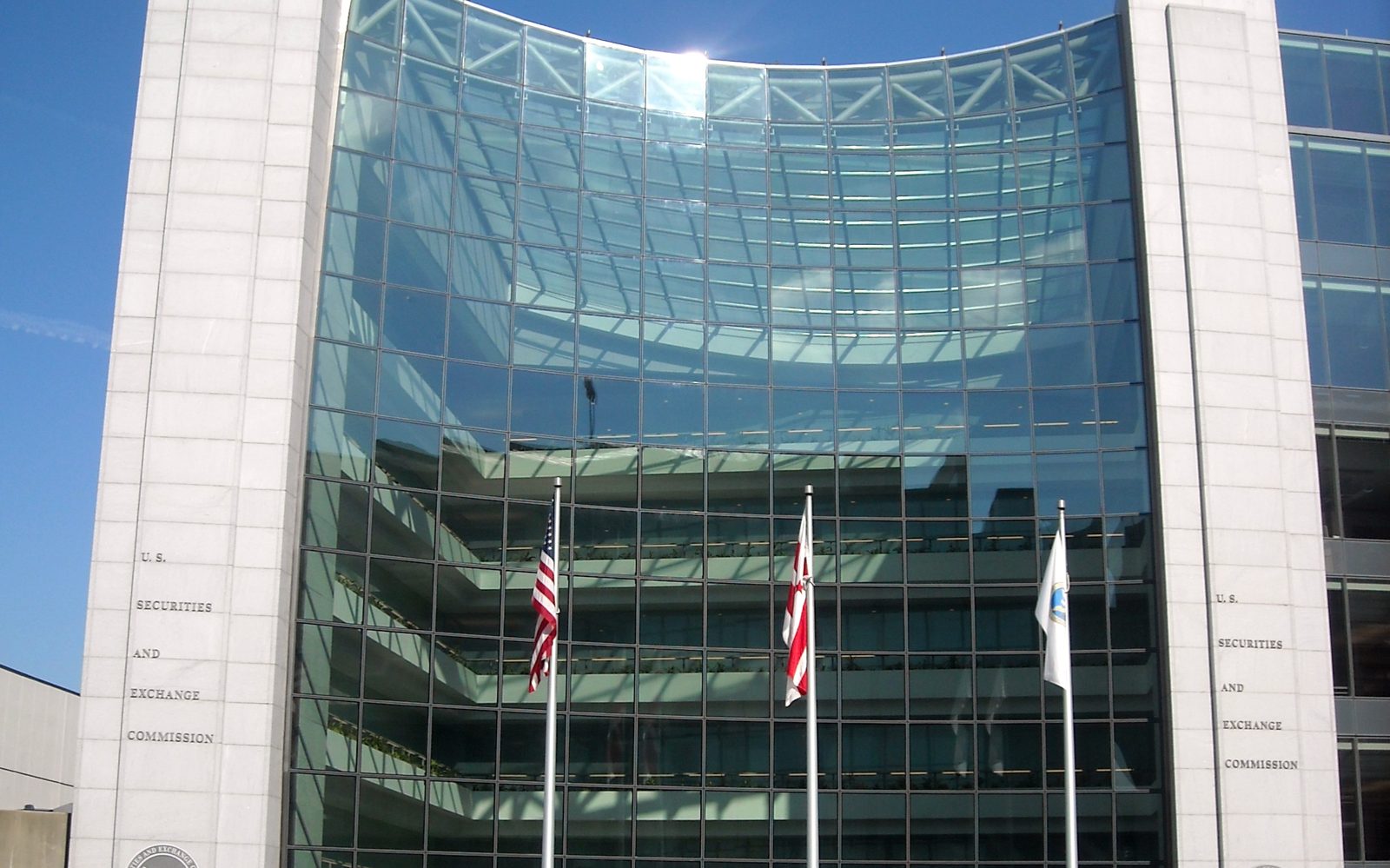
Featured image: U.S. Securities and Exchange Commission headquarters, Washington, D.C. Photo by AgnosticPreachersKid via Wikimedia Commons, licensed under CC BY-SA 3.0.
