

The last full week of August produced an unusually dense stretch of corporate paperwork: a C-suite restructuring at one of America’s largest department store chains, a $485 million energy divestiture, the Securities and Exchange Commission’s formal exit from a decades-old referee role in shareholder democracy, and more than $750 million in insider stock sales disclosed across three technology companies. Below, The Investigative Journal reviews seven disclosures from the past week’s filings that reward a closer read — with direct links to the underlying documents on SEC EDGAR.
Kohl’s Eliminates Its Chief Marketing Officer Role in C-Suite Realignment
Kohl’s Corporation disclosed in an 8-K filed August 25 that it has eliminated the position of Chief Marketing Officer outright. Christie Raymond, who held the role, will leave the company effective September 9, 2026. The filing states she is entitled to separation benefits under an Amended and Restated Executive Compensation Agreement dated August 16, 2022 — the dollar value of which is not disclosed in the 8-K and should surface in the company’s next proxy statement.
In Raymond’s place, the retailer created a new Senior Executive Vice President, Chief Customer Officer role and promoted Arianne Parisi — Chief Digital Officer since July 2025 and previously Global Chief Digital Officer at JD Sports Fashion — into it, effective September 1. According to the filing, Parisi will consolidate marketing, brand and creative, loyalty, personalization, media, and digital commerce (including Kohls.com and the Kohl’s app) under a single executive reporting directly to CEO Michael J. Bender. Trade press coverage notes Raymond spent nine years at the company.
The significance is structural: collapsing marketing and digital into one customer organization removes an entire C-suite seat at a retailer that has cycled through repeated leadership changes since 2022, including a CEO transition announced in 2025. Filings indicate the reorganization is the first major organizational move of the Bender era, and the terms of Raymond’s 2022-vintage separation agreement will be worth checking when compensation tables are next published.
Par Pacific Exits Laramie Energy in a $485 Million Asset Sale
Par Pacific Holdings disclosed in an 8-K filed August 25 that Laramie Energy, LLC — in which Par holds a 46% non-controlling interest — signed a definitive agreement to sell substantially all of its oil and gas assets to an unnamed third-party purchaser for $485 million in cash, with $60 million of that deferred to the fifth anniversary of closing and up to an additional $65 million available in price-contingent earn-out payments.
Per the filing, Par expects to receive approximately $146 million of the consideration net of Laramie’s debt repayment and closing adjustments (including roughly $27.5 million deferred five years), plus eligibility for up to about $30 million of the earn-outs, and will fully exit its Laramie investment. The transaction is expected to close by the end of 2026, subject to regulatory approvals. The disclosure marks the end of a long-running minority position that sat awkwardly beside Par’s core refining, logistics, and retail operations — a pattern consistent with the broader industry trend of refiners shedding non-core upstream exposure. Notably, the 8-K does not identify the buyer, an omission that will resolve only in later filings or closing announcements.
The SEC Permanently Exits the Shareholder-Proposal Referee Business
The SEC’s Division of Corporation Finance announced on August 14 that it will permanently stop responding to no-action requests under Rule 14a-8, the rule governing when companies may exclude shareholder proposals from their proxy ballots — a decision that drew continued analysis through this week, including a Ballotpedia summary published August 24. The move makes permanent a pause first announced November 17, 2025, and extends it to Rule 14a-8(i)(1) requests, a narrow category the staff had continued to review. Companies must still notify the Commission under Rule 14a-8(j) at least 80 calendar days before filing definitive proxy materials, as law firm analyses note.
The practical consequences are already visible in proxy data. According to Gibson Dunn’s season review, shareholder proposal submissions fell from 951 in 2025 to roughly 789 in 2026, and by early July approximately 135 companies had excluded about 165 proposals without staff concurrence — roughly half of them governance-related. Whether companies exclude more aggressively without a staff backstop, and whether proponents respond with litigation, is now the central question for the 2027 season. A pending lawsuit filed in March by the Interfaith Center on Corporate Responsibility and As You Sow challenges the underlying policy change on Administrative Procedure Act grounds; the case remains unresolved, and the allegations in it are just that — allegations.
Berkshire’s Q2 13F: A $15.5 Billion Alphabet Position and the End of a Selling Streak
Berkshire Hathaway’s 13F-HR for the second quarter, filed August 14, reported 29 positions worth $299.3 billion — and confirmed that Alphabet has vaulted into the conglomerate’s top four holdings alongside Apple, American Express, and Coca-Cola. Press analyses of the filing estimate Berkshire added roughly 24.5 million Class A shares (about $7.9 billion) and 23.6 million Class C shares (about $7.6 billion), a more than sevenfold increase in the Class C stake, and that the firm was a net buyer of equities — by one estimate roughly $19.8 billion net — for the first time in 14 quarters.
The other side of the ledger: reports on the filing indicate Berkshire sold approximately 30.2 million Bank of America shares for an estimated $1.6 billion, continuing a multi-year reduction, alongside trims in DaVita, Kroger, Ally, and Capital One. For a portfolio whose top five names represent roughly 72% of reported value, the Alphabet build is the clearest signal yet of how capital allocation is shifting in the first year of Greg Abel’s tenure as chief executive. The 13F, as always, shows only U.S.-listed equity positions as of quarter-end — not the timing or reasoning behind them.
Arista’s CEO Discloses More Than $270 Million in August Stock Sales
Form 4 filings show Arista Networks CEO and Chairperson Jayshree Ullal sold 763,029 shares on August 5 — approximately $154.3 million, according to Investing.com’s tally of the August 5 filing — followed by a second Form 4 reporting the sale of a further 573,509 shares on August 12 at weighted-average prices between $207.00 and $211.37, worth approximately $119 million based on the share counts and prices reported in the filing. The filings state the transactions were made under Rule 10b5-1 trading plans adopted November 14, 2025, with substantial portions sold from a family trust and from trusts benefiting her children, a nephew, and a niece, for which she serves as trustee or co-trustee while disclaiming beneficial ownership.
Sales under pre-arranged 10b5-1 plans carry an affirmative defense against insider-trading claims precisely because the schedule is fixed in advance, and founder-scale holders routinely diversify this way. Still, the scale is worth registering: a quarter-billion dollars of stock in one week is more than fifteen times the $16.9 million median annual pay package for an S&P 500 CEO, per Harvard Law School Forum data. Records suggest no violation of any kind — but concentrated executive selling at all-time-high AI-infrastructure valuations is a data point investors watch, and the filings exist so they can.
CoreWeave: Nearly $480 Million in Magnetar Sales — and a Same-Day Corrected Filing
Form 4 filings by Magnetar Financial LLC and affiliated entities, which report as 10% owners of AI-cloud provider CoreWeave, disclosed three consecutive days of selling: approximately $231.6 million on August 12, $213.8 million on August 13, and a further roughly $33.4 million on August 14, per Investing.com tallies of the filings — nearly $480 million combined. The August 14 report required same-day correction: an amended Form 4 (Form 4/A), covering 307,131 shares sold at weighted-average prices between $108.00 and $108.72, states in its remarks that the original filing “incorrectly stated the numbers of shares in Columns 4 and 5 in Table 1 with respect to certain Magnetar Funds,” while noting the amendment “does not change the aggregate number of shares sold.”
Two things can be true: the correction appears technical, and corrections of this kind matter. Section 16 filings are the market’s real-time window into what the largest insiders are doing; when a filer managing dispositions across multiple funds misstates share columns — even without changing the aggregate — it underscores how mechanically complex, and how error-prone, large multi-entity distributions can be. Magnetar’s continuing sell-down of one of the highest-profile AI infrastructure names of the past two years remains a filing stream worth monitoring week to week.
Upstart’s Executive Ranks Keep Selling
At lending platform Upstart Holdings, Form 4 filings summarized by TipRanks show President Sanjay Datta sold 18,945 shares for approximately $565,865 and Chief Legal Officer Scott Darling sold 7,696 shares for approximately $216,180 in transactions dated August 20–21. Darling’s Form 4, filed August 21, is on EDGAR; a companion Form 144 notice indicates a further planned sale of 8,945 shares valued at about $251,298. The dollar amounts are modest by the standards of the Arista and CoreWeave items above, but filings indicate the selling spans multiple members of the executive team — a breadth pattern, rather than a size pattern, that compensation-plan vesting schedules may explain and that the filings themselves do not.
What Warrants a Deeper Look
Four threads from this week’s filings merit continued TIJ attention. First, the dollar value of Christie Raymond’s separation package at Kohl’s, which the 8-K references but does not quantify; the 2022 agreement’s terms should become visible in future compensation disclosures. Second, the identity of Laramie Energy’s buyer, which Par Pacific’s 8-K conspicuously does not name. Third, the first full proxy season in which companies will exclude shareholder proposals with no staff no-action backstop at all — the exclusion statistics for 2027 will tell us whether the 2026 numbers were a floor or a ceiling. And fourth, the cadence of Magnetar’s CoreWeave distributions, where the filing mechanics themselves have now required amendment.
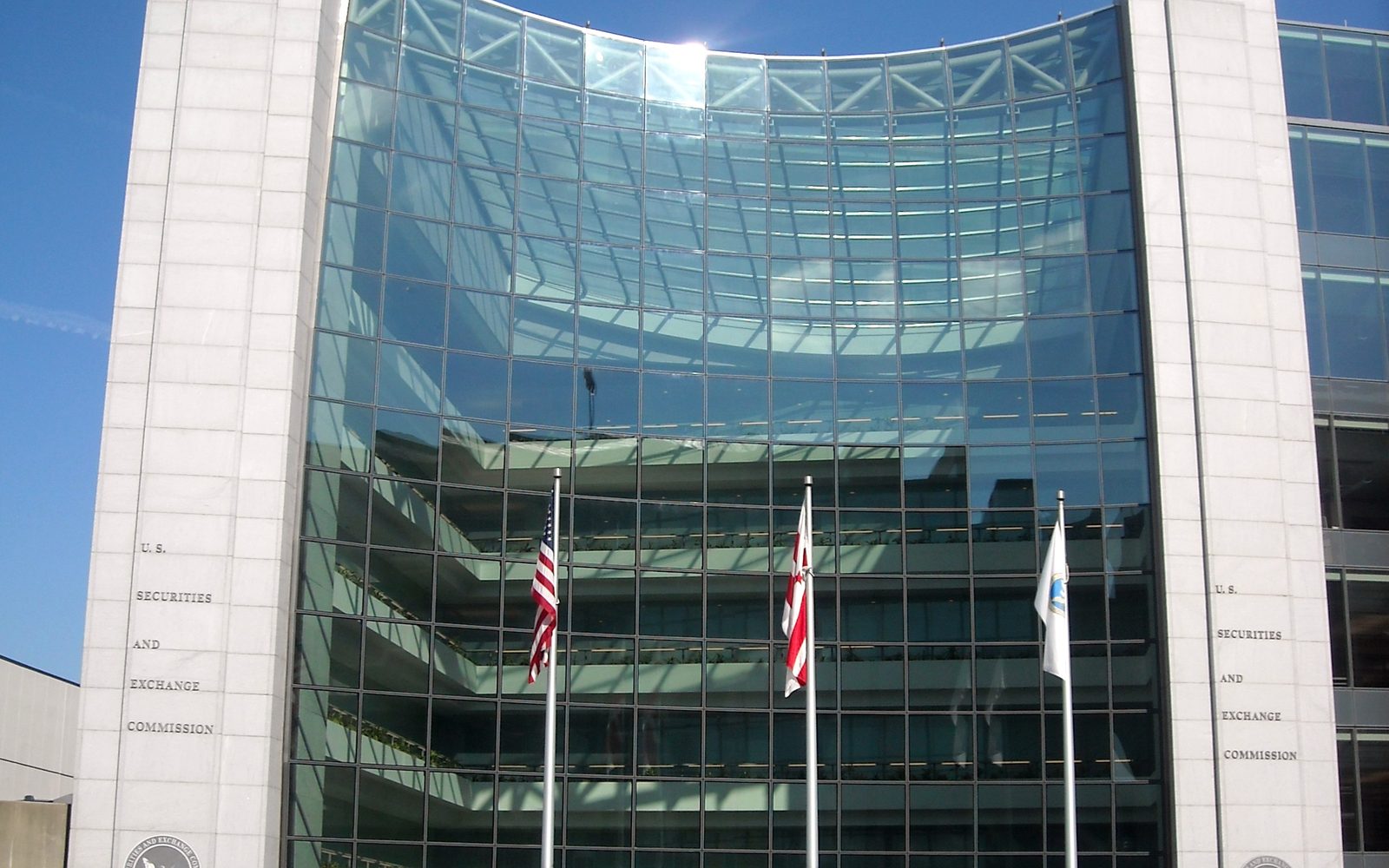
Methodology and disclosure: This roundup is based entirely on public filings with the U.S. Securities and Exchange Commission and the cited press reports. Dollar figures attributed to press tallies are estimates derived from the underlying filings. No company or individual named in this article was contacted for comment prior to publication, and nothing here should be read as an allegation of wrongdoing; insider transactions described above were disclosed in compliance with Section 16 reporting requirements, and pending litigation is noted as unresolved. Readers can verify every claim through the linked EDGAR documents. Featured image: U.S. Securities and Exchange Commission headquarters, Washington, D.C. — photo by AgnosticPreachersKid via Wikimedia Commons, CC BY-SA 3.0.
