

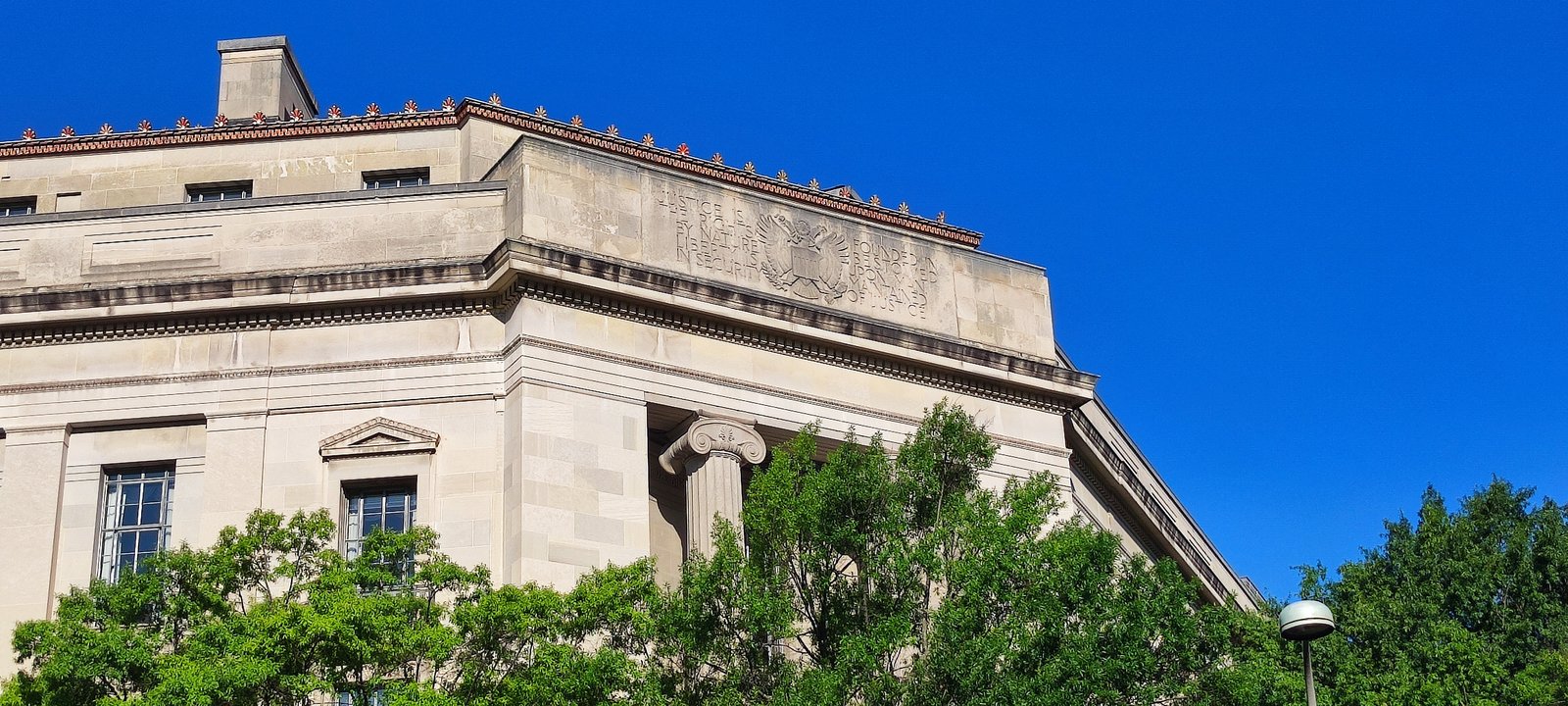
The Justice Department closed out the final full week of August with enforcement activity spanning nearly every corner of its docket: an espionage guilty plea from a former Defense Intelligence Agency employee, the seizure of hacking infrastructure that court filings tie to Chinese state-sponsored actors, a record antitrust penalty against one of the world’s largest investment firms, and a half-billion-dollar Medicare Advantage settlement in Florida. This edition of DOJ Watch covers the enforcement actions announced August 26–27, what the public records show, why each case matters, and the threads The Investigative Journal sees as worth pulling.
Former DIA insider-threat employee admits passing classified material in FBI sting
Nathan Vilas Laatsch, 29, of Alexandria, Virginia, a former IT specialist assigned to the Defense Intelligence Agency’s Insider Threat Division, pleaded guilty on August 26 to transmission of national defense information, the Justice Department announced Thursday. According to court documents summarized in the department’s release, Laatsch joined DIA as a civilian employee in 2019 and held a Top Secret clearance. In March 2025, the FBI learned he had offered classified information to what he believed was a friendly foreign government; the person he began corresponding with was in fact an undercover FBI agent.
Filings indicate that over roughly three days in late April 2025, Laatsch transcribed classified information onto a notepad at his classified workstation, carried it out of the building, and deposited a thumb drive at a public park in northern Virginia. The drive, retrieved by the FBI, contained typed documents with information up to the Secret and Top Secret levels, along with a message in which Laatsch said he had included “a decent sample size” to “demonstrate the range of types of products” he could access. Notably, records suggest money was not his primary aim: Laatsch told his handler he was interested in “citizenship” in the foreign country, saying he did not need “material compensation.” He was arrested on May 29, 2025, after a second handoff of classified documents. The department has not publicly identified the country involved.
The case, No. 1:25-cr-156 in the Eastern District of Virginia (court records are available via PACER), carries a maximum penalty of life in prison; sentencing is set for January 27, 2027. The significance is hard to overstate: an employee of the very division built to catch insider threats admitted to becoming one. “If you unlawfully disclose national defense information, we will find you and hold you accountable to the fullest extent the law allows,” Attorney General Todd Blanche said in the release.
DOJ and FBI seize hacking platforms filings tie to Chinese state-sponsored actors
The department and the FBI on August 26 announced court-authorized domain seizures that disabled two complementary hacking platforms, “QScan” and “QTRouter.” Court documents unsealed in the Southern District of California allege the platforms were created and operated by a People’s Republic of China state-sponsored group known as “QTFY,” employed by the Nanjing Xinjiuwei Network Technology Company, with paying customers that included China’s Ministry of State Security and the People’s Liberation Army. The seizure affidavit describes victims including NASA, the Federal Reserve, the Departments of Energy, Justice, and Health and Human Services, the National Institutes of Health, and the U.S. Senate.
According to the filings, QScan automatically scanned and infected thousands of internet-of-things devices worldwide, feeding them into QTRouter, an “obfuscation network” that made malicious traffic appear to originate from computers outside China, sometimes local to the targeted networks. Because the seized domains were hard-coded into both tools for communication and authentication, the department says the seizures rendered the platforms inoperable. The FBI and the National Security Agency simultaneously published a cybersecurity advisory with indicators of compromise reflecting QTFY activity dating to at least 2018.
This is at least the fourth technical disruption of PRC-linked hacking infrastructure in as many years, following operations against Volt Typhoon (2023), Flax Typhoon (2024), and the PlugX malware cleanup (2025). The pattern indicates a sustained strategy of dismantling adversary infrastructure through court process rather than waiting for prosecutions that may never reach a U.S. courtroom.
The Villages Health System agrees to $541.5 million False Claims Act settlement
The Villages Health System LLC, a provider group headquartered in Florida’s sprawling retirement community, has agreed to a $541.5 million settlement resolving self-disclosed allegations that it submitted false diagnosis codes to inflate Medicare Advantage payments, the department announced August 26. According to the release, from 2020 through 2024 the group submitted diagnosis codes that lacked adequate support in patient medical records, or that rested on record amendments that were untimely or not approved by the treating provider, inflating the risk-adjustment payments the Centers for Medicare & Medicaid Services made to three Medicare Advantage organizations: Humana, UnitedHealthcare entities, and GuideWell’s Florida Blue plans. The settlement agreement notes the insurers are returning the overpayments.
The case is unusual in how it surfaced: filings indicate the provider disclosed the conduct itself on December 27, 2024, through the HHS Office of Inspector General’s self-disclosure protocol, and the government credited its cooperation and remediation. The company filed for Chapter 11 protection in July 2025 (In re Villages Health System, LLC, Case No. 6:25-bk-04156-LVV, Bankr. M.D. Fla.), and the bankruptcy court approved the settlement on August 25. As the department notes, the claims resolved are allegations only, and there has been no determination of liability.
The settlement ranks among the largest Medicare Advantage risk-adjustment recoveries on record and lands amid the administration’s broader push against federal program fraud through the Task Force to Eliminate Fraud and the new National Fraud Enforcement Division. For a provider group serving one of the country’s largest retirement communities, the practical question, one TIJ intends to examine, is how much of the $541.5 million the government actually recovers through a bankruptcy estate.
KKR agrees to record $250 million penalty over premerger filing violations
The Antitrust Division on August 26 filed a proposed settlement requiring KKR & Co. GP LLC to pay a $250 million civil penalty, which the department calls the largest ever under the Hart-Scott-Rodino Act and more than 20 times any prior HSR penalty it has obtained. The government’s complaint alleged that in 2021–2022 the private equity giant evaded premerger antitrust review across at least 16 transactions: altering documents in HSR filings for at least eight, making no filing at all for at least two, and systematically omitting required documents in at least 10.
The HSR Act requires parties to larger deals to notify the DOJ and Federal Trade Commission before closing so the agencies can screen for competitive harm; penalties run to more than $50,000 per day, per violation. KKR, which the release describes as managing over $744 billion in assets and having been required to make more than 100 HSR filings since 2021, is a sophisticated repeat player, which is precisely why the department characterized the conduct as “serial.” “Companies that disregard their legal obligations will face serious consequences,” Associate Attorney General Stanley E. Woodward Jr. said. The proposed final judgment remains subject to court approval, and the complaint’s claims are allegations. In a securities filing reported in press coverage of the settlement, KKR said it disputes the department’s characterization of its conduct and that the penalty will be reimbursed by outside law firms, with no financial impact on the firm, its funds, or its investors. The open question worth watching is whether document-alteration allegations of this kind draw further scrutiny beyond a civil resolution.
81 charged in Homeland Security Task Force takedown of Puerto Rico gang
Attorney General Blanche traveled to Puerto Rico on August 27 to announce federal charges against 81 alleged members of “Los Baja Deo” (LBD), a drug-trafficking organization prosecutors say operated across western Puerto Rico. The FBI and the Puerto Rico Police Department led a takedown on August 26 that arrested 70 defendants, supported by 13 SWAT teams. The indictment alleges that since 2021 the organization distributed heroin, fentanyl, crack, cocaine, and marijuana in and around nearly two dozen public housing projects and neighborhoods in the Mayagüez area, and, according to the FBI, shipped controlled substances to the continental United States through the U.S. Postal Service.
Prosecutors estimate the organization moved at least 340 kilograms of fentanyl or fentanyl-laced narcotics and at least 2,200 kilograms of cocaine, generating more than $49 million in proceeds; the indictment carries a forfeiture allegation of $49.7 million, and agents seized 21 firearms during the investigation. Drug-count convictions would carry 10-year mandatory minimums up to life. As the department’s release states, an indictment is merely an allegation, and all defendants are presumed innocent until proven guilty.
Sinaloa-linked fentanyl manufacturer pleads guilty in Washington
Hernan Geovani Ojeda Elenes, 48, of Culiacán, Mexico, pleaded guilty August 27 to conspiring to manufacture and distribute fentanyl for importation into the United States and to distributing listed chemicals. According to court documents, from at least 2019 to 2024 Ojeda Elenes ran a Sinaloa-based trafficking operation with his father and co-defendant, purchasing precursor chemicals such as 4-Piperidone from Chinese companies, synthesizing fentanyl in a Mexican lab, and importing it into the United States. By his own admission, he was responsible for several metric tons of the drug; the DEA says the manufacturing was done on behalf of the Sinaloa Cartel.
The case also illustrates a quiet but consequential channel of U.S.-Mexico cooperation: Ojeda Elenes was transferred to the United States in January 2026 under Mexico’s National Security Law, the same mechanism used in other recent cartel cases. He faces a 10-year mandatory minimum and up to life in prison; no sentencing date has been set.
CJNG material-support pleas show terrorism statutes reaching cartel logistics
Two Mexican nationals pleaded guilty August 27 in the Western District of Texas in a case flowing from the designation of Cartel de Jalisco Nueva Generacion (CJNG) as a foreign terrorist organization. Maria Del Rosario Navarro-Sanchez, 40, admitted to conspiring to provide material support to CJNG by trafficking firearms to Mexico, along with methamphetamine, firearms-trafficking, and alien-smuggling counts; Gustavo Castro-Medina, 29, pleaded guilty to methamphetamine and firearms-trafficking counts. Court documents describe an August 2023 deal to buy 20 AK-47-style rifles and two .50-caliber rifles from undercover agents for $66,000, weapons intended for smuggling into Mexico in support of CJNG trafficking operations, and a 2020 traffic stop that yielded 36.36 kilograms of methamphetamine hidden beneath a trap door in a sedan.
The pleas grew out of an April 2025 indictment the department has held up as an early test of applying material-support charges to cartel-linked conduct after the FTO designations. Both defendants, transferred to the United States by Mexico’s government, face 10-year minimums up to life. “One of many to come,” U.S. Attorney Justin R. Simmons said of the material-support conviction, a signal that terrorism statutes are now a standing feature of border-related prosecutions.
On TIJ’s radar
Elsewhere on the docket this week: skin-cancer testing company DermTech Inc. agreed to pay up to $5 million to resolve allegations it billed Medicare for unreliable tests; the department announced a finding that George Washington University’s medical school discriminates based on race in admissions; and DOJ filed complaints against Arizona, New Mexico, Oregon, and Washington challenging in-state tuition laws for illegal aliens.
Four threads warrant deeper TIJ investigation. First, the Laatsch case leaves the central counterintelligence question unanswered: which “friendly foreign government” he believed he was serving, and how DIA’s own Insider Threat Division failed to flag one of its own for two months of documented exfiltration. Second, The Villages settlement invites scrutiny of who inside the provider group directed the medical-record amendments at issue, whether any individuals face exposure, and how much of the headline $541.5 million survives the bankruptcy process. Third, the KKR complaint’s allegation that documents were altered in at least eight filings raises the question of which transactions escaped review and what, if anything, follows the civil penalty. Fourth, Nanjing Xinjiuwei, the company court filings identify as QTFY’s employer, merits a corporate-structure investigation of the kind TIJ has applied to other PRC-linked contractors.
Editor’s note: Indictments and complaints contain allegations only; all defendants are presumed innocent unless and until proven guilty, and civil settlements referenced above resolve allegations without a determination of liability except where admissions are noted. This digest is drawn from public records and official releases linked throughout. TIJ did not receive comment from counsel for the individuals and companies named prior to publication, and their positions may not be fully reflected; responses will be added if received.
Sources
- DOJ: Former U.S. Government Employee Pleads Guilty to Attempting to Provide Classified Information to Foreign Government
- DOJ: Justice Department and FBI Seize Platforms Operated and Used by China State-Sponsored Hackers | Seizure affidavit | FBI/NSA advisory
- DOJ: The Villages Health System LLC Agrees to $541.5M Settlement | Settlement agreement
- DOJ: KKR Agrees to Pay Record $250M Penalty | Proposed final judgment
- DOJ: 81 Members of a Violent Gang in Puerto Rico Charged
- DOJ: Mexican Fentanyl Manufacturer Pleads Guilty
- DOJ: Two Mexican Nationals Plead Guilty to Alien Smuggling and Providing Material Support to CJNG
- Federal court records: PACER (U.S. v. Laatsch, No. 1:25-cr-156, E.D. Va.; In re Villages Health System, No. 6:25-bk-04156-LVV, Bankr. M.D. Fla.)