

The Investigative Journal’s daily review of notable filings posted to the Securities and Exchange Commission’s EDGAR system, plus new enforcement activity. All items below are drawn from public records linked in the text.
Roughly 3,600 filings hit EDGAR on Wednesday, September 9, according to the SEC’s daily form index — among them 198 current reports on Form 8-K, 27 quarterly reports, five annual reports, and 64 Schedule 13D/13G beneficial-ownership filings. Most were routine. A handful were not. The day’s disclosures include an all-stock merger of two apartment REITs, a definitive proxy asking Atkore shareholders to approve a $95-per-share sale to Italy’s Prysmian, a $1.8 billion Permian acquisition funded largely by securitization, and a founder-CEO’s Schedule 13D that explicitly reserves the right to discuss taking his company in new directions. On the enforcement side, a federal court entered final judgment against a man who allegedly traded on client secrets he obtained while working for an EDGAR filing agent — a case with particular resonance for readers of this column.
1. Independence Realty Trust and Centerspace agree to all-stock merger
Philadelphia-based Independence Realty Trust (NYSE: IRT) and Minot, North Dakota-based Centerspace (NYSE: CSR) each filed 8-Ks disclosing an Agreement and Plan of Merger dated September 8. According to IRT’s filing, each Centerspace common share will convert into the right to receive 3.800 shares of IRT common stock, with cash paid in lieu of fractional shares. The exchange ratio is fixed: the filing states it “will not change as a result of any change in the market price of IRT Common Stock” before closing.
The structure is a two-step company and partnership merger, with Centerspace surviving as a subsidiary. Pending closing, Centerspace’s quarterly dividend is capped at $0.77 per share without IRT’s consent, per the agreement. Centerspace’s parallel 8-K confirms the terms. The companies must still file a Form S-4 registration statement and joint proxy statement, which will contain the “background of the merger” narrative — typically the most revealing section of any deal proxy. A fixed exchange ratio means Centerspace holders bear IRT share-price risk between signing and closing, a point proxy advisers and any objecting shareholders are likely to examine.
2. Atkore’s definitive proxy: a $95.00-per-share cash exit to Prysmian
Electrical-infrastructure manufacturer Atkore Inc. (NYSE: ATKR) filed its definitive merger proxy statement (DEFM14A) for the previously announced acquisition by Prysmian S.p.A., the Milan-based cable group. The proxy states shareholders will receive $95.00 in cash per share, without interest, under a merger agreement dated August 2, 2026. A virtual special meeting is set for October 7, 2026.
The document annexes fairness opinions from Citigroup Global Markets and J.P. Morgan Securities, and includes appraisal-rights disclosures for dissenting holders. The filing indicates Prysmian Cables and Systems USA, LLC serves as guarantor for certain obligations. For those tracking foreign acquisitions of American industrial suppliers, the proxy’s background-of-the-merger and regulatory-approvals sections merit a careful read; the special-meeting timeline now puts a shareholder verdict less than a month away. Atkore’s investor relations page carries the related materials.
3. Diversified Energy discloses $1.8 billion Birch Permian deal, funded by securitization
Birmingham, Alabama-based Diversified Energy Company (NYSE: DEC) filed an 8-K disclosing definitive agreements, dated September 2, to acquire Birch Permian Holdings, Inc. and affiliated entities through three linked transactions. The filing states the deal covers approximately 46,000 net mineral acres in the Midland Basin, including 500 gross (480 net) operated wells, plus integrated midstream and water infrastructure.
The aggregate purchase price is approximately $1.8 billion, inclusive of debt repayment and subject to adjustments. Notably, the company says it expects to fund the deal with “an asset-backed securitization of approximately $1.5 billion in advance of closing,” alongside customary financing sources. Securitization-heavy funding of upstream acquisitions is a structure that shifts risk in ways conventional reserve-based lending does not, and the eventual notes documentation will reward scrutiny. Details are also posted to the company’s investor relations site.
4. Procore closes $845 million DroneDeploy acquisition
Construction-software maker Procore Technologies (NYSE: PCOR) disclosed in an 8-K that it consummated its acquisition of DroneDeploy, Inc. on September 9. The purchase price was approximately $845.0 million in cash, subject to working-capital and other adjustments, under a merger agreement dated July 27, 2026.
The closing folds a leading reality-capture and drone-mapping platform into Procore’s construction-management suite. Integration costs, retention arrangements, and any purchase-price adjustments should surface in Procore’s next quarterly report — worth watching given the size of the check relative to Procore’s acquisition history.
5. GoPro founder Nicholas Woodman files a Schedule 13D — and keeps his options open
GoPro (NASDAQ: GPRO) founder, CEO, and chairman Nicholas Woodman, together with a family trust, filed a Schedule 13D dated September 9 reporting beneficial ownership of 46,238,278 shares, or 20.3 percent of the class. A 13D — as opposed to the passive-investor Schedule 13G — is the form used by holders who may seek to influence control of an issuer.
The filing’s purpose section states the reporting persons “may engage in discussions from time to time” with GoPro’s board, management, or other stockholders regarding, among other things, the company’s “business, operations, governance, management, strategy or capitalization,” and lists alternative courses of action that include an “extraordinary corporate transaction, such as a merger, reorganization or liquidation,” changes to the board or management, and actions that could result in delisting. The filing commits to none of these; such reservation-of-rights language is standard in 13D filings. Still, when a founder controlling a fifth of the company moves from routine insider reporting to a 13D posture, records suggest shareholders should pay attention to what comes next.
6. WeightWatchers parent names Ookla’s Stephen J. Bye as CEO, ending five-month interim arrangement
WW International (NASDAQ: WW) disclosed in an 8-K the appointment of Stephen J. Bye as president, chief executive officer, and director, effective on a mutually agreed date no later than November 27. According to the filing, Bye has served since January 2023 as CEO of Ookla — the Speedtest and Downdetector operator, now an Accenture company — and gave notice of his resignation there this month.
The filing also discloses that the “Interim Office of the Chief Executive,” established April 3, 2026 following the departure of WW’s former president and CEO and staffed by CFO Felicia DellaFortuna and COO Jonathan Volkmann, will dissolve when Bye starts; both executives continue in their existing roles. The board expands from six to seven seats. Bye’s employment agreement is filed as Exhibit 10.1 for readers interested in the compensation terms attached to the turnaround job.
7. Lee Enterprises dismisses BDO, hires Grant Thornton, and discloses a remediated material weakness
Newspaper chain Lee Enterprises (NASDAQ: LEE) filed an 8-K under Item 4.01 — changes in certifying accountant — disclosing that its audit committee approved the dismissal of BDO USA effective upon completion of the fiscal 2026 audit, following what the company describes as a competitive evaluation process in consideration of audit-firm rotation. Grant Thornton was approved as successor for fiscal 2027, subject to its client-acceptance procedures.
The filing states there were no disagreements with BDO and no adverse or qualified opinions in the past two fiscal years, with one disclosed reportable event: a material weakness in internal control over financial reporting that existed through June 23, 2024, related to controls over the reliability of certain internally generated information and information from third-party service providers relevant to certain revenue transactions. The company states this weakness was remediated as of September 29, 2024, and BDO’s response letter is filed as Exhibit 16.1. Auditor transitions are routine, but at a company that has previously disclosed control deficiencies, the handoff audit cycle is worth monitoring.
8. Enforcement roundup: an EDGAR filing agent’s employee, a $5 million alleged Ponzi, and a $500,000 lesson in 13F compliance
Three enforcement items from September 8–9 stand out. First, per Litigation Release No. 26634, a federal court in the Eastern District of New York entered a final consent judgment against Justin Chen, who — according to the SEC’s 2025 complaint — worked for a company that helps clients make filings in EDGAR itself and allegedly used advance knowledge of clients’ unannounced mergers and earnings to trade on at least 13 occasions, generating, with a colleague, more than $2.2 million in alleged illicit profits. The final judgment orders disgorgement of $1,828,442 plus prejudgment interest; an earlier partial judgment imposed antifraud injunctions. The allegations underscore that the disclosure pipeline itself can be a source of insider risk.
Second, in Litigation Release No. 26633, the SEC filed settled charges in the Central District of California against Francisco Javier Sarabia, president and co-founder of Bonanza Global Solutions LLC. The complaint alleges that from roughly February 2022 through March 2023, Sarabia and a business partner raised more than $5 million from over 350 investors — targeting Spanish-speaking and Filipino communities — by falsely marketing Bonanza as a “hedge fund” promising 10 to 15 percent monthly returns, while allegedly spending investor money on luxury goods and making Ponzi-like payments to earlier investors. These are allegations resolved by settlement, not litigated findings.
Third, in an administrative proceeding announced September 8, the SEC found that Independent Financial Group, LLC willfully failed to file quarterly Form 13F holdings reports from at least February 2022 until May 2026 — despite, according to the order, its own chief compliance officers repeatedly recommending the filings be made. Without admitting or denying the findings, the firm agreed to a cease-and-desist order, a censure, and a $500,000 civil penalty. For a column that mines 13F data, the case is a reminder that the dataset is only as complete as compliance makes it.
On TIJ’s radar
Three filings from the same batch warrant deeper investigation in the coming days. Intuit’s fiscal 2026 annual report on Form 10-K, filed September 9, is the company’s fullest annual disclosure; its risk-factor and segment reporting deserve a line-by-line comparison against last year’s. GameStop’s quarterly report on Form 10-Q will be read closely for the balance-sheet composition — cash, investments, and any securities holdings — that has become the real story at the retailer. And Signet Jewelers’ 8-K disclosing a restated credit-card program agreement with Bread Financial’s bank subsidiaries — running through 2035, with a signing bonus repayable under certain conditions and a profit-share component — opens a window into the consumer-credit economics underneath America’s largest jewelry retailer. We will also watch for any amendments to Mr. Woodman’s GoPro Schedule 13D.
Methodology and sourcing: This digest is based on The Investigative Journal’s review of the SEC’s EDGAR daily form index for September 9, 2026, EDGAR full-text search results for September 9–10, and the SEC’s litigation-release and administrative-proceedings pages for September 8–9. Every factual claim above is sourced to the linked public records. SEC complaints contain allegations that remain unproven unless and until adjudicated; consent judgments and administrative settlements are resolutions in which defendants and respondents typically neither admit nor deny the allegations or findings, except as stated in the relevant orders.
Right of reply: TIJ did not seek comment from the companies or individuals named prior to publication of this filings digest. Named parties are invited to contact The Investigative Journal; substantive responses will be reflected in follow-up coverage.
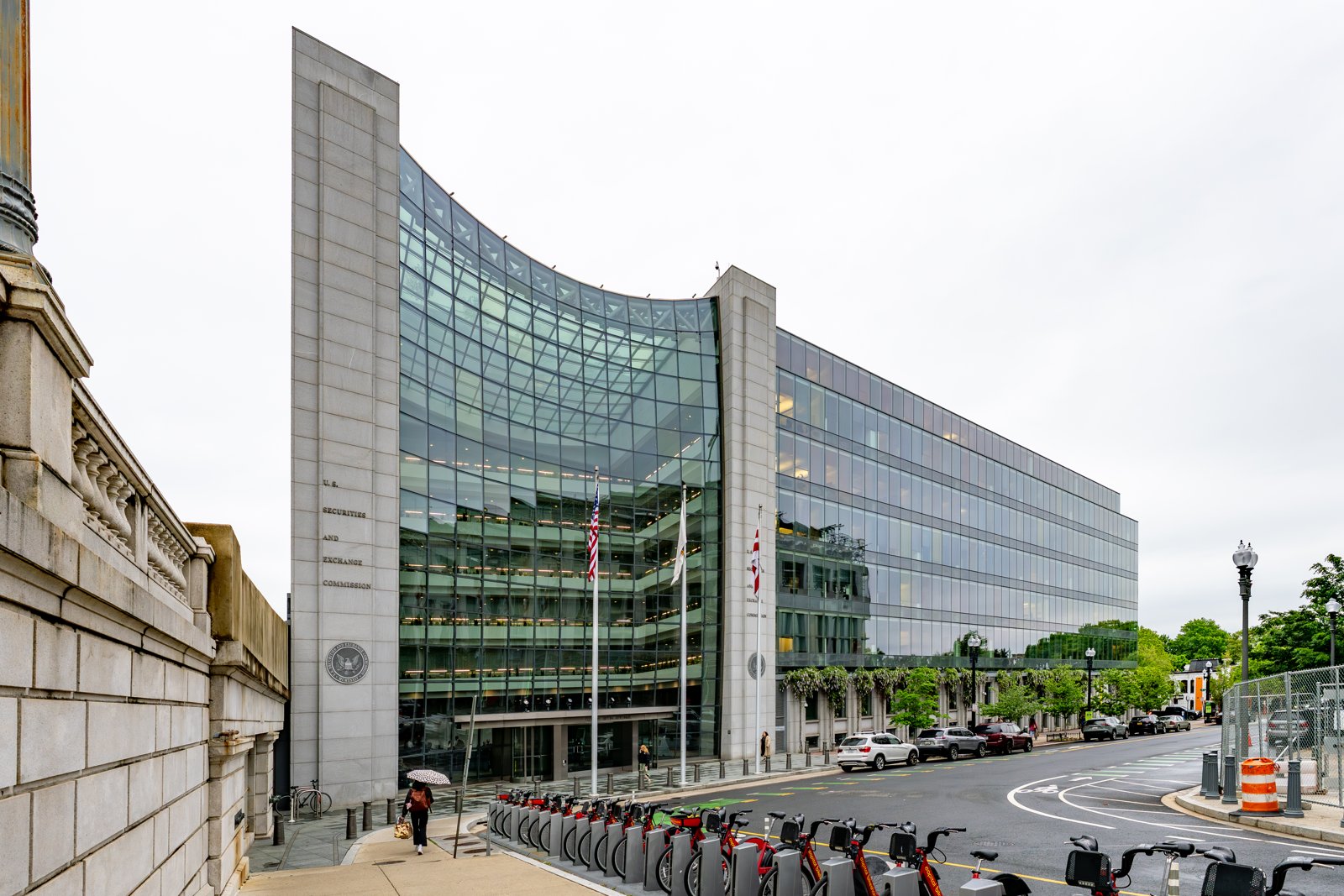
Featured image: The U.S. Securities and Exchange Commission headquarters, Washington, D.C. Photo by ajay_suresh via Wikimedia Commons, CC BY 4.0.
_(55266859043).jpg)