

The Investigative Journal’s Afternoon Wire is a daily digest of the day’s most consequential developments across government, the courts, and international affairs. Every item below is drawn from public records, official statements, and contemporaneous reporting, with primary sources linked throughout.
Correction & update (September 10, 2026): An earlier version of this briefing described the stopgap funding measure as still awaiting the president’s signature. The measure cleared the House on September 1 and was signed into law on September 2; the text and headline have been revised accordingly. The Senate-schedule item has been corrected to reflect that cloture proceedings on the Byrne nomination began in early August, and the Iran item has been updated with subsequent battle-damage reporting.
Washington moves through the back half of the week with a rare piece of fiscal certainty: the stopgap funding law signed September 2 has taken a pre-election government shutdown off the table. Overseas, the picture is less settled. The exchange of strikes between the United States and Iran intensified around the Persian Gulf and Jordan, Russian drones again struck Ukrainian cities, and the fight over mail-in voting rules moved back toward the Supreme Court with ballots already beginning to move. Here is where things stand as of Thursday afternoon, September 10, 2026.
Government
Stopgap funding law pushes the spending fight to December 11. The continuing resolution extending current federal funding through December 11, 2026, cleared the House 370–48 on September 1, according to a release from Rep. Hal Rogers’ office, and was signed into law September 2 after the Senate’s earlier approval. Federal News Network reports that lawmakers were determined not to run up against the September 30 fiscal-year deadline in the middle of campaign season, after the disruptive shutdown fights of recent years.
The margin is the story. A 370–48 vote on a clean extension suggests both parties concluded that a funding lapse seven weeks before the midterms served no one. The House Appropriations Committee majority framed the package as a return to regular order. The harder work remains: according to the Committee for a Responsible Federal Budget’s appropriations tracker, the House has passed only three of twelve fiscal 2027 spending bills and the Senate none, meaning December’s lame-duck session will carry the full weight of the annual spending fight.
Judicial confirmations grind on in a quiet Senate week. Before its September recess, the Senate’s last principal floor business was cloture proceedings, initiated in early August, on the nomination of Matthew Byrne to be a U.S. district judge for the Southern District of Ohio, per the Congress.gov floor summary; this week the chamber has held only pro forma sessions, including one Thursday afternoon. The light schedule reflects a familiar pre-election pattern: with the funding question settled, the executive calendar — and particularly district-court seats — is where the majority can still bank durable wins before November.
The Federal Reserve enters its decision week with its board intact — and its independence still in litigation. The Federal Open Market Committee meets September 16, and Governor Lisa Cook remains in her seat as that meeting approaches. In June, the Supreme Court declined to permit her removal while her lawsuit challenging the president’s attempt to fire her proceeds, a ruling that, as CNBC reported, left the underlying constitutional question unresolved. The allegations against Cook — centered on accusations about pre-appointment mortgage paperwork — remain contested claims, not findings; her challenge continues in the lower courts, and no final judgment has been entered. For markets, the practical takeaway is continuity: the board that votes next week is the board that voted in July.
Courts
The mail-in voting rule heads back to the Supreme Court as ballots start going out. The administration has asked the justices to clear the way for the Postal Service’s new mail-in voting rule, according to SCOTUSblog’s coverage of the application, after a federal judge in Massachusetts granted a preliminary injunction barring enforcement of the rule’s envelope and portal-registration provisions. Judge Indira Talwani wrote that implementing the rule less than seventy days before the November election “threatens disenfranchisement of millions of United States citizens who seek to vote by mail,” per NPR’s reporting on the litigation.
The timing pressure is acute. NBC News notes that the injunction landed as states began sending out ballots, which means any Supreme Court action — in either direction — will reach election machinery already in motion. The case remains pending; no court has issued a final ruling on the rule’s lawfulness, and the current posture could change quickly if the justices act on the emergency application.
Trump v. Cook proceeds below. The removal-power question at the heart of the Cook case — whether a president may fire a sitting Federal Reserve governor for cause he defines — returns to the district court for full litigation after the Supreme Court’s June order. Court filings indicate the dispute is likely to run well past next week’s FOMC meeting, keeping a foundational separation-of-powers question open through the fall.
Appellate courts continue to police executive-power claims. Recent appellate rulings tracked by the Brennan Center for Justice include a Fifth Circuit decision holding that the administration’s use of the Alien Enemies Act for rapid deportations was unlawful, part of a broader pattern this year — capped by the Supreme Court’s February decision striking down tariffs imposed under the International Emergency Economic Powers Act — of courts requiring clearer statutory authority for emergency-powers actions. Several of these disputes remain in active litigation, and outcomes could still shift on further review.
International
U.S.–Iran exchanges escalate around the Gulf and Jordan. Iran launched a wave of ballistic missiles toward Muwaffaq Salti Air Base in Jordan after U.S. forces struck five Iranian oil tankers, according to Washington Post reporting on the sequence, with Time reporting that Tehran cast the volley as retaliation for the tanker strikes. Haaretz’s live coverage, citing CBS, reports multiple U.S. aircraft were damaged in overnight strikes on the Jordan base; U.S. Central Command had not published a full battle-damage assessment as of this writing, and those reports should be treated as preliminary. Update, September 10: subsequent reporting citing a U.S. official put the damage at roughly eight F-15s, lightly damaged and since returned to service, per CBS News live coverage. The standoff traces to late August, when U.S. forces hit launch positions on Iran’s Larak Island in the Strait of Hormuz. Israeli Defense Minister Israel Katz, for his part, warned that any Iranian attack on Israel would draw a “powerful response,” per The Times of Israel’s live blog. The pattern — strike, retaliation, counter-strike, each side declaring its round complete — is the classic shape of an escalation ladder, and the question now is whether either capital sees an off-ramp before the exchange moves beyond bases and tankers.
Gaza: strikes continue against the backdrop of the October ceasefire framework. An Israeli strike in the northern Gaza community of Beit Lahiya killed at least four people, including two children, according to Associated Press reporting citing Shifa hospital; the Israeli military said its forces struck Hamas weapons-storage facilities in three areas. Israeli border-crossing figures indicate some 10,500 people have exited Gaza since the October 2025 ceasefire took effect, per The Times of Israel. The casualty figures and the military’s account could not be independently reconciled as of publication — a recurring feature of a conflict in which verification on the ground remains limited.
Ukraine: Sumy shopping-center strike caps another lethal week. A Russian drone struck a shopping center in the northern city of Sumy on Wednesday evening, killing a 21-year-old man and a 21-year-old woman and injuring at least twenty, according to Kyiv Post reporting; The Kyiv Independent reports at least 12 killed and 72 injured in strikes across the country in the same period. Two further data points deserve attention: North Korean leader Kim Jong Un used a major national celebration to publicly praise troops serving abroad — a further normalization of Pyongyang’s direct role in Russia’s war — and reporting indicates Russia plans a final test of a new ballistic missile with roughly 800-kilometer range by year’s end. Both developments point toward a deeper, longer war rather than a winding-down one.
Red Sea: Houthi forces reported to have taken Mocha. Houthi fighters are said to have seized the Yemeni port city of Mocha, near the Bab al-Mandab strait, per The Times of Israel. Separate claims of Saudi-backed airstrikes circulated via Houthi-controlled media and are unverified; we flag them only as claims from a party to the conflict. If the reported capture holds, control of Mocha would put Houthi forces closer to one of the world’s most consequential shipping chokepoints at the same moment the U.S. Navy is engaged against Iran across the region.
Tomorrow’s Watch
The 25th anniversary of September 11. Friday marks a quarter century since the 2001 attacks. The commemoration at the National September 11 Memorial begins at 8:30 a.m., with family members reading the names of the 2,983 people killed in the 2001 attacks and the 1993 World Trade Center bombing, six moments of silence marking the timeline of the attacks, and a seventh honoring those lost to 9/11-related illnesses. Ceremonies are also planned at the Pentagon and in Shanksville, Pennsylvania; the memorial plaza reopens to the public in the afternoon.
August inflation data, 8:30 a.m. ET. The Bureau of Labor Statistics releases the August Consumer Price Index — the last inflation reading before the Fed’s September 16 meeting. Forecasters surveyed ahead of the release expect roughly 0.4 percent month-over-month and about 3.4 percent year-over-year. A hot print would complicate any easing case days before the FOMC convenes.
Also on the radar: possible Supreme Court action on the administration’s mail-voting application, which could come at any time given the election calendar; the Senate’s return from pro forma session and scheduling of a final vote on the Byrne judicial nomination; and any Pentagon battle-damage assessment from the Jordan base strikes.
Methodology and standards: This briefing relies on public records, official statements, and linked contemporaneous reporting. Allegations are identified as allegations; pending litigation is noted as pending. Claims sourced to parties to a conflict are flagged as unverified. State-controlled media are not treated as independent sources.
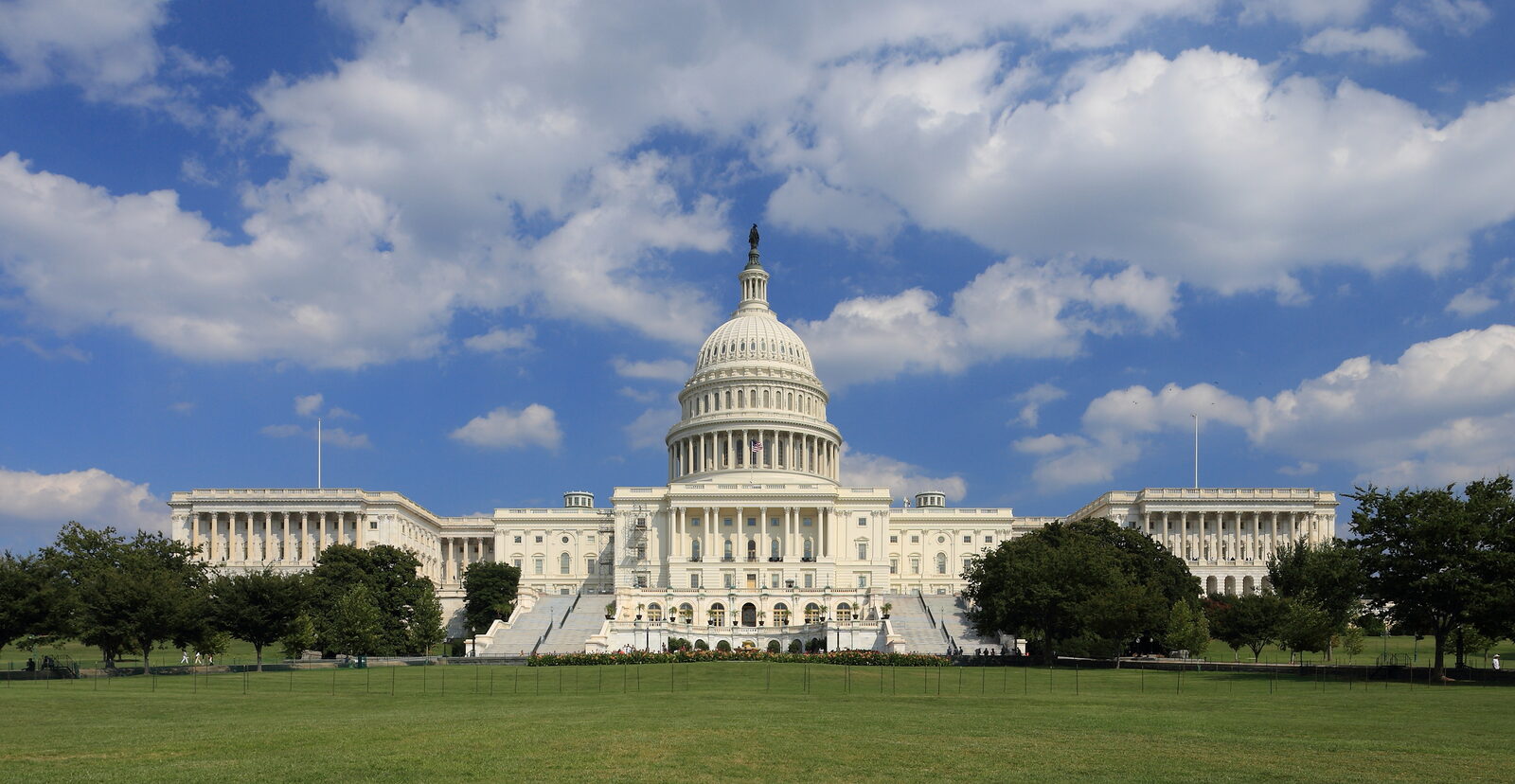
Featured image: U.S. Capitol, west side. Photo by Martin Falbisoner via Wikimedia Commons, CC BY-SA 3.0.
