

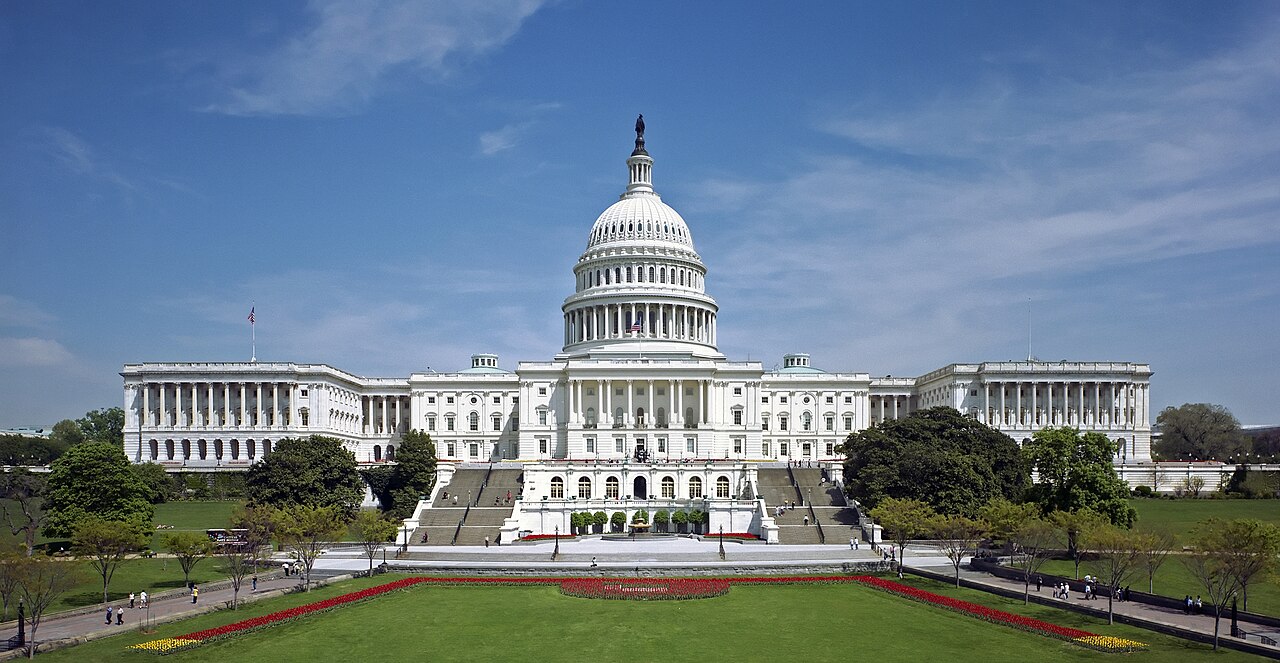
WASHINGTON — Congress opened September with a burst of floor activity and then went quiet. President Trump signed a stopgap funding bill on September 2 that, according to the White House, keeps federal agencies operating through December 11 — defusing the September 30 shutdown deadline before it arrived. Both chambers then scattered for a state work period: Senate floor records show the chamber adjourned until 3:00 p.m. Monday, September 14, and House leadership has announced the House will leave town September 15 and remain out through at least November 9, after the midterm elections. The quiet floors this week belie a loaded docket: an unfinished defense authorization, twelve unfinished appropriations bills, a Senate-passed sanctions package awaiting House action, and a Congressional Budget Office release calendar that keeps producing fiscal warnings. Here is where the week’s notable items stand.
1. Stopgap signed: government funded through December 11
The headline development is enactment of H.R. 6500, the Continuing Appropriations and Extensions Act, 2027. Records indicate the House cleared the Senate-amended measure 370-48 on September 1, following earlier Senate approval reported at 90-6, and the president signed it September 2. The law provides fiscal year 2027 appropriations at largely current levels through December 11, 2026.
Beyond the date change, the package carries policy freight: according to the signing statement and summaries of the bill, it extends authorities for surface transportation programs, veterans’ health and housing services, and trade preferences including the African Growth and Opportunity Act. House Appropriations Republicans framed the move as protecting the full-year funding process from a partisan shutdown. The practical effect is to push the real spending fight into a lame-duck December, weeks after voters render a verdict on control of both chambers.
2. Appropriations scoreboard: zero of twelve enacted
The stopgap was necessary because the regular process is far behind. The Committee for a Responsible Federal Budget’s Appropriations Watch tracker indicates that none of the twelve FY2027 bills has cleared Congress, only three have passed the House, and none has been reported out of the Senate Appropriations Committee.
That arithmetic makes December 11 a genuine cliff. With the House out from September 15 through early November, the window for conferencing full-year bills is effectively a few working weeks in November and December. The realistic outcomes, based on the current calendar, are an omnibus assembled in the lame duck, another continuing resolution into the new Congress, or a shutdown fight — a familiar menu that appropriators on both sides say they want to avoid.
3. House votes to fast-track mining permits
On a 218-201 vote recorded September 2, the House passed H.R. 1501, the Protecting Domestic Mining Act of 2025, which would make domestic mining and mineral processing projects eligible for the FAST-41 streamlined federal permitting process. The bill moved under a rule reported by the Rules Committee alongside a Natural Resources Committee report (H. Rept. 119-691).
Supporters, including Rep. Hal Rogers (R-Ky.), cast the measure as reducing reliance on Chinese-controlled critical mineral supply chains — a rare-earths and battery-inputs argument that has gained bipartisan currency, though the near-party-line vote suggests disagreement over environmental review remains. The bill now awaits Senate action, where floor time before the election is scarce.
4. Conditions on university aid over Israel boycotts clear the House
The House on September 3 passed H.R. 4795, the Protect Economic and Academic Freedom Act of 2026, by a 237-169 vote that drew 33 Democrats in support, with Reps. Thomas Massie and Warren Davidson the only Republicans opposed, according to the roll call. The bill would amend the Higher Education Act to make institutions that engage in what it defines as a “nonexpressive commercial boycott” of Israel ineligible for certain federal funds, and would require certifications that students are not obstructed from academic programs in Israel.
The Education and Workforce Committee’s report (H. Rept. 119-780) lays out the majority’s rationale; opponents argued the conditions raise First Amendment questions that courts would likely test if the measure became law. Senate prospects are uncertain in the time remaining this Congress.
5. Right-whale rule pause extended for lobster fishery
On September 1 the House passed H.R. 9436 by a recorded vote of 219-196. The bill would amend the Consolidated Appropriations Act, 2023 to extend the period during which existing North Atlantic right whale regulations remain in effect — in practice, extending the statutory pause that has shielded Northeast lobstermen from new gear restrictions. The Natural Resources Committee’s report (H. Rept. 119-766) accompanies the bill.
The measure pits a regional industry’s economic case against litigation-backed conservation mandates, and it is a useful marker of how Congress uses appropriations riders to manage Endangered Species Act and Marine Mammal Protection Act pressure. Senate action would be required before the current pause lapses.
6. NDAA waits on the Senate; sanctions bill waits on the House
The FY2027 National Defense Authorization Act sits mid-passage. The House passed its version, H.R. 8800, 216-212 on July 22, and the Senate Armed Services Committee reports it advanced its own version 18-9. A Congressional Research Service status tracker confirms the bill awaits Senate floor consideration — which the compressed fall calendar now squeezes toward the lame duck, a familiar NDAA endgame.
Moving in the opposite direction: the Senate in early August passed the Lindsey O. Graham Sanctioning Russia and Iran Act of 2026 on an 86-11 vote, per contemporaneous reporting, targeting major purchasers of Russian oil and gas. That bill now needs House floor time — of which, records suggest, only a handful of days remain before mid-November.
7. CBO week: government-efficiency bills scored, Social Security update due
The Congressional Budget Office’s cost-estimate docket filled with accountability-themed bills in the first days of September. Estimates dated September 3-4 cover S. 2732, the Bonuses for Cost-Cutters Act — which would strengthen programs rewarding federal employees who identify surplus funds and fraud — along with S. 2733, the Duplication Scoring Act, requiring assessments of duplicative programs in new legislation; S. 252, the Guidance Out Of Darkness Act; H.R. 3340, the Modernizing Access to Our Public Oceans Act; and H.R. 9332, the Load Forecasting Enhancement Act. All were ordered reported by their committees this summer, filings indicate.
The bigger fiscal document lands later this month: CBO has signaled its 2026 long-term Social Security projections for September release. The 2025 edition projected combined trust funds exhausted in fiscal 2034 — a number Congress has so far declined to address, and one worth watching for revision.
8. Regulatory watch: H-1B fees, accreditation, student-visa terms
Three comment clocks are running. A Department of Homeland Security proposal published in the Federal Register would establish a $103,265 fee for cap-subject H-1B petitions, with written comments due September 24, the notice indicates. The Department of Education’s proposed accreditation rule has a comment period closing September 21, with a final rule targeted for July 2027. And DHS’s rule ending “duration of status” for foreign students, exchange visitors, and foreign media — replacing it with fixed admission periods — is designated a major rule with a September 15 effective date. Each carries measurable costs for universities and employers, and each is a candidate for Congressional Review Act attention.
9. State watch: California moves first on AI
Sacramento supplied the week’s most consequential state action. Gov. Gavin Newsom’s office announced September 9 that he signed Senate Bill 813 and Assembly Bill 1405, described by his office as first-in-the-nation artificial intelligence safeguards, while explicitly calling on Washington to enact national rules. The Legislature adjourned August 31 after passing, by NBC News’ count, more than twenty bills restricting AI uses and minors’ social media access; measures on chatbots, data centers, and surveillance await signature or veto by September 30.
The national implication is straightforward: with no federal AI statute, California’s rules become de facto national compliance floors for companies that cannot geofence their products — strengthening the case, made by industry and some in Congress, for federal preemption legislation, and testing whether Washington responds.
On TIJ’s beats
For accountability watchers, the items to track are the efficiency bills now scored and awaiting Senate floor time — duplication scoring, cost-cutter bonuses, and guidance transparency are the rare oversight measures with bipartisan committee votes behind them. Separately, House records show the Ethics Committee filed reports (H. Rept. 119-693, H. Rept. 119-694) recommending the House find two individuals in contempt of Congress for refusing to comply with committee subpoenas; the resolutions were queued for floor consideration, and their disposition bears watching as a test of the chamber’s subpoena power. The December 11 funding cliff, the lame-duck NDAA, and the CBO’s forthcoming Social Security numbers will anchor this tracker through the fall. The Investigative Journal will follow each.