

The Investigative Journal’s weekly survey of reports from government auditors and private watchdog organizations across the political spectrum. For transparency, we note each organization’s institutional position and general orientation alongside its findings, and we link directly to the underlying reports and data.
The most consequential oversight document of the week came from the Government Accountability Office, which examined what actually happened to the money after the Department of Homeland Security terminated hundreds of contracts last year in pursuit of efficiency savings. The answer, according to the auditors: far less was saved than the headline figures suggested. Also this week: the Congressional Research Service breaks down a sweeping rewrite of federal grant rules set to take effect October 1, GAO details the banking barriers still facing state-legal cannabis businesses, POGO publishes data on ICE detention inspections, ProPublica releases a mortality analysis built on CDC data, Judicial Watch moves to unseal warrant records in federal court, and the Capital Research Center rolls out a series on the funders of anti-fossil-fuel advocacy.
GAO: DHS’s Reported $10.5 Billion in Contract-Termination Savings “Will Not Fully Materialize”
The Government Accountability Office — Congress’s nonpartisan audit arm — reported on September 3 (GAO-26-109096) on the Department of Homeland Security’s contract terminations carried out in consultation with the Department of Government Efficiency. Following a presidential directive in early 2025 to review contracts for potential savings, DHS terminated 438 contracts for convenience between January 20 and September 30, 2025, covering more than $1.6 billion in prior obligations, according to the report.
DHS publicly reported the terminations could avoid as much as $10.5 billion in current and future contract costs. GAO’s audit found the near-term arithmetic considerably smaller: the department deobligated more than $249 million, but incurred roughly $157 million in new obligations to settle canceled agreements and continue work under partially terminated contracts — a net of about $92 million. The $10.5 billion figure, auditors found, represented the maximum DHS could have spent if every terminated contract ran to the end of its term; records indicate 95 percent of it was attributable to just 30 terminated IT contracts with periods of performance stretching to fiscal year 2034. GAO also found DHS subsequently obligated more than $1.7 billion through governmentwide contract vehicles to buy many of the same requirements — costs the report describes as “not avoided but incurred through other contracts.”
The report has already produced a political response: House Democrats argued that Elon Musk, who led the DOGE effort during the period reviewed, should testify about the discrepancy, according to Government Executive. The findings do not suggest the terminations produced no savings — GAO documents real deobligations — but they indicate that public savings claims counted ceiling values rather than realized avoidance, a distinction that matters for any agency’s efficiency accounting. GAO reports incorporate agency review before publication; DHS’s perspective is reflected in the report itself.
CRS: A New Rulebook for Federal Grantmaking Takes Effect in Three Weeks
The Congressional Research Service — the nonpartisan research agency serving Congress from within the Library of Congress — published a Legal Sidebar on September 4 (LSB11464) analyzing the proposed Uniform Grants Regulation, a joint interagency rule published in May by the Office of Management and Budget and 41 grantmaking agencies. The rule would replace OMB’s Uniform Guidance, the framework that has governed federal grant administration since 2013, and OMB is targeting an effective date of October 1, 2026 — the start of the new fiscal year.
According to CRS and legal analyses of the proposal, the regulation would expand political-appointee oversight of discretionary awards, broaden agencies’ authority to suspend and terminate grants, integrate administration policy priorities into award selection and administration, and revise cost-allowability rules. Analysts at Arnold & Porter have described it as the most significant revision to the federal grants framework in more than a decade. Federal grants move hundreds of billions of dollars annually to states, localities, universities, and nonprofits; how termination authority and policy conditions are applied under the new framework will be one of the most consequential — and least-covered — accountability questions of fiscal year 2027.
GAO: Cannabis Businesses Still Largely Locked Out of Banking
In a second notable release, GAO publicly issued a report September 8 (GAO-26-107498) on banking access for state-legal cannabis businesses. Because cannabis remains a federally controlled substance, financial institutions that serve the industry face potential legal exposure and heavy Bank Secrecy Act compliance costs. FinCEN data cited in the report show that roughly 1,000 banks and credit unions filed suspicious activity reports indicating they served cannabis-related businesses in 2024 — a figure that grew from 2015 to 2019 but has remained essentially flat since, even as more states legalized.
Businesses told GAO they experience account closures, elevated fees, and high interest rates on loans when they can obtain them; employees in the industry reported difficulty accessing personal financial services. Financial institutions, for their part, cited federal legal risk and compliance burden as the principal reasons they stay out, according to the report and coverage in American Banker. The report lands as a factual baseline in a policy fight Congress has revisited repeatedly without resolution.
POGO: ICE Detention Inspections Fell 36 Percent as Detention Grew
The Project On Government Oversight — an independent watchdog nonprofit founded in 1981, funded primarily by foundations and individual donors; it describes itself as nonpartisan, though critics on the right sometimes characterize its coalition work as left-leaning — published a data investigation in late August that remains the most detailed public accounting of ICE’s inspection system this year. POGO’s analysis of inspection records found the number of ICE detention facility inspections dropped by 36.25 percent in 2025, a period in which the detained population — and deaths in custody — rose.
A companion investigation, “Inside ICE’s Broken System for Inspecting Detention Facilities,” reviewed the grades issued by ICE’s Office of Detention Oversight and reported that, in the period analyzed, the office never issued a failing grade to a “dedicated” ICE facility — one holding only ICE detainees. The facilities that did fail were county and municipal jails holding mixed populations. POGO recounts one Texas facility receiving a “Superior” rating — perfect marks, with all 38 interviewed detainees “reporting satisfaction” — while attorneys and records described sharply different conditions outside inspection windows.
The findings are POGO’s characterization of ICE’s own inspection records; ICE’s ratings and inspection reports are public documents, which makes this an unusually verifiable dataset for follow-up reporting. The gap between inspection grades and documented in-custody deaths is a subject federal Inspectors General have flagged in prior years as well.
Judicial Watch Moves to Unseal Giuliani Search Warrant Records
Judicial Watch — the conservative 501(c)(3) legal watchdog funded by individual donors and foundations, best known for FOIA litigation — announced September 1 that it and former New York City Mayor Rudy Giuliani filed a motion in the U.S. District Court for the Southern District of New York to unseal materials related to two search warrants: a November 2019 warrant for Giuliani’s iCloud account and an April 2021 warrant for location data on two phone numbers assigned to him (In re Search Warrants Executed on April 28, 2021, No. 21-mc-00425).
The motion argues the warrant materials are judicial records subject to a presumption of public access under the common law, the First Amendment, and the Fourth Amendment’s Warrant Clause, and notes that a similar application by The New York Times was previously granted in part. Judicial Watch states that Giuliani was never charged with a federal crime arising from the investigation. It is worth being precise about what this is: a request, not a ruling. The Justice Department’s response to the motion was not yet on the docket as of the filing announcement, and no court has yet found any impropriety in the warrants’ issuance.
The filing is part of a broader Judicial Watch docket on what it calls the politicization of federal law enforcement — including motions to unseal warrant materials for former Trump lawyer Victoria Toensing and records litigation over the Mar-a-Lago search. Whatever one’s view of that framing, unsealing warrant applications from closed investigations is the kind of transparency question courts have often resolved in favor of disclosure, and the underlying documents, if released, would be primary-source material.
ProPublica: Ectopic Pregnancy Deaths Nearly Doubled, With Sharper Rises in Ban States
ProPublica — the nonprofit investigative newsroom funded principally by philanthropic foundations; it is widely characterized as left-of-center, and its data work is generally regarded as methodologically rigorous — published a mortality analysis September 9 built on CDC WONDER cause-of-death and natality data. The analysis found that almost 200 women died after an ectopic pregnancy from 2020 to 2025, compared with about 100 in the previous six years. In 2023–2025, the death rate reached 13.1 per million live births in states with strict abortion bans, versus 7.1 in states without bans, with a national rate of 9.8, according to the published figures and methodology.
The piece is careful about causation, and readers should be too. ProPublica’s own experts cautioned that abortion bans alone cannot explain the national rise — the increase began during the pandemic and appears in states without bans as well, and ban states have long had weaker maternal-health outcomes on average. Ban statutes generally include explicit exceptions for ectopic pregnancies, which are almost never viable. The documented concern, per lawsuits and federal EMTALA findings cited in the piece, is delay: clinicians hesitating to treat before an ironclad diagnosis. In one Texas case, regulators found a hospital failed to properly screen a patient whose fallopian tube later ruptured; the hospital denies related malpractice allegations in court filings and told ProPublica its clinicians provide medically indicated treatment for ectopic pregnancies.
The data invites replication: CDC WONDER is public, and ProPublica published its state groupings and suppression-threshold methodology. That is the standard other newsrooms should be held to — and one TIJ can independently check.
Capital Research Center: “Enemies of Energy” Series Maps Anti-Fossil-Fuel Philanthropy
The Capital Research Center — a conservative think tank founded in 1984 that investigates left-of-center philanthropy and advocacy funding; it is itself funded by conservative foundations and donors — published three installments of its Enemies of Energy series this week in its Green Watch vertical: on the Skyline Foundation (September 4), on fossil-fuel “subsidy mythology” (September 7), and on North Carolina philanthropist Fred Stanback (September 8), authored by Ken Braun.
The Stanback installment extends research CRC has pursued for years. Its earlier reporting, drawing on public tax filings, documented that the Foundation for the Carolinas — where Stanback is among the largest known account holders — granted $88.5 million to the Southern Environmental Law Center between 2020 and 2022, and media reports have credited Stanback with at least $50 million in giving to that group. CRC’s characterization of Stanback’s philanthropy as “anti-humanist” — pointing to his documented donations to population-control-focused organizations — is the center’s own editorial framing, and readers should weigh it as such. The underlying grant flows, however, are drawn from IRS filings that anyone can inspect, and the series usefully illustrates how much energy-policy advocacy runs through donor-advised funds that obscure original donors.
What Warrants a Closer Look
Three threads from this week’s reports merit deeper TIJ investigation. First, the DHS savings accounting: GAO’s method — comparing claimed ceiling-value “cost avoidance” against actual deobligations, settlement costs, and re-procurement through other vehicles — can be replicated for other agencies’ termination claims using public deobligation records on USAspending.gov. If DHS’s $10.5 billion netted out near $92 million, the governmentwide gap between announced and realized savings is an open, quantifiable question.
Second, the Uniform Grants Regulation’s October 1 effective date. The first tranche of awards, terminations, and policy conditions issued under the new framework will show how the expanded discretion is actually used — and by whom. The rule’s text, comment docket, and early grant actions are all public records.
Third, fiscal-year-end spending. The federal “use-it-or-lose-it” season peaks in the next three weeks. OpenTheBooks — the spending-transparency nonprofit founded by Adam Andrzejewski, generally regarded as right-leaning — documented in its oversight report and a March 2026 analysis that the Pentagon obligated a record $93.4 billion in grants and contracts in September 2025, including $50.1 billion in the final five working days. Whether September 2026 repeats that pattern is a story that will be written in USAspending data by October — and TIJ will be watching.
Editor’s note: This roundup summarizes findings as stated in the linked reports and filings; characterizations are attributed to their authors. Where organizations or individuals named in these reports have publicly responded, those responses are noted; several matters described above, including the Judicial Watch motion and litigation referenced in ProPublica’s reporting, are pending and unadjudicated. Corrections and responses: editor@tij.news.
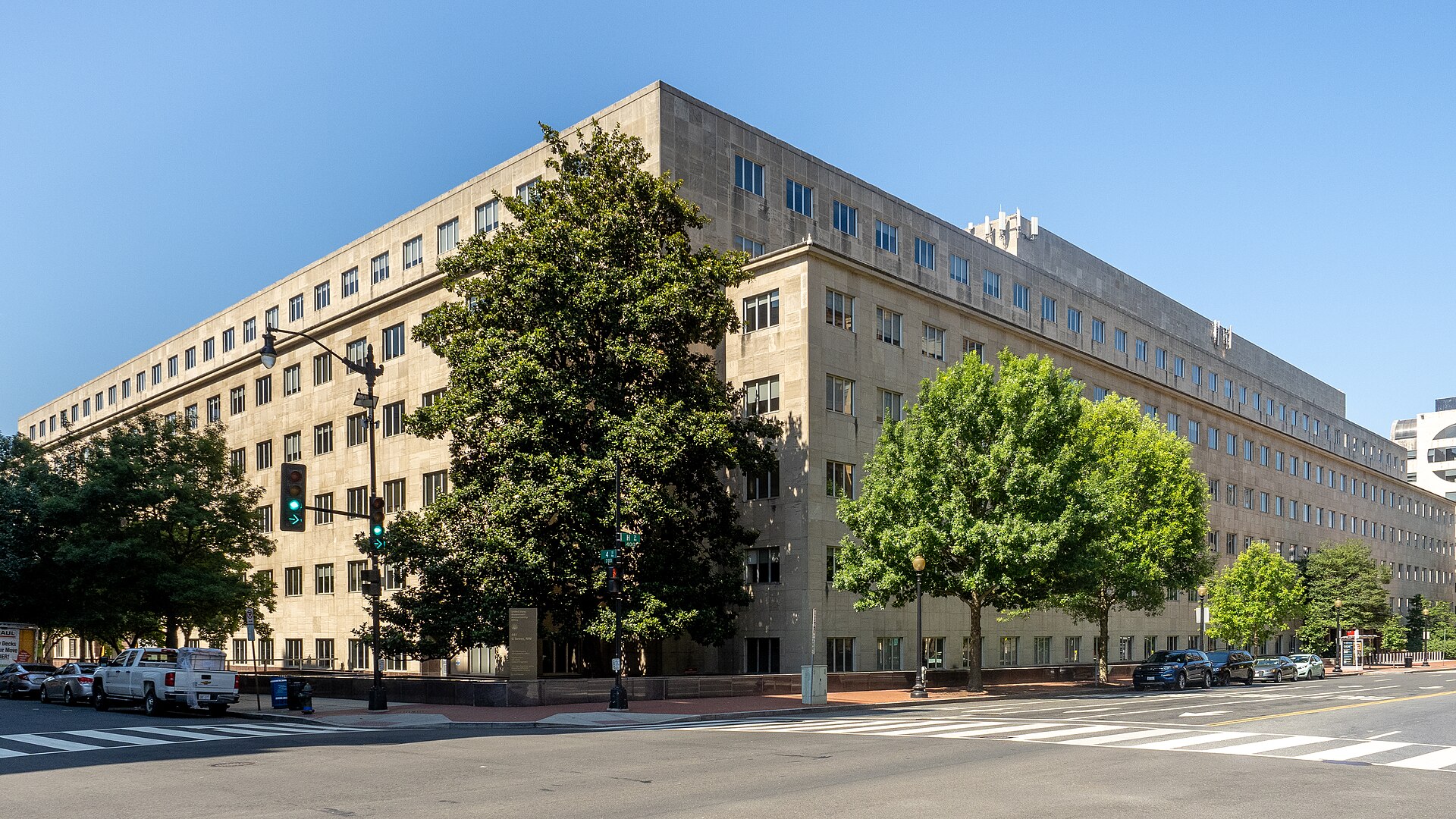
Featured image: Headquarters of the U.S. Government Accountability Office, Washington, D.C. Photo by ajay_suresh via Wikimedia Commons, CC BY 2.0.
.jpg)