

The Investigative Journal’s weekly survey of the federal and state courts. This digest summarizes public court records and contemporaneous reporting; the parties’ positions are drawn from their filings, and allegations described below remain allegations unless a court has ruled otherwise.
Election litigation dominated an unusually consequential week in the courts. The Supreme Court blocked Missouri’s redrawn congressional map for a second time in three days, the justices weighed two separate emergency applications from the administration touching on mail-in ballots and voter-roll verification, and two federal appeals courts handed down significant rulings on taxpayer privacy and immigration detention. Here are the developments that mattered, grouped by court level.
Supreme Court
1. Justices block Missouri’s new congressional map — twice in one week
The defining court story of the week unfolded across three levels of the judiciary. On September 10, the Supreme Court issued a brief, unsigned order pausing a ruling by Chief U.S. District Judge Stephen Clark of the Eastern District of Missouri that would have allowed the state to use a congressional map drawn in 2025 to favor Republicans in November’s midterm elections. According to SCOTUSblog’s Amy Howe, no justice publicly dissented from the order, which granted a request from referendum organizers to put Judge Clark’s ruling on hold while litigation proceeds.
The order came less than two days after Justice Brett Kavanaugh, who handles emergency matters from Missouri, declined a request from Missouri Attorney General Catherine Hanaway to disturb the Missouri Supreme Court’s unanimous September 3 decision. That state ruling, as reported by the Missouri Independent, held that the state constitution’s referendum provision applies to redistricting and barred use of the new map unless voters approve it in a November 3 ballot measure. The conflicting federal and state rulings had left the state’s map, in the words of NBC News, “in limbo” — until the justices stepped in.
The practical effect, records suggest, is that Missouri will likely conduct the midterms under its 2022 map. SCOTUSblog noted the deadline for mailing military and overseas ballots was roughly nine days away when the order issued, leaving little runway for further map changes. Coverage from The Washington Post and The Wall Street Journal characterized the sequence as one of the fastest-moving election disputes of the cycle. The underlying referendum fight continues, and the state has indicated it will press its federal claims.
2. USPS mail-ballot rule remains blocked as justices weigh a stay
The administration’s request that the Court allow the U.S. Postal Service to implement its new mail-ballot rule remained pending as of Monday morning. The rule flows from Executive Order 14399 on election integrity; U.S. District Judge Indira Talwani of Massachusetts entered a preliminary injunction on September 4 blocking key provisions — envelope requirements and a portal-registration mandate — for the 2026 election, according to Just Security’s analysis and the ACLU, which represents some plaintiffs.
The government sought stays in both the First Circuit and the Supreme Court, as NPR reported. On September 10, a unanimous three-judge First Circuit panel denied the government’s application. At the Supreme Court, state and organizational plaintiffs filed oppositions on September 9 urging the justices to leave the injunction in place, and the Solicitor General has since replied, per Just Security. With ballots already going out in some states, a ruling on the application could come at any time — this is the case to refresh your docket alerts for.
3. Administration asks Court to unfreeze SAVE citizenship-verification database
On September 8, the Justice Department asked the Supreme Court to halt a Washington, D.C. federal judge’s June ruling that blocked the expanded Systematic Alien Verification for Entitlements (SAVE) database, which states could use to check the citizenship of registered voters. According to reporting by The Detroit News and The Spokesman-Review, the district court found the revamped system had been assembled hastily and contained unreliable citizenship data — findings the government disputes in its application, which cites election-fraud concerns ahead of the midterms.
The application is the third election-related emergency matter to reach the justices in a matter of weeks, alongside the Missouri and USPS disputes. Filings indicate the case tests how far federal agencies may go in offering voter-roll verification tools to states — an area where, as the Brennan Center has cataloged, several district courts have ruled against federal data-collection efforts. A ruling in the government’s favor would restore the tool before November; the challengers argue the data quality issues make that premature. The matter is pending.
4. Government seeks review of acting U.S. attorney appointments
On September 10, the administration petitioned the Supreme Court to decide whether the president may install acting U.S. attorneys by designating a new “first assistant” under the Federal Vacancies Reform Act. The petition challenges a Ninth Circuit ruling by Judge Eric Miller holding that the statute’s text is “unambiguous” — a first assistant succeeds to a vacant office only if he or she held that role when the vacancy arose. The government’s filing warns the ruling “threatens to inject mass confusion into five U.S. Attorney’s Offices in the Ninth Circuit” handling more than 8,000 cases annually.
The dispute, which arose from the Nevada U.S. attorney’s office, has implications for criminal cases nationwide: defendants in several districts have moved to dismiss indictments signed by officials whose appointments are contested. Whether the Court grants review — likely at or after its September 28 long conference — will determine if the appointments question is resolved before further indictment challenges accumulate. The case is a petition for certiorari, not yet a grant, and the defense bar will be watching closely.
5. October immigration argument scratched; Bankman-Fried arrives at the Court
Two docket developments rounded out the week at One First Street. On September 11, the Court dismissed Genalo v. Black, a case set for October argument on whether noncitizens with certain criminal convictions are entitled to bond hearings after prolonged immigration detention. Solicitor General D. John Sauer notified the Court the case was moot after New York Governor Kathy Hochul pardoned the detainee at its center, identified in filings as Keisy G.M.; the parties filed a joint stipulation, as The Washington Times and Bloomberg Law reported. The underlying legal question — the subject of a deep circuit split — remains unresolved.
A day earlier, FTX founder Sam Bankman-Fried asked the justices to review his fraud conviction and an $11.02 billion forfeiture order. His petition, filed September 10 and first reported by The New York Times, argues the trial court unfairly barred evidence that FTX’s assets could cover customer losses and that the forfeiture violates the Eighth Amendment’s excessive fines clause. The Second Circuit affirmed his conviction and 25-year sentence on June 12; four votes are needed for the Court to take the case.
Federal Appeals Courts
6. D.C. Circuit: IRS sharing of taxpayer addresses with ICE was unlawful
A unanimous D.C. Circuit panel on September 8 affirmed an injunction blocking the IRS’s data-sharing arrangement with Immigration and Customs Enforcement, holding the agency’s disclosures violated Section 6103 of the Internal Revenue Code, the taxpayer-privacy statute enacted after Watergate. Writing for the panel, Judge Cornelia Pillard found the exchange procedure failed the statute’s requirement that a requesting agency supply the taxpayer’s address, since ICE’s requests needed only a ZIP code in the address field, according to The Washington Post and The Hill.
Court records indicate the IRS disclosed 47,289 taxpayer addresses under the arrangement, out of roughly 1.28 million ICE had sought. The opinion warned, in Judge Pillard’s words, that the IRS “is now on notice twice over” about the legal defects of the disclosures and that willful violations carry civil and criminal consequences, per CPA Practice Advisor. The ruling affirms a district court decision from last November; the government has not yet indicated whether it will seek Supreme Court review. For tax practitioners, the decision is a significant reaffirmation that Section 6103’s confidentiality rules bind interagency agreements.
7. Fourth Circuit rejects mandatory-detention policy, deepening a circuit split
A divided Fourth Circuit panel on September 10 ruled against the administration’s policy of denying bond hearings to certain detained immigrants, joining the majority side of a now-lopsided circuit split. According to Politico’s report, the majority opinion drew a pointed historical comparison between the no-bond policy and Japanese internment — language that underscores how sharply the appellate courts have divided over the government’s reading of the detention statute.
By our count of published decisions, the Second, Fourth, Sixth, Ninth, Tenth, and Eleventh Circuits have now ruled against the mandatory-detention interpretation, while the Fifth and Eighth Circuits have sided with the government. With Genalo v. Black dismissed as moot the following day, the Fourth Circuit’s decision makes it all but certain a replacement vehicle will reach the justices — the question is which case, and how fast. The government’s position, per its filings, is that the statute mandates detention without individualized bond hearings for the covered class; challengers argue due process requires a hearing after prolonged confinement.
District Courts
8. Puerto Rico oversight board firings permanently enjoined — and a caveat
In the District of Puerto Rico, Judge María Antongiorgi-Jordán entered a permanent injunction on September 1 invalidating the attempted removal of three Financial Oversight and Management Board members — Arthur J. Gonzalez, Andrew G. Biggs, and Betty A. Rosa — converting the preliminary relief she granted last October, when she found the removals “plainly contrary to law,” according to the plaintiffs’ counsel and the underlying preliminary injunction opinion. The government abandoned its appeal after the Supreme Court’s ruling in the Lisa Cook Federal Reserve removal case and did not oppose permanent relief, per the San Juan Daily Star.
The caveat, and the reason the case stayed in the news last week: Justice Department filings indicate the government does not read the order “to preclude any further removals” of the plaintiffs, according to The Bond Buyer. That reservation suggests the administration may attempt a for-cause removal process rather than the summary terminations the court rejected — a move that would likely trigger a fresh round of litigation over what process the governing statute requires. Municipal bond markets, which watch the board’s composition closely, should take note.
State Courts
9. Indiana Supreme Court weighs religious exemptions to abortion ban
The Indiana Supreme Court heard argument September 10 in the state’s appeal of an injunction protecting a class of plaintiffs who assert that Indiana’s near-total abortion ban conflicts with their religious beliefs, in a case brought under the state’s Religious Freedom Restoration Act. As the Indiana Capital Chronicle and Courthouse News Service reported, the justices probed how far the 2015 statute — enacted to protect religious exercise — extends when it collides with the state’s asserted interests behind the 2022 ban. The argument video is available from the court.
The case is being watched well beyond Indiana because it inverts the usual religious-liberty alignment: plaintiffs including Jewish Hoosiers argue their faiths affirmatively permit or require abortion in circumstances the ban forbids. A ruling upholding the class-wide injunction could supply a template for RFRA-based challenges in other states with similar statutes; a reversal would confine such claims to individual plaintiffs. A decision is expected in the coming months. The case remains pending, and no ruling on the merits has issued.
Class Action Corner
Several consumer settlements hit key deadlines last week. Claims closed September 8 in the $50 million Disney YouTube TV/DirecTV Stream antitrust settlement covering subscribers from April 2019 through March 2026, and in the $20 million VSL Pharmaceuticals false-marketing settlement, according to Yahoo Finance and Top Class Actions. Still open: the $18.8 million O’Reilly Automotive Telephone Consumer Protection Act settlement, with claims due September 28. Settlement participation, as always, requires meeting each fund’s class definition; the settlements resolve allegations the defendants have not admitted.
The Week Ahead: Cases to Watch
Watch first for the Supreme Court’s ruling on the USPS mail-ballot stay application — with ballots being mailed now, the justices are unlikely to sit on it long, and the SAVE database application is queued close behind. The Court’s September 28 long conference will produce the first substantial batch of cert grants for the new term, with the acting U.S. attorneys petition among the higher-profile candidates. October Term 2026 opens Monday, October 5, with arguments in Suncor Energy v. Board of County Commissioners of Boulder County, testing whether state-law climate suits against energy producers belong in federal court, and Johnson v. United States Congress. In Missouri, the map fight now shifts to voters, who decide the redistricting referendum November 3 — with further federal litigation likely whichever way it goes. And in the detention docket, watch for the government or challengers to tee up a successor vehicle to Genalo before the split widens further.
Corrections and responses: The Investigative Journal welcomes comment from parties and counsel in the matters covered above; requests for comment or correction may be sent through our contact page and will be noted in updates to this digest.
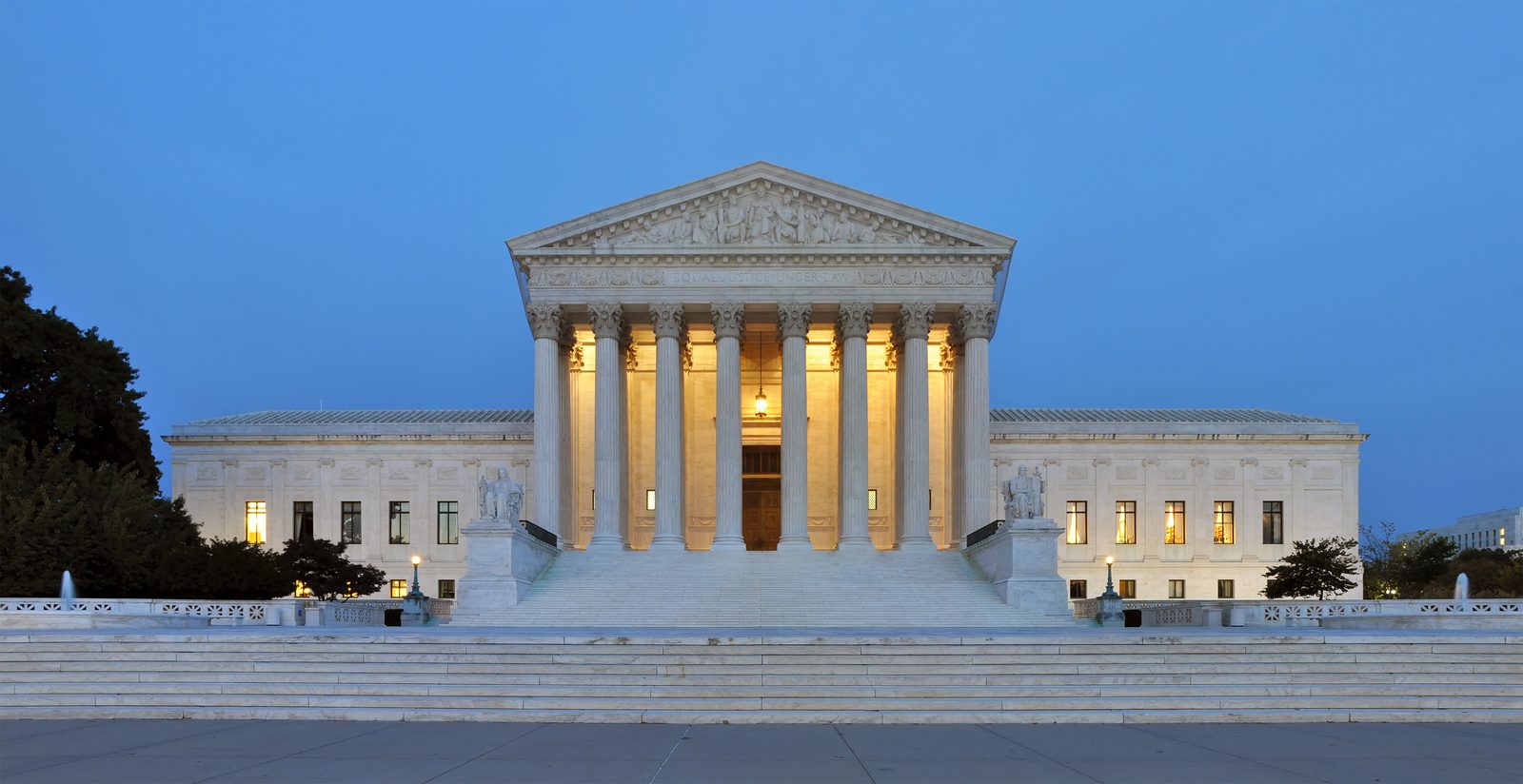
Featured image: United States Supreme Court Building at dusk. Photo by Joe Ravi, licensed under CC BY-SA 3.0, via Wikimedia Commons.