

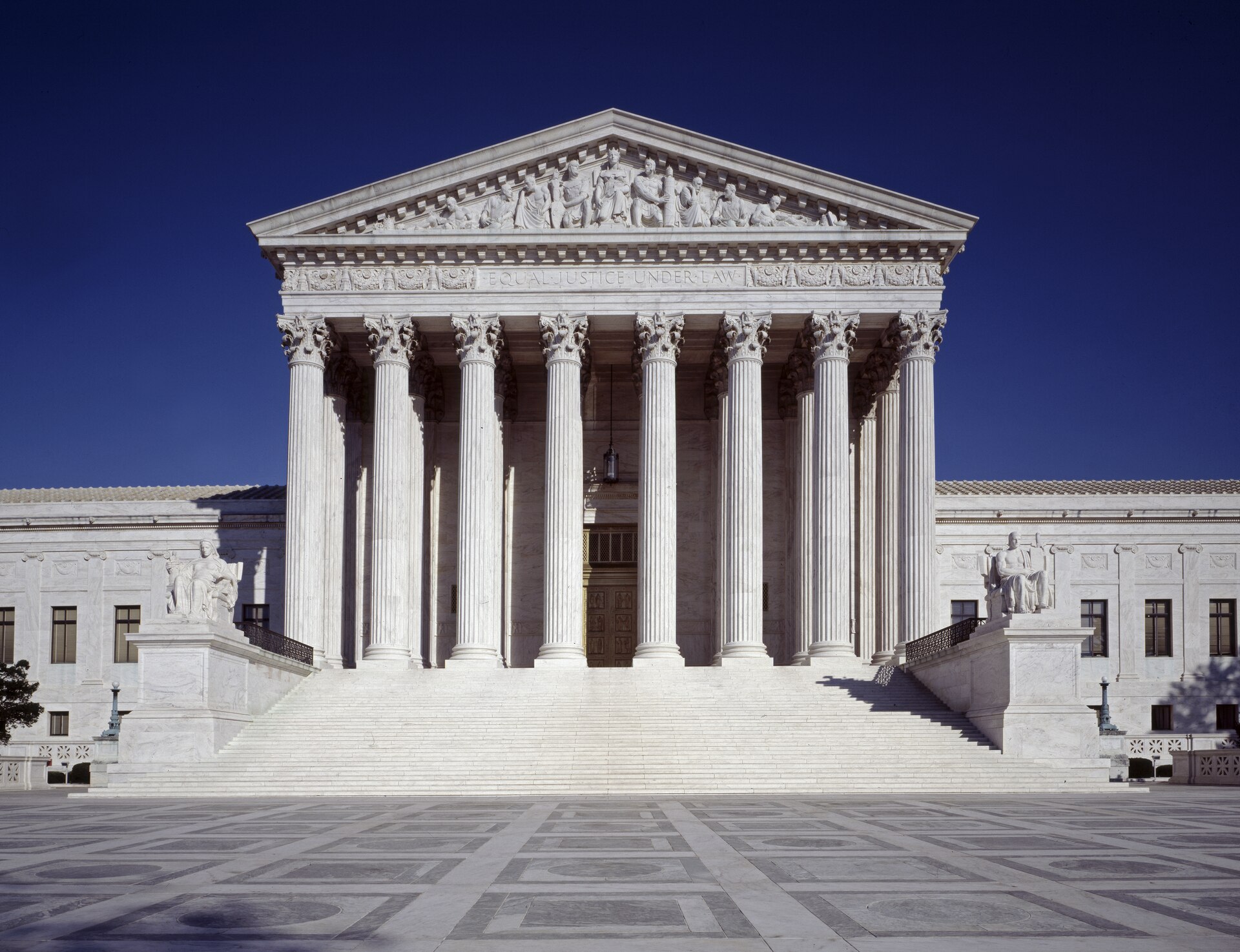
The federal judiciary’s summer lull ended abruptly during the week of Aug. 17. With the Supreme Court still in recess and no merits opinions on the calendar, the action migrated to the emergency docket, where Chief Justice John Roberts issued a one-sentence order Friday afternoon that kept construction cranes moving at the White House. Below the Supreme Court, a federal appeals court left in place limits on immigration enforcement at eight houses of worship, a Texas district judge struck down a Biden-era firearms regulation on Second and Fifth Amendment grounds, and the Georgia Supreme Court declined to resolve a question that could shape mass toxic-exposure litigation across the state. Records and filings from the week point to a judiciary managing an unusually heavy volume of interim relief requests during what is nominally its quietest stretch of the year.
Supreme Court
Roberts administratively stays order halting White House ballroom work
The most consequential order of the week was also among the shortest. On Friday afternoon, Chief Justice Roberts issued a temporary administrative stay in National Park Service v. National Trust for Historic Preservation, No. 26A203, keeping on hold an order by Senior U.S. District Judge Richard Leon that would have stopped most above-ground construction on a new 90,000-square-foot White House ballroom at the end of that day. The stay does not resolve the underlying application; it preserves the status quo while the full court considers the government’s request.
The procedural history matters here. Leon’s order permitted underground work on security features such as bunkers and shelters to continue while barring most surface construction, but filings indicate it has never actually taken effect. The U.S. Court of Appeals for the D.C. Circuit affirmed on Aug. 7 while giving the government 14 days to seek relief from the Supreme Court, which kept the order suspended throughout.
In his Aug. 14 application, Solicitor General D. John Sauer told the justices that a 250-person crew was working 20 hours a day, seven days a week, and that the project was roughly 65 percent complete. He argued the National Trust lacks standing and that Congress has authorized the work through statutes permitting presidential alterations to the White House and construction in national parks. The Trust, represented by Tad Heuer of Foley Hoag, responded on Aug. 18 that the government was attempting to “outrun judicial review.” Both positions remain contested; the court has not ruled on the merits. Commentators have noted that a standing holding here could reach well beyond this project, since a narrow rule on aesthetic and preservation injuries would touch a range of environmental and historic-preservation statutes.
Summer order list clears rehearing petitions
The court issued the second of three summer order lists on Aug. 17. Among the denials was President Donald Trump’s petition for rehearing in Trump v. Carroll, No. 25-573, which sought reconsideration of the court’s June refusal to review a $5 million civil verdict. As is customary, the court gave no reasons. Rehearing petitions are rarely granted; by one count, the last grant came in 2018. A separate petition filed July 28 in the related $83.3 million matter remains pending and is expected to be considered in the fall.
The same list turned away Verizon’s request to modify the court’s June 4 decision on FCC forfeiture orders and the Seventh Amendment. Verizon expressly declined to challenge the holding, asking only for a remand parallel to the one AT&T received. The denial leaves the two carriers in materially different procedural positions on remand — a wrinkle telecommunications counsel will want to track. The court also denied a stay of execution on Aug. 18 to William Frances Silvia, who was executed in Florida hours later. The final summer order list is scheduled for Sept. 4.
Two significant petitions arrive
A certiorari petition in Trump v. Cable News Network, Inc., No. 26-223, was docketed Aug. 20. It asks the justices to review an 11th Circuit decision affirming dismissal of a defamation suit arising from the network’s use of the phrase “the Big Lie.” The petition frames a genuine methodological question under Milkovich v. Lorain Journal Co.: whether courts should apply a contextual, multi-factor test to determine when an opinion implies verifiable fact, as the petition says four circuits do, or the assessment the 11th Circuit employed. Circuit conflicts of this kind are a standard predictor of review, though the court denies most petitions regardless. CNN’s response is due Sept. 21.
Separately, Florida Republicans — including the University of South Florida College Republicans and U.S. Rep. Byron Donalds — appealed in University of South Florida College Republicans v. Lutnick, No. 26-205, docketed Aug. 18. The suit seeks recalculation of 2020 census figures, arguing that the Census Bureau’s pandemic-era use of statistical imputation departed from the Constitution’s “actual Enumeration” requirement. A bureau survey cited in the filings estimated a 3.48 percent undercount of Florida’s population. A three-judge district court dismissed on standing and limitations grounds, reasoning in part that locating 18.8 million uncounted people five years later would be impracticable. The appellants counter that Utah v. Evans is “on all fours.” The government’s response is due Sept. 17.
Federal Appeals Courts
Fourth Circuit affirms limits on enforcement at eight houses of worship
On Aug. 18, a unanimous Fourth Circuit panel affirmed a preliminary injunction in Yearly Meeting of the Religious Society of Friends v. Department of Homeland Security, No. 25-1512. The order requires DHS to apply its prior 2021 enforcement guidance at properties belonging to eight Quaker, Sikh and Cooperative Baptist Fellowship plaintiffs. Judges Steven Agee and Pamela Harris sat with Senior Judge Barbara Milano Keenan; the case was argued May 6.
The dispute concerns a January 2025 policy rescinding longstanding limits on enforcement at sensitive locations. The plaintiffs alleged declining worship attendance and impaired ministry; the court’s affirmance is interlocutory and does not resolve the merits. The relief is party-specific rather than nationwide, a scope distinction that has become central to injunction practice since Trump v. CASA. Coverage of the ruling appears at Courthouse News Service, and the docket history is catalogued at the Civil Rights Litigation Clearinghouse.
Justice Department moves to reinstate charges at the Sixth Circuit
Federal prosecutors filed a brief in the Sixth Circuit on Aug. 17 seeking reinstatement of human smuggling charges against Kilmar Abrego Garcia, following U.S. District Judge Waverly Crenshaw’s earlier finding of likely vindictive prosecution. The filing contends the government “had an obvious interest in protecting the public.” The charges relate to a 2022 traffic stop and remain allegations that have not been adjudicated; the district court’s vindictiveness finding is itself under review. Reporting on the filing is available from The Hill.
District Courts
Northern District of Texas voids ATF frame-or-receiver rule as applied
Chief U.S. District Judge Reed O’Connor ruled for Defense Distributed and the Second Amendment Foundation, holding key provisions of the ATF’s 2022 frame-and-receiver rule unconstitutional as applied to those plaintiffs and their members. Reporting indicates the court rested on two independent grounds: that terms including “readily” and “clearly identifiable” are impermissibly vague under the Fifth Amendment’s Due Process Clause, and that the rule burdens a historically grounded right to build and repair firearms. The injunction reportedly names specific products, including the plaintiff’s M1911 80% frames and G80 build kit. The ruling is as-applied rather than a facial vacatur, and appeal to the Fifth Circuit is likely. See coverage via InsideNoVa.
Massachusetts judge lifts last TPS block
U.S. District Judge Brian Murphy on Aug. 18 lifted an order that had protected roughly 5,000 Ethiopian nationals from termination of Temporary Protected Status, citing the ripple effects of the Supreme Court’s June 25 decision in Mullin v. Doe. According to Reuters, this was the last remaining judicial block on country-specific TPS terminations. Murphy’s order preserves the plaintiffs’ ability to continue litigating a Fifth Amendment claim.
Western District of Arkansas strikes ballot-measure restrictions
On Aug. 21, U.S. District Judge Timothy Brooks permanently enjoined Arkansas laws requiring canvassers for statewide initiatives and referenda to be state residents, along with a ban on per-signature compensation, holding them inconsistent with the First Amendment. Brooks reportedly found no evidence that the state had ever been unable to investigate a nonresident canvasser. The suit was brought by the League of Women Voters of Arkansas against Secretary of State Cole Jester. Additional coverage appears in the Arkansas Democrat-Gazette.
Meta trial opens before Judge Gonzalez Rogers
Opening statements began Aug. 18 in a suit brought by the attorneys general of California, Colorado, Kentucky and New Jersey alleging that Meta engineered its platforms for compulsive youth engagement and misrepresented its safety practices. A deputy California attorney general told the jury that “profits won.” Meta has called the allegations unsubstantiated and the requested penalty — reported at up to $1.4 trillion in theory — disproportionate, arguing the states offer no proof any resident was misled. These are allegations only; no findings have been entered. Coverage is available from NPR and CNN.
State Supreme Courts
Georgia declines to resolve medical-monitoring questions
The Supreme Court of Georgia issued its opinion in Bio-Lab, Inc. v. Tartt, No. S26Q0585, on Aug. 18, answering — or declining to answer — two questions certified by the Northern District of Georgia in a class action arising from the September 2024 Conyers warehouse fire. Writing for a unanimous court, Justice Charles J. Bethel declined to say whether Georgia law permits medical-monitoring relief absent present physical injury, reasoning that the motion-to-dismiss posture made the question premature, and declined to define an eligibility standard on federalism grounds, writing that the court “express[ed] no view” on ultimate entitlement to injunctive relief. Chief Justice Nels S.D. Peterson and Justice Shawn Ellen LaGrua were recused.
The practical effect is to return the question to the district court without foreclosing the theory — a result that leaves defense counsel without the categorical bar they sought and plaintiffs without an affirmative rule. The full Aug. 18 opinion list also included a dissental in Sanoh v. Metropolitan Atlanta Rapid Transit Authority, No. S26C0559. Background on the underlying fire is available from CBS News Atlanta.
Cases to Watch
Three matters sit closest to decision. The ballroom application remains fully briefed and pending; the administrative stay signals only that the court wanted more time. The consolidated mail-voting applications in Trump v. California and Alabama v. California, No. 26A124, have been pending since late July, with the government urging a “prompt” ruling and 23 states plus the District of Columbia opposing. With the November midterms approaching, election administrators need lead time regardless of outcome.
The clearest candidate for eventual review is immigration detention. Per Politico, the First Circuit’s Aug. 13 decision made it the seventh circuit to reject mandatory detention without bond hearings for long-resident noncitizens, against two circuits the other way — a 7-2 split that practitioners expect the justices to take up. Related litigation under the Alien Enemies Act narrowed when the en banc Fifth Circuit dismissed as moot after the named petitioners were removed under other authorities. Also worth monitoring: Justice Department efforts to obtain state voter rolls, where the full Sixth Circuit declined rehearing in the Michigan case, and a Texas Ten Commandments petition filed Aug. 17. The court returns for its long conference in late September.
All matters described above are pending or subject to appeal unless otherwise noted. Allegations described in filings are allegations and not findings. Parties named in this report have the opportunity to respond through their counsel of record; no request for comment was declined at publication.