

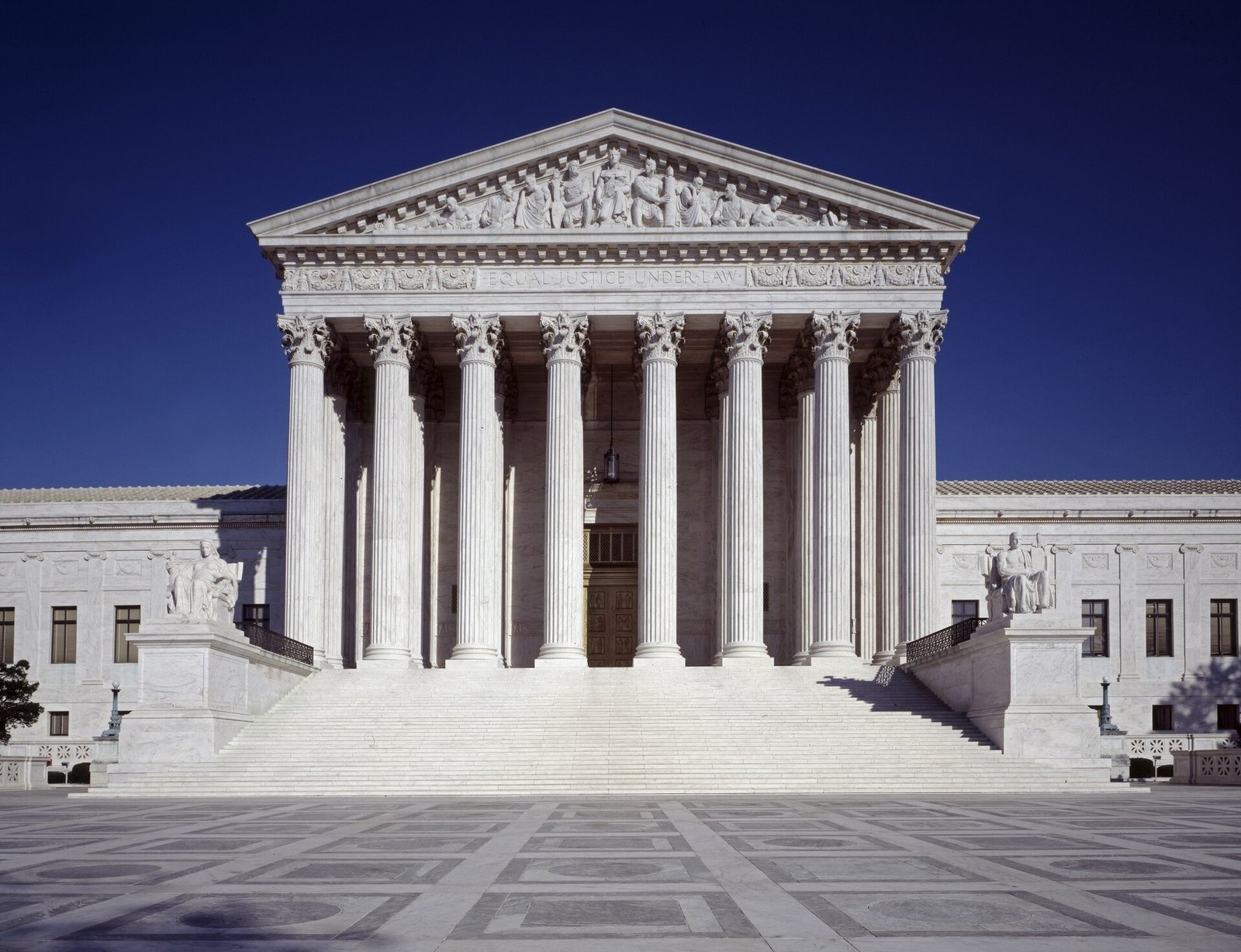
The week ending Sept. 20 delivered one of the most consequential election-law rulings of the 2026 cycle, a pair of administrative-law defeats for federal agencies on visa policy and food assistance, a state supreme court decision voiding a voter-approved energy initiative, and a District of Columbia ruling that halted — for the second time this year — an effort to attach President Donald J. Trump’s name to the Kennedy Center. Below is The Investigative Journal‘s survey of the week’s most consequential court actions, grouped by court level, with links to the underlying records.
Supreme Court
1. Justices leave USPS mail-ballot rule blocked for the midterms
The most significant order of the week came on Sept. 14, when the Supreme Court denied the federal government’s application for a stay in United States Postal Service v. California, No. 26A305. The application, presented to Justice Ketanji Brown Jackson and referred to the full Court, asked the justices to pause a district court injunction blocking parts of a new Postal Service rule governing how federal ballot mail is processed. According to the Court’s order, the government was unlikely to succeed on the merits and the equitable factors did not favor emergency relief.
The rule at issue would require federal ballot mail to travel in envelopes bearing three specified features: an election-mail logo, compatibility with high-speed processing equipment, and a specialized barcode unique to each voter. Justice Brett Kavanaugh, concurring, wrote that on the interim record there was at least a fair prospect the final rule falls within the Postal Service’s statutory authority under 39 U.S.C. § 401(2) — but that applying the rule during the 2026 elections would be arbitrary and capricious, given how little time state and local election administrators have to adapt before November. Justice Samuel Alito, joined by Justice Clarence Thomas, dissented.
The practical effect is that voters will not encounter the new envelope and portal-registration requirements this fall. The legal effect is more nuanced than the headlines suggest: Kavanaugh’s concurrence signals that a majority may yet be receptive to the Postal Service’s authority argument in a future cycle, and the order resolves timing rather than the underlying statutory question. An earlier application in the same dispute, No. 26A297, was withdrawn on Sept. 6. The merits litigation continues in the lower courts.
2. Roberts turns away employer challenges to NLRB enforcement
On Sept. 16, Chief Justice John Roberts denied a stay application in Vermont Information Processing, LLC v. National Labor Relations Board, No. 26A332. The company had asked the Court to halt a D.C. Circuit mandate requiring it to submit to a compliance proceeding before the labor board. The denial came without noted dissent.
The order fits a pattern visible across the interim docket this month. On Sept. 4, Roberts also denied a stay in NP Red Rock LLC v. NLRB, No. 26A289, which sought to pause a D.C. Circuit mandate upholding a board order requiring the Red Rock Casino Resort and Spa to bargain with a union. The same day, the full Court denied a renewed application in CEMEX Construction Materials Pacific, LLC v. NLRB, No. 26A118, which had challenged a Ninth Circuit mandate enforcing a board order. Justice Elena Kagan had denied the original CEMEX application on July 27; the company renewed it to Justice Alito the same day.
Taken together, filings indicate the Court is declining to use emergency relief as a vehicle for restructuring labor-board enforcement — at least outside the merits docket. Employers pressing structural challenges to the NLRB appear likely to need a cert grant rather than an interim order. None of these denials carries precedential weight on the underlying questions.
3. Single-justice denials cluster around ballot access
The interim docket absorbed a steady flow of election-adjacent applications as ballot-printing deadlines approached. Records on the Court’s interim docket show Justice Neil Gorsuch denied an injunction application on Sept. 17 in New Mexico Forward Party v. Oliver, No. 26A357, which sought to require New Mexico to place the party’s candidates on the November ballot. On Sept. 18, Justice Alito denied an application by a Libertarian candidate seeking placement on the ballot in New Jersey’s 7th Congressional District, and separately denied a stay in Americans for Prosperity Foundation v. Albence, No. 26A349, which challenged disclosure requirements under the Delaware Elections Disclosure Act.
These are unsigned, single-justice dispositions that decide nothing about the merits. But they reflect the Purcell principle in operation: as an election nears, courts grow increasingly reluctant to disturb the administrative status quo, regardless of which party benefits. Litigants who wait until September to seek emergency ballot relief face steep odds — a lesson that cuts across ideological lines and applies equally to the Delaware disclosure challenge and the minor-party access claims.
Federal appeals courts
4. Ninth Circuit rejects DMCA “output” theory against GitHub’s AI coding tools
On Sept. 16, the U.S. Court of Appeals for the Ninth Circuit issued its opinion in Doe v. GitHub, Inc., No. 24-7700, affirming the Northern District of California’s dismissal of Digital Millennium Copyright Act claims brought by a group of John Doe plaintiffs whose open-source software projects were used in training GitHub’s Codex and Copilot AI coding tools.
The panel found the plaintiffs had plausibly alleged an injury sufficient for Article III standing — a meaningful holding on its own, given how many AI training suits have foundered at that threshold. But the court dismissed the copyright claims on the merits reasoning that Codex and Copilot generate new works and do not remove or alter copyright management information from existing works, which is what Section 1202 of the DMCA prohibits. The panel also held that plaintiffs had forfeited their alternative “input” theory of infringement.
For the AI industry, the ruling narrows one of the more heavily used theories in the pending wave of training-data litigation. Plaintiffs suing model developers under the DMCA now face circuit-level authority in the Ninth Circuit — home to a substantial share of the defendants — that generated output does not itself strip CMI from source works. The decision does not address fair use, direct infringement, or state-law claims, all of which remain live in parallel cases.
5. Federal Circuit affirms fee award over “objectively baseless” diamond patent claims
On Sept. 17, the Federal Circuit affirmed an attorneys’ fee award entered by the Southern District of New York in Carnegie Institute of Washington v. Fenix Diamonds LLC, No. 24-1804. The court held that Carnegie should have recognized its infringement position was objectively baseless once Fenix produced evidence that its lab-grown diamonds were manufactured using a process involving extensive non-monocrystalline growth — while Carnegie’s patents claim methods using only insubstantial amounts of polycrystalline growth.
The same panel week produced In re Incept LLC, No. 25-1900, vacating and remanding a Patent Trial and Appeal Board decision that had affirmed an examiner’s rejection of medical catheter claims. The Federal Circuit found the board erred in construing “flow barrier” to describe only the positioning of the catheter’s ridges without any sealing effect — a construction the court found unsupported even under the broadest reasonable interpretation standard.
Fee awards under 35 U.S.C. § 285 remain rare, and the Federal Circuit’s willingness to affirm one signals continued appellate tolerance for district courts that sanction litigants who press claims after discovery has undercut them. Practitioners should read the opinion as a reminder that the obligation to reassess a case is ongoing, not fixed at filing.
District courts
6. Judge blocks DHS four-year cap on student and postdoctoral visas
On Sept. 14, Judge F. Dennis Saylor IV of the U.S. District Court for the District of Massachusetts issued a preliminary injunction halting a Department of Homeland Security rule that would have imposed a four-year cap on the nonimmigrant visas used by graduate students and postdoctoral researchers. The rule was set to take effect the following day. The challenge was brought by a coalition of academic groups including NAFSA: Association of International Educators and the Presidents’ Alliance on Higher Education and Immigration.
Saylor wrote that “the promulgation of the rule clearly failed to comply with the [Administrative Procedure Act],” and found that the administration’s national-security justification was weak enough to raise “legitimate questions as to whether its real purpose is not to safeguard national security and protect our borders, but to achieve other, undisclosed, goals — such as, for example, asserting greater government control over academic institutions,” according to STAT’s account of the ruling. He found a substantial likelihood of success for the plaintiffs but declined to enter summary judgment.
The policy targets what the administration has described as “forever students” who allegedly enroll perpetually to avoid departure. The rule would have replaced the “duration of status” framework in place since 1979. Federal data show international researchers account for roughly a quarter of U.S. life-science Ph.D. graduates and about 60% of postdoctoral researchers, so the stakes for research institutions are substantial. These are preliminary findings in pending litigation, not final determinations, and an appeal appears likely.
7. Oregon judge voids USDA’s retroactive SNAP compliance clock
On Sept. 17, Judge Mustafa Kasubhai of the District of Oregon ruled for 22 states and the District of Columbia in a challenge to how the Department of Agriculture implemented SNAP changes enacted in the July 2025 reconciliation law. Federal rules give states 120 days to implement certain changes before error rates begin counting against them. USDA took the position that the clock started when the law took effect — but did not announce that interpretation until late August and did not release guidance on the new noncitizen eligibility rules until Oct. 31, one day before the period was to close.
“Defendants have placed plaintiffs in an impossible situation to timely implement H.R. 1’s changes to SNAP though contradictory, absent, and misleading messaging,” Kasubhai wrote in the ruling. He held that USDA’s own regulations tie the exclusionary period to the required implementation date rather than the statute’s effective date, and that the agency had changed a years-long practice without explanation — an APA violation. A second holding found USDA’s eligibility charts unlawfully omitted refugees, asylees, and certain Afghan and Ukrainian parolees from lists of those eligible after obtaining lawful permanent residency and exempt from the five-year waiting period.
The financial exposure is significant. Court filings indicate North Carolina told the court that if its SNAP error rate remains above 10%, the state could owe as much as $420 million annually toward the program by 2028 — a figure state officials said could force it to exit SNAP, which serves roughly 1.4 million residents there. Thursday’s ruling makes permanent protections that had been in place on a temporary basis since December. USDA representatives did not immediately respond to a request for comment reported by Courthouse News Service.
8. D.C. judge blocks second Kennedy Center naming attempt
On Sept. 15, Judge Christopher Cooper of the U.S. District Court for the District of Columbia ruled that the Kennedy Center’s Board of Trustees may not install memorials honoring President Trump — or anyone other than President John F. Kennedy — at the performing arts center without congressional approval. The ruling came on an emergency request from Rep. Joyce Beatty, an Ohio Democrat and ex officio trustee.
The board’s Aug. 13 resolution had proposed three honors: an inscription reading “Renovated and restored by Donald J. Trump”; a second inscription reading “Endowed by The Trump Kennedy Center Fund” once that fund reaches $100 million; and naming the center’s grounds “President Donald J. Trump Plaza.” The board initially set a Sept. 8 implementation deadline, later extended to Oct. 8. A May 29 ruling in the same litigation had held that the federal statute creating the center named it for Kennedy alone and prohibited any other name; the center removed Trump’s name from the building in mid-June in compliance.
Following the ruling, the board voted to close the center, citing financial pressures and the naming dispute. Reporting by JURIST indicates the board had been weighing options for recognizing Trump amid concern that contributions needed for renovations could otherwise cease. A separate order this week requires the center to give 30 days’ notice before any major physical change to the building. The underlying dispute concerns statutory interpretation of the center’s enabling act, not the merits of any individual’s contributions.
State supreme courts
9. Washington Supreme Court voids Initiative 2066 on single-subject grounds
On Sept. 17, the Washington Supreme Court invalidated Initiative 2066 in a 6-3 en banc decision. Voters had approved the measure in November 2024 by a 51.7% margin; it sought to protect natural gas access and roll back portions of the state’s decarbonization framework.
Writing for the majority, Chief Justice Debra Stephens held the initiative embraced four distinct subjects — natural gas access and supply, restrictions on air quality authority, building code changes, and amendments to the Washington Decarbonization Act for Large Combination Utilities — in violation of the state constitution’s single-subject rule. “It is impossible for us to assess which of these four subjects, if any, would have received majority support had they been presented alone,” Stephens wrote, concluding that no provision could be severed and saved.
Justice Salvador Mungia dissented, writing that “the power of the people to enact their own laws is sacred” and that courts have an obligation to interpret initiatives so as to sustain their validity where possible. He would have struck only portions of the measure. The Building Industry Association of Washington, a defendant, called the decision “a direct rejection of the clearly expressed will of Washington voters.” The ruling affirms a King County Superior Court decision from last year, though on narrower grounds.
10. Missouri redistricting fight escalates into a contempt proceeding
Missouri’s congressional map dispute moved from the merits into enforcement. After the Missouri Supreme Court ruled on Sept. 3 that a veto referendum on the 2025 map could proceed and that the 2022 map must be used in November, the U.S. Supreme Court declined to intervene: Justice Kavanaugh denied a stay application in Hoskins v. von Glahn, No. 26A304 on Sept. 8, and on Sept. 10 the Court granted a stay in People Not Politicians v. Onder, No. 26A326 of a ruling that would have allowed the new map’s use.
The state high court subsequently ordered Secretary of State Denny Hoskins to appear and explain why he should not be held in contempt for directing local election officials to use the barred map, and found him in contempt. Reporting by NPR and the Missouri Independent indicates Hoskins subsequently agreed to instruct clerks to use the map the court ordered.
The sequence is notable less for its partisan valence than for what it illustrates about the mechanics of election administration. State supreme courts retain coercive authority over state officers, and the U.S. Supreme Court’s repeated declination to intervene on the interim docket left that authority undisturbed. The referendum itself remains pending before Missouri voters.
Cases to watch in the coming week
The long conference. The justices are scheduled to meet in late September for the annual “long conference,” at which they consider petitions accumulated over the summer recess. Per the Court’s case distribution schedule, grants from that conference are typically announced in early October alongside the opening of oral argument for October Term 2026. Second Amendment petitions involving large-capacity magazine and semiautomatic weapons bans have been held and carried toward the conference. Election-law watchers are tracking Republican National Committee v. Mi Familia Vota, an Arizona case raising documentary proof-of-citizenship requirements for voter registration, already on the fall docket.
Pending interim applications. Four applications remain undecided on the Court’s interim docket, including Department of Homeland Security v. League of Women Voters, No. 26A308, which asks the justices to pause a ruling barring the government from using the current version of DHS’s Systematic Alien Verification for Entitlements database to verify voter citizenship. Also pending is M.W. v. Superior Court of California, Los Angeles County, No. 26A325, a surrogacy parentage dispute.
Appeals in motion. The DHS visa-duration injunction out of Massachusetts is a strong candidate for an emergency application to the First Circuit and potentially to the Supreme Court, given the administration’s pattern of rapid appeal in APA cases. The SNAP ruling from Oregon may follow a similar path through the Ninth Circuit. In the Third Circuit, Penn State v. Vintage Brands — argued Sept. 17 and involving whether “vintage” collegiate logos can be sold as merely ornamental — awaits decision and could reshape collegiate licensing.
All facts in this report are sourced to court orders, docket entries, opinions, or the contemporaneous reporting linked above. Cases described as pending have not reached final judgment, and allegations described in filings are not findings. Parties named in adverse rulings were afforded the opportunity to comment through the outlets cited; where a response was not received, that is noted. Corrections may be directed to the editor.