

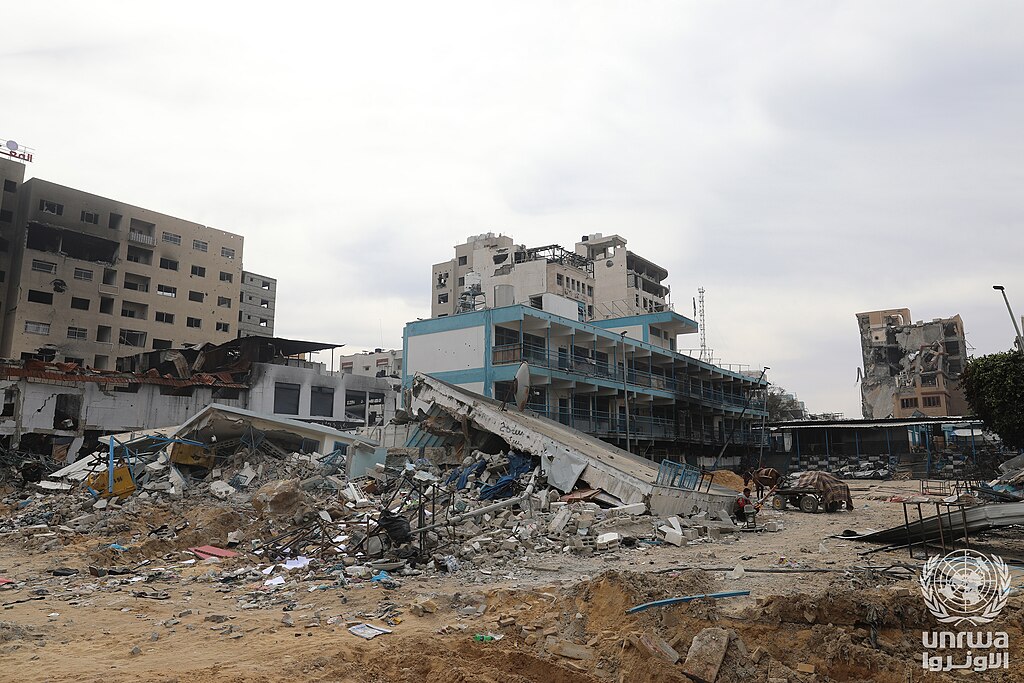
On the morning of October 7, 2023, Hamas launched the deadliest attack on Israeli civilians in the nation’s history. In the weeks that followed, Israeli intelligence provided documentation to the United Nations alleging that nineteen employees of the United Nations Relief and Works Agency for Palestine Refugees — UNRWA, the largest UN agency operating in Gaza — had participated in or supported the attack. The UN Office of Internal Oversight Services completed its investigation in August 2024 and concluded that evidence indicated nine staff members “may have been involved” in the attacks, that evidence for nine others was “insufficient” to support the allegations, and that for one employee no evidence was obtained. The careful bureaucratic language could not obscure the fundamental finding: a significant number of employees of a UN agency funded overwhelmingly by Western democracies had credible links to a designated terrorist organization.
UNRWA’s total funding in 2023 was $1.47 billion, drawn almost entirely from voluntary contributions by individual governments. The European Union and the United States together accounted for roughly $865 million — 75 percent of the agency’s $1.16 billion operating budget. The United States was the first country to suspend UNRWA funding in January 2024, followed by fifteen other nations. Prior to the suspension, U.S. funding for fiscal year 2024 had reached $121 million, though this was well below the $360 million annually that the U.S. had provided before the Trump administration’s 2018 cutoff.
The Investigation and Its Limits
The USAID Office of Inspector General initiated its own proactive investigation following October 7, and its findings raised additional concerns about the UN’s internal oversight capacity. The Inspector General found that the UN’s Office of Internal Oversight Services had redacted valuable information at UNRWA’s request, further obscuring the extent of staff involvement. The House Committee on Oversight and Government Reform, under Chairman James Comer, launched a separate investigation into what it characterized as UNRWA obstruction of accountability efforts. Israeli military documentation with specific allegations against twelve staff members provided the evidentiary foundation for multiple parallel investigations, but the compartmentalized nature of UN oversight meant that no single body had access to the complete picture.
The international response to the funding suspensions reflected the tension between humanitarian imperatives and accountability concerns. By mid-2024, several countries had reinstated their UNRWA funding, recognizing what a joint U.S.-U.K. statement described as the agency’s “extremely critical financial situation” alongside 116 other governments. The reinstating nations acknowledged “serious humanitarian, political and security risks” from the suspension — an implicit admission that UNRWA had become so deeply embedded in Gaza’s infrastructure that withdrawing support would inflict humanitarian harm regardless of the agency’s institutional failures. The United States and United Kingdom remained holdouts as of July 2024.
The Structural Problem
The staff involvement allegations, while shocking, are symptoms of a deeper institutional dysfunction. UNRWA employs approximately 30,000 people in Gaza, the West Bank, Jordan, Lebanon, and Syria — making it one of the largest employers in the Palestinian territories. In Gaza, where Hamas has governed since 2007, the overlap between the agency’s workforce and the territory’s ruling political-military organization is a structural inevitability that UNRWA has been unwilling to confront directly. The agency operates schools, health clinics, and social services that serve millions of Palestinian refugees, and its defenders argue that no alternative institution exists to provide these services at scale.
This argument, while factually accurate, has become a shield against accountability. The notion that UNRWA is too important to reform — that any meaningful investigation or restructuring would compromise humanitarian operations — creates a perverse incentive structure in which the agency’s indispensability protects it from the consequences of its failures. Western taxpayers are asked to fund an organization that cannot guarantee its employees are not members of or sympathizers with a group that massacred civilians, and the justification offered is that the alternative would be worse.
The honest question is whether an agency this compromised can be reformed or whether the international community needs to develop alternative mechanisms for delivering humanitarian services to Palestinian refugees. That conversation has been avoided for decades because it implicates the broader political questions surrounding the Israeli-Palestinian conflict — questions that no government or international institution wants to address directly. But the events of October 7 and their aftermath have made the status quo untenable. Continuing to fund UNRWA without fundamental structural reform is not humanitarianism; it is institutional inertia dressed in moral language, and the people who ultimately pay the price are the Palestinian refugees whose welfare the agency was created to protect.
Sources: OFAC SDN List | State Dept. Iran Sanctions | MarineTraffic AIS Data | Panama Maritime Authority | Treasury Sanctions Programs