

The Investigative Journal tracks federal enforcement daily. This digest summarizes notable Justice Department actions announced in the week ending September 21, 2026, drawn from the Department’s published press releases and the court records they cite. Charges described as alleged are accusations only; defendants in pending matters are presumed innocent unless and until proven guilty.
Former Nodus Bank CEO sentenced to 112 months in fraud and sanctions-evasion case
The Justice Department’s most consequential white-collar announcement of the week concerned the collapse of a Puerto Rican international bank. According to a Criminal Division press release issued September 21, Tomás Niembro Concha, 64, a Spanish and Venezuelan national and the former chief executive officer of Nodus International Bank, was sentenced to 112 months in prison and three years of supervised release. He was ordered to forfeit more than $16.9 million, an amount the Department describes as the value of the proceeds he derived from the wire fraud conspiracy.
Niembro pleaded guilty on March 19 to a two-count information charging conspiracy to commit wire fraud and conspiracy to violate the International Emergency Economic Powers Act. Court filings cited by the Department indicate that between 2017 and 2023 Niembro and Board Chairman Juan Ramirez caused Nodus Bank to invest $11 million in a Miami-based lender so that those funds could be routed back to the two men as personal loans, and separately induced the bank’s board and comptroller to purchase at least 47 promissory notes totaling roughly $25.3 million from Nodus Finance, a Miami company the pair jointly owned. Filings indicate the scheme was concealed from other board members, executives, and the bank’s regulator, Puerto Rico’s Office of the Commissioner of Financial Institutions, and that it ultimately contributed to the bank’s 2023 failure.
The sanctions count is the element with the broadest policy significance. Between 2021 and 2023, according to the Department, Niembro conspired to conduct prohibited transactions with an individual designated by the Treasury Department’s Office of Foreign Assets Control as a Specially Designated National for providing material support to Petróleos de Venezuela, S.A. The arrangement described in the release involved obtaining OFAC authorization to foreclose on the designated person’s Southampton, New York, home, then executing a separate private agreement to sell the property back to that same individual for $4 million through a front company — a transaction the Department says was never licensed. “When individuals who are supposed to serve as gatekeepers to our financial system choose to abuse that trust,” Assistant Attorney General A. Tysen Duva of the Criminal Division said in the release, “the Criminal Division will hold them accountable.” IRS Criminal Investigation led the inquiry.
Vitol trader sentenced to four years in Ecuador and Mexico bribery schemes
On the same day, the Department announced that Javier Aguilar, 52, a Mexican national living in Houston and a former oil trader, was sentenced in Brooklyn to four years in prison, ordered to forfeit $7.13 million, and fined $100,000 for his role in two foreign bribery schemes. A jury convicted Aguilar of conspiracy to violate the Foreign Corrupt Practices Act, a substantive FCPA violation tied to the Ecuador scheme, and conspiracy to commit money laundering; he separately pleaded guilty to FCPA and Travel Act conspiracy counts connected to Mexico.
Trial evidence summarized by the Department indicates Aguilar paid more than $1 million in bribes to officials of Ecuador’s state oil company Petroecuador and of PEMEX Procurement International, a subsidiary of Mexico’s state oil company, while employed as a trader at Vitol Inc. between 2015 and 2020. The Ecuador scheme secured a $300 million fuel oil contract, with Aguilar and co-conspirators routing the deal through a Middle Eastern state-owned entity to circumvent Petroecuador’s restrictions on contracting with private companies. Roughly $600,000 in bribes to PEMEX Procurement International officials secured contracts to supply ethane gas. The concealment architecture — fake contracts, sham invoices, and shell entities in Curaçao, Panama, and the Cayman Islands, plus alias email accounts — is a familiar template in commodities-corruption prosecutions.
The case is notable for its accumulated reach rather than its individual sentence. Seven co-conspirators, including three foreign government officials, have pleaded guilty and collectively agreed to forfeit more than $63 million. Vitol itself admitted FCPA anti-bribery violations in Ecuador, Mexico, and Brazil in December 2020 under a deferred prosecution agreement that carried $135 million in combined penalties coordinated with the Commodity Futures Trading Commission and Brazilian authorities. FBI Miami’s International Corruption Squad investigated.
Sixteen charged in coordinated non-citizen voting cases
In a September 18 announcement, the Department disclosed charges against 16 individuals across eight federal districts in connection with alleged illegal voting, illegal voter registration, and related election-fraud conduct. The charges include voting by an alien in a federal election, false claims of citizenship to register or vote, and collateral offenses — wire fraud, naturalization fraud, passport fraud, and unlawful firearm purchases — that the Department says were uncovered during the investigations.
The Northern District of Texas accounts for the largest cluster, with eight defendants. Other charged matters arise in the Western District of Texas, Idaho, the Northern District of Georgia, Massachusetts, the Western District of Wisconsin, New Jersey, and the Eastern District of Michigan. The Idaho matter is the broadest single indictment: a federal grand jury in Boise returned charges spanning wire fraud, theft of government funds, false statement of citizenship in order to vote, voting by an alien, false statement in a passport application, fraudulent production of identification documents, and firearms offenses.
Every case in this announcement is at the charging stage. The Department’s own release states plainly that “a complaint, indictment, and information merely contain accusations” and that all defendants are presumed innocent. This is the third such multi-district announcement the Department has made this month, following charges against six individuals in California, Kansas, and Louisiana on September 14 and five defendants in Pennsylvania, New Jersey, and Wisconsin on September 4. The cadence suggests a sustained referral pipeline rather than a single sweep, and the case outcomes — conviction rates, dismissals, and sentences — will be the meaningful measure once these matters reach disposition.
Arizona clinic owner draws 14 years in $69 million Medicaid fraud
Rita Ntusa Anagho, 54, a licensed nurse practitioner who owned Tusa Integrated Clinic LLC, was sentenced on September 17 to 14 years in prison. Court documents cited by the Department show Tusa billed the Arizona Health Care Cost Containment System more than $69 million between approximately May 2022 and March 2023, of which the state program paid roughly $54.9 million. Anagho was ordered to pay nearly $55 million in restitution and to forfeit almost $9.5 million seized from seven bank accounts plus nearly $7 million in real estate. She pleaded guilty in May 2025 to conspiracy to commit wire fraud and health care fraud.
The targeting described in the record is the aggravating detail. Filings indicate the scheme deliberately recruited patients covered under the American Indian Health Care Program fee-for-service plan because it reimbursed at higher rates than other AHCCCS plans. The Department says Anagho billed for addiction treatment services that were either never provided or not provided as billed, paid kickbacks to sober-home operators for patient referrals, falsified treatment records, and — after Tusa received a document subpoena — instructed former employees to create fabricated medical records. “Ms. Anagho’s scheme manipulated a program that was intended to help Native Americans in Arizona,” U.S. Attorney Timothy Courchaine for the District of Arizona said in the release. The FBI and the Department of Health and Human Services Office of Inspector General investigated.
Syrian prison warden sentenced to 60 years for torture
Samir Ousman Alsheikh, 74, a former Syrian prison warden and provincial governor, was sentenced on September 17 to 60 years in prison in the Central District of California. A jury convicted him in March 2026 of conspiracy to commit torture, three substantive torture counts, visa fraud, and attempted naturalization fraud. Trial evidence established that he ordered and participated in the torture of prisoners while heading Adra Prison outside Damascus from roughly 2005 to 2008, and that he later lied to U.S. immigration authorities about his background to obtain a green card. He entered the United States in 2020 and has been in custody since his arrest in July 2024.
Three victims testified at trial. Assistant Attorney General Duva stated in the release that Alsheikh “is the highest-ranking former member of the Assad regime to be tried and convicted in person outside of Syria,” and credited cooperation from Germany’s Federal Criminal Police Office. The prosecution was handled by the Criminal Division’s Human Rights and Special Prosecutions Section with Homeland Security Investigations Los Angeles and the FBI. For accountability reporting, the case is a practical demonstration that the extraterritorial torture statute and immigration-fraud charges can function together where direct evidence of overseas conduct survives displacement and time.
$2.5 million in Gambian corruption proceeds returned
The Department announced on September 18 the return of $2,507,911.73 to the Republic of The Gambia — the net proceeds from the forfeiture and sale of a Potomac, Maryland, mansion. As alleged in the civil forfeiture complaint, former Gambian President Yahya Jammeh and his wife Zineb Jammeh purchased the property with misappropriated public funds and criminal proceeds, and Jammeh obtained millions through embezzlement and bribes solicited from businesses seeking monopoly rights over sectors of the Gambian economy. Under an agreement with The Gambia, the funds are to compensate eligible victims as defined under that country’s Victims Reparations Act of 2023.
Homeland Security Investigations’ Illicit Proceeds and Foreign Corruption Group in Miami led the investigation; the Department notes the group has seized more than $500 million traced to foreign corruption since its 2003 establishment. No U.S. criminal conviction of the Jammehs is claimed in the release — this is a civil forfeiture outcome, and the underlying corruption remains an allegation as a matter of U.S. law.
Durable medical equipment supplier settles False Claims Act allegations for $825,000
Crown Medical Solutions LLC and its owners, Michelle King and Philanzo King, agreed to pay $825,000 to resolve allegations they submitted false claims to Medicare, the Department announced September 21. The government alleged that from November 1, 2017 through April 30, 2019, Crown billed Medicare for durable medical equipment — knee braces, heel stabilizers, and back braces — that was not medically necessary or not properly prescribed by a physician. The release states the settlement amount is based on the defendants’ ability to pay.
The matter originated as a qui tam action, United States ex rel. Martinelli v. Crown Medical Solutions, LLC, No. 1:19-cv-01660 (N.D. Ga.), with relator Karen Martinelli set to receive approximately $123,750. The Department’s release is explicit that “the claims resolved by the settlement are allegations only and there has been no determination of liability.”
Justice Manual revised on False Claims Act enforcement
On the policy side, the Department announced revisions to the Justice Manual on September 18 covering two areas. The first reinstates and expands the Department’s 2017 position that sub-regulatory guidance cannot impose legal obligations beyond those established by statute or regulation. The second directs Department litigators to consider exercising dismissal authority over qui tam actions in which the government declines to intervene, and to revisit that assessment during litigation.
“The Department of Justice should enforce the law, not make law through enforcement,” Associate Attorney General Stanley E. Woodward, Jr. said in the release. The revised provisions appear at JM 1-19.000 and JM 4-4.000. The practical effect on the relator bar deserves watching: qui tam actions generate a substantial share of False Claims Act recoveries, and a more active dismissal posture in declined cases will shape which theories survive to discovery.
What warrants a closer look
Three threads from this week merit further TIJ reporting. First, the Nodus Bank failure: a regulated institution collapsed in 2023 after what the Department describes as years of self-dealing concealed from its board and its regulator. The supervisory record at Puerto Rico’s Office of the Commissioner of Financial Institutions — what was examined, when, and what was missed — is a documentary question that public filings may answer.
Second, the Arizona sober-home referral economy. The Anagho prosecution describes kickbacks paid to the owners of “numerous” area sober homes, but names none of them. Whether those operators face separate exposure, and how many patients were moved through that network, is traceable through AHCCCS provider data and subsequent filings.
Third, the election-crime charging cadence. Three multi-district announcements in under three weeks is a measurable shift in resource allocation. The reportable question is not the announcements themselves but the dispositions — how many of these charges survive to conviction, and what the sentences look like. TIJ will track the dockets.
Right of reply: this digest summarizes Justice Department press releases and the public filings they cite. Counsel for any named individual or entity may submit a response to The Investigative Journal for publication.
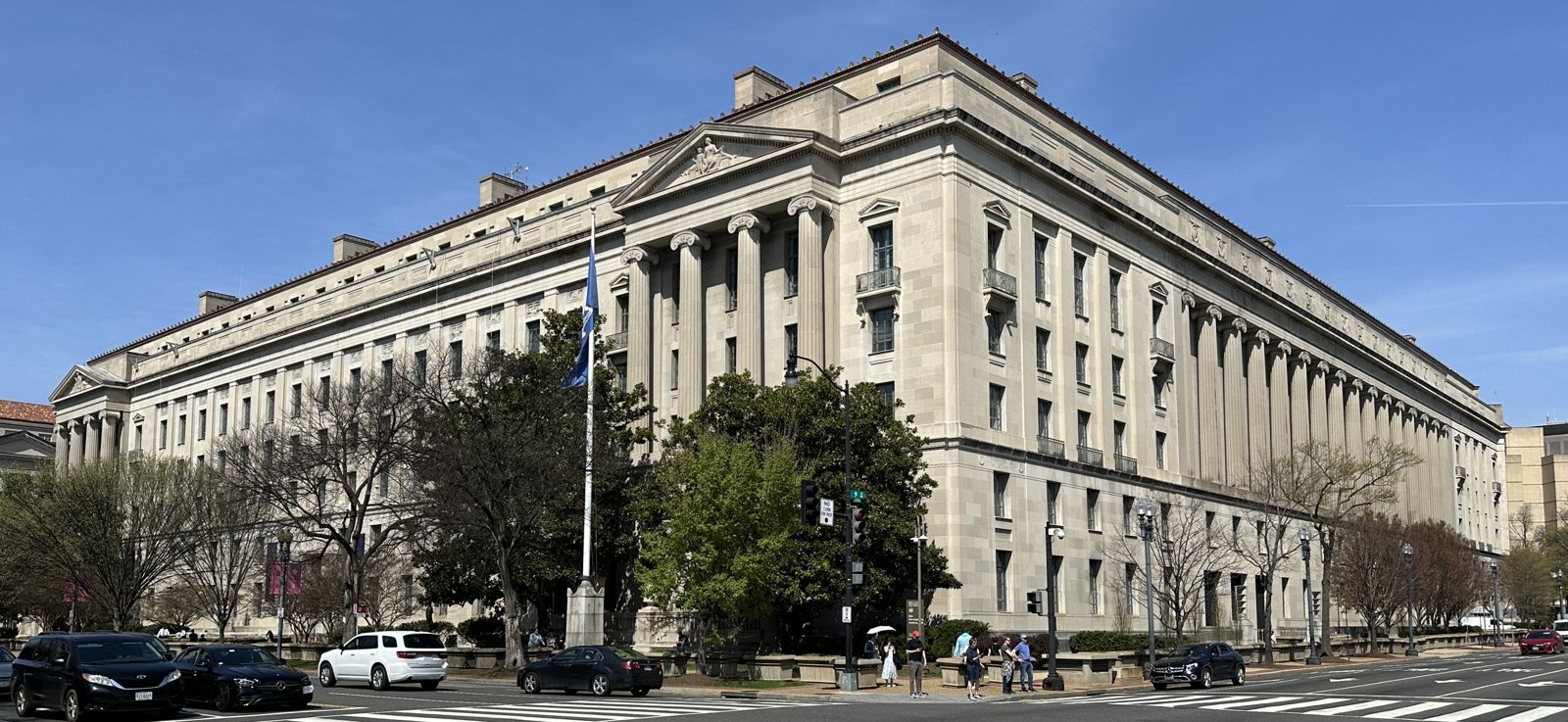
Featured image: Robert F. Kennedy Department of Justice Building, Washington, D.C. Photo by APK via Wikimedia Commons, licensed CC BY 4.0.