

By Eduardo Bacci, The Investigative Journal. Sunday, October 18, 2026. Today’s wire draws on primary records published by the Justice Department, the White House, the Supreme Court and its reporters, and live coverage of overseas developments. Unless noted, every matter below is an allegation, a filing or a pending proceeding, not a finding.
Government
1. Justice Department sues California over its voter list
On October 15 the Justice Department, working with the Department of Homeland Security, filed suit against the State of California over its voter rolls. According to the department’s release, federal officials believe more than 20,000 likely noncitizens are registered to vote in the state, and the complaint alleges they registered or voted in federal elections.
The release says Homeland Security Investigations compared publicly available voter-registration records against federal immigration data, and describes the findings as preliminary with analysis ongoing. It also states that California was given the opportunity to remove suspected noncitizens and to sequester ballots from suspected ineligible voters, and declined. The complaint alleges the state’s practice of mailing ballots to every registered voter compounds the problem.
Those are the government’s allegations. The release does not include California’s response or any court ruling, and matching registration data to immigration records is a method whose error rates courts will likely scrutinize. With the midterm elections less than three weeks away, the timing guarantees the case will draw attention; how quickly a judge acts is the question to track.
2. DOJ challenges mask bans and ID rules for federal officers in St. Paul and Portland
The same day, the department filed two complaints against the cities of St. Paul, Minnesota, and Portland, Oregon. The suits target local ordinances that bar federal officers from wearing masks and require them to identify themselves in a prescribed manner, citing St. Paul Code sections 268A and 268B and Portland City Code sections 23.30.030 and 23.30.100.
The department’s theory rests on the Supremacy Clause: that localities cannot regulate the federal government or its law enforcement officers. It argues the rules endanger agents who have faced harassment, doxxing and violence. The release describes the filings as part of a Civil Division effort that already includes similar suits involving New York, Virginia, Connecticut, New Jersey, California, Maryland, Philadelphia, Denver and Milwaukee.
The release does not name the courts or detail the relief sought. The cities have not yet answered in the public record available to us, and the intergovernmental-immunity questions these cases raise are well established but fact-dependent.
3. Sixteen people charged in illegal-voting cases
On October 16 the department announced charges against 16 people across three districts: ten in the Eastern District of North Carolina, five in the Northern District of New York and one in the District of Idaho. The charges include voting by an alien and, in North Carolina, falsely claiming citizenship to vote.
The release itself supplies an important qualifier: in North Carolina only one defendant, identified as 22-year-old Eduardd Omar Majano Sosa, is described as an illegal alien, while the others are described as lawful permanent residents. The department states that all defendants are presumed innocent until proven guilty beyond a reasonable doubt and that charging documents contain only accusations.
4. Funding runs through December 11
The October shutdown was averted when the House passed a stopgap measure 370-48 under suspension of the rules, according to Breaking Defense. The Senate had passed the bipartisan deal in August. The bill funds government operations through December 11, keeps current Pentagon weapons programs at fiscal 2026 levels, and spares civilians from furlough.
The measure leaves difficult work for the lame-duck session. It excludes the Iran war funding requested in the president’s supplemental and omits most of the Pentagon’s requested exemptions, including $1 billion for the Trump-class battleship and language for multiyear munitions contracts on five programs. Without a sequestration exemption for reconciliation funds, the White House said about 8 percent of unobligated reconciliation money would become unavailable. Congress must now pass full-year appropriations by December 11.
5. Three bills signed into law
The White House announced October 15 that the president signed S. 240, which amends the Crow Tribe Water Rights Settlement Act to give more flexibility in completing water projects on the Montana reservation; S. 283, the Illegal Red Snapper and Tuna Enforcement Act, which directs the Commerce Department to develop a standard chemistry-based method for determining seafood’s country of origin; and S. 2403, the Retire through Ownership Act, which amends ERISA to define adequate consideration for certain closely held stock. None is sweeping, but the seafood-origin measure gives federal enforcers a scientific tool against mislabeled imports.
Courts
6. Supreme Court pauses Fourth Circuit order in political ad-rate dispute
On October 14 the justices granted the government’s request to pause a Fourth Circuit order in FCC v. Brown, in a five-page unsigned opinion. Justices Sotomayor and Jackson would have denied the requests. The separate application from Republican committees was dismissed as moot, per SCOTUSblog.
The dispute concerns discounted advertising rates that federal law gives candidates in the 45 days before a primary and 60 days before a general election. In March the FCC’s Media Bureau issued a notice saying parties and joint fundraising committees should receive those rates too. Democratic candidates sued in June while their request for full-commission review was pending, and a divided Fourth Circuit panel sided with them. The Court found that an order demanding a decision within 48 hours on a petition filed five months earlier likely violated separation of powers and would cause irreparable harm by forcing the agency to rush. The FCC has no obligation to rule on any timeline, the discounted rates remain in place for now, and the underlying appeal continues.
7. Cities ask the Court to pause a Texas-DOJ consent judgment
In City of Baltimore v. Texas (No. 26A500), Baltimore, New Haven, Columbus and the legal-services group Centro Legal de la Raza asked the justices to pause an agreement between Texas and the Justice Department. The agreement ended a 2024 Executive Office for Immigration Review rule allowing immigration judges to administratively close some deportation proceedings.
According to SCOTUSblog, Chief Judge Reed O’Connor entered final judgment within hours of Texas’s filing at the request of both sides, then denied the cities’ bid to intervene for lack of standing; the Fifth Circuit declined to block the judgment. Their lawyer describes the arrangement as collusion, a characterization that is the challengers’ own and that the defendants may contest. The question of whether an agency can sidestep notice-and-comment rulemaking by declining to defend a rule is the issue to watch.
8. Solicitor General seeks limits on vacatur of agency rules
On October 14 Solicitor General D. John Sauer filed a petition in HHS v. Texas Medical Association (No. 26-491), asking the Court to decide whether and when a court may vacate an agency action in its entirety. The case arises from rules implementing the No Surprises Act, and the full Fifth Circuit vacated some of the challenged provisions in an opinion joined by nine judges.
Sauer, relying on Trump v. CASA (2025), argues that vacatur “as to everyone” mirrors the universal injunctions the Court curtailed, encourages forum shopping and burdens courts with emergency applications. A response is currently due November 13, though it may be extended.
9. New cases granted for the term
On October 13 the Court granted review in three cases: U.S. DOGE Service v. U.S. District Court for the District of Columbia, on discovery orders in a FOIA dispute with the watchdog CREW; Blanche v. Ozurumba, on what counts as material support for a terrorist organization; and Berry v. United States, on certificates of appealability. The Court’s next scheduled orders session is Monday, October 19, at 9:30 a.m.
10. Lexington, Mississippi police settlement
On October 16 the department announced a settlement with the City of Lexington over its police department, resolving violations identified in a September 2024 findings report under 34 U.S.C. 12601. The city will amend policies on fines, fees and bail, and revise rules on stops, searches, arrests and use of force. The release characterizes the underlying violations as alleged.
International
11. CENTCOM describes economic pressure on Iran
According to the Times of Israel’s October 17 live coverage, CENTCOM commander Adm. Brad Cooper said the U.S. naval blockade has blocked about $25 billion in Iranian oil exports and helped freeze roughly $350 million in Iranian cryptocurrency, and that U.S. forces escorted about 400 merchant vessels through the Strait of Hormuz in the past week. Those are U.S. military claims we could not independently verify. Background compiled on Wikipedia traces the blockade to April 13, its lifting in June after a memorandum of understanding, and its reinstatement in July.
The same coverage reports that Iran’s Revolutionary Guards said a tanker carrying more than 2 million barrels exploded after hitting a naval mine on an unauthorized route, and that another tanker was struck by an unknown projectile off Saudi Arabia. It also cites a Wall Street Journal report that Iran has increased intelligence and targeting help to the Houthis, who have struck Saudi targets; Saudi Arabia said it downed four drones, including one over Riyadh. These accounts are attributed and unconfirmed.
12. Israel’s election campaign tightens
Israel votes October 27. Opposition leader Yair Lapid said he does not trust Prime Minister Netanyahu not to launch an Iran strike that could disrupt the election, per the same live coverage. Avigdor Liberman urged voters in the opposition bloc to back a single party and push turnout above 76 percent, and Gadi Eisenkot, whose Yashar party leads the opposition in polls, denied seeking a post-election deal with Netanyahu. These are campaign claims, not established facts.
13. UN secretary-general race: informal poll
Former Costa Rican vice president Rebeca Grynspan narrowly led an informal Security Council straw poll for UN secretary-general, the Times of Israel reported, though every candidate drew at least one permanent-member veto signal. Pakistan’s Express Tribune reported a similar result on October 11. The polls are non-binding.
14. West Bank: reported attack on a journalist
The live coverage reports that American photojournalist Heidi Levine, working for The Washington Post, was beaten by settlers in Abu Falah and underwent surgery on a nearly severed finger. It also reports continued harassment of Palestinian olive pickers. The IDF had not commented on the incidents at the time of reporting, and Netanyahu’s office has said it is too early to draw conclusions about a separate attack in Taybeh. Investigations are pending.
Worth Watching
Monday, October 19: The Supreme Court issues orders at 9:30 a.m. ET; the justices considered petitions at their October 16 conference, so new grants or denials are possible. Watch for any movement on the Baltimore application (No. 26A500).
Ongoing: California’s response to the Justice Department’s voter-list suit, and early docket activity in the St. Paul and Portland cases.
October 27: Israel’s election. The Iran blockade, Hormuz shipping incidents and Houthi attacks on Saudi targets bear on its backdrop.
November 13: Current deadline for the response in HHS v. Texas Medical Association.
December 11: Expiration of the stopgap funding bill, with Iran war supplemental money and Pentagon exemptions unresolved.
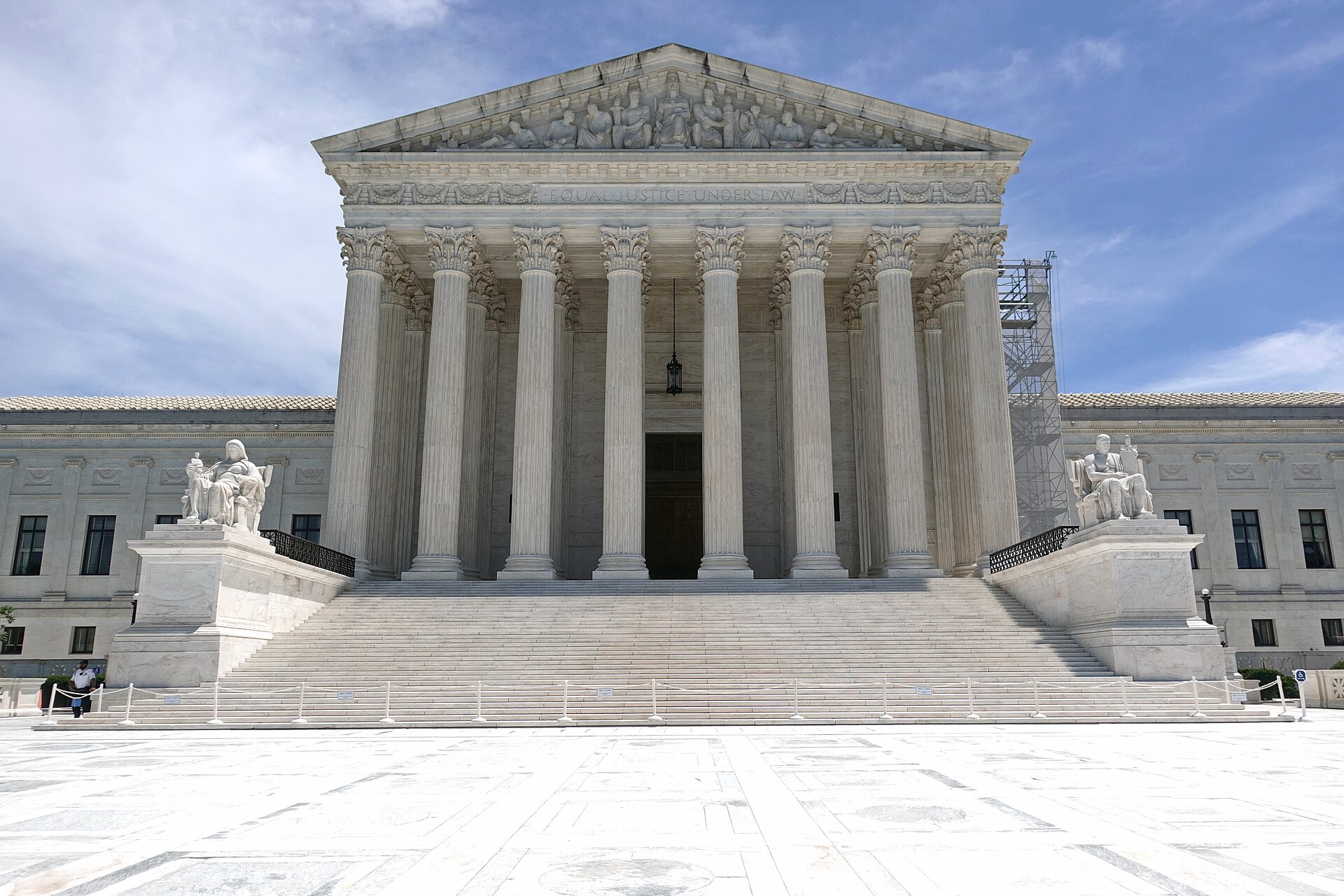
Right of reply: The Investigative Journal invites any person or agency named above to submit a response for publication. Contact the editor at the address listed on tij.news. Featured image: Exterior of the U.S. Supreme Court Building, by 颐园居, via Wikimedia Commons, licensed CC BY-SA 4.0.