
Federal prosecutors closed out a busy week with a docket spanning public corruption, classified-information leaks, a multi-scheme health care fraud sweep in Los Angeles, a lengthy Medicare fraud sentence, an international cryptocurrency-laundering extradition and a coordinated set of election-related prosecutions in California. This edition of DOJ Watch summarizes six actions announced between October 19 and October 23, 2026, drawing on Justice Department press releases. Each case described below that involves a pending charge is an allegation only; the Justice Department states that all defendants are presumed innocent unless and until proven guilty beyond a reasonable doubt in a court of law.
1. Virginia State Senator Indicted in Racketeering Case
The most prominent action of the week came on October 22, when the Justice Department announced an eight-count indictment naming Virginia state Sen. Lillie Louise Lucas, 82, of Portsmouth, as the alleged leader of what prosecutors call the “Lucas Enterprise.” According to the Justice Department’s press release, the indictment charges racketeering conspiracy and includes counts of marijuana distribution, money laundering, honest services fraud through bribery, maintaining drug-involved premises, possession of firearms in furtherance of drug trafficking and wire fraud. The release says seven defendants were charged in total; it names Lucas, business partner Carlton Upton Jr., 54, of Chesapeake, and several alleged participants, but does not specify which defendant faces which count.
Prosecutors allege Lucas directed an effort to acquire and distribute 100 kilograms or more of marijuana and supervised the laundering of proceeds. The release further alleges she used her position as chairwoman of the Senate Finance and Appropriations Committee to shield the enterprise and to influence legislation that would benefit it. It also alleges that in August 2022 she paid $750,000 for a 100 percent stake in a shell company tied to a co-conspirator’s expected recreational marijuana license, and that she did not report the interest on required ethics forms. The FBI Director described the alleged scheme as lasting five years and worth an estimated $4.5 million, according to the release. Agents executed search warrants on May 6 at two retail locations and, per the release, recovered marijuana and firearms.
The case is being prosecuted by the U.S. Attorney’s Office for the Eastern District of Virginia. Its significance is twofold: it involves a sitting legislator who chairs a powerful budget committee, and the bribery theory rests on honest-services fraud, a statute whose reach the Supreme Court has narrowed in recent years. Defense challenges to that theory, as well as to the search warrants, are likely. The press release does not list potential penalties. TIJ has not yet reviewed the indictment itself and will seek the court filing; the defendants have not publicly responded in the materials we reviewed, and TIJ will update this item upon receiving any statement.
2. Government Contractor Arrested Over Alleged Leak of National Defense Information
On October 23, the Justice Department announced the arrest of Ian A. Brinksman, 42, of the District of Columbia, on a criminal complaint charging one count of unlawfully transmitting national defense information. The release states that Brinksman worked for a U.S. government agency based in the Eastern District of Virginia beginning in 2020 and, from 2022, as a systems integration developer for a contractor to that agency. He is alleged to have held a Top Secret clearance with Sensitive Compartmented Information access.
According to the Justice Department, Brinksman “reached far outside his own duties” to obtain classified information and passed it to a romantic partner, identified only as Individual 1, whom he allegedly knew intended to publish it. The release says Individual 1 operates a Substack publication that repeatedly posted classified material, including a September 2026 fundraising article claiming its reporting drew on classified assessments, and posted the line “I also accept leaks.” The case was referred by the CIA and investigated by the FBI’s Chicago Field Office with help from the Washington Field Office, with the National Security Division’s Counterintelligence and Export Control Section and the U.S. Attorney’s Offices for the Eastern District of Virginia and the District of Columbia prosecuting.
The complaint is an accusation, and no indictment had been described in the release. The case will draw attention because the alleged recipient publishes independently, which raises questions about how prosecutors will treat the recipient’s conduct. The release describes only the charge against Brinksman, and it does not announce any charge against Individual 1. Whether any further charges follow is unknown.
3. Los Angeles Health Care Fraud Takedown: 15 Defendants, More Than $1.8 Billion in Claims
Also on October 22, the department’s National Fraud Enforcement Division announced a Los Angeles takedown with charges against 15 defendants, including six medical professionals, alleging more than $1.8 billion in fraudulent claims to government and private health care programs. Eight people were arrested on October 22; the case is in the U.S. District Court for the Central District of California, with two defendants appearing in Texas.
The largest alleged scheme, valued at more than $1.6 billion in claims to private insurers, involves substance abuse treatment. Prosecutors allege that David and Nathan Young and Honey and Cody Phipps trafficked vulnerable patients to Southern California for sham treatment; the Justice Department says it is the largest case of its type it has prosecuted. Separately, Nicholas Moore pleaded guilty to a superseding information and admitted assisting in $199 million in fraudulent claims. Other alleged schemes include unnecessary arterial procedures billed to Medicare at roughly $134 million to $135 million, hospice enrollment of non-terminal patients totaling more than $138 million across three schemes, kickbacks for genetic testing orders and patient referrals, a roughly $270 million Medi-Cal pharmacy fraud (about $178.7 million allegedly paid) and the alleged sale of prescription drug samples, including diabetes and weight-loss medications.
The investigation involved the FBI, HHS Office of Inspector General, IRS Criminal Investigation, DEA, the U.S. Marshals Service and the California Department of Justice. Charges are allegations, and only Moore has been described as pleading guilty. The scale of the private-insurer substance abuse case suggests that commercial payers, not only Medicare and Medicaid, are an increasing focus of federal fraud prosecutions.
4. Telemedicine Owner Sentenced to 20 Years in $46 Million Medicare Fraud
In a resolved case, the Justice Department announced on October 23 that Christopher Harwood, 44, of Fort Lauderdale, owner of telemedicine company TelevisitMD, was sentenced to 20 years in prison. He pleaded guilty in March 2026 to conspiracy to commit health care fraud and wire fraud and was ordered to pay $17,942,402 in restitution and $10,431,463 in forfeiture.
According to the release, the conspiracy ran for more than six years. Harwood and co-conspirators allegedly used telemarketing to persuade Medicare patients to accept orthotic braces and genetic tests they did not need, paid doctors who had no genuine relationship with the patients to sign orders, and sold the signed orders to equipment suppliers, laboratories and marketers. Harwood also owned Florida durable medical equipment companies that billed Medicare. False claims totaled $46.2 million, of which Medicare paid $17.9 million, and Harwood personally profited more than $10.4 million, the release states. The FBI’s Miami Field Office and HHS-OIG investigated.
The sentence is a reminder that the telemedicine-ordering model remains a priority for prosecutors, and that guilty pleas can still produce multi-decade terms where loss and profit figures are substantial.
5. Chinese National Extradited in Cryptocurrency Laundering Case
Also on October 23, Zheng Zhao, 44, a Chinese national, was arraigned in the Central District of California after extradition from the Netherlands. He was charged in August 2025 with conspiracy to commit money laundering, which carries a maximum of 20 years in prison. The Justice Department alleges an international network operating from scam centers in Cambodia contacted U.S. victims through social media, calls, texts and dating services and steered them to fake cryptocurrency trading websites. Authorities identified 174 U.S. victims, and more than $36.9 million was allegedly moved to a single account at Deltec Bank in the Bahamas, converted to Tether and sent to a Cambodian wallet.
Eight co-conspirators have pleaded guilty, according to the release; two of them, ShengSheng He and Jingliang Su, were sentenced to 51 and 46 months, respectively, after pleading guilty to conspiracy to operate an unlicensed money transmitting business. The investigation was led by the U.S. Secret Service with assistance from several federal agencies and Dutch authorities. The case illustrates the department’s use of extradition and international cooperation against transnational “pig butchering” style fraud, and Zhao is presumed innocent.
6. Operation Protect the Vote: 28 Charged in California
Earlier in the week, on October 19, the department announced charges against 28 foreign nationals in California under what it called “Operation Protect the Vote,” a joint effort of the state’s four U.S. Attorney’s Offices with Homeland Security Investigations. All 28 are lawful permanent residents, and 11 were arrested. Charges include false statements in naturalization applications and fraudulent voter registration, mostly felonies carrying up to five years, as well as, in the Eastern District, a misdemeanor count of voting by an alien in a federal election carrying up to one year.
The release says the cases follow a dispute between the federal government and California: on October 13 the department provided the state a list of individuals to assist in setting aside mail-in ballots until citizenship could be confirmed, California declined, and the United States sued. The list reportedly includes more than 20,000 likely noncitizen registrants, and the department says all 28 defendants appear on it. Most defendants were charged by criminal complaint, no pleas were taken at initial appearances, and each is presumed innocent. The prosecutions will likely test both the underlying facts of each registration and the broader legal dispute over the list.
Cases Warranting Deeper TIJ Review
Several matters merit follow-up reporting. First, the Lucas indictment: TIJ will seek the indictment and any detention or arraignment filings to confirm which defendants face which counts, and to examine the ethics-disclosure allegations. Second, the Brinksman complaint: the supporting affidavit should clarify the evidence, and any decision on charging the alleged recipient would be significant for press-freedom debates. Third, the Los Angeles substance abuse treatment case, given the alleged $1.6 billion in private-insurer claims and the reach of patient-trafficking allegations. Fourth, the California election prosecutions, where court filings may show how many cases survive and how the list was compiled.
Right of reply: The Investigative Journal invites any person or entity named in this digest to submit a response or correction to the editor. All information above derives from Justice Department press releases linked in each section; indictments, complaints and informations are accusations, not findings of guilt, except where a guilty plea or sentence is expressly noted.
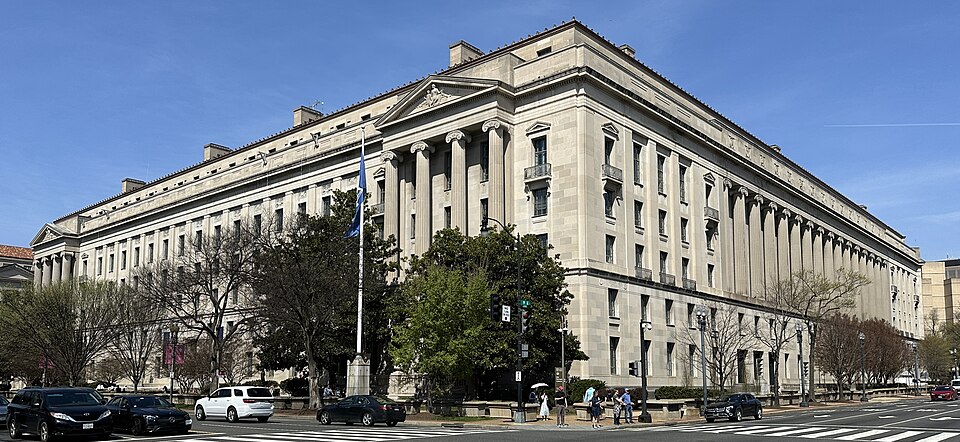
Featured image: Robert F. Kennedy Department of Justice Building, photo by APK via Wikimedia Commons, licensed under CC BY 4.0.