
The Justice Department’s docket this week is led by a case with a clear date attached: former National Security Advisor John R. Bolton is scheduled to be sentenced tomorrow, October 28, in federal court in Maryland. Alongside it, prosecutors announced new fraud indictments, securities-fraud guilty pleas, a hate-crime and explosives indictment in Utah, and a new civil enforcement program aimed at the healthcare industry. All charges described below are allegations unless a plea or conviction is noted. Defendants are presumed innocent until proven guilty in court.
1. Former National Security Advisor John Bolton faces sentencing in Maryland
According to the Justice Department’s press release, Bolton, 77, of Bethesda, Maryland, pleaded guilty on June 26, 2026, to willfully retaining national defense information. The plea resolves an 18-count indictment returned by a federal grand jury in the District of Maryland in October 2025, which charged him with willfully transmitting and retaining national defense information. The retention count carries a maximum penalty of 60 months in prison. The plea agreement, as described by the department, includes an agreed fine of $2.25 million.
The department says Bolton, who served as National Security Advisor from April 2018 to September 2019, recorded classified information in documents he called “diary” entries, including material up to the TOP SECRET and Sensitive Compartmented Information levels. Filings indicate those documents concerned subjects such as foreign military operation plans and covert U.S. actions abroad. According to the release, he sent the entries to two family members who were not authorized to receive classified material, using non-governmental email accounts and a messaging application not approved for classified information, and kept copies at his home.
The release also states that Bolton’s personal email account was later compromised by a cyber actor believed to be linked to Iran, and that he reported the intrusion to law enforcement without disclosing that the account contained national defense information. Sentencing is set before U.S. District Judge Theodore D. Chuang. Beyond the prison range, the department notes that the conviction bars Bolton or his survivors from collecting a federal annuity or retirement pay. The outcome will be watched as a marker for how courts treat handling of classified material by senior officials of any administration.
2. Illinois lab co-owner charged in alleged $66 million COVID-19 testing fraud
A federal indictment announced October 20 charges Rajesh “Raj” Patel, 52, of Schaumburg, Illinois, with five counts of wire fraud, according to the Justice Department. Patel is described as co-owner and operations chief of a clinical laboratory in Hillside, Illinois, that ran COVID-19 PCR tests. Each count carries a maximum of 20 years in prison.
The government alleges that the lab paid Meridian Medical Staffing Inc. tens of millions of dollars for specimen collection and patient information, and that many of the purported patients either did not exist or never provided specimens. Prosecutors allege that from May 2021 to April 2022, Patel generated false negative results for at least 380,000 PCR tests the lab never performed so it could bill the HRSA Uninsured Program. The release says the lab submitted about $66.2 million in claims, HRSA paid about $44.1 million, and Patel allegedly obtained roughly $28 million personally.
The FBI’s Chicago Field Office and the HHS Office of Inspector General investigated, and the Fraud Division’s Health Care Fraud Section is prosecuting. The case matters because it targets pandemic-era program integrity, an area where the department has continued bringing cases years after the emergency programs were created. As the department states, an indictment is merely an allegation.
3. Eight defendants charged in alleged bank fraud scheme using counterfeit checks
The U.S. Attorney’s Office for the Southern District of New York unsealed an indictment on October 21 charging eight people from the Bronx, Mount Vernon, and Yonkers with bank fraud and conspiracy to commit bank fraud. Each count carries a maximum sentence of 30 years, though the office notes that judges determine actual sentences.
Prosecutors allege that from about 2022, the group defrauded national financial institutions of millions of dollars by recruiting people through social media to provide access to their bank accounts, depositing counterfeit checks and U.S. Treasury notes, and withdrawing funds before banks detected the fakes. The release says the defendants shared images of fraudulent checks, bank branch locations, and others’ personal identifying information on social media and messaging apps. Seven defendants were scheduled for arraignment before U.S. Magistrate Judge Andrew E. Krause.
U.S. Attorney Jamie McDonald said in the release that “bad actors are increasingly seeking to abuse technology platforms.” The investigation involved the FBI’s Westchester Safe Streets Task Force and several local and state agencies. The case illustrates a pattern prosecutors have flagged: check fraud organized through social media recruitment of account holders.
4. Pump-and-dump scheme: securities fraud pleas unsealed in Georgia
The U.S. Attorney’s Office for the Northern District of Georgia announced on October 26 that several defendants have pleaded guilty in connection with two penny-stock schemes. Zoltan Nagy, 60, of Vancouver, pleaded guilty October 20 to conspiracy to commit securities fraud, and Glenn Laken, 72, of Chicago, pleaded guilty September 25 to the same charge. Phillip Sewell, Richard Tang, and Davies Wong, all of Vancouver, entered earlier pleas. A sixth defendant, Rahim Mohamed of Calgary, is described as not in custody.
According to the release, the first scheme involved Lotus Bio-Technology Development Corp. (LBTD), of which Nagy was sole officer and director. In August and September 2017, hacked U.S. brokerage accounts were allegedly forced to buy LBTD shares while co-conspirators sold at inflated prices; in September 2017, 24 accounts were compromised and about 7.75 million shares were sold for nearly $1.1 million. The second involved Good Gaming, Inc., where, per the release, Laken controlled a company holding 61% of the stock. Hacked accounts allegedly bought more than one million shares in January 2018 while co-conspirators sold more than 700,000 shares for nearly $170,000.
Sentencings are set for January 2027. Four defendants face up to five years in prison, while Tang, who pleaded to wire fraud conspiracy, faces up to 20. The FBI investigated with substantial assistance from the Securities and Exchange Commission. The case is notable for combining account takeovers with market manipulation, and for the length of time, nearly nine years, between the underlying conduct and the most recent plea.
5. Georgia investment broker and attorney charged in alleged Ponzi-style programs
Also from the Northern District of Georgia, a press release dated October 20 says Roosevelt Tobias “Toby” Bailey, 70, of Duluth, Georgia, and Alvin Jones, 58, of Tampa, Florida, a former prosecutor and practicing attorney, were indicted by a grand jury on September 22. Bailey faces seven counts of wire fraud, one count of money laundering conspiracy, and three counts of money laundering. Jones faces one count of money laundering conspiracy and three counts of money laundering.
Prosecutors allege that from about October 2018 through October 2022, Bailey ran two fraudulent investment programs through his company, Borg Global. One allegedly promised to pool funds to buy precious stones and metals abroad and resell them at a higher price; the other allegedly promised returns of up to 16 times principal within 30 to 90 days based on leasing or monetizing standby letters of credit. The release states neither program used investor money as represented, that investors were directed to send funds to Jones’s attorney trust accounts, and that Jones allegedly forwarded money to Bailey and to earlier investors. Bailey allegedly received nearly $2 million.
The allegation involving a lawyer’s trust account is a reminder that fiduciary accounts can be used to lend credibility to investment offers. Both defendants are presumed innocent, and the government must prove guilt beyond a reasonable doubt.
6. Utah man indicted over alleged synagogue threats and explosives
A federal grand jury in Salt Lake City has indicted Skyler AJ Rose of Ogden, according to the Salt Lake Tribune, reporting on October 23. The charges, as reported, are possession of an unregistered destructive device, threatening to kill and injure persons and to destroy a building with an explosive, and attempting to commit a hate crime. Investigators reportedly began looking into the matter after online threats in December 2025, and Ogden police said rifles, ammunition, and pipe bombs were found at his home. TIJ was unable to retrieve a corresponding Justice Department release, so these details rest on press reporting and should be treated as allegations.
U.S. Attorney Melissa Holyoak was quoted as saying, “A place of worship should be a refuge of peace and safety.” The case is part of continuing federal attention to threats against houses of worship.
7. DOJ and HHS launch a healthcare False Claims Act self-disclosure pilot
On October 22, HHS and the Justice Department’s Civil Division announced a six-month pilot for healthcare companies that voluntarily disclose potential False Claims Act violations. Disclosures are accepted through April 22, 2027. Qualifying participants can resolve the conduct through a coordinated civil release, with repayment calculated using a multiplier between 1.25 and 1.6, depending on factors such as timeliness, duration and scope, senior leadership involvement, and financial benefit.
In exchange, the announcement says DOJ releases the company from liability for the disclosed violations, HHS-OIG will not impose exclusion or require a Corporate Integrity Agreement, and CMS will not revoke enrollment or impose civil monetary penalties. The program follows a steady run of False Claims Act resolutions. In August, for example, the department announced that Complete Health Partners Holdings would pay $14.1 million to resolve allegations that it caused the submission of unsupported diagnosis codes in Medicare Advantage, with the whistleblower to receive approximately $2.47 million. The settlement contains no determination of liability.
8. Background: a former DIA employee’s guilty plea in a classified-information case
For context on the national security docket, the department announced in August that Nathan Vilas Laatsch, 29, of Alexandria, Virginia, a former Defense Intelligence Agency IT specialist, pleaded guilty to transmitting national defense information to a foreign government. Filings indicate he believed he was dealing with a friendly foreign government but was in contact with an FBI agent. He faces a maximum of life in prison, with sentencing set for January 27, 2027 in the Eastern District of Virginia.
Significance and implications
Three themes stand out. First, handling of classified information remains an active enforcement priority regardless of the defendant’s standing, as the Bolton and Laatsch cases show. Second, the department is pairing traditional prosecutions with incentives, as the self-disclosure pilot signals a preference for negotiated resolutions with companies that come forward. Third, fraud cases keep following money through intermediaries: staffing vendors in the testing case, recruited account holders in the check case, and attorney trust accounts in the Georgia case.
Cases that warrant deeper TIJ investigation
TIJ will follow Bolton’s sentencing hearing and any judicial findings on the agreed fine and the disposition of the remaining counts. We also intend to review court dockets for the Illinois laboratory case, specifically the role of Meridian Medical Staffing Inc., which the release names as a payee but does not charge. In the Georgia Ponzi case, records on the use of IOLTA trust accounts merit examination. Readers with documents relevant to these matters can contact the newsroom.
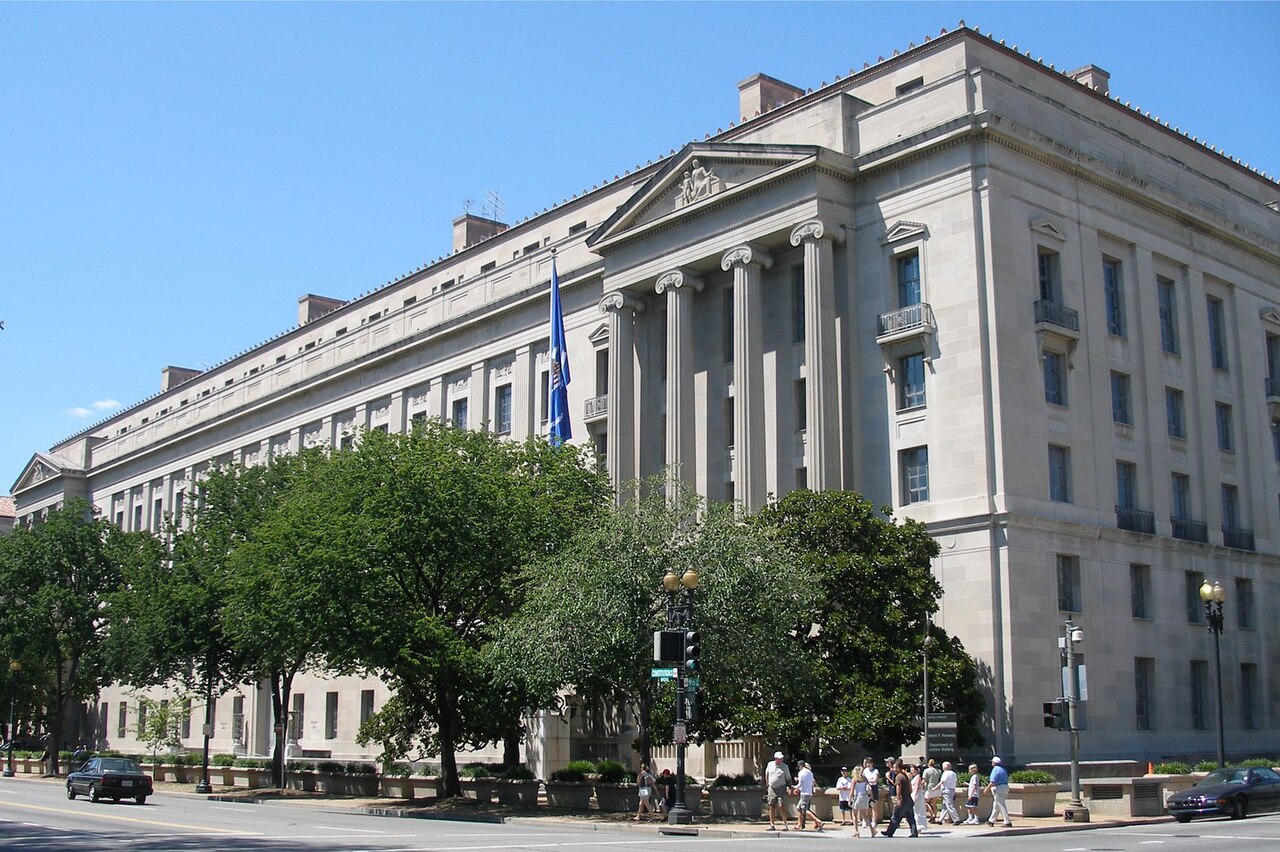
Right of reply: TIJ welcomes responses from any person or entity named in this digest and will update the article promptly. Image: Robert F. Kennedy Department of Justice Building, photographed by Coolcaesar, via Wikimedia Commons (GFDL).
Sources: DOJ – Bolton plea; DOJ – Illinois lab indictment; USAO SDNY; USAO NDGA – securities pleas; USAO NDGA – Borg Global; HHS – FCA pilot; DOJ – Complete Health; DOJ – Laatsch; Salt Lake Tribune.