

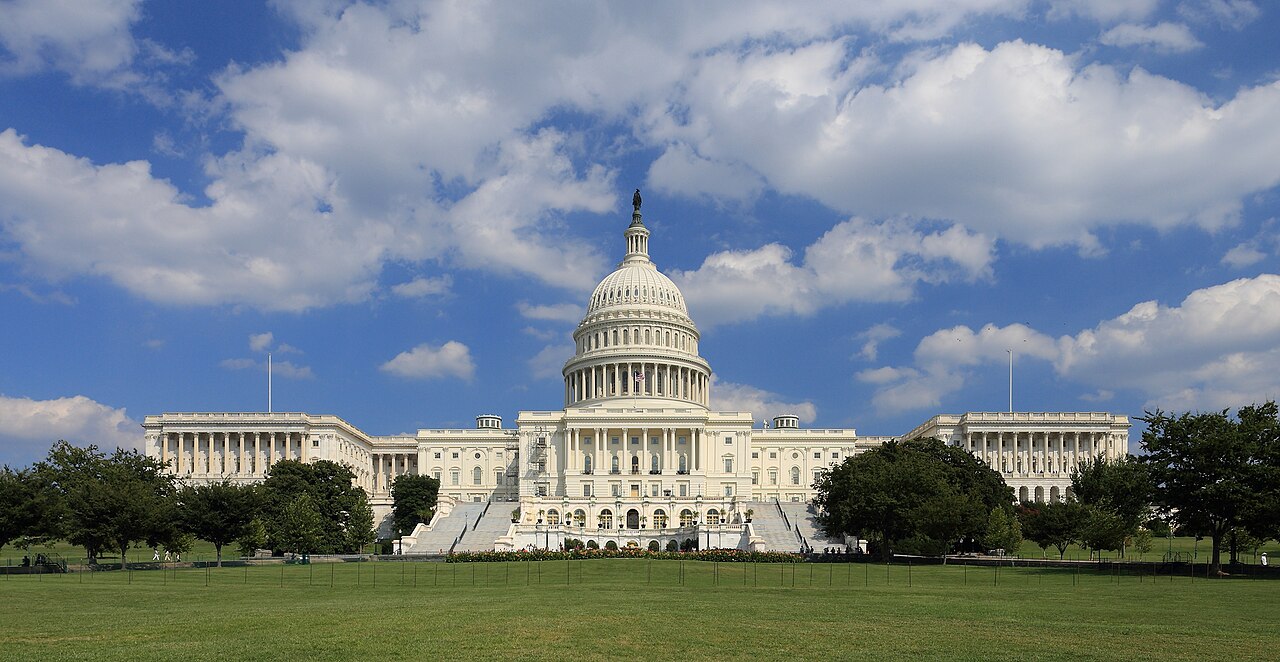
Congress returned from its two-week spring recess this week to confront an unusually crowded legislative calendar, with deadlines converging on multiple fronts. From a record-setting partial government shutdown to expiring surveillance authorities and a second attempt at a war powers resolution on Iran, lawmakers face a compressed timeline with midterm elections looming in November. Here is what advanced, stalled, or shifted on Capitol Hill during the week of April 13.
DHS Shutdown Enters Record Territory as Republicans Pursue Two-Track Strategy
The partial shutdown of the Department of Homeland Security surpassed 60 days this week, making it the longest funding lapse ever recorded for a single federal department. The shutdown, which began on February 14 after Democrats refused to support funding for Immigration and Customs Enforcement and Customs and Border Protection without accountability reforms, has forced furloughs, delayed operations at the Transportation Security Administration and the Federal Emergency Management Agency, and disrupted Coast Guard activities.
Senate Majority Leader John Thune and House Speaker Mike Johnson met this week to advance a two-track strategy to resolve the impasse. The first track involves passing a bipartisan appropriations bill — already approved by unanimous consent in the Senate — that would fund most of DHS except for ICE and CBP. The second track would use a party-line budget reconciliation bill to fund those two agencies for up to three years, circumventing the need for Democratic votes.
President Trump endorsed the narrowly focused reconciliation approach and set a June 1 deadline for delivery. Thune described the planned reconciliation bill as “anorexic,” signaling leadership’s intent to keep it limited to immigration enforcement funding. However, several Republican senators, including Sen. Tommy Tuberville of Alabama and Sen. John Kennedy of Louisiana, have pushed to expand the bill to include military funding, elements of the SAVE Act voter ID legislation, and other priorities. Senate Budget Committee Chairman Lindsey Graham is drafting a budget resolution expected to be released by the end of this week, with floor votes on the resolution anticipated as early as the week of April 20.
Johnson indicated the House would not vote on the bipartisan DHS funding bill until the reconciliation package reaches the president’s desk, creating a sequencing challenge that could extend the shutdown further. According to reporting by Politico, fiscal hawks like Sen. Rand Paul of Kentucky remain skeptical, while appropriators have expressed concern about using reconciliation to encroach on their bipartisan turf.
FISA Section 702 Reauthorization Faces Deadline Pressure
The House moved to extend Section 702 of the Foreign Intelligence Surveillance Act, which authorizes the collection of foreign intelligence from non-U.S. persons located abroad through U.S. communications providers. The authority is set to expire on April 20 without congressional action.
The House Rules Committee met on April 14 to tee up a floor vote on H.R. 8035, an 18-month clean extension requested by the White House. Speaker Johnson pushed to block all amendments, drawing objections from members of both parties who want reforms to address concerns about warrantless querying of Americans’ communications data. According to NPR, the government credits the program with disrupting terrorist attacks, identifying Chinese fentanyl precursor supply chains, and countering foreign espionage on U.S. soil.
Rep. Warren Davidson of Ohio sought an amendment that would prevent data brokers from selling information to the federal government, a provision that drew bipartisan support. However, GOP leaders resisted changes, and reports indicated the House punted a key procedural vote as leadership scrambled to secure sufficient support. Administration officials, including CIA Director John Ratcliffe, FBI Director Kash Patel, and Director of National Intelligence Tulsi Gabbard, lobbied wavering House Republicans to support a clean extension. The outcome remained uncertain as the April 20 deadline approached.
House Passes ALERT Act on Aviation Safety, 396–10
The House overwhelmingly approved the Airspace Location and Enhanced Risk Transparency Act (H.R. 7613) on April 14, by a vote of 396 to 10. The bipartisan legislation is a comprehensive response to the January 2025 midair collision between American Airlines Flight 5342 and a U.S. Army Black Hawk helicopter at Ronald Reagan Washington National Airport, which killed all 67 people aboard both aircraft.
Introduced by Transportation and Infrastructure Committee Chairman Sam Graves and Ranking Member Rick Larsen, the ALERT Act addresses all 50 recommendations issued by the National Transportation Safety Board following its full investigation of the crash. The bill includes provisions on helicopter route safety, air traffic controller training, and enhanced aircraft transponder requirements. It also contains provisions from the Pilot and Aircraft Privacy Act restricting airports from using ADS-B data for fee assessments.
The legislation now moves to conference with the Senate, where the narrower ROTOR Act — passed unanimously by the upper chamber in December — remains the preferred vehicle. Senate Commerce Committee Chairman Ted Cruz continues to back the ROTOR Act, which focuses more narrowly on ADS-B equipment mandates. Reconciling the two bills will be a key task in the coming weeks, according to the Congress.gov bill tracker.
Senate Rejects Fourth Iran War Powers Resolution
The Senate on April 15 voted 47–52 to reject H.Con.Res. 40, the fourth war powers resolution this year seeking to compel the withdrawal of U.S. forces from hostilities with Iran. The vote came as the conflict entered its seventh week following President Trump’s February 28 military strikes, which were launched without prior congressional authorization.
The House is also expected to vote on the resolution this week, where a previous attempt — H.Con.Res. 38 — narrowly failed on March 5 by a vote of 212–219. Supporters argue the president has not articulated a clear imminent threat or strategy for the conflict, which has resulted in the closure of the Strait of Hormuz and a global energy price spike. Critics of the resolution contend that limiting the president’s authority during an active military operation would undermine national security.
The 60-day deadline under the War Powers Act of 1973 approaches at the end of April. Several Republican senators, including Thom Tillis of North Carolina, have signaled that the administration should prepare an Authorization for Use of Military Force and a funding plan if it intends to continue operations beyond that window. According to the Associated Press, Sen. Jim Lankford of Oklahoma noted that the real test will come when Congress considers whether to fund the war.
SAVE America Act Stalls in Senate Amid Filibuster Debate
The SAVE America Act (H.R. 7296), which would require proof of citizenship for voter registration and impose photo identification requirements at the polls, remains stalled in the Senate despite having passed the House. The bill lacks the 60 votes needed to overcome the legislative filibuster, and Senate Republican leaders have not yet identified a procedural path forward.
President Trump has repeatedly called on Majority Leader Thune to eliminate the filibuster to pass the legislation ahead of the November midterms. Some Republican senators, including Rick Scott of Florida and Ron Johnson of Wisconsin, have publicly endorsed the “nuclear option.” Others, such as Sen. Mike Lee of Utah, have advocated for a return to the “talking filibuster,” which would require senators to hold the floor continuously to maintain a filibuster. Thune has resisted both approaches, warning that eliminating the filibuster would expose the party to the same tactic when Democrats return to power. Prediction markets, including Kalshi and Polymarket, assign approximately a 12 percent probability to the bill becoming law.
Farm Bill Heads Toward House Floor Vote
The Farm, Food, and National Security Act of 2026 (H.R. 7567) is expected to receive a House floor vote in late April or early May, according to Politico. The House Agriculture Committee advanced the 802-page bill on March 5 in a 34–17 vote, with seven Democrats joining Republicans.
The legislation strengthens support for specialty crop growers, invests in agricultural export programs, and improves forest health to reduce wildfire risk. However, controversial provisions — including language that would overturn California’s Proposition 12 animal welfare standards and shield pesticide manufacturers from certain lawsuits — have drawn criticism from Democrats and advocacy groups. House Agriculture Committee Chairman Glenn Thompson is eyeing an additional $20 billion in farm aid, with Senate Agriculture Committee Chairman John Boozman stating his chamber would produce its own bill in “weeks rather than months.”
Kevin Warsh Fed Confirmation Hearing Set for April 21
The Senate Banking Committee scheduled a confirmation hearing for April 21 to consider Kevin Warsh’s nomination as the next chairman of the Federal Reserve Board. Warsh, who served as a Fed governor from 2006 to 2011, submitted financial disclosures this week revealing assets exceeding $100 million, according to CNBC reporting.
The hearing was delayed from its originally planned April 16 date due to outstanding paperwork. Sen. Thom Tillis of North Carolina has pledged to block any Fed nominees from advancing out of committee until the Department of Justice drops a criminal investigation into current Chair Jerome Powell. Ranking Member Elizabeth Warren has called on the Fed to release all records from Warsh’s earlier tenure, citing concerns about his role during the 2008 financial crisis. Powell’s term as chair expires May 15, creating a tight timeline for confirmation.
Bipartisan Tax Bills Await Floor Action
Five bipartisan tax bills unanimously approved by the House Ways and Means Committee on March 25 await scheduling for full House floor votes. The package includes the Survivor Justice Tax Prevention Act (H.R. 2347), which addresses tax treatment of sexual assault survivor settlements; the Federal Disaster Tax Relief Act (H.R. 5366), extending relief for natural disaster victims; the Supporting Early-Childhood Educators’ Deductions Act (H.R. 5334); the Taxpayer Experience Improvement Act (H.R. 7971); and the IRS Whistleblower Program Improvement Act (H.R. 7959).
While the bills enjoy broad support, analysts suggest meaningful movement on tax legislation is unlikely before the midterm elections. Ways and Means Chair Jason Smith has indicated he will not support any future reconciliation package that does not include tax provisions, keeping the door open for a potential third reconciliation bill based on the FY2027 budget resolution beginning October 1.
FY2027 Budget Hearings Ramp Up
Multiple congressional committees held budget justification hearings this week following President Trump’s April 3 submission of his FY2027 budget request. The House Budget Committee examined the overall proposal, while the Senate Finance Committee held a hearing on the IRS’s 2026 filing season and operations — timed to Tax Day on April 15. The House Ways and Means Committee hosted HHS Secretary Robert F. Kennedy Jr. for testimony on April 16, and the Senate Budget Committee convened its own hearing on the president’s budget proposal.
The FY2027 budget requests significant increases for defense — including $17.5 billion for the “Golden Dome” homeland missile defense initiative and $350 billion in mandatory defense spending — while proposing cuts to education, foreign aid, and climate-related programs. The budget eliminates all funding for the U.S. Agency for International Development and the Corporation for Public Broadcasting, continuing the administration’s posture from the FY2026 cycle.
Legislation Signed Into Law
President Trump on April 13 signed the Small Business Innovation and Economic Security Act into law. The legislation reauthorizes the Small Business Innovation Research and Small Business Technology Transfer programs through FY2031, restoring funding that had lapsed after September 30, 2025. The programs provide federal research and development grants to small businesses.
Looking Ahead
The coming days will be defined by several converging deadlines. The FISA Section 702 expiration on April 20 demands immediate resolution. The War Powers Act’s 60-day clock on the Iran conflict ticks toward the end of April. The Senate Budget Committee aims to release its reconciliation budget resolution by the end of this week. And the Warsh confirmation hearing on April 21 will test whether the Senate can fill the Fed chair vacancy before Powell’s term expires in mid-May. For a Congress already contending with a partial government shutdown now in its third month, the margin for delay continues to narrow.