

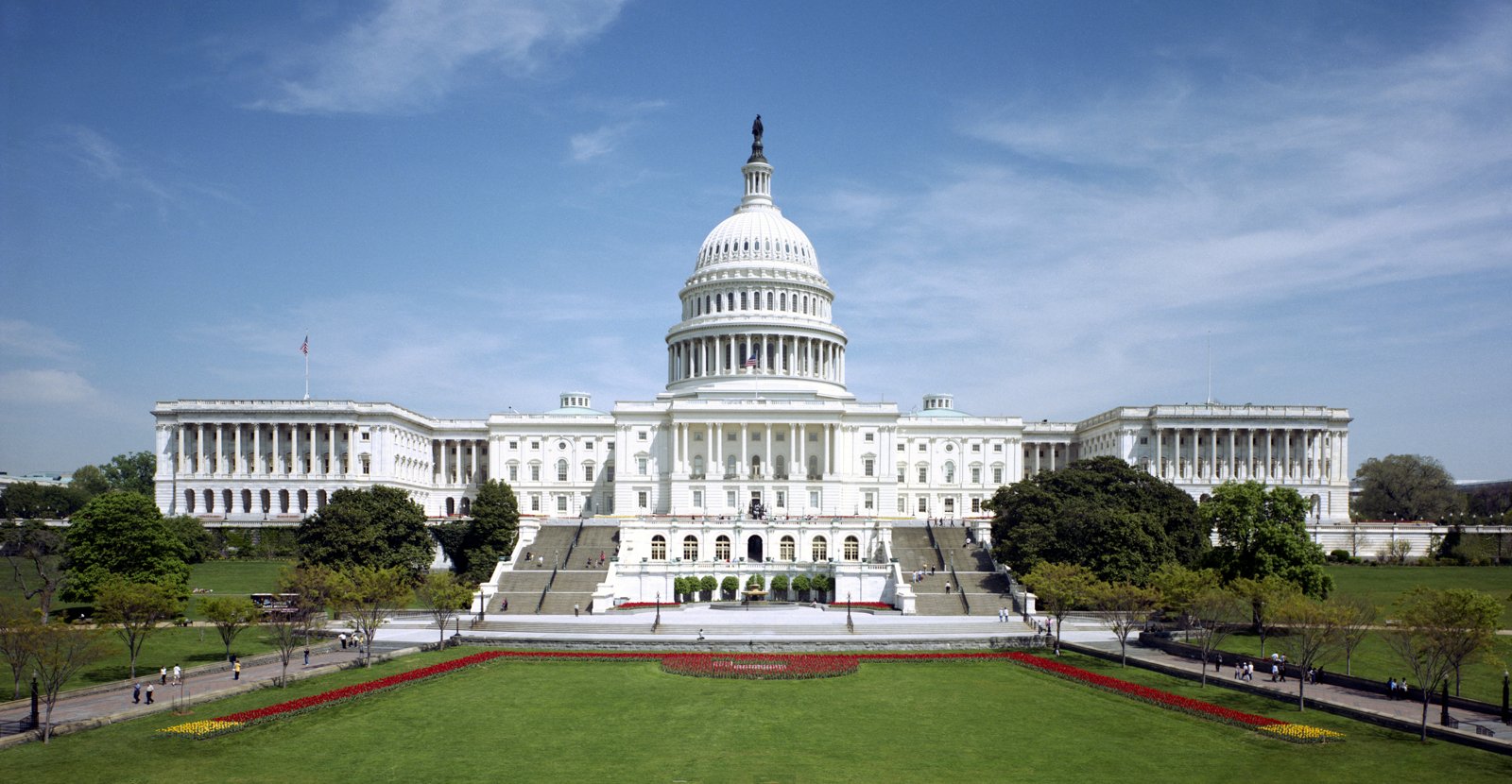
WASHINGTON — Congress returns from a brief weekend recess to a Capitol crowded with high-stakes business: a Senate cloture vote on the nominee to lead the Bureau of Alcohol, Tobacco, Firearms and Explosives, House Rules Committee action on a long-awaited rewrite of federal surveillance authorities set to expire within days, a sprawling new farm bill teed up for floor consideration, and a state visit by King Charles III that will pause regular legislative business for a Joint Meeting of Congress on Tuesday afternoon. The week opens against the backdrop of a freshly adopted Senate budget resolution that puts immigration enforcement spending on a fast track and a Congressional Budget Office reminder that the federal deficit, while modestly narrower than last year, remains historically large.
The Investigative Journal’s Capitol Watch tracks today’s schedule, the bills moving, the oversight fights still simmering, and what to watch next. Records show the House gavels in at noon for morning hour and 2:00 p.m. for legislative business, with votes postponed until 6:30 p.m., according to the published weekly schedule issued by Majority Leader Steve Scalise (R-La.). The Senate stands adjourned until 3:00 p.m., when senators will resume executive session and proceed to a 5:30 p.m. cloture vote on a key Justice Department nomination.
1. Senate moves to confirm Cekada at ATF as criminal enforcement case waits
At 5:30 p.m. on Monday, the Senate is scheduled to vote on cloture for the nomination of Robert Cekada to serve as Director of the Bureau of Alcohol, Tobacco, Firearms and Explosives. Majority Leader John Thune (R-S.D.) filed cloture last week after the Senate Judiciary Committee advanced the nomination on a 14–8 vote, according to a Judiciary Committee release. If invoked, cloture would tee up a confirmation vote later in the week.
Records suggest the confirmation’s outcome carries weight beyond the agency’s personnel chart. As trade press has reported, a federal judge has stayed proceedings in an ongoing “engaged in the business” enforcement matter pending Senate action on the nomination, an unusual procedural pause that filings indicate is meant to allow the next Senate-confirmed director to set policy direction before the case proceeds.
Cekada faced extensive questioning at his Judiciary hearing earlier this year on use-of-force policy, the agency’s firearms-tracing backlog, and pending rulemakings. Industry groups including the National Shooting Sports Foundation have noted his pledge, in on-the-record testimony, “not to burden law-abiding gun owners.” Civil-society groups focused on firearms regulation have urged senators to press the nominee on enforcement priorities. The Investigative Journal will continue tracking how the post-confirmation ATF approaches statutory enforcement of the Gun Control Act.
2. House Rules Committee takes up the Foreign Intelligence Accountability Act
The House this week is set to consider S. 1318, the Foreign Intelligence Accountability Act, with House amendment text posted by the Rules Committee under the print designation RCP_S-FISA. According to the Rules Committee print and a summary published by the Democratic Rules staff, the bill would extend the sunset on Section 702 of the Foreign Intelligence Surveillance Act for three years, moving expiration from April 30, 2026 to April 30, 2029, while layering new compliance and notification requirements on the Federal Bureau of Investigation.
The text would require monthly written reports from the FBI to the Civil Liberties Protection Officer in the Office of the Director of National Intelligence on each U.S.-person query, and would condition certain sensitive queries — those “reasonably believed” to identify U.S. religious organizations or prominent persons within them — on attorney approval. Filings indicate that any FBI query reasonably believed to identify a Member of Congress would trigger “prompt” notification of congressional leadership and the affected member, with a narrow national-security exception. Coverage by trade outlets describes the package as introducing “strict oversight and criminal consequences to prevent surveillance overreach,” a framing the bill’s House sponsor, Intelligence Committee Chairman Rick Crawford (R-Ark.), has used as well.
The package illustrates a familiar Capitol Hill pattern: pairing a controversial reauthorization with new accountability guardrails to round up votes from civil-liberties skeptics in both parties. The Senate, where Section 702 reauthorization has its own track in the form of S. 4344 — a three-year extension on which Majority Leader Thune has separately filed cloture — will need to act before the April 30 sunset to avoid a lapse in collection authorities. Records suggest leadership in both chambers is targeting passage this week.
3. Farm, Food, and National Security Act of 2026 returns to the floor
Also queued for consideration under a rule is H.R. 7567, the Farm, Food, and National Security Act of 2026, sponsored by House Agriculture Committee Chairman Glenn “GT” Thompson (R-Pa.). The Agriculture Committee approved the measure 34–17 in early March after a roughly 25-hour, two-day markup, according to a Rules Committee posting and the committee’s own farm bill page.
The bill provides for the reform and continuation of programs administered by the Department of Agriculture through fiscal year 2031, including commodity supports, conservation programs, specialty-crop assistance, agricultural research, and nutrition programs. The committee says more than 500 stakeholder organizations have endorsed the package; the National Farmers Union, in a statement, expressed appreciation for the long-overdue reauthorization but said the bill “fails to match the magnitude of the challenges” facing family farmers and ranchers in a strained farm economy.
A bipartisan amendment effort to remove a provision shielding pesticide manufacturers from certain state-law warning requirements has drawn attention from agricultural and consumer advocates, with reporting from Civil Eats documenting a cross-party coalition of two Republicans and two Democrats backing the change. Whether the rule allows debate on that amendment is the procedural fight to watch.
4. Senate-passed budget resolution opens reconciliation lane for ICE and CBP
The Senate adopted S. Con. Res. 33 on April 23 by a 50–48 roll call following an overnight vote-a-rama, according to Roll Call coverage and a statement from Senate Budget Committee Chairman Lindsey Graham (R-S.C.). The blueprint instructs the House and Senate Judiciary and Homeland Security committees to each report reconciliation legislation by May 15 that increases the deficit by no more than $70 billion over fiscal years 2026 through 2035, providing a filibuster-proof pathway for funding for U.S. Immigration and Customs Enforcement and U.S. Customs and Border Protection.
The House this week is scheduled to consider the same resolution under a rule, according to the Majority Leader’s schedule. Adoption in the House would lock in the reconciliation instructions and start the clock on committee drafting. Records suggest Republican leaders intend to move a unified bill before Memorial Day. A policy summary from PwC notes the targeted, single-purpose nature of the instructions distinguishes this resolution from the broader reconciliation vehicles used in earlier rounds of fiscal policy.
5. Iran War Powers Resolution may force House floor vote
House Democrats are pressing for floor consideration of H. Con. Res. 75, a War Powers Resolution sponsored by Rep. Josh Gottheimer (D-N.J.) that would, pursuant to Section 5(c) of the War Powers Resolution, direct the President to remove U.S. armed forces from hostilities against the Islamic Republic of Iran. The Majority Leader’s schedule lists the resolution as “legislation that may be considered.”
The measure preserves the President’s authority to defend U.S. forces, embassies, and allied nations from imminent attack and exempts search-and-rescue and intelligence activities, according to the introduced text. It directs withdrawal within 30 days unless Congress provides specific authorization for the use of military force or a formal declaration of war. Reporting in The Hill indicates that Democrats intend to use the privileged status of war-powers resolutions to force repeated votes if leadership tables this one. A previous war-powers vote earlier this year was defeated, according to CBS News.
6. King Charles III to address Joint Meeting of Congress on Tuesday
The House is scheduled to recess and reconvene at approximately 3:00 p.m. on Tuesday for a Joint Meeting of Congress to receive His Majesty King Charles III, according to the Majority Leader’s posted schedule. The address, formally announced by Speaker Mike Johnson, Majority Leader Thune, Democratic Leader Chuck Schumer, and Democratic Leader Hakeem Jeffries, comes as part of a state visit running April 27–30 and tied to the 250th anniversary of American independence. A leadership statement describes the address as the first by a British monarch to a joint meeting of Congress in 35 years.
According to a Congressional Research Service backgrounder, only ten kings or queens have previously addressed Joint Meetings of Congress; King Charles will be the eleventh. Coverage from CBS News notes that the visit will also include a state dinner at the White House on April 28. The Joint Meeting is ceremonial and does not produce legislative business, but it will pause floor action on Tuesday afternoon and shape the day’s news cycle.
7. Tax-policy and IRS-oversight package moves under suspension
The House on Monday will work through a long suspension calendar weighted toward Ways and Means Committee bills focused on tax administration, IRS oversight, and small-business and disaster tax relief. Under the chamber’s rules, suspension bills require a two-thirds vote, signaling broad expected support. The package, listed in the Majority Leader’s schedule, includes the Taxpayer Experience Improvement Act (H.R. 7971, Schweikert), the IRS Whistleblower Program Improvement Act (H.R. 7959, Kelly), the Taxpayer Notification and Privacy Act (H.R. 6495, Steube), and the Doug LaMalfa Federal Disaster Tax Relief Certainty Act (H.R. 5366, Steube), among others.
The IRS Whistleblower Program Improvement Act in particular has a record of bipartisan support; previous iterations have moved through the Ways and Means Committee with cross-party cosponsorship. The expansion of intellectual-property enforcement information sharing (H.R. 4930, Moore) and the BARCODE Efficiency Act (H.R. 6956, Schneider) round out the trade and commerce items moving today.
8. CBO releases new economic-sensitivity tool; deficit narrows modestly
The Congressional Budget Office published two notable products this month bearing on the budget debate ahead. On April 21, CBO released “How Changes in Economic Conditions Might Affect the Federal Budget: 2026 to 2036,” an interactive tool allowing analysts to vary four key economic variables — productivity growth, labor-force growth, interest rates, and inflation — and observe the effects on revenues, outlays, and deficits over the next decade. The publication is unusual in its degree of transparency and its invitation to outside users to test alternative scenarios.
Earlier in the month, the agency’s Monthly Budget Review for March 2026 reported that the federal deficit totaled $1.2 trillion in the first half of fiscal year 2026, $139 billion below the same period a year earlier. Higher receipts from individual income and payroll taxes accounted for most of the improvement, the analysis indicates. Records suggest the budget picture remains historically tight even with the modest year-over-year improvement, a context in which the new $70 billion reconciliation instructions will be debated.
Oversight watch: Epstein-records subpoena dispute continues
Beyond this week’s floor schedule, the long-running dispute over the House Oversight and Government Reform Committee’s investigation into the Department of Justice’s handling of records related to Jeffrey Epstein remains active. Records suggest former Attorney General Pam Bondi was scheduled to give a sworn deposition on April 14 pursuant to a committee subpoena. According to a Justice Department communication reported by multiple outlets, Bondi did not appear, with the Department asserting that her departure from office discharged the subpoena’s obligation. Committee Democrats, including Reps. Ro Khanna (D-Calif.) and Nancy Mace (R-S.C.), dispute that interpretation.
Chairman James Comer (R-Ky.) has separately said the Department is complying with the documents portion of the subpoena. The committee’s investigative trajectory — and any move toward a contempt referral — bears watching as a test of post-administration subpoena enforcement, a recurring theme across multiple administrations and one that The Investigative Journal will continue to follow.
What to watch next
Floor action this week will be shaped by three deadlines: the April 30 sunset on Section 702 of FISA, the May 15 reconciliation reporting deadline imposed by S. Con. Res. 33, and the rolling appropriations calendar for fiscal year 2027, with House Appropriations subcommittees continuing to mark up bills, including a recent FY27 Agriculture–FDA bill approved at subcommittee on April 23, according to a Republican Appropriations Committee posting. The week’s ceremonial pause for the King’s address on Tuesday will compress Wednesday and Thursday legislative time. Last votes are expected no later than 3:00 p.m. Thursday.
Outside the floor, the Senate Judiciary Committee continues its review of the FISA reauthorization architecture, with hearing testimony (including a January 28 statement from outside experts) on file. The Senate Appropriations Subcommittee on Homeland Security has been examining FIFA World Cup 2026 preparations, an item TIJ has flagged in earlier coverage as having significant federal-cost and oversight implications.
The Investigative Journal will update this digest as roll-call results and committee actions are recorded. Capitol Watch is part of TIJ’s Legislative Watch and Government Accountability beats. Members of Congress and their staff are invited to respond to any item in this digest at the editorial address listed on tij.news/contact.
Sources:
- House Majority Leader Weekly Schedule (Week of April 27, 2026)
- U.S. Senate Daily Press, April 23, 2026
- Senate Judiciary Committee — ATF Director and other nominees advanced
- Congress.gov — S. 1318, Foreign Intelligence Accountability Act
- House Rules Committee — H.R. 7567, Farm, Food, and National Security Act of 2026
- Congress.gov — S. Con. Res. 33 (FY2026 Budget Resolution)
- Congress.gov — H. Con. Res. 75 (Iran War Powers Resolution)
- Speaker Johnson — Joint Meeting Announcement, King Charles III
- CBO — How Changes in Economic Conditions Might Affect the Federal Budget
- CBO — Monthly Budget Review: March 2026
- House Oversight — Epstein records subpoena update