

The Investigative Journal’s daily afternoon digest of the day’s top developments across government, courts and international affairs. Filed Sunday, April 26, 2026.
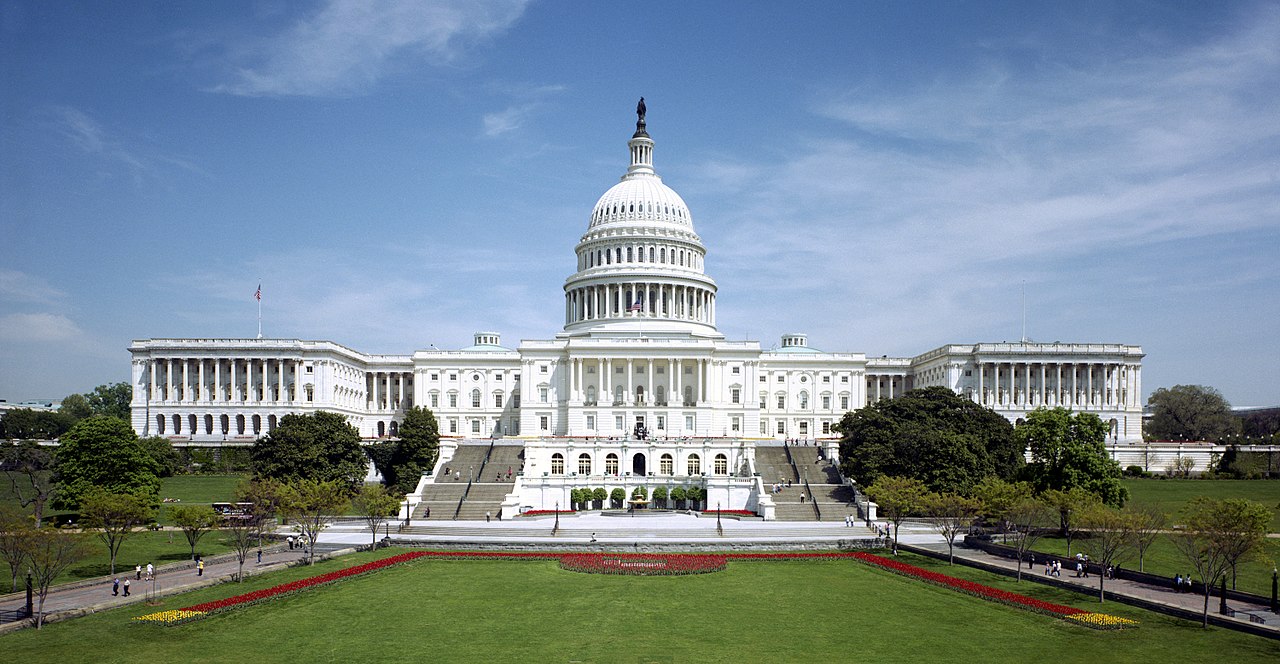
The weekend produced no pause in Washington’s policy churn. The Senate cleared a partisan path to a roughly $70 billion infusion for federal immigration enforcement after a marathon overnight vote that ended at 3:35 a.m. Friday, while the Justice Department on Friday formally moved to restore the firing squad as a federal execution method and reinstate single-drug pentobarbital lethal injections. A divided panel of the U.S. Court of Appeals for the District of Columbia Circuit struck down the administration’s directive suspending asylum at the southern border, and on the international front President Trump abruptly canceled a Pakistan trip by his Iran envoys after Tehran’s foreign minister departed Islamabad. Tomorrow, attention shifts to the Capitol’s South Lawn as King Charles III and Queen Camilla begin a four-day state visit timed to the United States Semiquincentennial.
Government
Senate adopts $70 billion immigration-enforcement budget blueprint. By a 50-48 party-line tally, the Senate adopted a budget-reconciliation resolution that would direct roughly $70 billion to U.S. Immigration and Customs Enforcement and U.S. Customs and Border Protection. The measure, advanced under reconciliation rules that bypass the chamber’s 60-vote filibuster threshold, is intended to end the record partial shutdown of the Department of Homeland Security and fund the agencies for approximately 3.5 years, according to CNBC’s reporting on the chamber action.
President Trump has set a June 1 deadline for final passage. The blueprint now moves to the House, where committees must adopt the resolution before drafting the underlying spending bill. The Washington Post reported that Senate Republicans turned to reconciliation after Senate Democrats refused to fund the department absent policy changes to enforcement practices following two U.S.-citizen deaths during federal operations earlier this year. Two Republicans broke ranks during the vote-a-rama, according to TIME’s roll-call analysis.
Records suggest the maneuver has implications well beyond immigration policy. By using reconciliation to fund a single department, Senate Republicans have established a procedural template that future majorities of either party may seek to replicate, an outcome longtime budget specialists have warned could erode the chamber’s traditional bipartisan appropriations posture.
Justice Department restores firing squad as federal execution method. The Justice Department announced on Friday that it is readopting the lethal-injection protocol used during the first Trump administration and expanding the federal execution menu to include firing squad. Deputy Attorney General Todd Blanche directed the Bureau of Prisons to “include additional, constitutional manners of execution that are currently provided for by the law of certain states,” according to the department’s official press release.
The federal government had not previously included firing squad in its execution protocols, the Death Penalty Information Center confirmed in remarks to CNN. The order also reinstates pentobarbital, a single-drug injection used to carry out 13 executions during the first Trump term, more than under any modern president, according to CBS News.
Filings indicate that constitutional challenges are likely. Defense organizations representing federal death-row prisoners have signaled they will contest both the procurement chain for pentobarbital and the firing-squad protocol on Eighth Amendment grounds. The administration has framed the changes as an effort to clear a backlog of capital cases involving the most violent federal offenders.
Council of Economic Advisers files 2026 annual report. The White House Council of Economic Advisers transmitted its statutory annual report to Congress under the Employment Act of 1946 and the Full Employment and Balanced Growth Act of 1978. The document, released this month, is the administration’s principal vehicle for laying out its macroeconomic outlook, productivity assumptions and policy priorities. The full text is posted on the White House site as the 2026 Economic Report of the President.
Courts
D.C. Circuit blocks asylum suspension at southern border. A divided three-judge panel of the U.S. Court of Appeals for the District of Columbia Circuit on Friday blocked the administration’s directive suspending access to asylum and other legal protections for migrants who cross the southern border without authorization. Judge J. Michelle Childs wrote for the majority, joined by Judge Cornelia Pillard; Judge Justin Walker concurred in part and dissented in part. The ruling holds that federal immigration law does not authorize the president to deport migrants under the new summary-removal framework or to suspend the statutory right to apply for asylum. CBS News reported the ruling Friday afternoon.
The decision sits at the center of the broader litigation map of executive-action challenges tracked by Just Security’s litigation tracker. The administration is expected to seek en banc review or move directly to the Supreme Court’s interim docket. Pending such review, the lower-court framework governs ongoing operations on the border.
Northern District of Illinois finds First Amendment violation in app-removal pressure. U.S. District Judge Jorge L. Alonso ruled on Friday that the administration violated the First Amendment when officials pressured Apple and Meta to remove ICE-tracking groups and applications from their platforms. The decision distinguishes lawful government speech from coercive pressure on private intermediaries to suppress lawful third-party expression, according to coverage referenced in a daily court roundup compiling Friday’s filings.
Records suggest the ruling will become a touchstone in the developing jurisprudence on jawboning, the term legal scholars use to describe informal government pressure on platforms to moderate or de-platform speech. The decision is appealable to the Seventh Circuit.
Supreme Court interim docket activity continues. The justices remain seized of the administration’s request for emergency relief in several immigration-enforcement cases, and the term’s marquee dispute, Trump v. Barbara, on the legality of the executive order ending birthright citizenship, was argued April 1. SCOTUSblog’s argument analysis notes the case may turn on the contested meaning of “domicile” under the Citizenship Clause. A decision is expected before the term concludes.
International
Trump cancels Witkoff and Kushner Pakistan trip; Iran talks stall. President Trump on Saturday called off a planned Islamabad visit by special envoys Steve Witkoff and Jared Kushner after Iranian Foreign Minister Abbas Araghchi departed Pakistan for Oman without committing to a second round of direct talks. Trump said the latest Iranian ceasefire proposal “offered a lot, but not enough” and reiterated that Tehran cannot be permitted to acquire a nuclear weapon. The Washington Post reported the cancellation Saturday evening.
Iranian President Masoud Pezeshkian told Pakistani Prime Minister Shehbaz Sharif that Tehran would not negotiate while a U.S. blockade on Iranian ports remained in place, framing the lifting of those measures as a precondition for renewed talks. The administration disputes that characterization. Filings with the IMO and shipping data referenced in CNN’s Saturday live blog indicate the closure of the Strait of Hormuz continues to weigh on global oil and shipping markets.
Coordinated militant attacks across Mali. Al-Qaeda-linked Jamaat Nusrat al-Islam wal-Muslimeen (JNIM) on Saturday claimed responsibility for simultaneous assaults in Bamako and four other cities, including Sevare, Kidal and Gao. Heavy weapons and automatic gunfire were reported near Modibo Keita International Airport, and inbound and outbound flights were canceled. The Malian government said 16 people were wounded and gave no death toll, according to France 24’s reporting from the scene.
The coordinated nature and geographic spread of Saturday’s operation mark a significant escalation in the Sahel insurgency, security analysts told NPR. JNIM said the attacks were carried out alongside the Azawad Liberation Front, a separatist coalition active in the north of the country.
Hungary’s Orban will not take parliamentary seat. Former Prime Minister Viktor Orban announced Saturday that he will return his parliamentary mandate, ending a 36-year run in the National Assembly that began in 1990, after Tisza Party leader Peter Magyar’s landslide victory in the April 12 election. With 97.35 percent of precincts counted, Tisza secured 138 of 199 seats on 53.6 percent of the vote, while Fidesz won 55 seats with 37.8 percent. Orban indicated he would focus on rebuilding his party rather than serving as opposition floor leader, according to The Washington Post.
Aviation costs spike on Hormuz closure. The parent company of British Airways warned that ticket prices may rise as the closure of the Strait of Hormuz continues to drive up jet-fuel costs. Records referenced in market filings indicate sustained pressure on Brent crude, with downstream effects rippling through transatlantic and intra-European routes.
Tomorrow’s Watch
King Charles III and Queen Camilla begin four-day state visit. Their Majesties arrive Monday for the first state visit by a British monarch to the United States since May 2007. The trip is timed to the United States Semiquincentennial, marking the 250th anniversary of the Declaration of Independence, and includes stops in Washington, New York and Virginia. A state banquet is scheduled at the White House on Tuesday, April 28, and the King is expected to address a joint meeting of Congress, his first since Queen Elizabeth II’s 1991 address. The White House announcement confirms the schedule.
House to take up Senate budget resolution. The House is expected to begin floor consideration of the Senate-passed reconciliation blueprint funding ICE and CBP. Adoption by the lower chamber is the necessary procedural step before authorizing committees can begin drafting the underlying legislation ahead of the president’s June 1 deadline.
Federal courts. Watch for an emergency application to the Supreme Court from the administration seeking a stay of Friday’s D.C. Circuit asylum ruling. Filings tracked on the Court’s interim docket suggest such applications have been processed within days in comparable cases this term.
Iran diplomacy. Oman, the traditional back-channel host for U.S.-Iran contacts, is the most likely venue for any resumption of negotiations following Foreign Minister Araghchi’s Saturday departure from Islamabad. Energy markets will be sensitive to any signal on the Strait of Hormuz.
Mali aftermath. Authorities are expected to release a more complete casualty count and damage assessment from Saturday’s coordinated assaults, and ECOWAS partners will weigh whether to convene an emergency session.
The Investigative Journal will update this briefing as warranted. Tips, document leads and corrections may be sent to the editorial desk.