

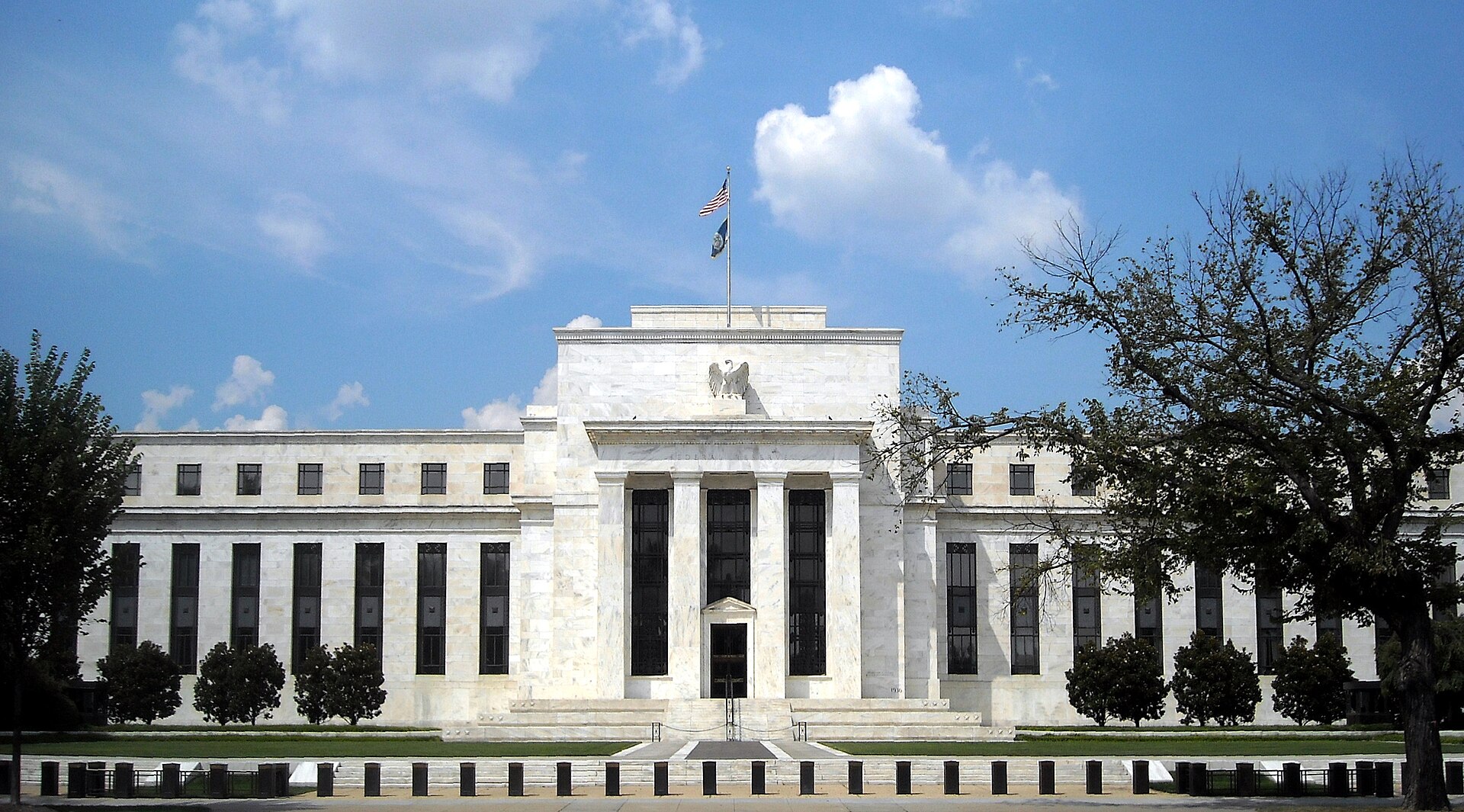
WASHINGTON — The Federal Reserve announces its September policy decision at 2 p.m. Eastern this afternoon, hours after Saudi Arabia declared an attempted drone strike near Mecca a “red line” and one day after a Senate floor session that blocked the crypto industry’s top legislative priority while advancing a sweeping college-sports overhaul. Federal prosecutors, meanwhile, unsealed charges against five men they describe as part of a Russian intelligence assassination network, and the House Oversight Committee voted unanimously to hold billionaire Leon Black in contempt. Here is where the day stands.
Government
Fed decision due at 2 p.m., with the first hike of the Warsh era on the table
The Federal Open Market Committee concludes its September 15–16 meeting today, with the policy statement scheduled for 2 p.m. ET and Chair Kevin Warsh’s press conference at 2:30. The federal funds target has sat at 3.50%–3.75% since December, and market previews describe today’s call as a genuine toss-up: Cambridge Currencies’ preview notes traders have priced a quarter-point rise to 3.75%–4.00% as more likely than not after Warsh’s hawkish Jackson Hole speech and a solid August jobs report, while two straight months of falling headline CPI — 3.4% in July, per the same preview — argue for patience. Event contracts on Robinhood’s prediction market showed the outcome contested into this morning.
Today’s meeting is one of four each year that carries a Summary of Economic Projections and dot plot, and those may matter more than the rate call itself: a hold paired with upgraded rate projections would still read hawkish, while a hike alongside a shallow forward path would read as a one-off adjustment. Either way, the committee decides against unusual crosscurrents — including the Congressional Budget Office’s estimate, detailed below, that war costs are adding roughly half a percentage point to inflation into early 2027.
Senate blocks crypto framework, advances college-sports overhaul in split-screen floor day
The Senate on Tuesday rejected cloture on the motion to proceed to the Digital Asset Market Clarity Act, 50–49 — short of the 60 votes required — in what CNBC called a significant regulatory setback for the digital-asset industry. Per CNBC’s tally, all Democrats present and four Republicans — Susan Collins, Josh Hawley, Jerry Moran and Thom Tillis — opposed the motion. NPR reported that a revised draft released Sunday added ethics restrictions aimed at Democratic concerns about public officials profiting from crypto ventures, but that negotiators never closed the gap. Sen. Cynthia Lummis told reporters before the vote that “it’s over” for the Congress if cloture failed, and CoinDesk’s survey of industry reaction suggests market-structure legislation now likely slips to next year, with the chamber scheduled to leave Washington in early October.
The same afternoon produced the opposite result for college sports: senators voted 74–24 to begin consideration of the Protect College Sports Act, the framework that would codify athlete name-image-likeness compensation rules, set national transfer and eligibility standards, and shield certain NCAA rules from antitrust challenges, NBC News reported. Final-passage timing remains unclear, according to ESPN, and the House has yet to act — but Tuesday’s margin makes it one of the few bipartisan vehicles with a plausible path before the midterms.
Oversight panel holds Leon Black in contempt in Epstein records fight
The House Oversight Committee voted unanimously Tuesday to recommend holding Apollo Global Management co-founder Leon Black in contempt of Congress, after Black did not appear for a Sept. 3 deposition and withheld nondisclosure agreements subpoenaed in the panel’s review of the federal government’s handling of the Jeffrey Epstein investigation, according to the committee’s release. Ranking Member Robert Garcia issued a parallel statement backing the referral — a rare point of bipartisan alignment in the inquiry. AP reporting notes the resolution must still pass the full House before any referral to the Justice Department, where criminal contempt carries up to a year in prison and a $100,000 fine.
The dispute concerns subpoena compliance; the committee’s releases do not accuse Black of wrongdoing connected to Epstein’s crimes, which Black has long denied in other forums. Rather than appear, Black sued the committee, arguing the subpoenas exceed its lawful authority, CNBC reported — litigation that now runs in parallel with the contempt process and could determine which side’s theory of the House’s investigative power prevails first.
Trump’s third surgeon-general pick faces the Senate
The Senate HELP Committee this morning took up three health nominations at once: Chris Klomp for deputy secretary of Health and Human Services, Dr. Nicole Saphier for surgeon general, and Dr. Timothy Westlake to lead the Substance Abuse and Mental Health Services Administration, per the committee’s hearing notice. Saphier, a radiologist and former Fox News contributor, is President Trump’s third nominee for the post, advanced after wellness entrepreneur Dr. Casey Means’s nomination stalled in the Senate, the AP reported.
The AP’s curtain-raiser flagged two likely lines of questioning: Saphier’s criticism of COVID-19 booster requirements and of universal at-birth hepatitis B vaccination, and her ownership of DropRx, a wellness firm whose products the AP said contain ingredients the FDA has described as potentially causing severe liver injury. NPR’s coverage tracked senators’ questioning across all three nominations; committee votes had not been announced as of publication.
CBO: Iran conflict has cost $38 billion and depleted interceptor stocks
The Congressional Budget Office reported this week that U.S. operations against Iran cost the Pentagon roughly $38 billion through July and would likely run $2 billion to $3 billion a month if recent hostilities continue, Roll Call reported. The largest component, per the report, is $21.7 billion in munitions replacement — including $13.1 billion for missile-defense interceptors, expenditures Defense News reports have drawn down roughly two-thirds of U.S. interceptor inventories.
The estimate excludes repairs to damaged U.S. facilities in the region, and Time’s account notes CBO expects the conflict to keep inflation roughly 0.5 percentage points above its prior projections into the first quarter of 2027 — a data point that lands, not coincidentally, on the Fed’s decision day. Expect the interceptor figures to anchor Pentagon replenishment requests when appropriators turn to the stalled FY27 bills in the lame-duck session.
Courts
Five charged as alleged Russian intelligence murder-for-hire network
Federal prosecutors in the Southern District of New York unsealed an indictment Tuesday evening charging five men — including a former Russian intelligence colonel and a serving FSB officer — with conspiring to finance terrorism and to commit murder for hire on behalf of Russia’s intelligence services, according to the Justice Department’s release. The indictment alleges the network recruited a U.S. resident this summer to surveil a prominent Russian dissident believed to be in the Washington area — offering $40,000 to “eliminate” the target — and separately offered a U.S. citizen $25,000 to kill a man in Lithuania whom one defendant allegedly accused of “telling lies about Russia.” All five defendants remain at large; the terrorism-financing count carries up to 20 years in prison.
“It is our job to stop America’s adversaries from unleashing violence and terror on American soil,” Attorney General Todd Blanche said in the release. Courthouse News and ABC News note the indictment also describes attacks coordinated in Prague and in Lithuania in 2024, part of what prosecutors characterize as a campaign against countries perceived as “helping Ukraine.” An indictment is an allegation; the defendants are presumed innocent unless and until proven guilty.
Mail-ballot injunction stands as states begin sending ballots
The practical shape of November’s mail voting firmed up this week: after the Supreme Court on Monday declined to let the Postal Service enforce parts of its new mail-ballot rule, the lower-court injunction remains in place for the 2026 election, Ballotpedia notes, with Justices Samuel Alito and Clarence Thomas dissenting, per Votebeat. The order capped what SCOTUSblog documented as three emergency applications in under six weeks, in which Solicitor General D. John Sauer argued the rule imposes “only modest envelope-design and addressee-information requirements” for ballots sent through the mail.
The litigation is not finished. A companion application over the executive order’s citizen-database provision remains pending at the court, per SCOTUSblog, and the underlying merits case brought by 23 states continues in Boston. With mail ballots already moving in several states, NBC News reports, any renewed implementation push would face the timing objections Justice Brett Kavanaugh flagged in his concurrence, per Votebeat — suggesting the administration’s realistic path on the rule runs through future cycles, not this one.
Student-visa ‘duration of status’ cap stays frozen
A preliminary injunction from U.S. District Judge F. Dennis Saylor in Boston continues to block the Department of Homeland Security rule that would have ended “duration of status” — the decades-old policy letting international students and exchange visitors, a category that includes foreign journalists and Fulbright scholars, remain in the country for the length of their programs. Saylor called the government’s rationales “exceptionally weak” in ruling for a coalition of unions and higher-education groups a day before the rule was to take effect, Reuters reported via CP24.
STAT notes the injunction preserves the status quo for graduate researchers and postdocs while the case proceeds. The ruling is preliminary, not a final judgment; DHS has defended the rule as an oversight measure, and any appeal would go to the 1st Circuit.
International
Saudi Arabia calls attempted Mecca strike a ‘red line’ as Houthis deny responsibility
The Saudi-led coalition said it destroyed a drone south of Mecca overnight before it entered prohibited airspace over Islam’s holiest city — an incident that triggered the first emergency alerts for the area of the current Middle East conflict, CNN reported. Coalition spokesman Turki al-Malki said the security of Mecca is “a red line,” according to AP reporting, while Yemen’s Houthis denied targeting the city, saying their operations were aimed at Saudi oil facilities and military bases “far removed” from the holy sites.
NBC News reports the claim drew condemnation across the region but no immediate commitments of military support, as fears grow of a return to all-out fighting between Riyadh and the Iran-aligned rebels — with implications for energy markets already strained by the Hormuz standoff, per CNBC. Both the coalition’s account and the Houthi denial come from parties to the conflict; neither could be independently verified.
Kyiv: one dead as drones strike fuel infrastructure across the capital
Ukrainian officials said Russia launched roughly 200 strike drones overnight into Tuesday, hitting two Kyiv gas stations among other sites; a man injured at a Darnytskyi district station later died in the hospital, and at least eight people were hurt, Mayor Vitali Klitschko said, per the Kyiv Post and the Kyiv Independent. City officials have counted damage at 16 fuel stations in recent strikes while saying no fuel shortage is expected for now, according to United24 Media, an outlet operating under Ukrainian government auspices.
The repeated strikes on retail fuel infrastructure suggest a targeting shift as winter approaches, though battlefield accounts from either side cannot be independently verified. The attacks land the same week as a separate reminder of Moscow’s reach beyond the front: the SDNY indictment described above alleges Russian intelligence recruitment for arson and sabotage across “all the countries that are helping Ukraine.”
ICIJ’s ‘China Capital’ files put the world’s biggest bank under scrutiny
The International Consortium of Investigative Journalists and 23 media partners this week began publishing “China Capital,” an investigation built on 4.8 million leaked records from the London operations of the Industrial and Commercial Bank of China, the world’s largest bank by assets. The files — which ICIJ says were obtained by hacking groups and later leaked anonymously — indicate the state-owned lender served as a financing hub for companies linked to sanctioned Russian and Belarusian business figures and at times breached its own sanctions and anti-money-laundering policies, according to the consortium’s reporting.
Among the specific findings: ICIJ reports that in early 2019, shortly after the U.S. indicted Huawei, ICBC bankers moved roughly $1.3 billion in “emergency cash” out of London for the company, per the consortium. The fallout is already political: ICIJ reports the UK Parliament has taken up infrastructure-security questions raised by the files. TIJ has not independently reviewed the leaked records; ICIJ’s published materials describe its verification methodology, and the revelations arrive eight days before Chinese President Xi Jinping’s scheduled Washington visit.
Tomorrow’s Watch — Thursday, September 17
The Fed aftermath. Whatever lands at 2 p.m. today, Thursday belongs to the repricing: the dot plot’s year-end median and Chair Warsh’s press-conference framing will set rate expectations heading into the fall. The Labor Department’s weekly unemployment-claims report, due Thursday morning, gets extra attention as the first labor-market read after the decision.
Capitol Hill. Watch for scheduling of a full-House vote on the Black contempt resolution following Tuesday’s committee referral; further Senate floor handling of the Protect College Sports Act after the 74–24 procedural vote, with final-passage timing still unclear per NBC News; and any committee follow-up to today’s HELP hearing on the three health nominations. House Financial Services holds a field hearing on community-bank capital access Friday in Richmond, Ky., per the committee’s September notice.
Courts. The pending Supreme Court application over the mail-voting executive order’s citizen-database provision, per SCOTUSblog, remains the live front in the election-rules fight as ballots continue going out.
Looking ahead. Chinese President Xi Jinping’s Washington visit is eight days out, on Sept. 24, with analysts expecting trade, semiconductor controls, AI and Iran to dominate the agenda, per CNBC — a backdrop this week’s ICBC revelations seem likely to complicate.
Editor’s note: This briefing is compiled from the public records, court filings, official statements, and press reports linked above. Entities named were not separately contacted for comment on this digest. Indictments and contempt referrals are allegations or procedural steps, not findings of guilt; preliminary injunctions are not final judgments; and pending legislation, nominations, and litigation remain subject to change. Featured image: the Marriner S. Eccles Federal Reserve Board Building, Washington (AgnosticPreachersKid via Wikimedia Commons, CC BY-SA 3.0).