
A September inspector general investigation found that California’s high-speed rail agency paid consultants for first-class flights, premium rideshares to nightclubs and a cigar lounge, and travel its own staff never approved. The board has now curbed the CEO’s contracting power, and the governor has vetoed a bill to strengthen the watchdog.
California’s High-Speed Rail Authority paid more than $2 million in travel costs to consultants at four firms over two fiscal years, and its own inspector general says about $593,000 of the amount reviewed should not have been paid. The findings appear in Investigation #2026-INV-08, released September 15, 2026, which found the allegations of wasteful and unallowable travel “substantiated.”
The report reviewed $1.15 million of the $2.01 million in travel payments. Of that reviewed sum, $680,500, roughly 60 percent, was paid without advance approval. Auditors classified $81,000 as unallowable under state travel regulations and $543,400 as unallowable under contract terms, for a combined $592,900 after accounting for overlap.
The disclosures have already changed how the agency operates. On October 9 the authority’s board voted 7-2 to strip CEO Ian Choudri of sole authority over contracts below $25 million, according to CalMatters. Three weeks earlier, Gov. Gavin Newsom had vetoed a bill that would have given the inspector general more room to hire auditors and sign contracts. The sequence raises a question the records do not yet answer: who was supposed to be watching the money?
What the Inspector General Found
The inspector general’s report does not name the four consulting firms, labeling them instead as Financial Advisor, Legal Services, PDS and Track & Systems Design. News outlets later identified them as KPMG LLP, Nossaman LLP, the AECOM-Fluor Joint Venture and the SYSTRA/TYPSA Joint Venture. The report itself gives no contract values, only travel payment totals.
The report’s tables (pp. 4, 7 and 16) break the spending down this way:
- Financial Advisor: $488,000 in travel payments; $57,200 identified as unallowable.
- Legal Services: $127,000 in travel payments; $3,900 identified as unallowable, though only $40,800 was reviewed.
- PDS (project delivery services): $883,000 in travel payments; $379,600 identified as unallowable under contract terms, the largest single figure.
- Track & Systems Design: $515,000 in travel payments; $152,200 identified as unallowable, including more than $118,000 in international travel the contract expressly barred.
The report’s examples are specific. A legal consultant received $40,800 in travel reimbursements plus $86,500 in “travel time” for 30 Denver-to-Sacramento trips in one year. A consultant flew a private aircraft from Washington, D.C., then submitted a premium commercial fare of an estimated $4,182 each way, which the authority paid without documented prior approval. An Uber Black ride cost nearly $40 for less than a mile in downtown Sacramento. Premium rides to a restaurant, a bar and a nightclub were paid between 9:40 p.m. and 2:30 a.m., and the list of questionable destinations included a tiki bar, a Washington cigar lounge, an escape room and repeated trips to Planet Fitness gyms.
Deputy Inspector General Amanda Millen told CalMatters that KPMG billed for the nightclub, tiki bar and cigar lounge trips, according to CalMatters’ reporting. KPMG declined to comment to Fox Business; Nossaman, AECOM-Fluor and SYSTRA/TYPSA did not respond to initial requests for comment, per the same coverage. At the October 9 board meeting, CalMatters reported, AECOM-Fluor said its own review found only about $1,000 in overbilling, including an $86 electric-vehicle ride against an $84 standard fare. The inspector general’s report, by contrast, attributes roughly $380,000 in unallowable out-of-state claims to the PDS category, a figure CalMatters ties to AECOM-Fluor. The two accounts have not been reconciled publicly. The findings are those of the inspector general; no firm has been charged with wrongdoing, and the records reviewed do not allege criminal conduct.
Approval Gaps and a Disputed Standard
The most consequential finding may be procedural. According to the report, some staff learned of trips only when invoices arrived, and some approvals cited justifications as vague as a “typical M-F week.” One consultant told auditors that the CEO had requested his presence at meetings, so he did not feel he needed to justify the travel, and said that questioning the CEO’s direction would be inappropriate, CalMatters reported. The report’s recommendations include a memorandum clarifying that executive-requested travel still requires advance written approval.
The authority’s formal responses (pp. 27-28) show a disagreement with its own watchdog. The agency committed to enforce travel rules, maintain an approved list of consultant office locations and review claims by early 2027. But it said contracts and regulations do not require justification for each trip, a position the inspector general called “fundamentally incorrect.” The authority also said the CEO memorandum might be issued “at the appropriate executive level,” which may not be the CEO.
Choudri told reporters the agency had taken unspecified disciplinary actions against some consultants. CFO Jamey Matalka said travel payments to the four firms are paused and the authority will seek to recover questionable charges, with a new travel approval form planned by the end of 2026 and a uniform advance-approval process by the end of March. Board member Lynn Schenk, who has served since 2003, called the spending “outrageous.” Assembly Minority Leader Alexandra Macedo, a Republican, has called for Choudri’s firing.
The Oversight Office That Cannot Fill Its Own Seats
The inspector general’s office was created in 2022. As of September, three of its eight full-time audit and review positions were vacant, and a planned review of change orders had been pushed from spring to fall, CalMatters reported. Inspector General Ben Belnap has said that state contracting rules slow his work: a $300,000 software purchase for confidential tip complaints reportedly took more than a year and added about $1 million in costs through the state contracting process.
Assembly Bill 1608, authored by Assembly Transportation Committee Chair Lori Wilson, a Democrat, would have let the office hire specialized staff and sign contracts under $1 million. According to Streetsblog California, it passed the Assembly 64-8 and the Senate 39-0. Newsom vetoed it on September 30, writing that the office should work through existing procedures rather than receive “broad, permanent exemptions from generally applicable statewide administrative safeguards.” Belnap said he was disappointed but that the governor’s staff had offered to help remove obstacles. The bill record shows the measure drew near-unanimous legislative support.
The governor’s office has argued it has supported the watchdog through other means, including a separate 2026 measure, AB 169, that shields the office’s sensitive records and whistleblower information from public disclosure. Whether those protections offset the staffing and contracting constraints is a judgment the record leaves to the Legislature and the public.
A Pattern, Not an Outlier
The travel findings land on a project whose finances were already under scrutiny. Voters approved a $10 billion bond in 2008 for a San Francisco-to-Los Angeles line estimated at $33 billion to $45 billion, depending on the accounting. The current full-system estimate cited in coverage is $126 billion or more, with some estimates higher. The authority’s 2026 Final Business Plan puts the Merced-to-Bakersfield segment at $35.7 billion, with an early operating segment targeted for 2032, and says the Federal Railroad Administration terminated roughly $4 billion in federal funding. The plan identifies Cap-and-Invest revenue of $1 billion a year through 2045 as the state’s main funding source.
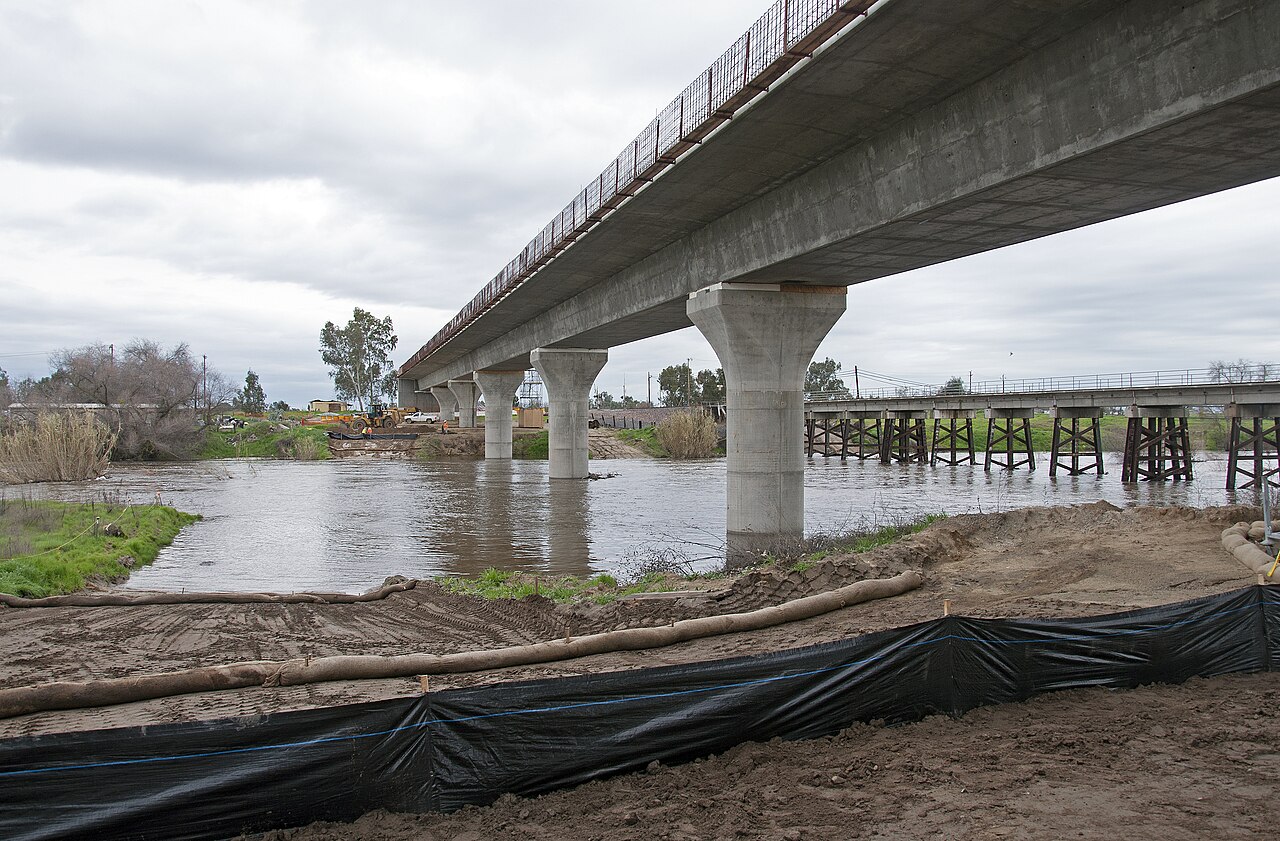
Construction continues. Streetsblog reports 66 structures completed along the first 119 miles. But as TIJ documented in an earlier look at the project’s consultant-driven cost growth, the program has long relied on outside firms for core management functions. That reliance is what makes the travel controls consequential: consultants billing hourly, with minimal pre-approval, operate in a system where each unreviewed trip is an unreviewed cost. The inspector general’s annual report, published in 2025, describes the office’s mandate to detect exactly this kind of lapse.
What Remains Unknown
Several questions are open. The report reviewed just over half of the travel payments, so the $593,000 may understate the total. The contract values for the four firms have not been made public in the coverage reviewed here, which makes it hard to judge the travel costs against total billings. The authority has not said how much it expects to recover, or whether any consultant will be required to repay charges. The inspector general said it will evaluate the authority’s corrective actions after March 2027.
TIJ sought comment from the authority and the four firms through the contacts publicly listed in coverage; where responses were available they are reported above, and the firms’ positions beyond those statements could not be independently confirmed. Two further developments are worth watching: whether the Legislature revisits oversight funding for the inspector general in the coming session, and whether the authority’s recovery effort produces measurable repayments. Until then, the public record shows a project that spent roughly $600,000 on travel its own watchdog says was unallowable, and an oversight office that, by its director’s account, lacks the tools to move faster.