

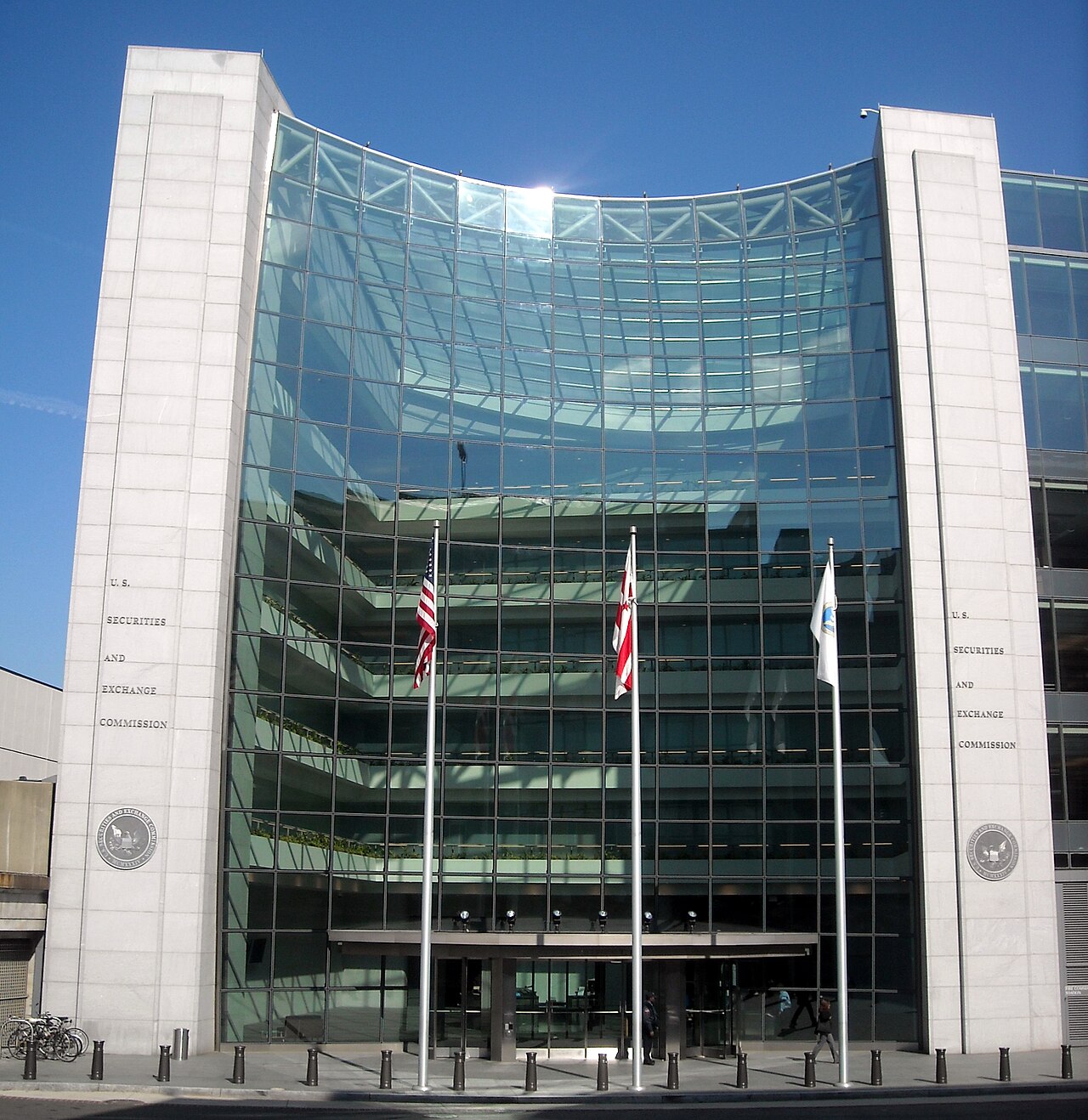
The Investigative Journal’s weekly survey of public-company filings, executive pay disclosures, insider trades, and governance flashpoints. Each item is sourced to a primary document on the SEC’s EDGAR system or a corresponding company press release. Where allegations are pending, that status is noted explicitly.
Apple’s once-in-a-generation succession lands in an 8-K
The most consequential corporate disclosure of the week was a single Item 5.02 entry from Apple Inc. (NASDAQ: AAPL). On April 20, 2026, the company reported that Chief Executive Officer Tim Cook will transition to executive chairman effective September 1, 2026, with Senior Vice President of Hardware Engineering John Ternus elevated to chief executive and a board seat. Filings indicate that Arthur Levinson, who has held the non-executive chairman post since 2011, will move to lead independent director on the same date. The transition was approved unanimously by Apple’s board and follows what the company described as a long-running succession process. According to Apple’s newsroom announcement, Cook will continue to engage with policymakers worldwide in his new chairman role.
For investors, the proxy implications are significant. Apple’s next definitive proxy will need to disclose the negotiated terms of Cook’s transition compensation, any retention awards granted to Ternus, and the structure of the chairman role going forward. Records suggest Cook’s reported total compensation has averaged near $74 million annually over the past three fiscal years, well above the S&P 500 median of roughly $16 million reported by Equilar. Investors will be watching whether Ternus’s initial pay is benchmarked to that legacy figure or reset closer to industry norms — a question that will be answerable only when the next DEF 14A is filed.
The succession also reshapes Apple’s risk-factor profile. Item 1A disclosures across the technology sector now routinely identify “key person” risk and AI-execution risk; Apple’s next Form 10-K will likely need to address how the handoff of operational authority during a generative-AI product cycle is being managed. The 8-K itself is available on EDGAR via Apple’s filer page (CIK 0000320193).
Strategy Inc. discloses $2.5B equity raise to fund single-week Bitcoin buying spree
Strategy Inc. (NASDAQ: MSTR), the former MicroStrategy, filed a string of Item 8.01 disclosures in April 2026 that, taken together, document one of the largest single-asset accumulation programs ever attempted by a public operating company. Filings indicate that during the week ended April 20, 2026, Strategy sold 21,795,389 shares of its STRC variable-rate preferred stock for $2.18 billion in net proceeds and 2,165,000 shares of MSTR common stock for $366 million in net proceeds — total proceeds of $2.54 billion — and used the entire amount to purchase 34,164 bitcoin at an average price of approximately $74,395 per coin. A subsequent 8-K filed for the week ending April 26 disclosed an additional 1,451,601 MSTR shares sold under the at-the-market program for $255 million, used to purchase a further 3,273 bitcoin at roughly $77,906 each.
Strategy’s filings now show aggregate holdings of 818,334 BTC at a cost basis of approximately $61.8 billion — an average price of $75,537 per coin, including fees. Available capacity under the company’s announced ATM program stood at roughly $26.47 billion of MSTR shares as of April 26. The structure raises governance questions that warrant deeper inquiry: Strategy’s preferred-stock dilution mechanics, the speed at which the company is willing to convert equity capacity into a single non-yielding asset, and the scenario analysis being shown to its audit committee should be central to the company’s next 10-Q risk-factor update. Filings indicate the strategy is approved by the board, but the disclosures do not yet address what happens to the operating software business if a sustained drawdown in bitcoin pricing impairs the carrying value of the digital-asset treasury.
Goldman Sachs faces April 29 say-on-pay vote on $47M Solomon package
Goldman Sachs Group Inc. (NYSE: GS) holds its annual meeting today — Wednesday, April 29, 2026, in Salt Lake City — with a binding shareholder vote on Chief Executive David Solomon’s $47 million 2025 compensation package. The bank’s DEF 14A proxy statement, filed March 19, breaks down Solomon’s compensation as $2 million in base salary, a $10.1 million cash bonus, $31.5 million in performance share units, and $3.4 million in carried interest from funds the bank manages. The total represents a 20.5% increase over Solomon’s $39 million 2024 package and likely makes him the highest-paid chief executive among the six largest U.S.-based banks for the 2025 measurement year, according to a comparison published by Banking Dive.
The proxy discloses that the bank’s Lead Director, Compensation Committee Chair, and investor-relations team participated in more than 120 engagement meetings representing over 45% of shares outstanding between fall 2024 and the end of 2025. Records suggest those meetings centered on the retention awards granted to Solomon and President John Waldron in January 2025 — the same retention grants that, in earlier proxy seasons, drew “F” grades from proxy advisers. Today’s say-on-pay outcome will be disclosed in an Item 5.07 8-K within four business days of the meeting, providing the first hard data on whether Goldman’s expanded engagement playbook materially shifted institutional voting behavior. The result is a story the TIJ newsroom will cover as a follow-up.
Wayfair seeks ratification of $280.8 million performance grant for co-founder
Wayfair Inc. (NYSE: W) filed its 2026 definitive proxy ahead of a virtual annual meeting scheduled for May 21, 2026. The proxy seeks shareholder approval of an amendment to the 2023 Incentive Award Plan that would add 20,000,000 Class A shares, including the 5,000,000 shares underlying a multi-year performance stock unit award granted to chief executive and co-founder Niraj Shah. Records indicate that grant — combined with prior outstanding awards — pushed Shah’s 2025 total disclosed compensation to $280.8 million, the highest in this year’s Equilar 100 study of large-company chief executive pay. The award vests only if Wayfair’s stock achieves a series of escalating price targets ranging from $176 to $679 per share over a ten-year measurement window.
For context, the Equilar median for the 100 largest U.S. public companies came in at $29.4 million for fiscal 2025 — a 23.2% year-over-year jump but still less than 11% of Shah’s headline figure. The proxy mechanically discloses the award at its grant-date fair value, but the practical realized payoff would only materialize if Wayfair’s market capitalization expanded by a multiple of current levels. Investors evaluating the say-on-pay vote will need to weigh whether a target band that tops out near $679 per share represents legitimate “moonshot” alignment with shareholder upside or an outsized headline that obscures lower-probability vesting economics. Wayfair’s filings are accessible at CIK 0001616707.
Tyler Technologies closes $212.5M For The Record acquisition
Tyler Technologies Inc. (NYSE: TYL) filed an Item 2.01 8-K on April 14, 2026 disclosing the completion of its previously announced cash acquisition of For The Record (FTR), a digital court-recording vendor, for approximately $212.5 million. The filing identifies FTR’s principal product line as AI-powered legal-grade speech-to-text and real-time multilingual transcription, technology that will be integrated into Tyler’s courts-and-justice software portfolio. According to the company’s investor-relations release, FTR’s existing offices in Arizona, Massachusetts, and Australia will continue to operate during integration.
The disclosure is significant beyond the dollar figure: it signals that mission-critical AI transcription is being inserted directly into U.S. courtroom workflows by a publicly traded vendor. Filings indicate Tyler will need to address audit-trail integrity, data-residency, and accuracy-rate disclosures in its next 10-Q. Public-record courtroom transcription is uniquely exposed to evidentiary and constitutional challenges, and the integration of generative-AI components into that pipeline is a story TIJ will track in coming months. The 8-K is available via Tyler’s EDGAR filer page.
Amkor Technology authorizes $300M buyback alongside Q1 results
Amkor Technology Inc. (NASDAQ: AMKR), a semiconductor packaging-and-test contractor, disclosed Q1 2026 results in an April 27 Item 2.02 8-K. The company reported net sales of $1.685 billion, net income of $83 million, and a gross margin of 14.2%. Concurrently, the company disclosed in an Item 8.01 entry that its board had authorized the repurchase of up to $300 million of common stock as part of its shareholder-return framework on April 23, 2026. Filings are available on Amkor’s EDGAR filer page.
The buyback represents approximately 2.4% of Amkor’s recent market capitalization — modest by mega-cap standards but meaningful for a company with significant capital-expenditure obligations tied to Arizona-based U.S. capacity expansion. Records suggest the repurchase is being funded out of operating cash flow rather than incremental debt, but the next 10-Q will be needed to confirm pacing and to disclose whether any portion of the buyback runs through a Rule 10b5-1 plan.
Insider selling: IMAX, Fastly, Mineralys disclose CEO Form 4 transactions
Three notable Form 4 insider-trading filings reached EDGAR in April 2026, each meriting attention not because of the absolute dollar value but because of the surrounding context. IMAX Corporation (NYSE: IMAX) chief executive Richard Gelfond reported aggregate sales of 75,919 common shares for approximately $2.81 million across April 16-17, 2026 open-market transactions. The filing notes the sales were tied to stock options scheduled to expire in June 2026, a routine but disclosable expiration-cycle pattern that does not, on its face, constitute an unusual signal.
Fastly Inc. (NYSE: FSLY) chief executive Charles Lacey Compton III reported the sale of 29,533 shares for approximately $720,000 across April 16-17, 2026. Mineralys Therapeutics (NASDAQ: MLYS) chief executive Jon Congleton sold 75,000 shares for approximately $1.97 million on April 2, 2026. None of the three filings disclose pre-arranged 10b5-1 plan adoption dates in the basic Form 4 line; the cover-text disclosures should be cross-referenced against any 10b5-1 plan disclosures filed with each company’s most recent 10-Q under the SEC’s December 2022 amendments. Filings are accessible directly through the EDGAR Form 4 search.
Risk-factor watch: AI disclosures dominate 10-K updates
Data shows a continued surge in artificial-intelligence risk-factor disclosure across the S&P 500. According to the most recent Harvard Corporate Governance Forum analysis, 72% of S&P 500 companies disclosed at least one material AI risk in their 2025 10-K filings — up from 12% in 2023. Approximately 36% of S&P 500 filers now treat AI as a stand-alone Item 1A risk factor, up from 14% the prior year. The most-cited subcategory is reputational risk (38%), followed closely by cybersecurity-and-deepfake risk and regulatory uncertainty.
The trend matters for disclosure analysts because it reframes how investors should read upcoming proxy and 10-Q filings. Companies that materially under-disclose AI exposure relative to their peer set are increasingly visible to plaintiffs’ firms tracking misrepresentation claims. The SEC, under chairman Paul Atkins, has signaled a broader Regulation S-K review with public comments accepted through April 13, 2026; preliminary guidance from his office indicates a preference for principles-based disclosure over prescriptive line-item rules. Filings indicate the agency’s forthcoming rule proposals on Rule 14a-8 and emerging-growth-company accommodations remain on the spring 2026 regulatory agenda.
Disclosures warranting deeper TIJ investigation
Three threads from this week’s filings merit follow-up reporting. First, Strategy Inc.’s rolling at-the-market issuance program — now a recurring weekly disclosure pattern — raises questions about whether the company’s audit committee has formally adopted bitcoin-specific impairment-trigger thresholds, and how the company’s preferred-stock holders are being protected from common-stock dilution arithmetic. The TIJ newsroom will request the company’s response and review STRC offering documentation in coming weeks.
Second, Goldman Sachs’s say-on-pay vote outcome will be a leading indicator of how 2026’s expanded shareholder-engagement playbook is performing across major financial institutions. A second-strike rejection would carry meaningful governance-policy consequences. Third, Wayfair’s $176-to-$679 performance band invites a closer look at how grant-date fair-value accounting captures — or fails to capture — the practical economics of decade-long stock-price hurdles. TIJ will examine comparable multi-year mega-grants at peer e-commerce companies. Right of reply has been requested from each named company; responses will be reflected in subsequent coverage. Pending matters are noted as such, and no findings of wrongdoing are alleged where filings document only routine corporate action.
The Investigative Journal monitors corporate disclosures weekly. Tips on inadequate disclosure, related-party transactions, or governance gaps may be sent to the editor through the publication’s secure tip channel.