
The Investigative Journal’s Corporate Disclosure Watch tracks the week’s most consequential filings with the U.S. Securities and Exchange Commission, translating proxy statements, 8-K disclosures and compensation tables into plain language for shareholders and citizens. All figures below are drawn from public filings, which are linked directly.
A quiet but unmistakable pattern surfaced in late-June corporate filings: shareholders at several U.S.-listed companies used their annual “say-on-pay” votes to reject the compensation their boards awarded to top executives. The advisory votes are non-binding, but they are among the bluntest instruments ordinary investors hold, and a failed vote is rare enough to function as a public rebuke. The freshest example landed on June 29, when data-cloud company Snowflake disclosed that its stockholders had declined to approve its executive pay for the second consecutive year.
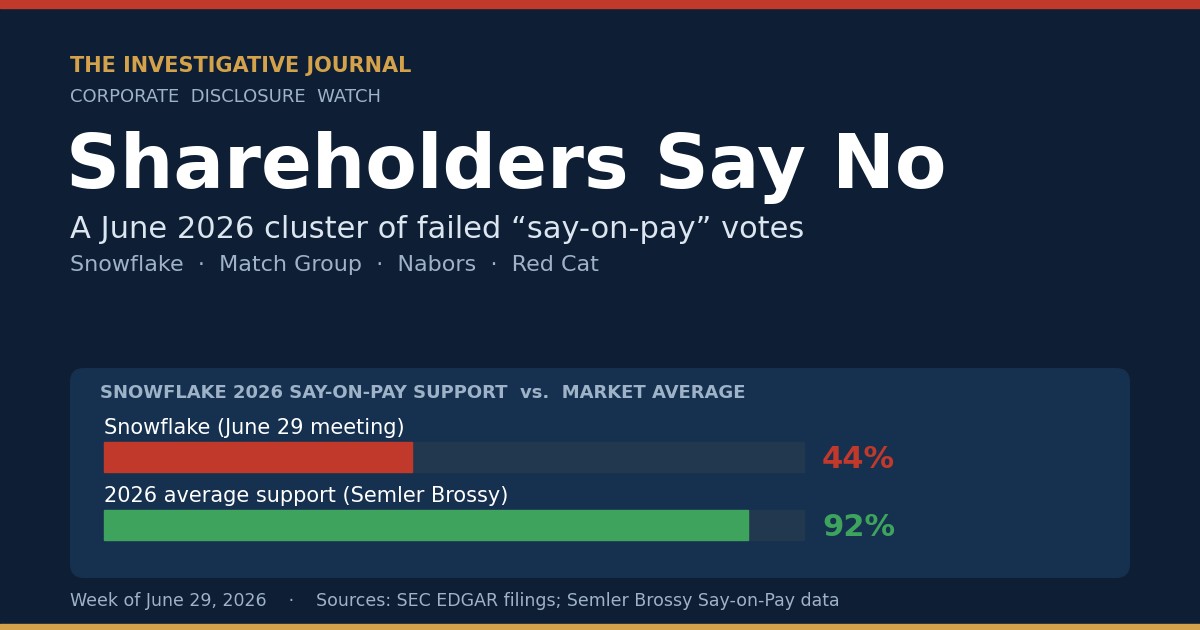
Say-on-pay failures remain unusual. Compensation consultancy Semler Brossy, which tracks the votes, reported that through the mid-point of the 2026 proxy season only five Russell 3000 companies (about 0.4 percent) and a single S&P 500 company had failed, with average shareholder support running above 91 percent. For a cluster of well-known issuers to draw majority “no” votes within a few weeks of one another is, against that baseline, a signal worth reading. Below are the week’s most notable disclosures.
1. Snowflake: a $100 million hiring package still haunts the ballot
Snowflake Inc. (NYSE: SNOW) reported in a Form 8-K that at its 2026 Annual Meeting on June 29, with 346,602,915 common shares represented, stockholders voted down the advisory resolution on named-executive-officer compensation. The tally was 96,340,999 shares in favor to 124,481,663 against, with 637,553 abstentions — roughly 44 percent support among shares voted for and against. The same meeting saw investors elect three Class III directors, ratify PricewaterhouseCoopers as auditor, and approve a non-binding shareholder proposal calling for a majority-vote standard in future director elections, according to the company’s vote-results filing.
The rejection is notable because it is the second in a row. Filings and compensation trackers indicate that Chief Executive Sridhar Ramaswamy’s pay for the fiscal year ended January 31, 2025 — his first as CEO — carried a headline value of roughly $101 million, the bulk of it a one-time equity and option grant tied to his hire. Support for that package at the 2025 meeting reportedly fell to about 30 percent. Even though the company’s 2026 proxy statement shows Ramaswamy’s more recent pay stepping down sharply, and even after Snowflake filed a supplemental proxy statement ahead of the meeting, a majority again withheld approval.
For a company that has repeatedly told investors it is disciplined about dilution, a repeat “no” vote suggests the board’s compensation committee has not yet closed the gap with its own shareholders. Records indicate Snowflake’s holders simultaneously endorsed stronger director-accountability mechanics, a combination that typically signals investors want structural change rather than a one-year fix.
2. Nabors Industries: outsized pay at a debt-heavy driller
Oil-and-gas drilling contractor Nabors Industries Ltd. (NYSE: NBR) held its annual general meeting on June 2. Shareholders representing 80.61 percent of outstanding common stock participated; they elected the board’s nominees, approved PricewaterhouseCoopers as auditor and amended the company’s 2016 stock plan, but the advisory vote on executive compensation failed, according to the company’s post-meeting report. The underlying 2026 proxy statement details the pay program that drew the dissent.
An analysis of that proxy by Quiver Quantitative put Chairman, President and CEO Anthony G. Petrello’s 2025 total compensation at roughly $29.6 million — more than double the $12.1 million reported for 2024 — with variable pay accounting for the large majority of the total. That figure sits well above the mid-teens-of-millions range that compensation trackers describe as typical for the broader S&P 500, and it lands at a company that analysts characterize as carrying heavy balance-sheet leverage and uneven free-cash-flow generation. Petrello has drawn shareholder scrutiny over pay for more than a decade, making the 2026 rejection a continuation of a long-running governance tension rather than a one-off.
Institutional-ownership data compiled from 13-F filings adds context: several large holders cut their Nabors positions in the fourth quarter of 2025, with Brigade Capital Management reducing its stake by about 77 percent and both Oaktree Capital Management and Apollo-affiliated funds exiting entirely, according to the same aggregated filing data. Concentrated selling by sophisticated holders, followed by a failed pay vote, is the kind of sequence that merits continued monitoring.
3. Match Group: a new CEO’s welcome package gets a cold reception
Match Group, Inc. (Nasdaq: MTCH), the parent of Tinder and Hinge, disclosed in a Form 8-K that at its June 16 annual meeting — with more than 208.6 million shares represented — stockholders voted against the advisory say-on-pay proposal covering 2025 named-executive-officer compensation. Investors nonetheless elected all four director nominees, ratified Ernst & Young and approved an amended stock and incentive plan, per the company’s vote-results filing.
The disputed pay largely reflects the arrival of Chief Executive Spencer Rascoff, who took the role in February 2025. Match Group’s disclosure of his employment terms describes an equity award with a grant-date value of about $47.2 million — split among time-vesting restricted stock, performance-based units and a $30 million “value-creation” award contingent on share-price gains — alongside an $800,000 base salary and a target bonus of up to $1.6 million. Large front-loaded grants for incoming chief executives are common, but they frequently attract say-on-pay opposition when a stock has lagged, as proxy advisers weigh the size of the award against realized shareholder returns. That investors approved a new incentive plan in the same session indicates the objection is aimed at the magnitude and structure of the CEO award rather than at equity compensation in principle.
4. Red Cat Holdings: a cash-burning defense-drone maker rewards its founder
Red Cat Holdings, Inc. (Nasdaq: RCAT), a maker of small unmanned aircraft for military and public-safety customers, reported that at its June 18 annual meeting 71,433,137 of roughly 122 million eligible shares were represented. Stockholders elected five directors and ratified KPMG, but the advisory vote on executive compensation failed to secure a majority of votes cast; the company’s compensation committee signaled it may retain an independent adviser and would weigh the result in future pay decisions.
Red Cat’s 2026 proxy statement reports total 2025 compensation of $6,816,406 for founder, Chief Executive and President Jeffrey Thompson, the overwhelming majority of it — about $6.5 million — in stock awards, atop a $137,500 salary and a $125,000 bonus. For a company of Red Cat’s size, that is a substantial equity grant, and it was awarded during a period in which the company has reported significant operating losses and heavy cash consumption while scaling to fulfill U.S. Army orders. The disconnect between a multimillion-dollar equity package and persistent unprofitability is precisely the pay-for-performance question say-on-pay was designed to surface, and shareholders answered it directly.
5. Moderna: bonus pools funded above target as revenue recedes
Vaccine maker Moderna, Inc. (Nasdaq: MRNA) offers a related disclosure worth flagging even absent a failed vote. According to the company’s 2026 proxy statement, its 2025 corporate bonus pool was funded at 170 percent of target, with a large share of the chief executive’s compensation classified as performance-based or “at risk.” Funding an annual incentive well above target invites scrutiny at a company whose revenue has fallen sharply from its pandemic-era peak, and it illustrates how “at-risk” pay can still pay out generously depending on the goals a board chooses to measure. TIJ notes the funding level is drawn from the company’s own filing and reflects the compensation committee’s stated assessment of 2025 performance against pre-set objectives.
The bigger picture: dissent is rising against a rare-failure backdrop
None of these votes forces a board to claw back or reduce a dollar of pay; say-on-pay is advisory by law. Their weight is reputational and, over time, electoral: directors who ignore repeated majority dissent can find their own re-elections targeted. That is why the timing matters. Semler Brossy’s data show median CEO compensation still rose in 2025 — up roughly 12 percent across the Russell 3000 and 7 percent in the S&P 500 — even as the share of pay tied to performance metrics grew. When pay keeps climbing and a visible minority of companies draw outright rejections, the gap between boardroom compensation philosophy and shareholder patience becomes the story.
One policy development sharpens the stakes. Commentary published on the Harvard Law School Forum on Corporate Governance notes that on May 19, 2026, the SEC proposed simplifying corporate disclosure, including reduced executive-compensation reporting obligations for smaller reporting companies — those with a public float under roughly $2 billion. By the SEC’s own estimate, the threshold could make about 80 percent of public companies eligible for lighter disclosure, though nearly all S&P 500 and S&P 400 constituents would remain subject to full reporting. If adopted, the proposal would preserve detailed pay disclosure at the largest issuers while thinning it at thousands of smaller ones — the very tier where governance oversight is often weakest.
What warrants a closer look
Three threads from this week’s filings merit deeper reporting. First, Snowflake’s back-to-back rejections raise the question of whether its board will restructure future grants or simply wait out shareholder anger; the company’s next proxy will reveal which. Second, the concentration of institutional selling in Nabors ahead of its failed vote invites a closer read of who is exiting and why, and whether the board’s compensation choices are a cause or a symptom. Third, Red Cat’s combination of a multimillion-dollar founder grant and continuing losses — at a company increasingly dependent on federal defense contracts — places it at the intersection of executive pay and taxpayer-funded procurement, a subject The Investigative Journal will continue to examine.
All companies named here are public issuers whose compensation practices are documented in the public record; the advisory votes described are non-binding, and nothing above should be read as an allegation of wrongdoing. Where figures are drawn from third-party analyses of proxy filings rather than directly from a summary compensation table, that attribution is noted. Readers can review each filing in full through the linked SEC EDGAR records.