

The Investigative Journal’s daily wrap of notable U.S. Department of Justice enforcement activity. Charges referenced below are allegations; defendants are presumed innocent unless and until convicted.
The Department of Justice closed out a busy April with a fast-moving week of indictments, settlements and seizures that touched almost every corner of the federal enforcement portfolio — from a politically charged fraud case against one of America’s best-known civil rights nonprofits to the first criminal prosecution arising out of a prediction-market bet, a transnational migrant-smuggling case anchored to an Iranian national arrested in Colombia, and a sprawling cyber strike against Southeast Asian “pig butchering” scam compounds. Below, TIJ’s daily round-up of the cases worth watching.
1. SPLC indicted on wire fraud, bank fraud and money-laundering counts
A federal grand jury in Montgomery, Alabama, on April 21 returned an 11-count indictment charging the Southern Poverty Law Center with six counts of wire fraud, four counts of false statements to a federally insured financial institution, and one count of conspiracy to commit concealment money laundering. According to the DOJ press release and the indictment, prosecutors allege that between 2014 and 2023 the SPLC funneled more than $3 million in donor funds to individuals associated with the Ku Klux Klan, Aryan Nations and the National Socialist Party of America while publicly fundraising on a promise to dismantle those same groups.
Acting Attorney General Todd Blanche and FBI Director Kash Patel announced the case in Washington. The indictment alleges the payments moved through bank accounts opened in the names of fictitious entities to disguise the source and destination of the money — the conduct underpinning the bank-fraud and money-laundering counts. Two related civil forfeiture actions filed in the Middle District of Alabama seek to recover assets allegedly traceable to the scheme.
The SPLC has denied wrongdoing, with its interim chief executive characterizing the payments as a longstanding, lawful confidential-informant program used to monitor extremist groups. As CBS News reported, several former federal prosecutors have publicly questioned the indictment’s legal theory, noting that paying sources is a routine investigative practice that is not, on its face, fraudulent. The case is expected to test how aggressively prosecutors can pursue donor-fraud theories against advocacy nonprofits whose internal investigative practices are not disclosed to small-dollar donors. Status: pending; no findings of fact have been entered.
2. Special Forces sergeant charged with insider trading on a prediction market
In what the Department of Justice described as a first-of-its-kind prosecution, a federal grand jury indicted U.S. Army Special Forces Sergeant Gannon Ken Van Dyke, 38, of Fayetteville, North Carolina, with three counts of violating the Commodity Exchange Act, one count of wire fraud, and one count of an unlawful monetary transaction. The April 23 DOJ announcement alleges Van Dyke used classified knowledge of “Operation Absolute Resolve,” a U.S. military operation that culminated in the January 3 capture of Venezuelan strongman Nicolás Maduro, to wager on related contracts on the offshore prediction market Polymarket.
According to the indictment, Van Dyke opened his Polymarket account on or about December 26, 2025, placed approximately 13 “YES” wagers totaling roughly $33,034 between December 27 and January 26, and walked away with profits of about $409,881 once the contracts resolved following the operation. Filings indicate that, on the day of the operation, Van Dyke moved most of his proceeds through a foreign cryptocurrency vault before depositing them in a newly created online brokerage account — conduct prosecutors cite as evidence of concealment.
The case is being prosecuted in the Eastern District of North Carolina by the DOJ Criminal Division’s Fraud Section and the U.S. Attorney’s Office. Coverage from CNBC, The Washington Post and NPR notes that this is the first criminal action U.S. authorities have brought against an individual over prediction-market wagers, and signals that DOJ intends to treat event-contract markets as commodities markets for enforcement purposes. A separate question worth watching: whether competing platform Kalshi, which says it blocked Van Dyke after the fact, becomes a witness, a target, or both as the case develops. Status: charges pending.
3. Iranian national indicted for $30,000-per-head migrant smuggling network
An indictment unsealed April 24 in the Western District of Texas charges Jafar Tafakori, 57, an Iranian national, with one count of conspiracy to bring an alien to the United States and five counts of bringing an alien to the United States for financial gain. According to the DOJ release, Tafakori allegedly orchestrated a network that moved Iranian nationals from South America through Central America and Mexico into the United States between December 2022 and May 2024, charging some clients up to $30,000 for shelter, transportation and airline tickets.
Colombian national police arrested Tafakori on April 23 in Pereira, Colombia, on a U.S. warrant. If convicted on three or more of the five “for financial gain” counts, he faces a mandatory minimum of five years and a maximum of 15 years in federal prison. The conspiracy count alone carries up to 10 years.
The case is significant beyond its caseload value. Federal investigators have for several years quietly tracked smuggling routes that move nationals of state-sponsor-of-terrorism countries through the Western Hemisphere, and the Tafakori indictment offers an unusually detailed look at how a single broker allegedly stitched the route together. Records suggest U.S. prosecutors will continue to lean on extradition cooperation with Colombian and other regional authorities to dismantle similar networks. Status: charges pending; extradition proceedings underway.
4. Multi-pronged strike on Southeast Asian “pig butchering” scam compounds
On April 23, the Justice Department, the FBI, and Treasury’s Office of Foreign Assets Control unveiled what officials described as the most comprehensive U.S. action to date against the cyber-enabled fraud compounds operating in Cambodia, Burma and Laos. Prosecutors unsealed criminal complaints against two Chinese nationals — Huang Xingshan and Jiang Wen Jie — identified as managers of the Shunda compound in Min Let Pan, Burma, where trafficked workers were allegedly forced to defraud American victims through fake cryptocurrency investment platforms.
The package also included the seizure of more than 503 .com domains used in the scams, the restraint of approximately $701.9 million in cryptocurrency tied to laundered victim funds, and a first-of-its-kind seizure of a Telegram channel with more than 6,000 followers used to recruit English-speaking workers to Cambodia under false job pretenses. OFAC simultaneously designated 29 targets in Cambodia, anchored on Cambodian Senator Kok An and his business associate Rithy Raksmei, alleging that their network of casinos, hotels and holding companies provides the physical infrastructure that houses the scam compounds. Coverage in Crypto Times and Chainalysis situates the action within a wider U.S. push to target the Asian scam economy at the cash-handling layer rather than the call-floor layer.
For investigators, the action consolidates several open threads: the use of human-trafficked labor inside the compounds, the role of regional politically exposed persons in laundering the proceeds, and the centrality of stablecoin rails to “pig butchering” operations. The structure of the OFAC designations — targeting infrastructure rather than individual scammers — suggests Treasury views the compound model as durable so long as the host economies tolerate it. Status: charges and designations pending; defendants remain at large.
5. IBM pays $17 million in first FCA settlement under Civil Rights Fraud Initiative
Acting Attorney General Todd Blanche on April 10 announced that IBM would pay $17,077,043 to resolve allegations under the False Claims Act that the company knowingly maintained employment practices that took race or sex into account while certifying compliance with the anti-discrimination provisions of its federal contracts. Records suggest the settlement is the first to be brought under the Department’s new Civil Rights Fraud Initiative, which treats certain diversity, equity and inclusion programs as actionable false certifications when paired with federal-contract attestations.
According to legal alerts published by Foley Hoag and Holland & Knight, the alleged conduct ran from 2019 through 2026 and covered hiring, compensation and other employment decisions. IBM did not admit liability. The settlement opens a new front of FCA exposure for federal contractors whose internal HR practices reference protected characteristics, and it is expected to drive a wave of compliance reviews across the contractor base.
Separately, on April 7, the Civil Rights Division announced a $313,420 settlement with New Jersey-based Compunnel Software Group, Inc., resolving allegations that the staffing firm posted job advertisements with citizenship-status restrictions not authorized by law — an Immigration and Nationality Act violation that the Division has prioritized in recent enforcement sweeps.
6. National Fraud Enforcement Division announces $340M in actions
The newly stood-up National Fraud Enforcement Division, created by departmental order on April 7, used its second weekly recap on April 17 to announce arrests, indictments, convictions and sentencings tied to schemes totaling more than $340 million in actual or intended losses. According to the DOJ release, individual cases ranged from approximately $54,000 to more than $100 million in alleged loss. The Division has also been the conduit for the Administration’s announcement of $300 million in supplemental prosecutorial funding, detailed in a follow-on release.
Headline cases included an indictment in the Northern District of Georgia charging Nigerian and Georgia defendants with a stolen-identity tax-refund fraud scheme that allegedly sought more than $100 million from the IRS; the indictment of six St. Louis-area residents for an $8.3 million pandemic-relief fraud scheme; arrests in Kentucky, Indiana and Colorado tied to a $1.6 million COVID-19 relief fraud; and the arrest of a Missouri physician accused of defrauding Medicare and Medicaid while distributing controlled substances to acquaintances.
The Division’s weekly cadence is itself a tell: by aggregating and re-publicizing dispersed U.S. Attorney’s Office actions, DOJ leadership is reframing routine fraud prosecutions as components of a coordinated national posture. For TIJ readers, the practical effect is that smaller district-level cases — the ones that historically went uncovered by national outlets — are surfacing in a single weekly digest worth tracking.
7. California man pleads guilty in $270M Medi-Cal medication fraud
On April 7, the Justice Department announced that a California man pleaded guilty to orchestrating a medication-reimbursement fraud scheme that caused at least $269,120,829 in false and fraudulent claims to Medi-Cal between May 2022 and April 2023. The defendant admitted to using a network of pharmacies to bill the state’s Medicaid program for high-cost medications that were either never dispensed or were dispensed in quantities far below what was billed.
The plea is part of a broader push that DOJ characterized in an early-April release as the prosecution of more than half a billion dollars in healthcare and COVID-era fraud. Records indicate that Medi-Cal — the largest Medicaid program in the country — remains a focal point for federal investigators in the wake of pandemic-era expansions to coverage and prescribing rules.
On April 2, the U.S. Attorney’s Office for the Central District of California separately announced “Operation Never Say Die,” a takedown that produced charges against more than a dozen defendants tied to roughly $60 million in alleged hospice-care fraud. Filings in that operation describe “sham” hospice operators allegedly paying $300-per-month kickbacks to healthy beneficiaries to pose as terminally ill, generating Medicare claims that the operators then split with the recruiters.
8. Army employee charged under the Espionage Act for leak to a journalist
On April 8, federal prosecutors in the Eastern District of North Carolina announced the arrest and indictment of Courtney Williams, 40, of Wagram, North Carolina, on a single count of willful transmission of national defense information under the Espionage Act. According to the DOJ release, Williams held a Top Secret clearance while supporting a special military unit at Fort Bragg and is alleged to have transmitted classified materials to individuals not authorized to receive them, including a journalist.
Independent reporting from UPI notes that Williams is identified as a named source in Seth Harp’s nonfiction book The Fort Bragg Cartel: Drug Trafficking and Murder in the Special Forces, published in August 2025. The case raises classic press-freedom questions — particularly because the underlying reporting concerns alleged criminal conduct on a U.S. military installation — and is likely to attract amicus interest from First Amendment organizations as it proceeds. The maximum statutory penalty on the single charged count is 10 years’ imprisonment. Status: charges pending.
What warrants deeper TIJ investigation
Three of this week’s actions stand out as deserving sustained reporting. First, the SPLC indictment will turn on a contested legal theory about when nonprofit fundraising disclosures cross into wire fraud. The internal DOJ deliberations behind the charging decision — and the political context in which Acting Attorney General Blanche announced the case — warrant primary-document reporting. Second, the Van Dyke prosecution is the first prediction-market insider-trading case to reach a federal grand jury; the CFTC and DOJ Fraud Section’s coordination here will set the template for how event-contract platforms are policed going forward. Third, the Cambodia-anchored OFAC and DOJ package against scam compounds raises an open question about how U.S. law enforcement can reach principals who sit inside the political class of host states — and whether sanctions on infrastructure operators are an effective substitute for criminal cases that cannot be brought.
The Investigative Journal will continue to track all three threads, along with the routine, high-volume fraud actions surfacing through the National Fraud Enforcement Division’s weekly recaps. Readers with relevant tips can reach the editor at the address listed on our masthead.
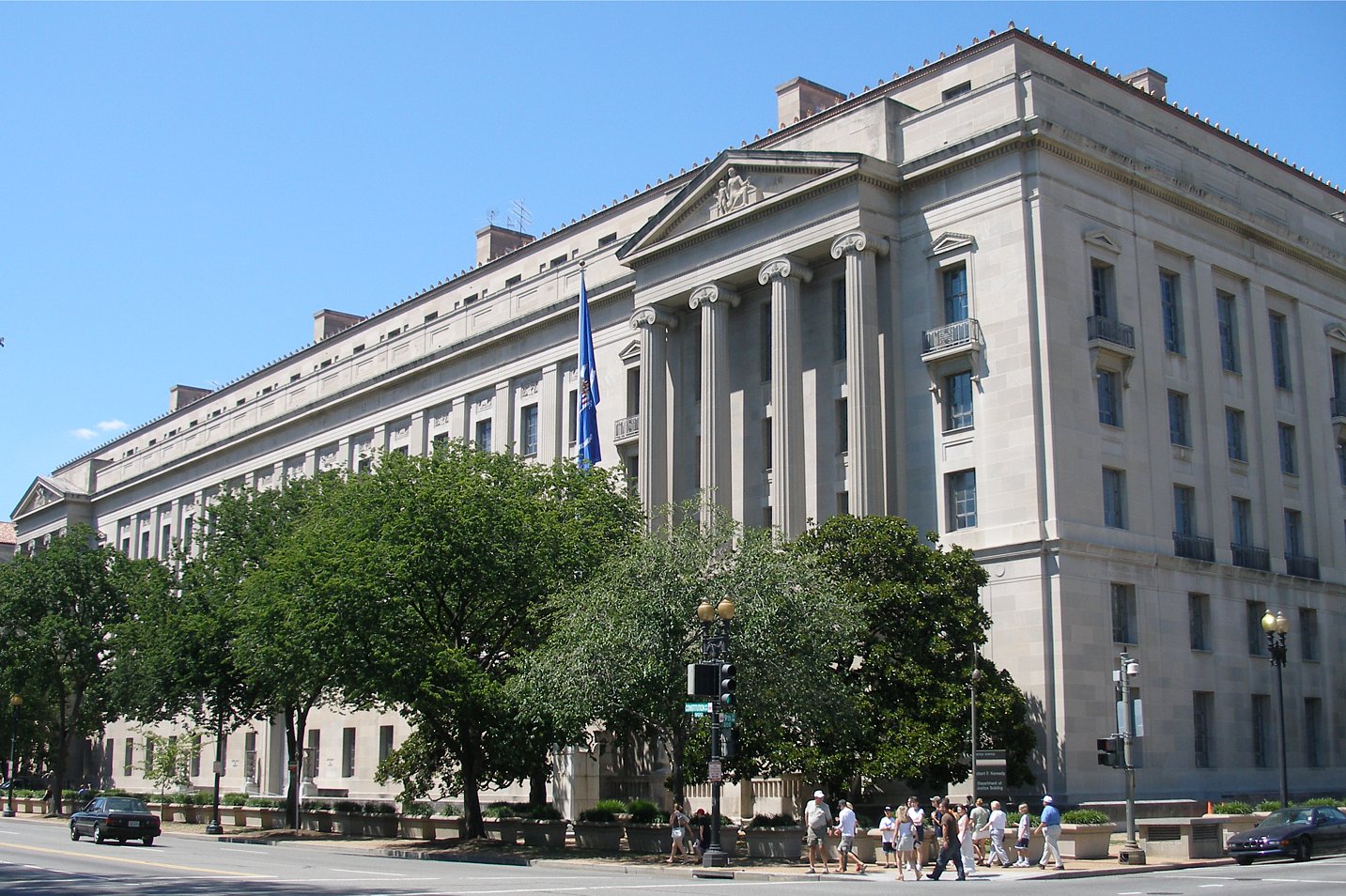
Sources: U.S. Department of Justice Office of Public Affairs press releases (justice.gov/opa); U.S. Attorney’s Office and Criminal Division press releases (justice.gov/criminal/press-releases); FBI press releases (fbi.gov/news/press-releases); independent press coverage cited inline. Featured image: U.S. Department of Justice headquarters, photographed August 12, 2006, by Coolcaesar via Wikimedia Commons, used under the Creative Commons Attribution-ShareAlike 3.0 license (file page).