

The Justice Department closed the second week of July with an enforcement docket that ranged from an alleged domestic-terror plot against a White House event to the collapse of a defense-industry merger, a transnational narcotics case built around a former Afghan general, and the sentencing of a federal officer who beat a shackled prisoner. This edition of DOJ Watch surveys seven notable actions announced between July 9 and July 13, 2026, drawing exclusively on the department’s own press releases and court filings.
Taken together, the week’s actions track the priorities the department has emphasized through 2026: national security and counterterrorism, cybercrime, health care and government fraud, public integrity, antitrust enforcement in defense markets, and environmental compliance. Each case below links to its primary source. Where charges remain unproven, that status is noted explicitly.
1. Eight Men Indicted Over Alleged Plot to Attack White House UFC Event
A federal grand jury in Columbus, Ohio, returned a two-count indictment on July 9 charging eight men in connection with an alleged plot to attack the Ultimate Fighting Championship’s “Freedom 250” event held at the White House on June 14, according to the Justice Department. The indictment charges conspiracy to provide material support to terrorists and conspiracy to commit murder on federal government territory and to murder a federal official.
According to the indictment, the defendants—who ranged in age from 19 to 32 and lived in Ohio, Nebraska, Missouri, Washington, California and West Virginia—began coordinating in May 2026 through chat groups on Signal, SimpleX, Discord, TikTok and Instagram. Prosecutors allege the group amassed firearms, ammunition, body armor, explosives and drones, conducted marksmanship and combat training, and organized itself into a tiered command structure. The department said the men allegedly agreed to target the President, the Vice President, other federal officials, the Prime Minister of Israel and Elon Musk, among “other high value targets.” An eighth defendant, a 21-year-old from West Virginia allegedly assigned to serve as a sniper, was arrested by the FBI this week in West Virginia.
The case is being handled by the U.S. Attorney’s Office for the Southern District of Ohio and the department’s National Security Division. Conspiracy to provide material support to terrorists carries up to 15 years in prison; the murder-conspiracy count carries a maximum of life. An indictment is an allegation only, and all eight defendants are presumed innocent unless and until proven guilty. The case warrants close attention as it moves toward trial—both for what the government’s evidence may reveal about online radicalization networks and for how the material-support statute is applied to an alleged domestic plot.
2. Former Afghan General Extradited on Heroin, Meth and Weapons Charges
Abdul Zahir Qadeer—a former general in Afghanistan’s Border Force and a onetime First Deputy Speaker of the Afghan parliament’s lower house—was extradited to the United States on July 10 to face narcotics-importation and firearms charges in the Southern District of New York, the department announced. A complaint unsealed the same day alleges that Qadeer conspired to traffic hundreds of kilograms of heroin and methamphetamine for sale in the United States, along with an arsenal of military-grade weaponry.
According to the complaint, Qadeer negotiated from late 2024 with a confidential source working at the direction of the Drug Enforcement Administration who posed as a member of an international drug-trafficking organization. Prosecutors allege that in December 2024 Qadeer sold a two-kilogram test shipment of methamphetamine—delivered to an associate in Johannesburg, South Africa—for roughly $14,000, and later quoted prices for sniper rifles, heavy machine guns, rocket-propelled grenade launchers and grenades. He was arrested in Nairobi, Kenya, in April 2025 following a meeting with DEA sources and held pending extradition.
U.S. Attorney Jay Clayton said Qadeer, while “purporting to be a political leader,” allegedly “held a dual role as a large-scale international narcotics and military-grade weapons trafficker.” The narcotics count carries a 10-year mandatory minimum and a maximum of life; the machine-gun counts add a 30-year mandatory minimum. The charges are allegations, and Qadeer is presumed innocent. The case illustrates the DEA’s continued reliance on extraterritorial undercover operations to reach defendants far beyond U.S. borders.
3. Ransomware Negotiator Who Betrayed His Own Clients Sentenced to 70 Months
Angelo Martino, 41, of Land O’Lakes, Florida, was sentenced on July 9 to 70 months in prison for conspiring with operators of the BlackCat/ALPHV ransomware group to extort the very victims he had been hired to protect, the department said. Martino had been employed as a ransomware negotiator at a U.S.-based cyber-incident-response firm.
According to court documents, beginning in April 2023 Martino fed confidential information about his clients’ negotiating positions to BlackCat attackers so the criminals could maximize the ransoms victims paid. He also conspired with two other former cybersecurity professionals—each sentenced in May to 48 months—to deploy BlackCat ransomware against additional victims, splitting a roughly $1.2 million Bitcoin ransom from one target three ways. Prosecutors said law enforcement has seized about $10 million in assets tied to the scheme, including digital currency, vehicles, a food truck and a luxury fishing boat.
Martino pleaded guilty in April to conspiring to interfere with interstate commerce through extortion; a restitution hearing is set for September. The department framed the sentence as part of “Operation Riptide,” an FBI campaign against cyber-enabled crime, and noted that Americans reported more than $20 billion in cybercrime losses last year—a 26 percent single-year increase, according to the department. The case is significant for targeting an insider who exploited the trust of victims in crisis, a growing concern within the incident-response industry.
4. Former Deputy U.S. Marshal Sentenced for Assault on Shackled Prisoner
Joshua Firmin, 49, a former Deputy U.S. Marshal, was sentenced on July 10 to 45 months in prison after a federal jury in the Western District of Louisiana convicted him in April of deprivation of rights under color of law and falsification of records, the department said.
According to trial evidence, Firmin learned in February 2024 that a prisoner awaiting a court appearance at the federal courthouse in Lafayette had insulted him. He then entered the cellblock, pulled the handcuffed and shackled prisoner from his cell by the hair and slammed the man’s head into a wall, causing a scalp laceration that required staples to close. Firmin subsequently filed a use-of-force report that falsely claimed the prisoner had tried to spit on him and struck his head accidentally. Another deputy who witnessed the assault reported it up the chain of command, prompting a Justice Department Office of the Inspector General investigation.
The department’s Civil Rights Division prosecuted the case alongside the U.S. Attorney’s Office. Officials emphasized that the “great majority of law enforcement officers” serve honorably; the conviction is nonetheless a reminder that federal law-enforcement misconduct remains within the department’s public-integrity enforcement priorities—a thread TIJ will continue to follow across agencies.
5. Justice Department Forces Abandonment of Defense-Parts Merger
TransDigm Group abandoned its proposed acquisition of rival Stellant Systems on July 13 after the Justice Department’s Antitrust Division informed the companies it would sue to block the deal, the department announced. The two firms compete to supply and repair components used in radar systems for the Navy’s Aegis Combat System and the Air Force’s F-16 fighter jets.
The department said the merger would have left the military with a single source for critical products, raising supply-chain risk and eliminating the benefits of competition. TransDigm is headquartered in Cleveland, Ohio; Stellant is based in Torrance, California. No complaint was ultimately filed in court because the companies walked away once the department signaled its intent to litigate. For observers of the defense industrial base, the episode signals continued antitrust scrutiny of consolidation among Pentagon suppliers.
6. Keystone Pipeline Operator to Pay $26.8 Million Over 2022 Kansas Spill
The Justice Department, acting on behalf of the Environmental Protection Agency and the State of Kansas, filed a proposed consent decree on July 10 to resolve Clean Water Act claims against South Bow (USA) LP and an affiliated operator—owners of the Keystone Pipeline—stemming from the December 2022 rupture that spilled roughly 13,000 barrels of crude oil (about 543,000 gallons) into Mill Creek in Washington County, Kansas.
Under the proposed settlement, South Bow would pay a civil penalty of about $26.87 million, complete an estimated $40 million in work to prevent future discharges, and contribute more than $3 million to Kansas for natural-resource restoration. The department described the event as one of the largest inland oil spills in recent history and the largest ever from the Keystone system; the complaint states that oil coated Mill Creek bank-to-bank for 3.5 miles downstream and killed or affected more than 2,700 animals. The consent decree is subject to a 30-day public comment period before a court decides whether to approve it, and the allegations it resolves have not been adjudicated.
7. Former ODNI Chief Operating Officer Settles Ethics Allegation
Deirdre Walsh, the former Chief Operating Officer of the Office of the Director of National Intelligence, agreed to pay $20,000 to resolve allegations that she violated post-government-employment restrictions during the one-year “cooling off” period after leaving ODNI, the department announced July 10. The agreement resolves civil allegations and is not a criminal finding. Modest in dollar terms, the action is nonetheless a useful data point in how the department enforces revolving-door rules on senior national-security officials—an accountability beat worth tracking.
Cases TIJ Is Watching
Two threads from earlier in the summer still warrant deeper reporting. In late June, the department announced its 2026 National Health Care Fraud Takedown—455 defendants and more than $6.5 billion in alleged fraud—and simultaneously expanded the FBI’s new “Most Wanted Fraudsters” list. At least two high-dollar fugitives connected to that effort, Khalid Satary (tied to a $547 million genetic-testing scheme) and Emylee Thai (tied to a $90 million scheme), remain at large abroad, according to the department. Their cases, and the asset-recovery efforts behind them, are a natural focus for follow-up reporting.
The White House UFC plot indictment is the other case to watch closely. As it proceeds in the Southern District of Ohio, the government’s evidence should illuminate how the alleged conspirators organized online and how prosecutors intend to prove a domestic material-support case. TIJ will continue monitoring the docket. As always, readers should bear in mind that indictments and complaints are allegations, and every defendant is presumed innocent until proven guilty in a court of law.
Sources: All cases in this digest are drawn from U.S. Department of Justice Office of Public Affairs press releases published July 9–13, 2026, linked inline above. Statutory maximum and minimum penalties are prescribed by Congress and provided for informational purposes only; any sentence is determined by the court. Indictments and complaints are allegations; defendants are presumed innocent until proven guilty.
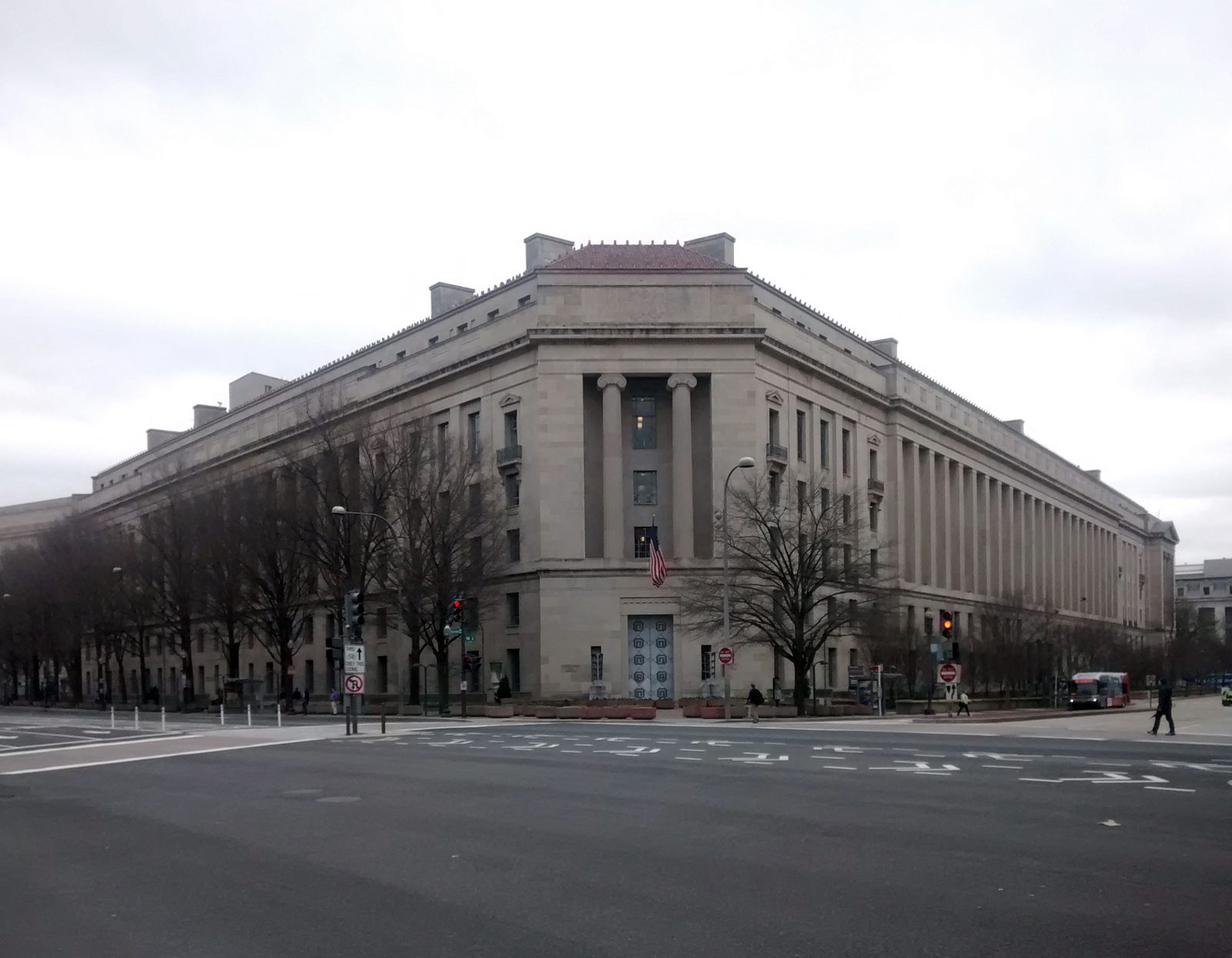
Featured image: Robert F. Kennedy Department of Justice Building, Washington, D.C. Photo by Gunnar Klack, licensed under CC BY-SA 4.0.