

DOJ Watch is The Investigative Journal’s daily digest of federal enforcement activity, drawn from Department of Justice press releases, U.S. Attorney announcements, and related court records. Every item below is sourced to a primary public record. Charges described as indictments, complaints, or allegations are exactly that: defendants are presumed innocent unless and until proven guilty.
The Justice Department closed the July 13–14 window with an unusually broad enforcement slate, spanning international cybercrime, trade fraud, Iran sanctions evasion, health care fraud, defense-industry antitrust, and the killing of a deputy U.S. marshal. Below are eight actions worth tracking, followed by the cases that merit a deeper look.
1. Three Russian nationals and two “bulletproof hosting” firms indicted in $62M cybercrime case
An indictment unsealed July 14 in the U.S. District Court for the Northern District of Ohio charges three Russian nationals—Alexander Alexandrovich Volosovik, 43; Kirill Andreevich Zatolokin, 34; and Yulia Vladimirovna Pankova, 29, all of St. Petersburg—along with the companies Medialand LLC and ML.Cloud LLC, with conspiracy to commit computer fraud, conspiracy to commit wire fraud, wire fraud, and conspiracy to commit money laundering. The indictment was originally returned in December 2024, according to the DOJ announcement.
Prosecutors allege the defendants ran “bulletproof hosting” services—infrastructure knowingly leased to cybercriminals to help them deploy malware and ransomware while evading law enforcement. Filings indicate that 42 victims across 21 states were targeted by criminal groups using the services, with total losses exceeding $62 million; victims reportedly included banks, schools, hospitals, government entities, and media companies. The State Department’s Rewards for Justice program simultaneously offered a reward of up to $10 million for information on the defendants and their networks, and the companies and individuals were sanctioned by the Treasury’s Office of Foreign Assets Control in November 2025.
The case is part of Operation Riptide, an FBI campaign the Department says targets the infrastructure and financial networks behind cyber-enabled fraud. DOJ noted Americans reported more than $20 billion in cybercrime losses last year, a figure that—if borne out—marks a 26 percent single-year increase and underscores why hosting intermediaries have become a federal priority.
2. Trade Fraud Task Force passes $1 billion; new Chicago customs-evasion charges
DOJ announced July 14 that its Trade Fraud Task Force (TFTF), stood up with the Department of Homeland Security in August 2025, has surpassed $1 billion in combined civil and criminal recoveries, penalties, forfeitures, and charged losses in under a year. The Department framed the milestone as a shift from administrative fines toward criminal prosecution and False Claims Act enforcement, per the official release.
The announcement was paired with new charges out of the Northern District of Illinois, the TFTF’s designated lead prosecutorial office. Raj and Veena Kohli, who operate Surya International Inc., were charged with falsely declaring that gold jewelry was manufactured in Singapore rather than its true origins of India and the United Arab Emirates; the charges allege roughly $38 million in evaded customs duties on jewelry valued at more than $693 million between 2020 and 2024. Separately, Narain Gulabani of Barkha Wholesale Inc. was charged with falsely declaring gold jewelry as made in Oman or Singapore, allegedly avoiding some $13.6 million in duties. The charges are allegations that have not been proven in court.
DOJ also announced a new Global Trade & Commerce Enforcement Section within its National Fraud Enforcement Division and released a joint DOJ–DHS Resource Guide to Trade Fraud Enforcement. For importers and downstream distributors, the message is that customs misdeclaration is being reframed as an economic crime rather than a cost of doing business.
3. Massachusetts man convicted of illegally exporting electronics to Iran
A federal jury in Boston convicted Mahdi Mohammad Sadeghi, 43, a dual U.S.-Iranian national of Natick, Massachusetts, following a 14-day trial on one count of conspiracy to violate the International Emergency Economic Powers Act and the Iranian Transactions and Sanctions Regulations, plus two substantive counts, DOJ announced July 14. Sentencing is set for October 13; each count carries a maximum of 20 years.
According to court documents, Sadeghi helped co-defendant Mohammad Abedini procure U.S.-origin components—including accelerometers, gyroscopes, and inertial measurement units—for reexport to Iran through a Swiss front company, Illumove SA. Prosecutors allege the components mirrored those used in the “Sepehr” navigation system built by Abedini’s Iranian firm for the Islamic Revolutionary Guard Corps, a designated foreign terrorist organization. DOJ stated that analysis of a drone recovered after the January 2024 Tower 22 attack in Jordan—which killed three U.S. service members—showed navigation hardware manufactured by Abedini’s company. Abedini remains a fugitive, and the allegations against him are unproven.
4. Pharmacy owner and technician sentenced in $620K health care fraud
Kirtan S. Patel, 34, who owned a Jersey City, New Jersey pharmacy, was sentenced July 14 to 30 months in prison and ordered to pay more than $620,000 in restitution and an equal amount in forfeiture after pleading guilty to making false statements relating to health care matters, according to the DOJ release. Prosecutors said Patel submitted falsified documents to an insurer during an audit, misrepresenting that providers had authorized prescriptions and that customers had picked them up.
Court records cite text messages in which Patel described billing “around 8-10k every month” to his own insurance as “free money” and boasting of keeping doctors “as corrupt as possible.” A pharmacy technician, Christopher Lugo, 36, was sentenced to 24 months and more than $565,000 in restitution after pleading guilty to health care fraud. DOJ tied the case to its Health Care Fraud Strike Force, which it says has charged more than 6,200 defendants since 2007.
5. TransDigm abandons Stellant acquisition after DOJ signals suit
TransDigm Group abandoned its proposed acquisition of rival defense component maker Stellant Systems after the Antitrust Division informed the parties it would sue to block the deal, DOJ said July 13. The two companies compete to supply and repair components used in radar systems for the Navy’s Aegis Combat System and the Air Force’s F-16 fighters.
The Department said the merger would have left the government with a single source for critical products, raising supply-chain risk. Associate Attorney General Stanley Woodward said the decision “preserved critical competition that protects American taxpayers and warfighters.” The outcome reflects a continuing willingness to challenge defense-sector consolidation on national-security as well as competition grounds—an area where antitrust and procurement policy increasingly overlap.
6. Louisiana man charged with murder of a deputy U.S. marshal
The U.S. Attorney’s Office for the Western District of Louisiana charged Clarence A. Frazier Jr., 48, of Alexandria by criminal complaint with the murder of Deputy U.S. Marshal Drew Hanson, DOJ announced July 14. Marshals and Rapides Parish deputies were attempting to arrest Frazier after he allegedly failed to appear for trial on a state sexual-battery charge.
According to court documents, officers bearing law-enforcement markings announced their presence and forced entry, after which Frazier allegedly barricaded himself and fired, fatally striking Hanson before surrendering following a standoff. If convicted, Frazier faces up to life in prison or the death penalty. A criminal complaint is only an allegation, and Frazier is presumed innocent. The FBI is investigating.
7. California towing company settles servicemember-protection claims
S & K Towing Inc. of San Clemente, California agreed to pay $160,000 to resolve a lawsuit alleging it violated the Servicemembers Civil Relief Act by auctioning off vehicles owned by military members without required court orders, according to the July 14 DOJ announcement. Settlements of this kind resolve allegations without a court finding of liability, but the SCRA remains an active civil-enforcement priority for the Civil Rights Division, particularly around vehicle repossessions and storage-lien auctions.
8. Bangladeshi national extradited from Brazil in human-smuggling case
Saifullah Al-Mamun, 39, made his initial appearance in Laredo, Texas on July 13 after being extradited from Brazil, DOJ said. A second superseding indictment charges him for his alleged role in a conspiracy that smuggled aliens from Bangladesh into the United States. The charges are allegations; Al-Mamun is presumed innocent. The extradition reflects continued reliance on international partners to reach transnational smuggling networks whose logistics chains cross multiple continents.
Cases warranting deeper TIJ investigation
The bulletproof-hosting economy. The Media Land indictment, the parallel $10 million reward, and the Operation Riptide framing point to a sustained federal effort against the infrastructure layer of cybercrime rather than individual hackers. The open question is enforceability: all three defendants remain in Russia, beyond U.S. reach absent travel or extradition. TIJ will track whether sanctions and reward mechanisms measurably degrade these networks, and which Western victims were affected.
Trade fraud’s criminal turn. The Trade Fraud Task Force’s pivot to criminal prosecution—and the creation of a dedicated Global Trade & Commerce Enforcement Section—signals that country-of-origin misdeclaration and tariff evasion are being treated as prosecutable economic crimes. The compliance and supply-chain implications for importers warrant close, ongoing coverage, especially given the task force’s stated focus on Section 301 tariffs, antidumping duties, and forced-labor sourcing.
Iran’s procurement pipelines. The Sadeghi conviction exposes how U.S.-origin microelectronics can reach IRGC-linked drone programs through European front companies. With co-defendant Abedini still a fugitive and the components allegedly linked to the Tower 22 drone, the export-control network behind Illumove SA is a thread worth pulling.
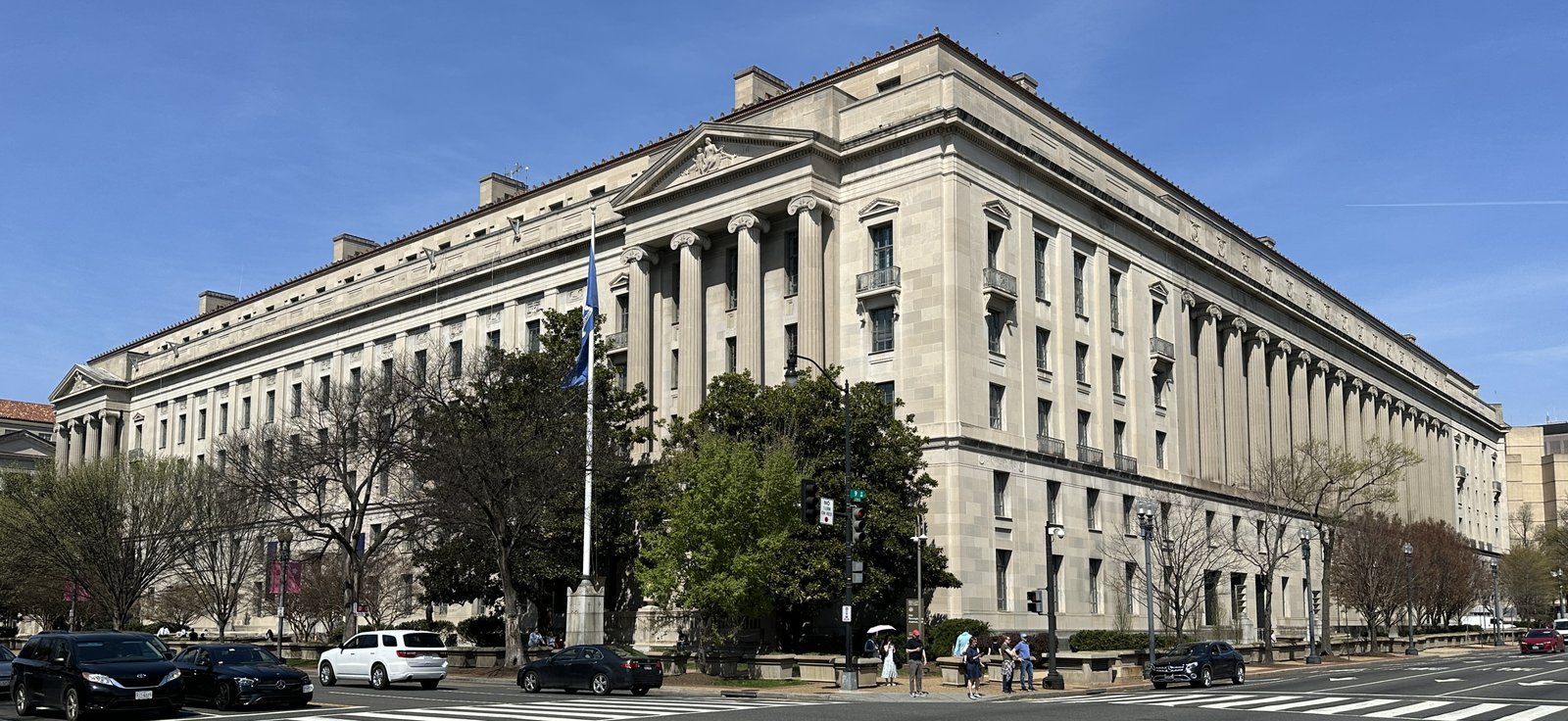
Sources: U.S. Department of Justice, Office of Public Affairs and U.S. Attorney press releases, July 13–14, 2026, linked inline above. Featured image: Robert F. Kennedy Department of Justice Building, photo by APK via Wikimedia Commons, licensed under CC BY 4.0.