
The Justice Department used the first half of this week to announce a notable mix of civil and criminal matters: a $315 million resolution with CVS over opioid dispensing, an indictment tied to a North Korean remote-IT-worker scheme, an arrest involving a device found at OpenAI’s San Francisco offices, and the arrest of a Colombian national long sought in Venezuela-related money laundering cases. This digest summarizes seven actions announced between October 9 and October 13, 2026, drawn from Justice Department press releases. Every case below is described as the government alleges it unless a conviction or sentence is specifically noted. A charge, complaint or civil claim is not proof of wrongdoing, and defendants are presumed innocent unless and until proven guilty in court.
1. CVS Agrees to Pay $315 Million Over Opioid Dispensing and Medicare Claims
According to a Justice Department press release dated October 13, CVS Pharmacy Inc. and related entities agreed to pay $315 million to resolve allegations under the Controlled Substances Act and the False Claims Act. The government’s complaint, filed December 13, 2024, in the District of Rhode Island, alleged that between October 2013 and December 2025 CVS pharmacies filled opioid and other controlled-substance prescriptions that lacked a legitimate medical purpose or fell outside the usual course of professional practice, and then sought reimbursement from Medicare and other federal health programs.
The release describes alleged red flags that pharmacists were said to have ignored, including excessive quantities, early refills, so-called “trinity” combinations of an opioid, a benzodiazepine and a muscle relaxant, and prescriptions from suspected “pill mill” prescribers. The complaint also alleges that corporate performance metrics, incentive pay and staffing policies prioritized volume over patient safety, and that company policies discouraged pharmacists from warning one another about problematic prescribers. The case began as a whistleblower suit, United States ex rel. Hillary Estright v. CVS Health Corporation, et al., No. 22-cv-00222 (D.R.I.), and the government intervened. The relator’s share has not yet been determined.
Beyond the payment, CVS entered a memorandum of agreement with the DEA that, according to the release, requires a hotline for employees and the public to report suspected illegal dispensing, proactive monitoring of dispensing patterns, and a process for evaluating suspect prescribers. The department states that the claims are allegations only and that there has been no determination of liability. For the industry, the compliance terms may prove as consequential as the dollar figure, since they suggest how regulators expect large pharmacy chains to monitor prescribers going forward.
2. North Korean Remote IT Worker Scheme: 12 Charged in Northern District of Ohio
The U.S. Attorney’s Office for the Northern District of Ohio announced on October 13 that a federal grand jury returned an indictment on October 1 against 12 named defendants, with two more under seal, in an alleged multi-year scheme to obtain remote IT jobs and generate revenue for the North Korean government. Ten of the named defendants, most of them in China, remain at large; two U.S. residents, Michael James Bostelle of Philadelphia and Juan Cecilio Pena Carrillo of San Juan, Texas, were recently arrested, according to the release. The charges include wire fraud conspiracy, money laundering conspiracy, conspiracy to commit identity theft and aggravated identity theft.
Prosecutors allege that U.S.-based facilitators helped North Korean workers get hired by American companies, in part by receiving and hosting company-issued laptops at their homes in what the department calls “laptop farms.” The indictment, as summarized by the department, says the scheme affected more than 70 U.S. employers across sectors including health care, communications, cybersecurity, retail and manufacturing, and generated roughly $3 million for the IT workers, with proceeds believed to have gone to sanctioned North Korean entities. The department also published a broader announcement of coordinated actions on the same day, and the FBI issued an alert to businesses about hiring practices.
The practical takeaway for employers is the one U.S. Attorney David M. Toepfer emphasized: the charges are meant as an alert to remain vigilant in hiring. The reliance on domestic facilitators, who are often easier to reach with U.S. process than overseas operators, appears to be a continuing enforcement theme.
3. Saudi National Arrested Over Alleged Recording Device at OpenAI
A press release issued October 13 states that Abdulrahman Alfozan, 35, a Saudi national who had worked as an engineer at OpenAI since July 2025, was arrested October 9 and made his initial appearance in the Northern District of California on October 13. He is charged by complaint with using or attempting to use a device to intercept oral communications, an offense carrying a maximum of five years in prison.
According to the complaint as described by the department, OpenAI found a recording device hidden in toilet paper and plugged into a USB port behind a television in an executive conference room on or about September 30, with its contents encrypted. The government alleges that surveillance footage placed Alfozan near the room on several dates, that he queried a productivity tool about meeting rooms and executive locations beforehand, and that a second similar device was found October 5 in a bag he left unattended. The release also says a chatbot account linked to his spouse received prompts about building and concealing an audio recorder. The FBI investigated with support from the National Security Division’s Counterintelligence and Export Control Section. The release does not allege a motive, and the case is at a very early stage. It nonetheless illustrates how federal counterintelligence resources are being applied to the protection of advanced AI research.
4. Alvaro Pulido Vargas Arrested in Venezuela-Related Money Laundering Cases
The department announced October 11 that the Homeland Security Task Force had arrested Alvaro Pulido Vargas, 62, a Colombian national also known as “German Enrique Rubio Salas,” with an initial appearance set for October 13 in the Southern District of Florida. He faces charges under two indictments. A 2021 indictment alleges he and others paid bribes to Venezuelan officials from about 2015 through at least 2020 to win contracts in the CLAP food and medicine program, inflating costs to fund the payments and receiving about $1.6 billion, of which roughly $180 million allegedly moved through or to the United States. A 2019 indictment, returned with co-defendant Alex Nain Saab Moran, alleges laundering of about $350 million tied to a currency-exchange bribery scheme between 2011 and 2015.
The release notes that the defendant had been a fugitive, and Criminal Division Assistant Attorney General A. Tysen Duva said the department will pursue foreign bribery and money laundering schemes that use the U.S. financial system. These remain allegations. The case is a reminder that foreign-corruption prosecutions can run for years before a defendant is brought before a U.S. court.
5. West Africa “Joint Disruption Week” Targets Scam Networks
On October 13 the department announced results of a coordinated effort during the week beginning October 6, the first of its kind focused on West Africa. The release reports 28 arrests (19 in Ghana and 9 in Nigeria), more than 350 devices seized, 117 trafficking victims identified in Ghana, 89 additional scam victims with approximate losses of $8.3 million, and over $11 million in potentially freezable funds. Private partners reported removing more than 3.7 million accounts, Pages and Groups. Targeted schemes included law-enforcement impersonation, “digital arrest” extortion and cryptocurrency investment fraud.
The release cites FBI Internet Crime Complaint Center data indicating that reported crypto-linked investment fraud losses rose 24 percent in 2025 to more than $7.2 billion, and cautions that figures likely understate actual losses. The operation involved the UK National Crime Agency, INTERPOL, Nigerian and Ghanaian authorities and major technology and crypto firms, signaling a model of public-private disruption that may be repeated.
6. Oklahoma Medical Supply Owner Sentenced to 14 Years in $30 Million Fraud
The department reported that Dr. Mark Loftis, 39, of Cushing, Oklahoma, owner of EZ Medical Supply, was sentenced to 14 years in prison after a 12-day jury trial ending in July 2026 on conspiracy to commit health care fraud and wire fraud. According to the release, the scheme involved more than $1 million in kickbacks, purchased doctors’ orders from telemedicine providers who never examined patients, and unneeded braces and glucose monitors sent to elderly and disabled beneficiaries. The company billed over $30 million and was paid more than $8 million. He was ordered to pay over $8 million in restitution and forfeit more than $560,000.
7. Charges Against 16 Individuals in Election-Related Cases
The department announced charges on October 12 against 16 individuals across 11 federal districts for alleged illegal voting, false claims of citizenship to register or vote, voting on behalf of a deceased person, multiple voting, and related citizenship-application offenses. Examples cited include a New Mexico man indicted for allegedly attempting to cast his deceased wife’s absentee ballot in 2024, a Missouri man charged with voting in at least 15 elections over about 20 years, and an Alabama man charged with voting in both Alabama and North Carolina in 2024. The release states that a complaint, indictment or information merely contains accusations. Several of the cases turn on what defendants knew about their citizenship status, which is likely to be contested in court.
What Warrants Deeper TIJ Investigation
Several threads merit follow-up. First, the CVS memorandum of agreement with the DEA may produce public compliance data worth tracking, and the relator’s eventual share will be a matter of record. Second, the North Korean IT-worker indictment raises questions about how the identified U.S. employers vetted remote hires; court filings may shed light on the facilitator network. Third, the OpenAI case could reveal more through the complaint affidavit and any detention proceedings. Fourth, the Pulido Vargas matter intersects with the earlier Saab Moran prosecution and may yield details on U.S. banking channels. TIJ will review court dockets as they become available.
Right of reply: The Investigative Journal has not independently verified the allegations summarized here, which are drawn from Justice Department press releases. Any individual or entity named is welcome to submit a response for consideration by contacting the editor.
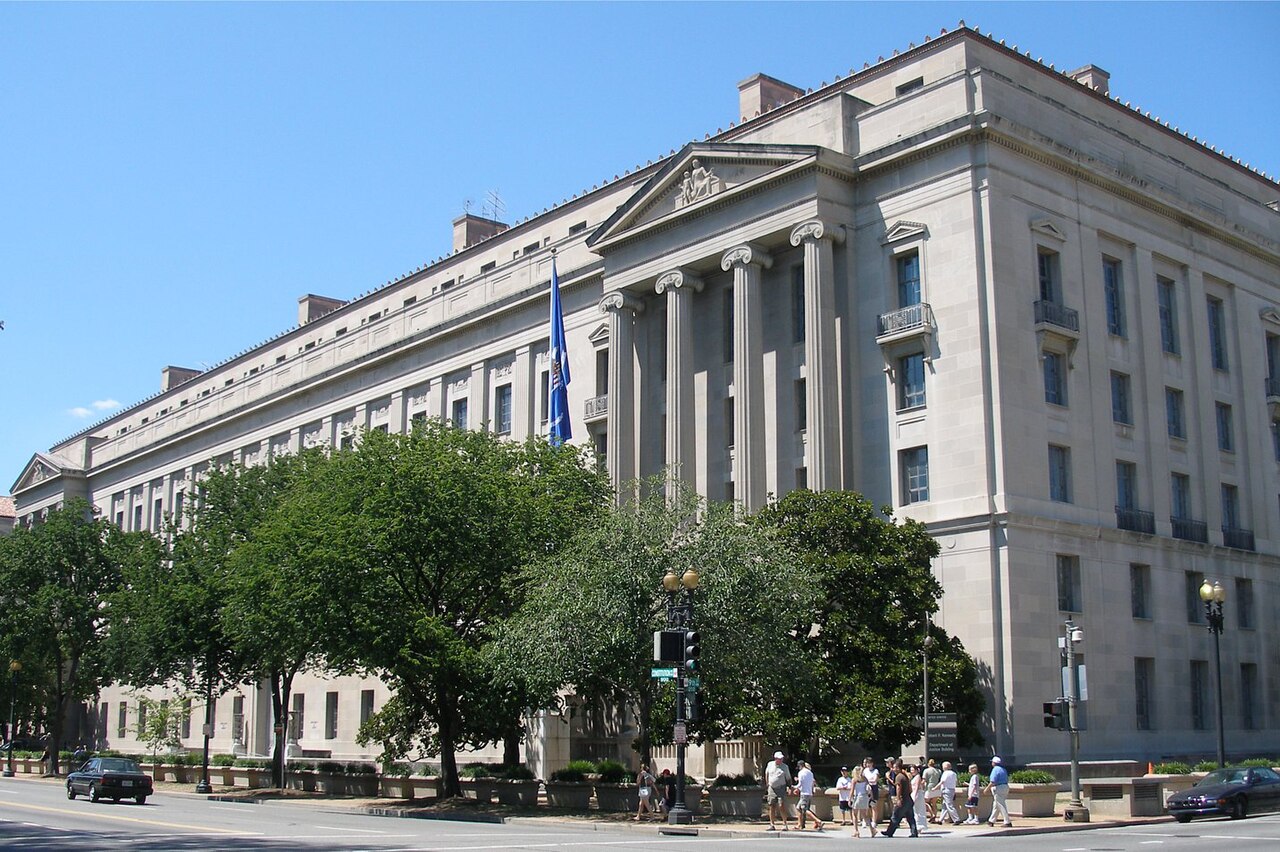
Featured image: U.S. Department of Justice headquarters, Washington, D.C., photographed by Coolcaesar (Wikimedia Commons, GFDL/Creative Commons, relicensed).
Sources:
- DOJ: CVS agrees to pay $315M (Oct. 13, 2026)
- USAO N.D. Ohio: North Korean remote IT worker indictment
- DOJ: Coordinated actions against North Korean remote IT worker schemes
- DOJ: Saudi national arrested, OpenAI recording device
- DOJ: Arrest of Alvaro Pulido Vargas
- DOJ: West Africa joint disruption results
- DOJ: Medical supply company owner sentenced
- DOJ: Charges involving 16 individuals, election crimes
- DOJ press release index