

Federal Register Watch is The Investigative Journal’s daily review of the rules, proposed rules, and presidential documents shaping federal policy. This edition covers the most recent complete issue of the Federal Register — Monday, September 14, 2026 — whose most consequential provisions take effect today, September 15.
The September 14 issue of the Federal Register runs 338 pages and contains 156 documents from 39 agencies: 6 final rules, 8 proposed rules, 137 notices, and 5 presidential documents, according to the issue table of contents. The headline story is a five-proclamation package escalating the U.S.–Canada trade dispute, with modified tariff coverage taking effect at 12:01 a.m. Eastern this morning and outright import bans queued for later this month. Federal banking regulators also moved to ease examination schedules for thousands of community banks, and four agencies opened comment periods that close between mid-October and mid-November.
Canada tariff package: modified duty coverage effective today, import bans to follow
President Trump signed five proclamations on September 8, all published Monday, that rework the Section 338 tariff regime imposed on Canadian goods this summer. Under Proclamation 11065, the list of Canadian products subject to the 50 percent ad valorem duty on motor vehicles changes as of 12:01 a.m. Eastern time today, September 15 — certain products are added to the duty list while others are removed, per the proclamation’s annexes. A companion proclamation (Proc. 11064) makes parallel scope changes for alcoholic beverages and dairy. The proclamation states that the duties apply in addition to any Section 232 national-security tariffs on the same goods.
The more dramatic step is Proclamation 11061, which invokes Section 338’s rarely used exclusion authority to ban certain Canadian alcoholic beverages from importation outright, effective 12:01 a.m. Eastern on September 29. Goods that arrive before that date but have not yet been entered for consumption remain subject to the existing 50 percent duty, the proclamation says. Companion proclamations apply the same exclusion mechanism to certain Canadian dairy products (Proc. 11062) and motor vehicles (Proc. 11063).
The proclamations recount the dispute’s timeline as the administration sees it: findings in July that Canada’s provincial liquor-purchasing bans and motor-vehicle tariff scheme discriminate against U.S. commerce; 50 percent duties that took effect in August after a three-day negotiating pause lapsed; and, according to the text of Proclamation 11061, a September 8 decision by Saskatchewan to impose an additional 50 percent levy on U.S. alcoholic beverages “expressly in response” to the U.S. duties. Notably, the ban proclamation contains a severability clause providing that if the import ban is invalidated in court, the affected goods revert to the 50 percent duty — drafting that suggests the administration is preparing for litigation over the seldom-tested Section 338 authority. U.S. Customs and Border Protection is directed to issue implementing guidance, so importers should watch CBP’s cargo systems messaging closely this week.
Banking regulators double the exam-cycle threshold to $6 billion
The OCC, Federal Reserve, and FDIC jointly issued an interim final rule allowing qualifying banks with less than $6 billion in total assets — up from $3 billion — to be examined on-site every 18 months instead of annually. The rule implements Section 903 of the 21st Century ROAD to Housing Act, which became law on July 11, 2026, and it makes parallel changes for U.S. branches and agencies of foreign banks.
Eligibility is not automatic: according to the rule text, an institution must be well capitalized, well managed, rated “outstanding” at its most recent exam (or “outstanding” or “good” for institutions at or below $200 million in assets), free of formal enforcement actions, and without a change in control in the preceding 12 months. The rule took effect September 14, but the agencies are accepting public comments — the comment window closes October 14, 2026. Community bankers have long argued that annual full-scope exams tie up compliance staff disproportionately at small institutions; the practical test will be whether supervisors detect problems as quickly on the longer cycle.
USTR opens the books for the 2027 foreign trade barriers report
The U.S. Trade Representative is requesting comments for the 2027 National Trade Estimate Report, the annual statutory inventory of foreign trade barriers used to drive negotiations and enforcement. The notice lists 15 categories of barriers on which USTR seeks information — including a category on duty evasion, circumvention, and transshipment, alongside non-market policies, state-owned enterprises, and forced-labor concerns — and asks commenters to estimate the export gains from removing each barrier they identify.
The country list spans more than 70 markets, including Canada, China, and the European Union. Submissions go to docket USTR-2026-0498 on Regulations.gov, and comments are due by 11:59 p.m. EDT on Thursday, October 29, 2026. For exporters caught in this year’s tariff crossfire, the NTE process is the formal channel to put foreign retaliation and market-access complaints on the administration’s radar.
FAA weighs letting firefighting aircraft carry firefighters
The Federal Aviation Administration published an advance notice of proposed rulemaking evaluating whether to permit firefighters to be transported to and from wildfire sites aboard certain restricted-category aircraft when the purpose is ground wildfire suppression. Current rules generally bar carrying persons on restricted-category aircraft except for crew and persons essential to the special-purpose operation, which agencies say complicates rapid crew shuttling during fire emergencies.
The agency is seeking data on safety records, aircraft types, and operational safeguards before deciding whether to propose a rule. Comments are due by November 13, 2026. With federal and state fire agencies increasingly dependent on contracted aviation, the docket is worth watching for both safety advocates and operators.
NIH proposes to replace its flagship biosafety framework
The National Institutes of Health issued a request for information on a draft comprehensive biosafety policy that, when finalized, would replace the decades-old NIH Guidelines for Research Involving Recombinant or Synthetic Nucleic Acid Molecules. The agency describes the goal as ensuring “gold-standard science is conducted under gold-standard biosafety conditions,” with oversight that keeps pace with evolving risks in biotechnology.
The stakes are considerable: the NIH Guidelines anchor institutional biosafety committee review at virtually every U.S. research university and many private labs. Researchers, biosafety officers, and institutions have until October 19, 2026 to submit comments through NIH’s Office of Science Policy portal linked in the notice.
E-Rate anti-fraud paperwork rules take effect
The FCC announced that the Office of Management and Budget has approved the information collections tied to its E-Rate competitive bidding overhaul, making the remaining provisions of the May 2026 rule effective September 14. The underlying order established a competitive bidding portal and document repository intended, in the Commission’s words, to protect the roughly $4 billion schools-and-libraries subsidy program “against waste, fraud, and abuse” by increasing transparency into how applicants solicit and select bids.
The filing also eases the burden side of the ledger: according to the notice, the approved changes alleviate the prior 10-year document retention and production requirement for E-Rate applicants and service providers. The commission pegs the program’s total annual paperwork burden at 236,890 hours across roughly 25,000 respondents — context for why procurement-integrity mandates and paperwork relief tend to move together.
On the accountability radar
Several smaller items from the issue connect to beats this publication tracks. Treasury’s Office of Foreign Assets Control published two sanctions notices formalizing additions to the SDN list — the Federal Register versions are the citable record of who was designated and under which authorities. The Justice Department lodged a proposed supplemental consent decree under the Clean Water Act and a proposed TSCA settlement, both open for public comment before courts act on them — settlement dockets that deserve more scrutiny than they typically receive.
U.S. Citizenship and Immigration Services filed 34 separate information-collection notices in a single day, covering nearly the entire immigration form catalog — from naturalization to DACA renewals to EB-5 investor petitions. Most are routine Paperwork Reduction Act extensions, but each opens a comment window on burden estimates, and the batch filing suggests a coordinated review of the agency’s forms inventory worth monitoring for substantive revisions. Elsewhere, the International Trade Commission instituted antidumping and countervailing duty investigations into corrugated pizza boxes from China, Malaysia, and Turkey; the Forest Service published environmental review materials for the Roca Honda Mine project in New Mexico’s Cibola National Forest; and NOAA issued a notice on marine mammal takings incidental to geophysical surveys tied to offshore oil and gas activity in the Gulf.
Today’s issue of the Federal Register posts at 6 a.m. Eastern at federalregister.gov. Federal Register Watch will track the comment dockets above as deadlines approach. All characterizations of agency findings and presidential determinations are drawn from the published documents linked in each item.
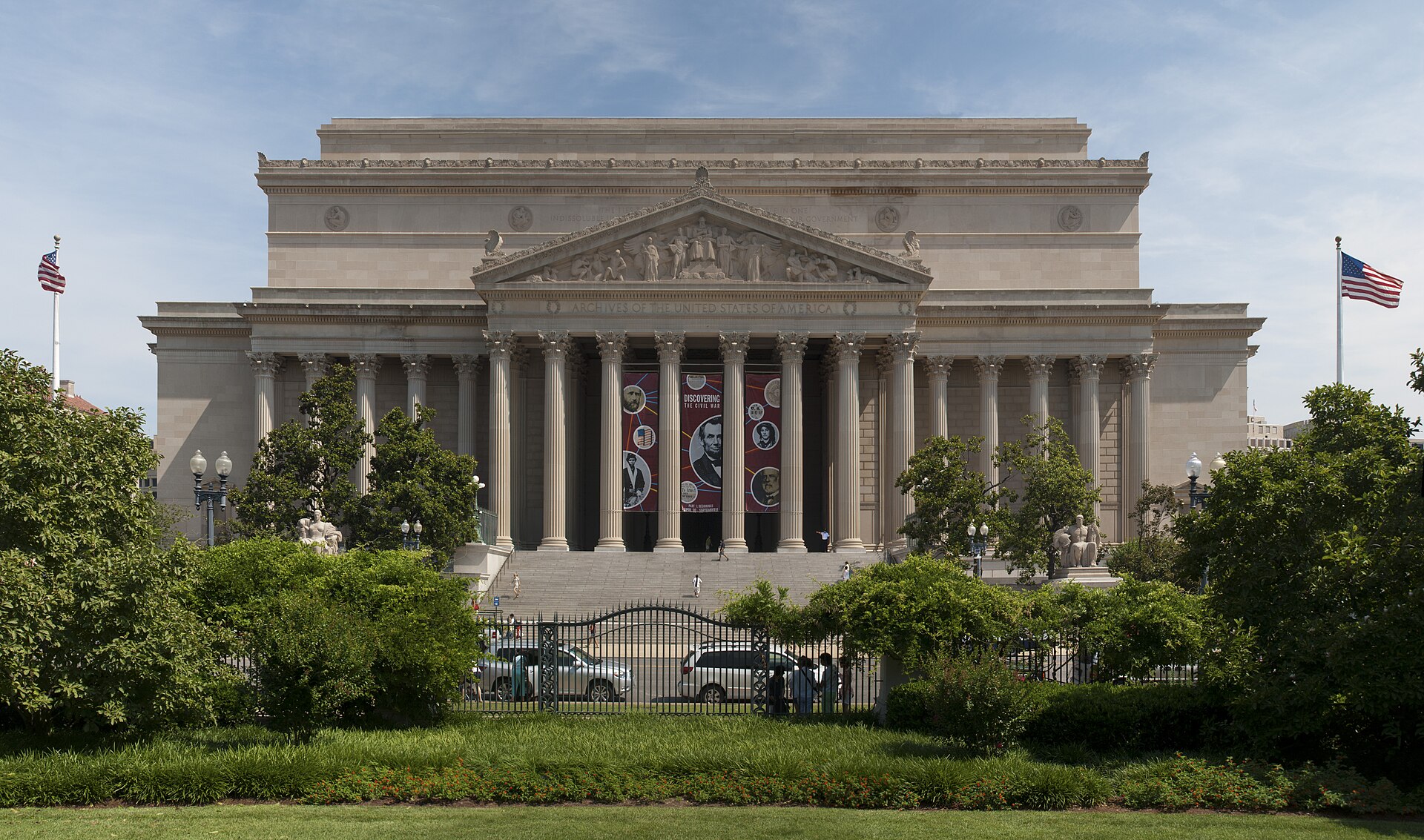
Featured image: the National Archives Building in Washington, D.C., home of the Office of the Federal Register. Photo by David Samuel via Wikimedia Commons, CC BY-SA 3.0.
Sources
Federal Register, September 14, 2026 issue; Proclamations 11061, 11062, 11063, 11064, 11065 (91 FR 58311–58346); OCC/FRB/FDIC interim final rule, 91 FR 58009; USTR, 91 FR 58247; FAA ANPRM, Docket FR 2026-18799; NIH, FR 2026-18646; FCC, 91 FR 58027.