

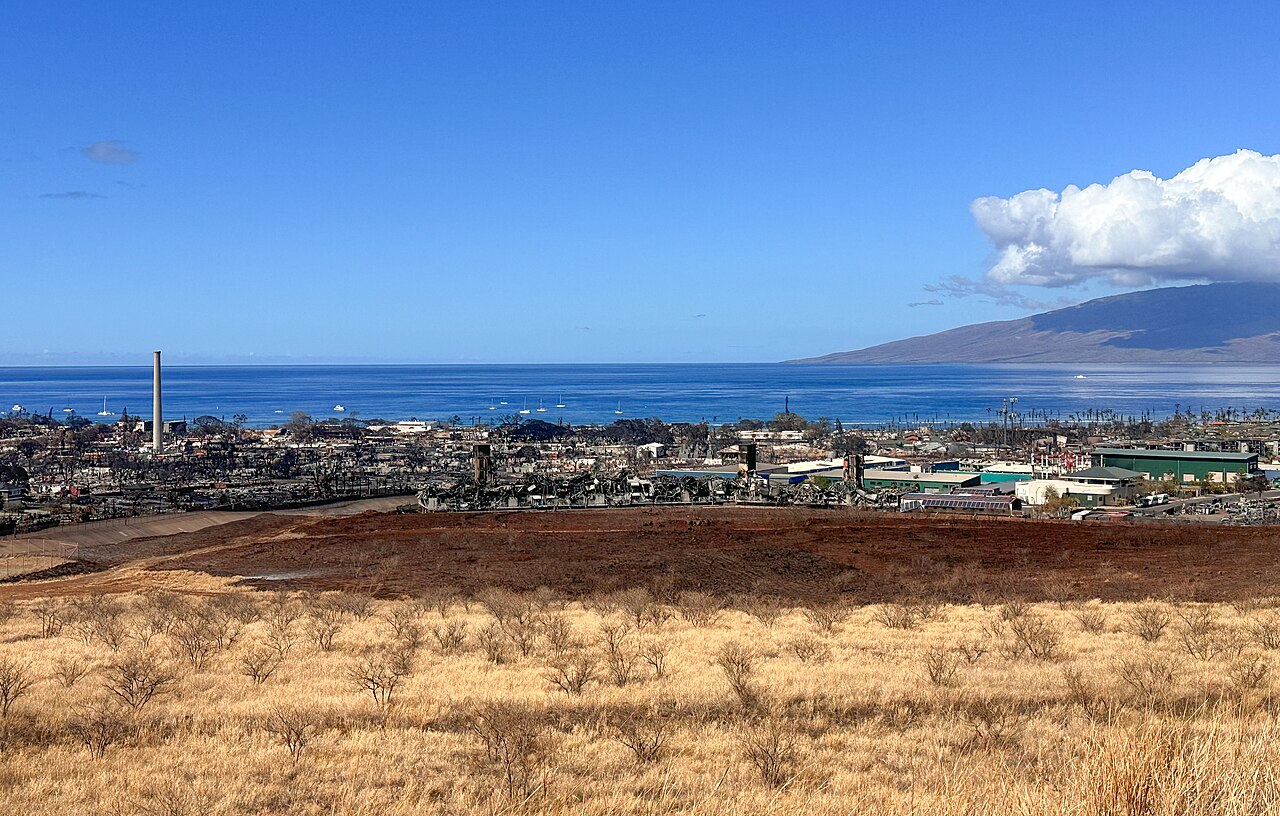
An investigative reconstruction of the August 8, 2023 Lahaina fire — from the decision not to sound warning sirens to the utility company’s failure to clear brush to the water system that ran dry as a historic town burned. 102 lives lost. $5.5 billion in damage. And a chain of preventable failures.
Image directive: Source a public domain satellite image of Maui from NOAA or NASA Earth Observatory. Alternatively, create a timeline infographic showing the sequence of failures: power line ignition → siren decision → water pressure loss → full conflagration. Search Unsplash for “wildfire aftermath” or “burned landscape.”
The Morning of August 8
The fire that destroyed Lahaina, Maui on August 8, 2023 killed 102 people and destroyed 2,207 buildings — 86% of them residential. With an estimated $5.52 billion in property damage, it was the deadliest American wildfire in over a century and the most destructive natural disaster in Hawaii’s history. Two people remain missing.
But the Lahaina fire was not simply a natural disaster. It was a cascade of institutional failures — each preventable, each compounding the next — that transformed what should have been a manageable brush fire into an unstoppable conflagration.
The Siren That Never Sounded
Maui’s outdoor warning siren system — designed specifically to alert residents to imminent danger — was not activated on August 8. The decision not to sound the sirens belonged to Herman Andaya, the Maui Emergency Management Agency Administrator, who defended the choice with a remarkable justification: he was concerned that sounding the sirens would cause people to evacuate “mauka” — toward the mountains and inland — potentially driving them into the fire’s path.
The Hawaii Emergency Management Agency subsequently noted that the county had been reminded that the sirens could be used before the fire devastated the area. The sirens were designed to provide exactly the kind of mass notification that could have given residents minutes — potentially life-saving minutes — to evacuate toward the ocean rather than shelter in place.
Andaya resigned on August 17, nine days after the fire, citing health reasons.
The Utility’s Failure
The fire’s initial cause was identified by both the Maui Fire Department and the ATF as accidental in nature — specifically, damaged power lines owned by Hawaiian Electric Company. The utility’s vegetation management and brush-clearing practices came under immediate scrutiny. Despite Maui’s well-documented fire risk, Hawaiian Electric’s wildfire mitigation planning had failed to prevent the conditions that allowed a downed power line to ignite a catastrophic fire.
De-energization procedures — shutting off power to vulnerable lines during high-wind events, a practice increasingly common in fire-prone areas of California — were not implemented on August 8 despite conditions that clearly warranted caution. Hawaiian Electric subsequently announced $110 million in wildfire resilience investments, an acknowledgment that its pre-fire preparations had been inadequate.
The Water That Wasn’t There
As the fire swept through Lahaina, firefighters discovered that the water system could not keep up with demand. Water pressure dropped as the municipal system was overwhelmed by simultaneous residential and firefighting use. Decisions about water diversion — specifically, how agricultural and residential water resources were allocated — became the subject of intense post-fire scrutiny.
The approximately 3,000 additional structures damaged beyond the 2,207 destroyed tell the story of a fire that moved faster than any response could match. Wind-driven flames jumped from structure to structure in a historic town built largely of wood, with narrow streets that became impassable as residents attempted to flee simultaneously.
The Institutional Autopsy
The Maui Police Department’s preliminary after-action report, released in February 2024, made 32 recommendations for future disaster response. The sheer number of recommendations — covering everything from communication systems to evacuation protocols to inter-agency coordination — reveals an emergency management infrastructure that was fundamentally unprepared for the disaster it was created to handle.
The failures were not exotic. They were bureaucratic. The sirens existed but weren’t used. The power lines were known risks but weren’t de-energized. The brush was supposed to be cleared but wasn’t. The water system was adequate for normal operations but collapsed under emergency demand. Each failure was the result of decisions made — or not made — by officials who had the authority and the responsibility to act.
The Question of Priorities
In the years before the fire, Maui County’s policy focus had increasingly shifted toward tourism management, affordable housing, and sustainability initiatives. These are legitimate priorities. But they came at the cost of attention to the fundamental infrastructure — emergency communication, utility maintenance, water system capacity, and wildfire preparedness — that determines whether people live or die when disaster strikes.
Lahaina was not destroyed by climate change, though changing conditions contributed to the fire risk. It was destroyed by institutional failures that were entirely within the power of local officials to prevent. The 102 people who died deserved leaders who prioritized the basics — and got leaders who prioritized everything else.
Eduardo Bacci is an investigative journalist at The Investigative Journal. Data sources include Hawaii Emergency Management Agency records, ATF fire investigation reports, Maui Police Department after-action report, and Hawaiian Electric Company filings.