
By Eduardo Bacci, The Investigative Journal. Compiled from official White House releases, the Supreme Court’s reporting ecosystem, and wire coverage of the past 12 to 24 hours. Pending matters are noted as such.
France moved to calm a week of nationwide unrest with targeted curfews, the Supreme Court added several notable cases to its docket while turning away others, and the White House logged a busy stretch of bill signings and executive action. Here is what the record shows as of Wednesday morning, October 21, 2026.
Government
Ten House bills signed into law
According to a White House release dated October 20, the President signed ten House bills, most of them narrow in scope. H.R. 6380 redesignates Chiricahua National Monument in southeastern Arizona as Chiricahua National Park. H.R. 2481, the Romance Scam Prevention Act, requires online dating services to notify members who received messages from someone banned for fraudulent activity. H.R. 4307 directs the Labor Secretary to train certain Labor Department employees to recognize human trafficking and help law enforcement respond.
Other measures in the package include H.R. 1721, which directs the Commerce Department to study whether high-demand products now imported because of supply chain constraints could practically be made in the United States, and H.R. 7831, which extends the Interior Department’s authority to collect certain oil and gas permit application processing fees. The list also includes land conveyances in Arizona, Alaska, Washington State and Mississippi, and H.R. 227, which opens a two-year window for ministers and members of religious orders to apply to the IRS to revoke an exemption from Social Security coverage.
The bills are individually modest, but the batch shows Congress continuing to move consensus legislation even as chamber floor activity thins ahead of the midterm elections.
Women’s health executive order
On October 19, the administration announced an executive order titled Advancing Women’s Health to Improve Outcomes in All Phases of Life. According to the White House, the order creates a White House Women’s Health Task Force and a new Women’s Health Division within the National Institutes of Health, and it encourages private-sector collaboration on women’s health technologies. The First Lady’s accompanying “Five Pillars” include directing research funding toward conditions that affect women differently, using advanced AI to better understand female biology, and moving promising therapies to patients faster while maintaining safety standards.
The President’s public schedule, as tracked by Roll Call’s Factba.se, lists the signing at 11:00 a.m. in the Rose Garden. The order’s practical impact will depend on how the NIH structures the new division and what funding is allocated, details the announcement does not specify.
Earlier Senate bills and a quiet House calendar
On October 15, the President signed three Senate bills: S. 240, amending the Crow Tribe Water Rights Settlement Act of 2010 to give the tribe more flexibility in completing water projects in Montana; S. 283, the Illegal Red Snapper and Tuna Enforcement Act, which directs the Commerce Department to develop a standard chemical-analysis method for determining the country of origin of seafood; and S. 2403, the Retire through Ownership Act, which amends ERISA’s definition of adequate consideration for certain closely held stock.
The House itself is largely absent from Washington. The Republican Cloakroom’s weekly schedule shows the chamber in pro forma sessions on Monday and Thursday and not in session Tuesday, Wednesday or Friday. No recorded votes are scheduled this week.
Courts
Justices will weigh race-neutral magnet school admissions
On October 19 the Supreme Court agreed to hear Association for Education Fairness v. Montgomery County Board of Education (No. 26-12). The question is whether a plaintiff challenging a facially neutral admissions policy as racially discriminatory must show that the targeted group suffered an aggregate disparate impact compared with its share of the applicant pool. The petitioners, a group of mostly Asian-American parents, argue that a lottery-based process adopted for selective Montgomery County, Maryland magnet middle schools was designed to reduce Asian-American enrollment.
The school board maintains the policy is a race-neutral lottery adopted during the pandemic. According to the court filings summarized by SCOTUSblog, the district court dismissed the complaint after finding that Asian-American students’ share of admitted students exceeded their share of applicants, and the Fourth Circuit affirmed in February 2026. Argument is expected in early 2027. This is a pending case, and no finding of discrimination has been made.
Home distilling ban gets a hearing
The Court also granted review on October 16 in Department of Justice v. McNutt (No. 26-204), which asks whether an 1868 federal law taxing distilled spirits while banning home distilleries is constitutional. The Fifth Circuit held the ban exceeds Congress’s powers, while the Sixth Circuit, in the related Ream case, upheld it under the Necessary and Proper Clause. That split is a conventional reason for the justices to step in. A decision is expected by late June or early July.
Orders: Chicago, 9/11 pleas and Wilcox
In its October 19 orders list, the Court declined several petitions. In O’Donnell v. City of Chicago, which challenged the city’s practice of seizing and selling cars of drivers with as few as two unpaid parking tickets, Justice Sotomayor, joined by Justice Gorsuch, wrote that she had “serious concerns” about the Seventh Circuit’s ruling but preferred to wait for more appeals courts to weigh in. The Court also denied petitions from Khalid Sheikh Mohammad and co-defendants seeking to reinstate withdrawn 9/11 plea agreements, and turned away Wilcox v. Trump, the challenge by a former National Labor Relations Board member to her removal. Per the SCOTUSblog account, the Wilcox denial carried no noted comment.
DOGE discovery, material support and a prisoner appeal
The Court has also granted three further cases. U.S. DOGE Service v. U.S. District Court for the District of Columbia (No. 25-1103) concerns discovery orders in a FOIA dispute brought by Citizens for Responsibility and Ethics in Washington over whether DOGE is a federal “agency.” Blanche v. Ozurumba (No. 25-1343) asks what level of support to a terrorist group triggers the federal “material support” bar, in a case involving a Nigerian national who worked about six months as a cook in a separatist group’s camp. Berry v. United States (No. 25-7026) addresses certificates of appealability when circuit precedent bars a claim that another circuit would allow.
Political ad rates: emergency stay
On October 14 the Court stayed a Fourth Circuit order requiring the FCC to rule within 48 hours on a petition about discounted “lowest unit charge” political ad rates. In a five-page unsigned opinion, the Court said the FCC has discretion over timing and that the order violated separation of powers. Justices Sotomayor and Jackson would have denied the request. As SCOTUSblog reports it, the FCC faces no deadline before the November election.
Administration asks justices to curb vacatur
The Solicitor General’s October 14 petition in HHS v. Texas Medical Association (No. 26-491) asks whether and when a federal court may throw out an agency rule in its entirety. The government argues the Administrative Procedure Act does not authorize broad vacatur and that the same equitable limits recognized in Trump v. CASA should apply. The challengers’ response is currently due November 13. The case arises from rules implementing the No Surprises Act.
International
France imposes targeted curfews after nationwide unrest
Protests on October 17 over rising living costs and school conditions turned violent in several French cities. According to AP reporting carried by PBS, Paris recorded its first calm night after an overnight curfew from 11 p.m. Monday to 6 a.m. Tuesday. Prime Minister Sébastien Lecornu said on X that the “targeted curfews helped keep last night calm” and that prefects and mayors can impose more locally where needed. The Justice Ministry reported roughly 2,500 arrests since Saturday, with 149 people jailed nationwide as of Tuesday noon.
A separate AP report published by ABC News says officials estimate at least 3,000 businesses were damaged or looted and that fire destroyed much of the 19th-century city hall in Limoges. Several northern cities including Lille set curfews for minors, and Marseille banned protests for part of Monday. Authorities reported no deaths, which Lecornu called “a miracle.”
Interior minister’s resignation offer rejected
Interior Minister Laurent Nuñez offered to resign on Sunday; President Emmanuel Macron refused, citing “the need for continued command of law enforcement in the current context,” according to the same AP account. Macron asked Nuñez to explain planning and intelligence failures and introduce new policing tactics quickly. Nuñez acknowledged authorities lost control in some cities on Saturday. National Rally’s Jordan Bardella accused the government of failing to protect the public. The National Assembly will open an inquiry, with findings expected by year-end, per PBS.
Prosecutions are also drawing scrutiny. In Lille, three men with no criminal record received 10-month prison sentences for looting a video game store, and Justice Minister Gérald Darmanin said he asked prosecutors to appeal sentences they considered too lenient. These are initial rulings, and appeals may follow.
Oil holds near five-month highs on Gulf tensions
Brent crude settled at $108.79 a barrel after touching a five-month high of $111.99 during the session, per ABC News Australia’s markets coverage, with prices supported by continued Houthi attacks on Saudi infrastructure and reports of vessel attacks in the Gulf. West Texas Intermediate’s November contract settled at $101.79. Earlier reporting from World Oil showed Saudi Arabia halting some energy operations after Houthi attacks in September. Sustained prices near $100 feed through to fuel costs and inflation worldwide.
Inflation worries sharpen in Australia
The Reserve Bank of Australia’s deputy governor Andrew Hauser said the inflation outlook is “materially worse” than the bank expected in August, according to the same markets report. Market pricing for a November rate hike rose above 40%, up from about 30%. The cash rate stands at 4.6% after a September increase, and the next decision is November 3. US equities closed higher, with the Dow up about 1% to 52,495.
Worth Watching
Today (Wednesday, October 21): The President’s schedule lists a roundtable at 2:30 p.m. and a political rally in Pendleton, South Carolina, at 7 p.m. per Roll Call’s calendar, which also shows rallies Thursday in Sioux City, Iowa, and Friday in Fort Myers, Florida. The calendar’s Wednesday entries overlap, so the schedule may change.
Thursday, October 22: Responses are due by 4 p.m. EDT on an emergency application to pause an agreement between Texas and the Justice Department on deportation proceedings, per SCOTUSblog. A decision on the administration’s separate request about Bureau of Prisons policy on gender-transition care could come at any time.
France: Watch whether prefects extend curfews and how the Assembly inquiry is structured. Markets: Oil direction depends on Gulf developments ahead of the RBA’s November 3 meeting.
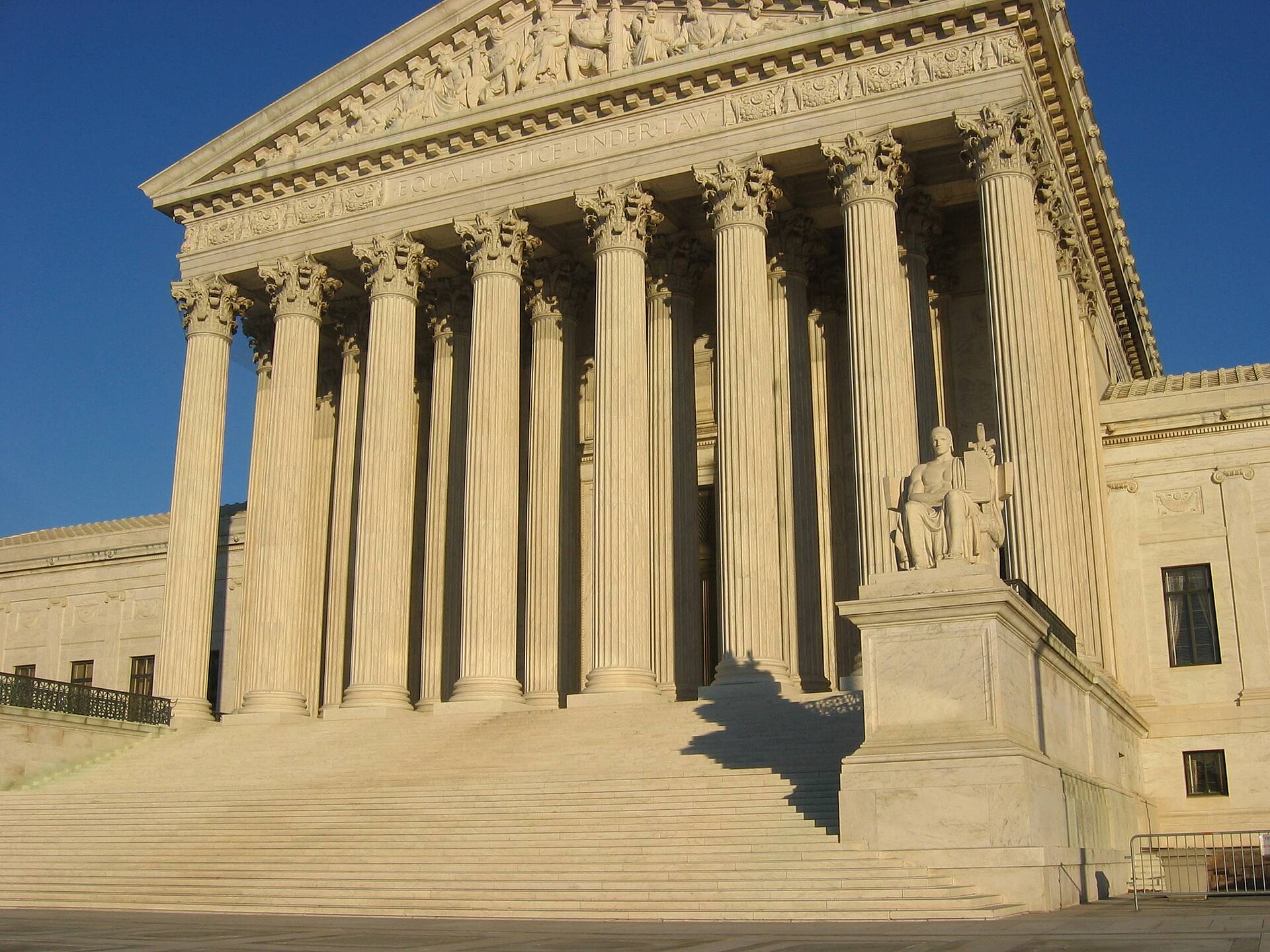
Right of reply: Individuals and organizations named in this briefing are invited to submit responses to The Investigative Journal’s editors. Lower-court rulings, petitions and prosecutions described here are pending or subject to appeal. Featured image: U.S. Supreme Court Building, via Wikimedia Commons (CC BY-SA 3.0).