

The Investigative Journal’s daily digest of overnight developments across government, the courts, and international affairs. All items are sourced to public records, official statements, or wire reporting. Pending matters are identified as such.
Government
Trump arrives in New York for two-day UNGA run as nearly 130 heads of state gather
President Donald Trump is scheduled to arrive in New York on Monday afternoon ahead of an address to the United Nations General Assembly on Tuesday morning, according to Reuters reporting published Sunday evening and a briefing given to reporters Friday by U.S. Ambassador to the United Nations Mike Waltz. Waltz told reporters the President “will highlight how he has and his administration have confronted complex problems head-on around the world,” and said the address will “touch on the importance of ensuring that Iran never has a nuclear weapon.”
The 81st session’s High-Level Week runs September 22 through 29, with the General Debate opening Tuesday. Nearly 130 heads of state and government are expected. The session is presided over by Assembly President Khalilur Rahman of Bangladesh under the theme “Restoring trust, managing transformation,” and is the final General Assembly session to open under Secretary-General António Guterres, whose second term expires December 31.
Trump’s bilateral schedule, as reported, includes Ukrainian President Volodymyr Zelenskyy — who confirmed in a social media post Sunday that the two had agreed to meet — British Prime Minister Andy Burnham, Japanese Prime Minister Sanae Takaichi, and Iraqi Prime Minister Ali Faleh al-Zaidi. The President is also set to participate in a Gulf Cooperation Council leaders’ meeting and reception. Separately, the office of New York Mayor Zohran Mamdani confirmed to Reuters on Sunday that Trump will meet the mayor at Gracie Mansion on Monday to discuss “issues affecting New York City and New Yorkers.” A White House official confirmed that meeting.
Rubio opens the day at the NYSE, closes it with a critical minerals signing
Secretary of State Marco Rubio’s official public schedule for Monday, released by the Office of the Spokesman, shows an unusually dense day: ringing the opening bell at the New York Stock Exchange at 9:00 a.m., followed by a meeting with Bolivian President Rodrigo Paz at 10:15 a.m. and a trilateral with Japanese Foreign Minister Motegi Toshimitsu and Republic of Korea Foreign Minister Cho Hyun at 11:15 a.m.
The afternoon turns to resource security and the Arctic. Rubio hosts an Arctic 7 meeting at 2:15 p.m., meets Kenyan President William Ruto at 3:30 p.m. and Iraqi Prime Minister al-Zaidi at 4:30 p.m., then closes with Italian Deputy Prime Minister and Foreign Minister Antonio Tajani — first a closed-press bilateral, then a pooled-coverage signing ceremony for a Critical Minerals Memorandum of Understanding at 6:00 p.m. The Department has scheduled no press briefing for the day. The schedule indicates the full senior bench of the Department, including Deputy Secretary Christopher Landau and Under Secretary for Economic Affairs Jacob Helberg, is in New York for the week.
Federal funding runs to December 11 under the stopgap signed this month
Agencies are operating under a short-term continuing resolution rather than full-year appropriations. According to a White House statement issued September 2, the President signed H.R. 6500, the “Continuing Appropriations and Extensions Act, 2027,” which provides fiscal year 2027 appropriations “through December 11, 2026” and extends authorities for a range of programs including surface transportation and veterans programs.
The statement establishes the operative deadline for the fall: appropriators have roughly eleven weeks, spanning the November midterm elections, to convert the stopgap into full-year bills or pass another extension. Contemporaneous reporting indicated the House cleared the measure 370-48 after Senate passage in August, a margin that suggests broad bipartisan appetite for avoiding a funding lapse ahead of the elections.
Fed reverses course, lifting rates for the first time since 2023
The Federal Open Market Committee voted 12-0 on September 16 to raise the target range for the federal funds rate by a quarter point to 3.75 to 4 percent. The statement describes economic activity as “expanding at a solid pace,” with resilient domestic spending, strong productivity growth and robust capital investment, while noting that “uncertainty remains elevated owing, in part, to geopolitical developments.”
The Committee’s language on prices is direct: “Inflation remains elevated. Today’s policy action will support a timelier return to the Committee’s 2 percent goal. The Committee will deliver price stability.” The unanimous vote is notable given the reversal it represents — the first increase since 2023 — and places monetary policy squarely in the backdrop of the energy-price pressures flowing from the Middle East conflict.
Courts
Justices decline to let the Postal Service implement parts of its mail-in voting rule
The Supreme Court on September 14 denied, by a 7-2 vote, the federal government’s application for a stay that would have allowed the U.S. Postal Service to carry out portions of a new rule governing mail-in voting, according to SCOTUSblog’s account of the order. The brief, unsigned order leaves in place a ruling by a federal judge in Boston barring implementation of the challenged provisions. The application is docketed as U.S. Postal Service v. California, No. 26A305.
Justice Brett Kavanaugh filed a one-paragraph concurrence indicating he agreed with denying relief on timing grounds — that election officials “do not have sufficient time to reasonably implement the rule before” the November elections — while suggesting the Postal Service may possess the underlying authority. Justice Samuel Alito dissented, joined by Justice Clarence Thomas, arguing that some challengers lack standing and characterizing the remaining claim in terms the Court has previously used for long-odds arguments.
The disposition is interim relief only. It does not resolve the merits of the rule’s legality, and the underlying litigation continues in the lower courts.
New term opens October 5; long conference set for September 28
The Court’s published October argument calendar shows the October Term 2026 sitting beginning Monday, October 5, with orders at 9:30 a.m. and argument at 10:00 a.m. in Suncor Energy (U.S.A.) v. County Commissioners of Boulder County — a climate-damages suit brought by a Colorado county against oil and gas producers — followed at 11:00 a.m. by Johnson v. United States Congress.
Before that, the justices hold their so-called long conference on Monday, September 28, at which they will work through petitions accumulated over the summer recess. The Court’s own summary data for October Term 2025 shows 74 cases granted, 58 arguments held and 67 decisions issued, with no decisions pending — a closed book heading into the new sitting.
Eighteen Moïse assassination suspects transferred from Haiti to Miami
Haitian authorities transferred 18 individuals accused of involvement in the July 2021 assassination of President Jovenel Moïse to U.S. custody on Sunday, according to wire reporting. The group, moved aboard a military aircraft, will face federal charges in the Southern District of Florida.
Reports indicate the group includes former Colombian military personnel and Joseph Badio, a former employee of Haiti’s Ministry of Justice who was arrested in Haiti in October 2023. Defense attorneys for other defendants have asserted in U.S. filings that Badio directed the plot; those are allegations by opposing parties, not findings, and the prosecution now encompasses roughly 30 formally accused defendants. All charges are pending and every defendant is presumed innocent. Counsel for the transferred individuals had not entered appearances at the time of the transfer reports, and right of reply remains open.
International
AfD takes Mecklenburg-Vorpommern at 38 percent; Merz calls the night a “disaster”
Exit polling from Germany’s public broadcaster projects the Alternative for Germany winning the Mecklenburg-Vorpommern state election with 38 percent, with the Social Democrats close behind at 36.5 percent and Chancellor Friedrich Merz’s Christian Democratic Union falling below the 5 percent representation threshold, CNN reported Sunday from Berlin.
Merz did not contest the framing. “We cannot sugar coat the result in Mecklenburg-Vorpommern,” he said in remarks after the exit polls. “It is a disaster. The CDU fought hard, but in the end it was the CDU that got crushed in the polarization.” AfD co-leader Alice Weidel told CNN her party is “clearly the new people’s party in Germany” and called Merz “strongly damaged.”
In Berlin, the picture inverted: Die Linke led at 26 percent, ahead of the CDU and the Greens, with the AfD fourth at 13.5 percent — up from 9.1 percent in the capital in 2023. The results follow the AfD’s 44 percent showing in Saxony-Anhalt two weeks earlier. These are exit-poll projections; certified results will follow.
United Russia leads at 57.5 percent as Kyiv launches record drone attack on Moscow
Initial data from Russia’s Central Election Commission puts United Russia at 57.5 percent in the three-day State Duma election that closed Sunday, with national turnout reported at 56.66 percent, CNN reported. Final results are not expected before September 25. Independent monitoring group OVD-Info reports more than 2,000 people currently imprisoned in Russia on political grounds; the country’s only registered anti-war party, Yabloko, was barred from the federal party-list ballot by the Russian Supreme Court last month.
The vote coincided with one of the largest Ukrainian strikes of the war. Ukrainian forces launched more than 1,600 long-range drones at Moscow Oblast overnight into Sunday, killing at least two people and setting the Moscow Refinery alight after several direct hits, per contemporaneous reporting; CNN put the figure above 1,900. President Zelenskyy publicly confirmed he ordered the attack, describing it as a response to Russian strikes on Ukrainian cities and saying FP-5 Flamingo cruise missiles and ballistic missiles were also used.
Election commission chair Ella Pamfilova said more than 3,000 waves of distributed denial-of-service attacks targeted election infrastructure during the voting period and that 74 buildings housing election commissions across 10 regions were damaged or destroyed. Those figures are the commission’s own and have not been independently verified.
Qatar works to restart U.S.-Iran ceasefire talks as Hormuz traffic recovers
Qatar’s foreign ministry said Sunday it is working to resume ceasefire negotiations between the United States and Iran, according to regional reporting. That follows a statement Saturday by Supreme National Security Council Secretary Mohsen Rezaee that Tehran has set seven conditions for resuming talks — terms that have not been published in full and should be treated as an Iranian negotiating position rather than an agreed framework.
On the commercial side, U.S. Central Command commander Brad Cooper said oil, cargo and liquefied natural gas shipments through the Strait of Hormuz have reached a six-month high, a data point that cuts against the sharpest scenarios for chokepoint disruption even as the conflict continues into its seventh month. Diesel prices in the United States, meanwhile, reached a record average of $5.85 per gallon earlier this month, per AAA figures reported at the time — a reminder that energy-market effects persist well after shipping volumes recover.
Worth Watching
Tuesday, the General Debate opens. Trump’s UNGA address is scheduled for Tuesday morning, with the Zelenskyy bilateral expected the same day. Watch whether the Iran nuclear framing Waltz previewed is paired with any specifics on the ceasefire track Qatar says it is trying to revive.
Monday evening, Gracie Mansion. The Trump-Mamdani meeting is the third between the two and the first on the mayor’s ground. Both prior sessions were described by participants as cordial despite sharp policy differences.
Monday, 6:00 p.m., critical minerals. The U.S.-Italy Critical Minerals MOU signing is scheduled for pooled coverage. Terms have not been released in advance; the document itself is the thing to read, not the ceremony.
September 25, Russian certification. The Central Election Commission’s final tally is due. The gap between the 57.5 percent initial figure and the certified result, and any revision to the 56.66 percent turnout number, are the metrics worth tracking.
September 28, the long conference. The justices return to a summer’s accumulation of petitions. Grants issued from this conference set much of the term’s substantive agenda; orders typically follow within days.
October 5, first Monday. Suncor v. Boulder County leads off, putting the jurisdictional architecture of state-law climate-damages litigation in front of the Court at the top of the term.
December 11, the funding cliff. The stopgap expires six weeks after the midterms. Whether appropriators deliver full-year bills or a third extension will be visible in committee markup schedules well before then.
Corrections and right-of-reply requests may be directed to the editor. Items describing pending litigation reflect allegations and interim orders only; no item in this briefing should be read as a finding of liability or guilt. Exit-poll and preliminary election figures are provisional pending certification.
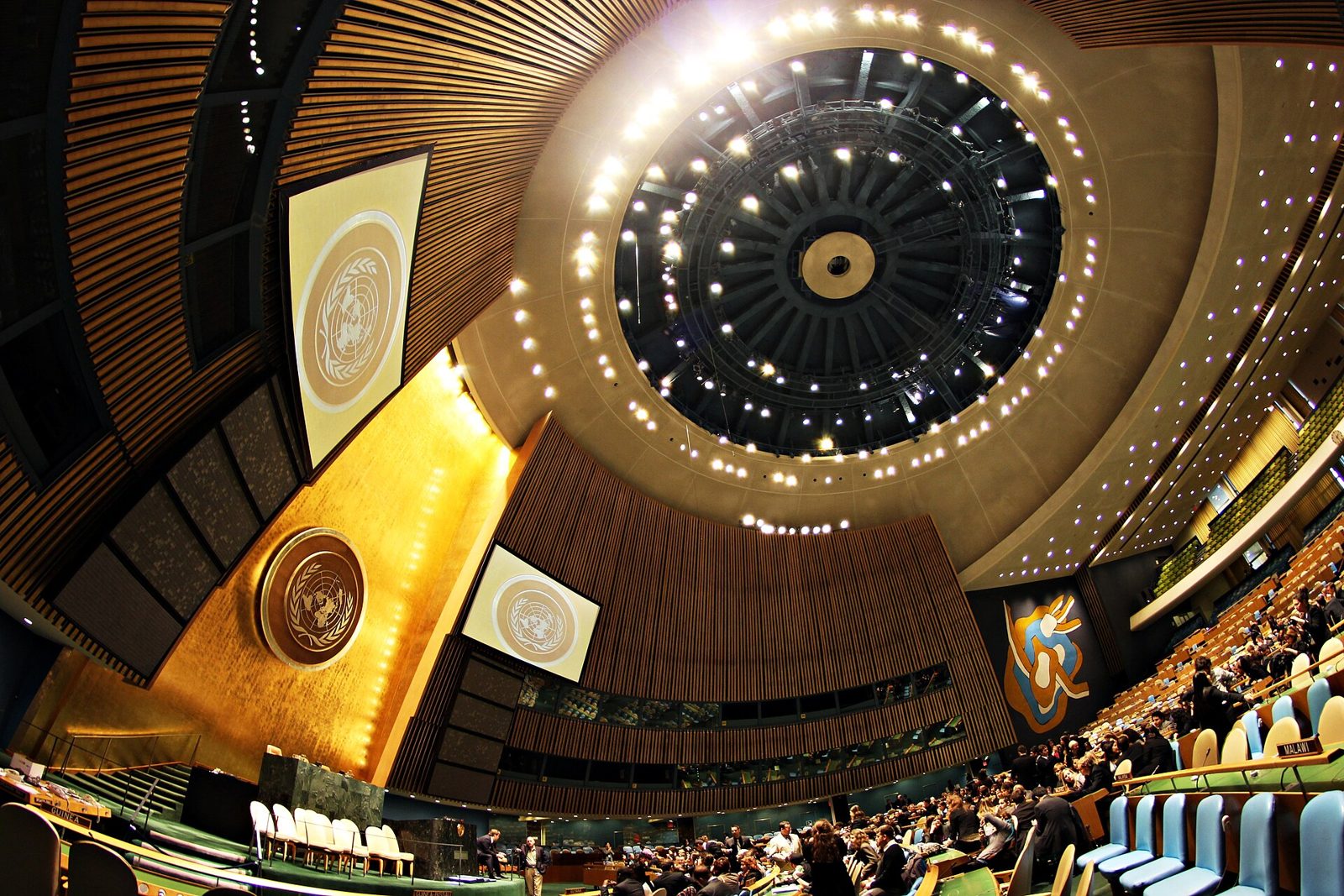
Featured image: United Nations General Assembly Hall, by Basil D Soufi, via Wikimedia Commons, licensed under CC BY-SA 3.0.