

The Investigative Journal’s weekly review of Form 990 filings, foundation disbursements, and charity enforcement across the United States.
New York Attorney General Letitia James moved on August 12 to dissolve a Chautauqua County charity that told donors it was building a healing retreat for disabled veterans, according to a petition filed by her office. The case is small in dollar terms and large in what it illustrates: the gap between what a charity promises on a donation page and what its bank records show is now the most productive vein state regulators are mining.
1. New York moves to dissolve a veterans’ retreat charity
Healing for Heroes — A Disabled Veteran’s Retreat and Wooded Oasis, Inc. billed itself as a free retreat-style stay for disabled veterans on 30 wooded acres in Bemus Point. The attorney general’s petition alleges the organization held only four retreats after its 2024 founding, and that all four were attended exclusively by board members and their families and friends.
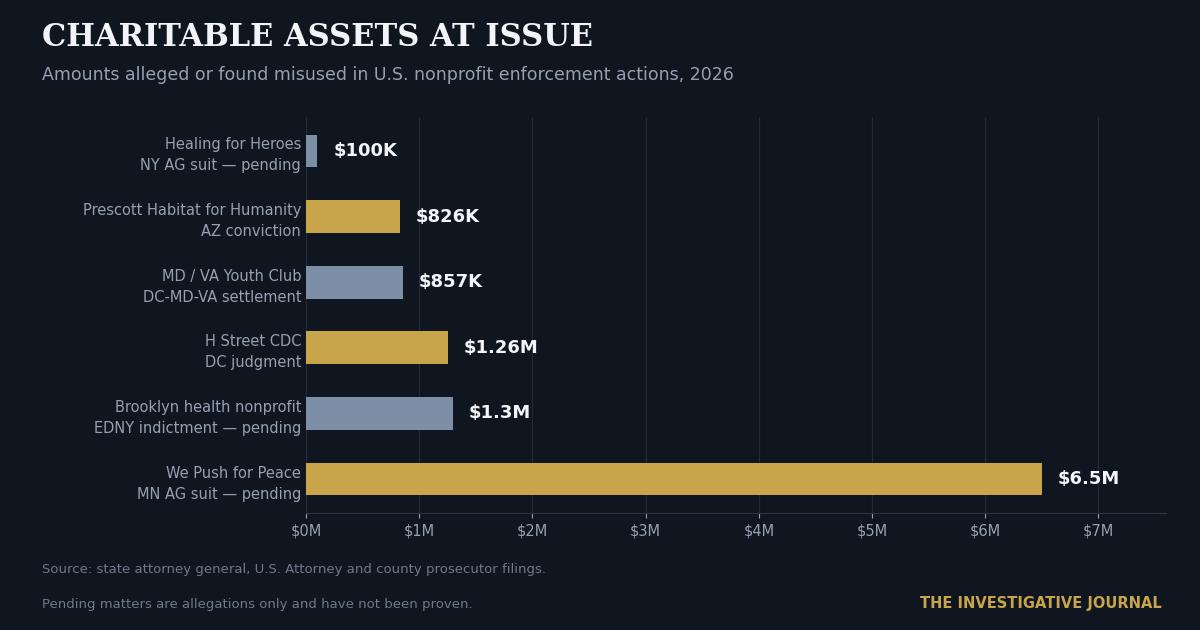
The filing states that investigators found the property’s owners — Board President Thomas Nelsen and Board Secretary-Treasurer Jennifer Milchanoski-Nelsen — rented the property on Airbnb at least 32 times across 2024 and 2025 while telling renters all proceeds would go to the charity, and instead deposited the $33,312.16 into their personal account. Of the roughly $100,000 the organization raised, records cited in the petition indicate almost half went to property maintenance and improvements including a bathroom renovation and a new deck, plus shopping, meals, vehicle repair and fuel for board members. The office also alleges the group solicited donations in 2024 before registering as a charity in New York.
James is asking the court to dissolve the organization, distribute its assets to charities that actually serve disabled veterans, bar the Nelsens from charity leadership or solicitation in New York, and impose penalties of $1,000 per charities-law violation and $5,000 per violation of the FAIR Business Practices Act. These are allegations. The matter is pending and the defendants have not been found liable. TIJ was unable to reach the Nelsens for comment prior to publication; the right of reply remains open.
2. Dark money network posts a record — and the 990s are public
Citizens for Responsibility and Ethics in Washington reported on August 11 that a network of connected 501(c)(4) nonprofits has already routed more than $33.1 million to federal super PACs in the 2026 cycle. That exceeds the roughly $14.6 million the same network moved in 2024 and the more than $22 million it moved in the 2022 midterms, according to CREW’s review of Federal Election Commission records.
Thirteen nonprofits directed funds to 31 super PACs, CREW found, with the largest single concentration — more than $14.5 million across five entities — landing in Kentucky’s Republican Senate primary. A further $8.9 million went to a super PAC backing Sen. John Cornyn in his losing Texas primary.
The governance picture in the underlying filings is the part worth donors’ and regulators’ attention. Nonprofit Explorer records show American Jobs and Security raised and spent more than $9.8 million in 2024 with no website, no employees, and a sole board member; roughly $4.6 million of that went out as grants to other entities in the same network. Comparable filings are available for American Jobs and Growth Fund, Defend US, Inc. and Conservative Agenda for America. CREW reports the same accountant prepares returns for all of them. Single-member boards and shared preparers are lawful. They also leave no internal check on how tens of millions of dollars move.
3. Treasury’s Form 990 rewrite targets the plumbing
The regulatory backdrop shifted in April. Treasury announced on April 23 that the IRS plans to revise Form 990 to require clearer reporting on government contracts, government grants and fiscal sponsorship arrangements. “Public money and tax-exempt status demand public accountability,” Treasury Secretary Scott Bessent said in the release. Assistant Secretary and Acting IRS Chief Counsel Ken Kies added that an organization receiving public funds “should be prepared to show who controls the money and where it goes.”
Fiscal sponsorship is a longstanding and entirely lawful structure, and Treasury said so. The concern is narrower: arrangements that obscure who operates a project and who controls its funds. Treasury and the IRS expect to publish proposed regulations with a public comment period before anything is finalized, so nonprofits have runway. Organizations that route significant federal or state dollars through sponsored projects should expect to document the chain of control in a way most currently do not.
4. A 62.5-year sentence in Arizona
Yavapai County Attorney Dennis McGrane announced that Karen Northcutt, 62, the former executive director of Prescott Area Habitat for Humanity, was sentenced on August 4 to 62.5 years in prison after being convicted of stealing $826,000 from the affiliate. Investigators reported she used the nonprofit’s bank and credit card accounts for her mortgage, utilities, home renovations, vehicles, veterinary bills and vacations, withdrew more than $100,000 in cash, and charged $187,000 to an unauthorized credit card account she opened. The investigation began with an anonymous tip in February 2024.
The sentence is an outlier — Northcutt was convicted on a stack of counts including fraudulent schemes, theft, identity-taking, evidence tampering, trafficking stolen property and money laundering — but the detection story is the ordinary one. An anonymous tip, not an audit, started it.
5. State attorneys general keep converting investigations into judgments
Three matters resolved earlier this year show the enforcement pipeline working across jurisdictions. In Minnesota, Attorney General Keith Ellison sued We Push for Peace and two former directors in May, alleging more than $6.5 million in charitable assets were misused, with over $6 million benefiting one director personally through luxury cars, Las Vegas trips, child support payments and for-profit businesses. The complaint also alleges the nonprofit lacked a board, failed to hold annual meetings, and that a defendant gave false statements to investigators under penalty of perjury. Those allegations are unproven.
In the District of Columbia, Attorney General Brian Schwalb secured a $1.255 million judgment against Kenneth Brewer Sr., the former executive director of H Street Community Development Corporation, after a court granted summary judgment on April 30. The office alleged Brewer took unauthorized annual bonuses ranging from $150,000 to $350,000 between 2017 and 2023. Separately, a DC-Maryland-Virginia joint action permanently dissolved two youth clubs that collected over $857,000 in gross candy sales between 2018 and 2022 through children recruited in low-income neighborhoods, with investigators reporting they could not document that the children received the promised scholarships or benefits.
Federal prosecutors are moving on the same terrain. In March, the U.S. Attorney’s Office for the Eastern District of New York unsealed an indictment charging a former board chairman and executive director with embezzling more than $1.3 million from a Brooklyn nonprofit that ran home care services and city homeless shelters, including an alleged $800,000 wire to a shell company after the board was told it was funding an affordable housing joint venture. The defendants are presumed innocent.
6. Gates commits $540 million as global health funding contracts
Not all of the week’s news was enforcement. The Gates Foundation announced a $540.2 million, ten-year grant to the Institute for Health Metrics and Evaluation at the University of Washington — the largest charitable grant in the university’s history, according to UW. The university said the funding will expand the Global Burden of Disease study from roughly 925 locations to nearly 5,000 and support IHME’s health forecasting, future-scenarios work, and tracking of health spending worldwide.
The timing matters. Fortune reported that IHME’s own tracking found development assistance for health fell 21 percent between 2024 and 2025, driven by a sharp decline in U.S. spending, and that the foundation — which said in January it intends to distribute roughly $9 billion this year ahead of a planned 2045 closure — is front-loading disbursements. Whether private philanthropy can substitute for retrenchment at that scale is a question the sector has not answered, and one commitment to one institute does not settle it.
7. Executive compensation: read the allocation, not the headline number
CharityWatch’s 2026 compensation update lists roughly 50 packages of $1 million or more across the charities it rates. The top figures are concentrated in medical research and hospital systems: $6,979,162 at Memorial Sloan Kettering, $5,460,799 at City of Hope, $4,563,563 at the American Heart Association. Outside health care the numbers compress sharply — $1,340,638 at the National Urban League, $1,313,605 at the American Red Cross, $1,283,886 at the Anti-Defamation League, $1,128,202 at the ACLU, $1,123,965 at the American Enterprise Institute, $1,076,883 at Judicial Watch.
CharityWatch cautions, correctly, that high salaries do not by themselves indicate inefficiency, because compensation is allocated across program, management and fundraising functions based on how staff spend their time. A surgeon devoting all of her time to patient care is a program expense. The number worth interrogating is not the total but its composition: several of the largest packages on the list are driven by bonus, incentive, or supplemental retirement payouts rather than base salary. Boards approving incentive compensation at a charity owe donors an explanation of what the incentive is measuring.
What TIJ is watching
Three threads warrant deeper reporting. First, the 501(c)(4) network CREW has mapped: the FEC contribution trail is public, but the grants moving between the entities before that point are visible only in Schedule I and Schedule R of returns that lag by two years. Second, fiscal sponsorship — Treasury has now formally identified it as a disclosure gap, and the comment period will show which organizations resist the change and why. Third, the detection pattern running through nearly every enforcement action above: anonymous tips and referrals, not audits, are what surfaced these cases. That points to a governance failure upstream of the fraud, and boards with a single member or no functioning board at all are where it concentrates.
Every figure in this report is drawn from the public record documents linked above. Matters described as pending are allegations that have not been proven, and the individuals named in them are entitled to the presumption of innocence. TIJ extends the right of reply to any organization or individual named here.