

The Investigative Journal’s daily review of notable filings on the Securities and Exchange Commission’s EDGAR system, along with Commission enforcement and rulemaking activity. Every item below is drawn directly from public records linked in the text.
Monday’s filing tape was dominated by debt: Amazon closed a four-tranche sterling bond sale totaling more than £4.2 billion, Plains All American completed a $1.5 billion offering of 30-year hybrid notes, and a KKR-managed private equity vehicle disclosed a larger, cheaper revolving credit line. Elsewhere, Chipotle seated a former KFC chief on its board, a newly public Dogecoin-branded company disclosed that it is trying to claw back nearly 7.9 million shares it says were issued in error, and the SEC’s latest enforcement action describes an alleged $16 million affinity fraud in New Jersey.
Amazon closes £4.2 billion sterling note sale
Amazon.com, Inc. disclosed in an 8-K filed September 14 that it closed the sale of £4.25 billion in aggregate principal of sterling-denominated notes that day: £1.25 billion of 5.200% notes due 2029, £1 billion of 5.550% notes due 2032, £1 billion of 6.250% notes due 2038, and £1 billion of 6.650% notes due 2045. According to the filing, the aggregate public offering price was £4.242 billion and estimated net proceeds were approximately £4.235 billion after underwriting discounts.
The notes were sold under an underwriting agreement dated September 9 and registered on Amazon’s shelf registration statement filed February 6, 2026, the filing states. The securities were issued under the company’s 2012 indenture, as supplemented, with Computershare Trust Company serving as successor trustee. The report was signed by Antonio Masone, Amazon’s vice president and treasurer.
The filing does not state a specific use of proceeds beyond the offering mechanics. The sterling issuance adds long-dated, fixed-rate funding in a second currency at a time when the company’s cover page already lists eight series of previously issued notes trading on Nasdaq — a reminder that one of the world’s largest companies is steadily building out a multi-currency debt complex. Records to watch next: the pricing prospectus supplement and any follow-on disclosures on how proceeds are deployed.
Plains completes $1.5 billion in 30-year hybrid notes — and files EPIC pipeline pro formas
Plains GP Holdings, L.P. disclosed that its subsidiary Plains All American Pipeline, L.P. completed a public offering on September 14 of $700 million of 6.750% Series A junior subordinated notes and $800 million of 7.000% Series B junior subordinated notes, both maturing December 15, 2056. According to the filing, the interest rates reset beginning December 15, 2031 for the Series A notes and December 15, 2036 for the Series B notes — at the five-year Treasury rate plus a spread, with a floor at the initial coupon — and the notes rank junior to the partnership’s senior debt.
The same 8-K carries a second disclosure of note: an unaudited pro forma statement of combined operations for 2025 giving effect to the partnership’s two-step purchase of EPIC Crude Holdings, the owner of the Cactus III Pipeline (formerly the EPIC Crude Oil Pipeline) — a 55% interest completed October 1, 2025 and the remaining 45% effective November 1, 2025. Filings indicate the pro formas do not give effect to the new notes offering, so readers looking for the combined leverage picture will need to assemble it themselves.
KKR vehicle upsizes revolver to $1.325 billion, with affiliate as arranger
KKR Private Equity Conglomerate LLC, a non-traded KKR vehicle, reported that certain subsidiaries entered an amended and restated revolving credit agreement on September 11 with Sumitomo Mitsui Banking Corporation as administrative agent. According to the filing, the amendment increases available credit by $100 million to $1.325 billion, doubles down on growth capacity by lifting the uncommitted accordion by $1 billion to a potential $2.5 billion, cuts the interest-rate margin by 50 basis points, and extends maturity from December 2027 to September 2029.
Two details merit attention. First, the pricing includes a new step-up: the margin rises by 50 basis points if loan-to-value reaches 27.50% or more, and by 200 basis points during certain events of default — a structure that effectively prices in leverage risk on a vehicle marketed to individual investors. Second, KKR Capital Markets LLC, an affiliate of the company, serves as joint lead arranger on the facility, an arrangement disclosed in the filing that places a related party in the fee stream of the fund’s own financing. Both points are disclosed; neither is alleged to be improper. They are the kind of terms that reward careful reading of semi-liquid fund documents.
Chipotle adds former KFC global chief to its board
Chipotle Mexican Grill, Inc. disclosed that its board voted September 14 to expand to 11 seats and elected Sabir Sami, 59, as an independent director, effective immediately. According to the filing, Sami spent 16 years at Yum! Brands, most recently as chief executive of the KFC Division from January 2022 to February 2025, and previously in a dual role as KFC’s chief operating officer and managing director of KFC Asia.
The filing states there are no arrangements or understandings behind the election, no family relationships with other directors or officers, and no related-party transactions requiring disclosure. Sami was not appointed to any board committees and will receive Chipotle’s standard non-employee director compensation, prorated to the next annual meeting. For a burrito chain that has spent the past year under a new chief executive, the addition of a global quick-service operator with deep Asia experience reads as a signal about where the company sees its next leg of growth — though that is inference; the filing itself offers no strategic rationale.
House of Doge files merger financials — and says 7.9 million shares were “issued in error”
House of Doge Inc., the Miami-based, Dogecoin-branded company that completed a reverse merger with Nasdaq-listed Brag House Holdings on June 30, filed an amended 8-K on September 14 supplying the audited financial statements and pro forma financial information required after the transaction. The filing, categorized by the SEC’s Crypto Assets office, details the merger mechanics: roughly 330 million shares of the private company converted into about 64 million public shares plus convertible preferred stock, leaving 75,902,985 shares outstanding after closing under the ticker HODO.
The most striking disclosure sits in the recap of post-closing events. According to the filing, on July 1 the company issued 9 million shares to its former chief executive, Lavell Juan Malloy II, its former chief operating officer, Daniel Leibovich, and parties they designated — and 7,875,000 of those shares “are in dispute, as the Company is seeking the return of these shares for cancellation on account that they were issued in error.” The filing does not elaborate on how the error occurred, and it does not include any response from Malloy or Leibovich; the dispute characterization is the company’s own. A near-8-million-share dispute at a company with fewer than 76 million shares outstanding is material by any measure, and TIJ will be watching the docket and subsequent filings for how it resolves.
Enforcement: SEC alleges $16 million Ponzi scheme targeting Ghanaian Christian communities
The Commission’s most recent enforcement press release, issued September 10, charges Ernest Ossei Boateng and two New Jersey companies he controls, Intercontinental Wealth Network LLC and I Wealth Network LP, with allegedly raising approximately $16 million from more than 200 inexperienced investors between January 2020 and March 2026. According to the SEC’s complaint, filed in the Eastern District of New York, Boateng marketed a purported low-risk fund with guaranteed fixed returns primarily to Christians of Ghanaian heritage in New York and New Jersey.
The complaint alleges that more than $5.8 million went to personal expenses — including the purchase, renovation, and furnishing of Boateng’s home — that roughly $6.6 million funded Ponzi-like payments to earlier investors, and that what little was invested went into speculative day trading that lost more than $750,000. “We allege that the defendants’ investors included retirees, taxi drivers, home health care providers, students, an ailing widow with young children, and at least two churches and one prayer group,” said Thomas P. Smith, Jr., associate director of the SEC’s New York office, in the release. The charges are allegations; no court has made findings, and the defendants are entitled to contest them. The SEC seeks injunctions, disgorgement, and civil penalties.
Disclosure policy: SEC exempts intermediary forms from Inline XBRL tagging
On the rulemaking side, the Commission announced September 14 an exemptive order (Release No. 34-106339) relieving market intermediaries of Inline XBRL data-tagging requirements — adopted in December 2024 — for several forms, including clearing agency Form CA-1, exchange registration Form 1, broker-dealer annual reports on Form X-17A-5 Part III, risk-assessment Form 17-H, and annual compliance reports of security-based swap dealers.
The Commission’s stated rationale is that these forms are used primarily by the agency itself to assess registrants, so mandatory machine-readable tagging would impose “potentially significant unnecessary compliance costs” — costs firms could pass to investors — “without meaningful gains in transparency,” according to the order. The move is a data point in the current Commission’s broader pattern of trimming compliance obligations adopted in the prior rulemaking cycle; investors who rely on structured data for oversight of intermediaries may see it differently. The order itself is the controlling document and worth reading in full.
On TIJ’s radar
Other filings from the latest tape that may warrant deeper investigation:
- The Children’s Place filed its quarterly report on Form 10-Q (filing index) — worth a close read on liquidity disclosures at the mall retailer.
- Dave & Buster’s filed its 10-Q (filing index) — a consumer-discretionary bellwether for the fall.
- Kennametal filed its definitive proxy statement (DEF 14A) ahead of an October 27 annual meeting — executive compensation tables now public.
- Payoneer Global reported shareholder vote results on Form 8-K (filing index).
- The activist tape was quiet: EDGAR’s latest-filings feed showed no fresh SC 13D filings at press time. The next broad window into institutional ownership comes with third-quarter 13-F filings, due by mid-November.
Methodology and fairness note: This digest is compiled from SEC EDGAR filings, SEC press releases, and Commission orders linked above; claims are attributed to those records. Enforcement matters described here are allegations unless a court or the Commission has made findings. The companies and individuals named have not been contacted for this digest; TIJ will seek comment from named parties in any follow-up reporting, and parties who wish to respond may contact the editor.
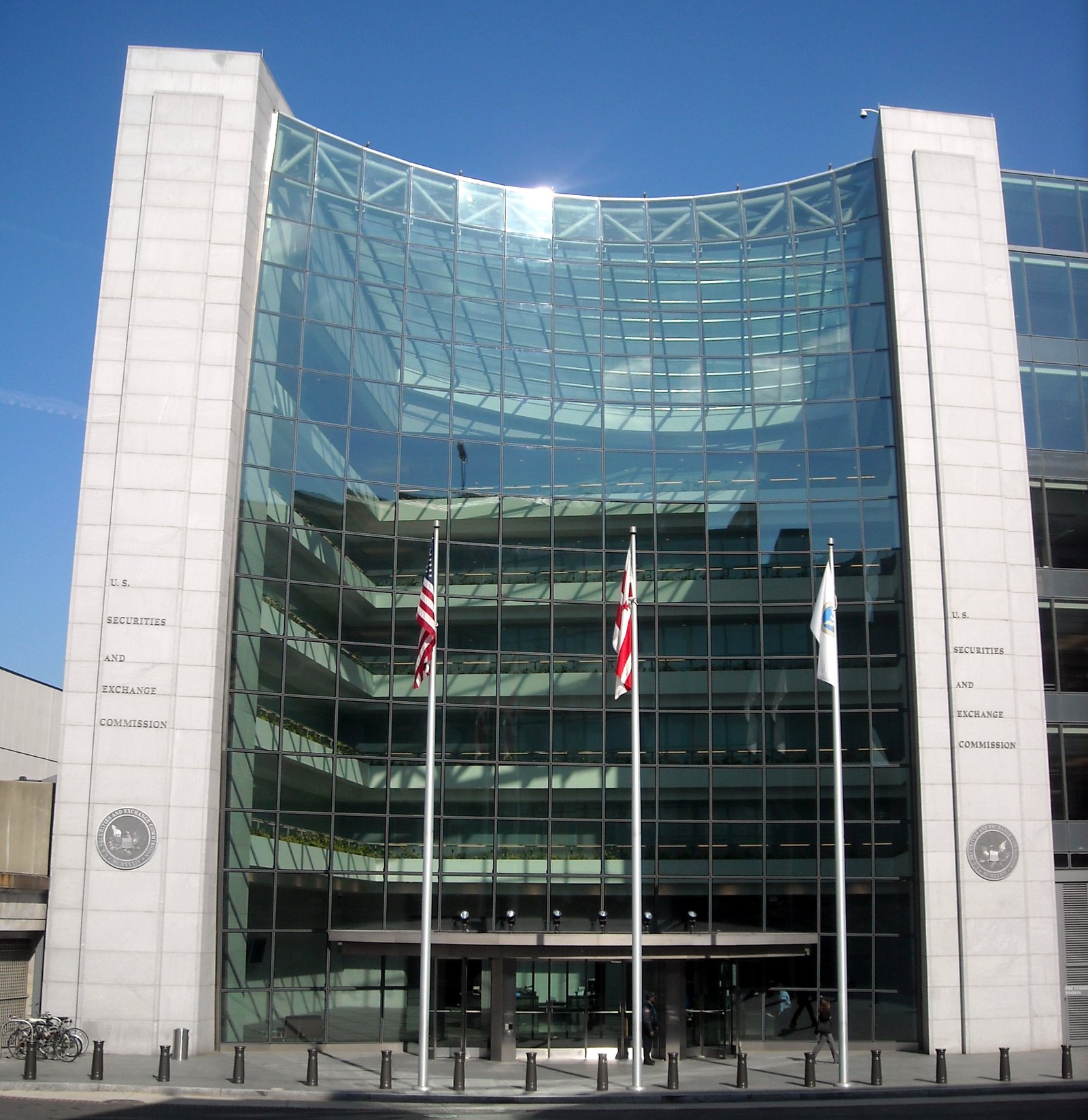
Photo: U.S. Securities and Exchange Commission headquarters, Washington, D.C. Credit: AgnosticPreachersKid via Wikimedia Commons, CC BY-SA 3.0.
