

The son of one of Iran’s most senior security officials now sits at the center of what the U.S. Treasury Department is calling the “financial equivalent” of a bombing campaign — a sprawling, multi-jurisdictional crackdown on an oil-smuggling empire that American prosecutors say funnels billions of dollars to the Islamic Republic, the Kremlin, and Hezbollah.
On April 15, 2026, the Treasury Department’s Office of Foreign Assets Control (OFAC) designated more than two dozen individuals, companies, and vessels operating within the network of Mohammad Hossein Shamkhani, an Iranian petroleum magnate whose father, the late Ali Shamkhani, served as a senior adviser to Supreme Leader Ali Khamenei until he was killed in an Israeli airstrike in Tehran in February 2026. The action formally launched “Operation Economic Fury,” a sweeping enforcement campaign that Treasury Secretary Scott Bessent has described as a companion to U.S. military operations in the Persian Gulf.
The sanctions package, combined with a parallel Justice Department civil forfeiture action filed in March seeking $15.3 million in frozen funds, provides the most detailed public accounting to date of how a single family-run enterprise allegedly laundered Iranian crude through Dubai free zones, Netherlands-registered shell firms, Venezuelan gold markets, and Hezbollah couriers in Turkey.
An Empire Built on Free-Zone Shell Companies
Court filings and OFAC designation documents portray the Shamkhani operation as a textbook case of jurisdiction-shopping. The network’s nerve center, according to Treasury, runs through the United Arab Emirates, where Dubai’s “DMCC” and “FZCO” free-zone structures allow foreign nationals to register trading companies with minimal disclosure, no corporate income tax, and near-total ownership secrecy.
Among the UAE-based entities designated April 15: Oriel Group, Corplinx Consultancy, House of Shipping Investment FZCO, Helmatic Consultancy DMCC, Taylor Shipping FZCO, and Meritron DMCC. According to the Treasury’s designation documents, Meritron — directed by Indian national Chetan Prakash Balhotra — was the procurement arm used to secretly acquire newbuild tankers. Between 2025 and early 2026, Treasury alleges, Meritron sought to purchase two newbuild vessels worth tens of millions of dollars from South Korean shipbuilders on behalf of Shamkhani, wiring “tens of millions of dollars” in down payments through the UAE banking system.
Meritron was previously managed by Shamkhani associate Elisabetta Cadeddu, an Italian national, and operated as a subsidiary of Max Energy Fuel Trading LLC — both of which were swept into OFAC’s prior enforcement action, a July 30, 2025 designation that Treasury called the largest single Iran-related action since the first Trump administration’s 2018 “maximum pressure” campaign. That earlier sweep named more than 50 individuals and entities and identified more than 50 vessels.
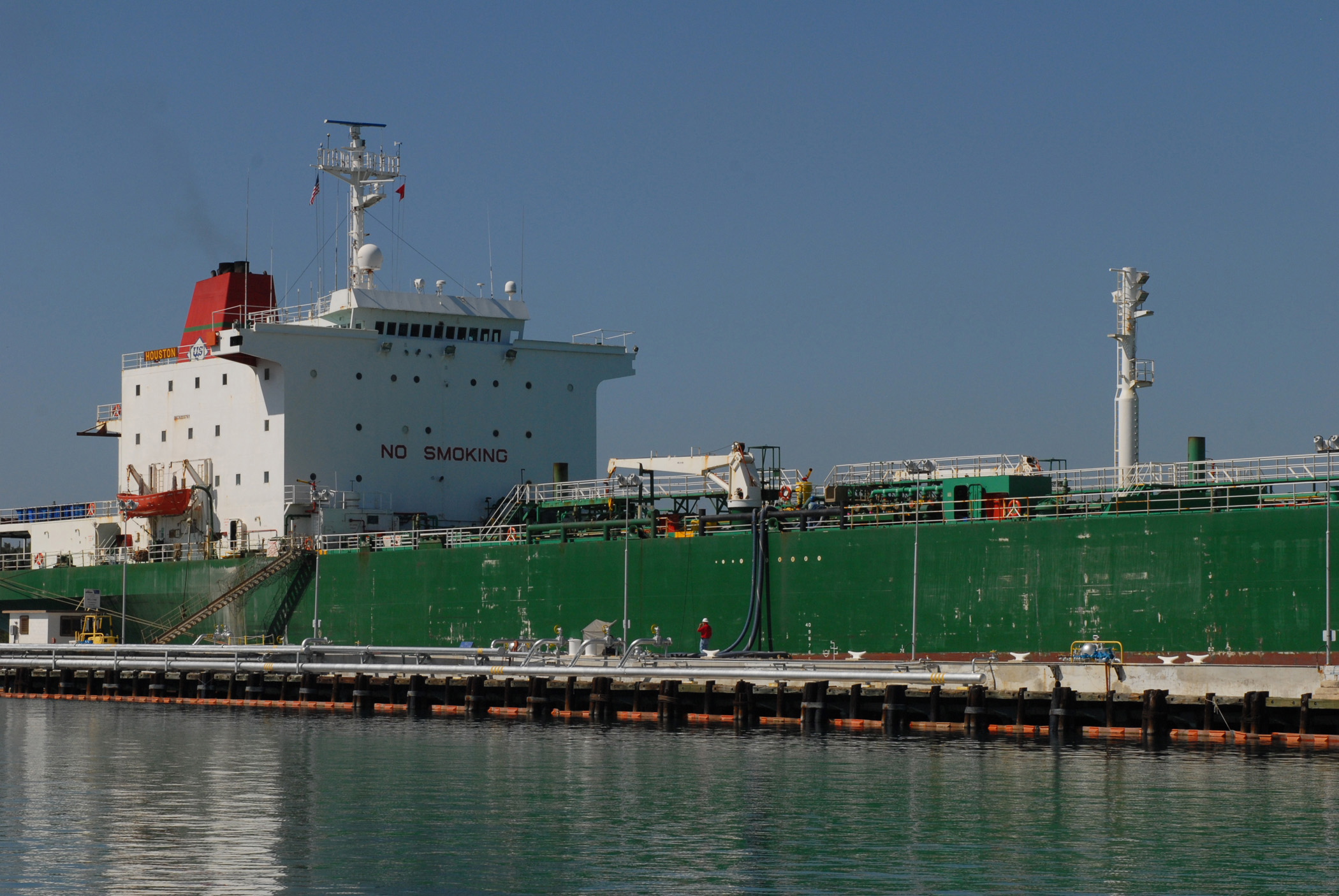
The April 15 action layered nine additional tankers onto the specially designated nationals (SDN) list: Aura (IMO 9274563), Horae (IMO 9413004), Versa (IMO 9379301), Anaya (IMO 9326885), Daphne V (IMO 9321677), Silvar (IMO 9291262), Cauveri (IMO 9282508), Bellaris (IMO 9332614), and Anika (IMO 9417464). Each vessel was designated pursuant to Executive Order 13902, which authorizes sanctions on entities operating in Iran’s petroleum sector.
Oil for Gold: The Caracas-Tehran-Istanbul Laundering Chain
The most striking feature of the April 15 filings is not the volume of oil moved but the laundering architecture used to monetize it. According to Treasury, the Shamkhani network’s financing arm was operated by Seyed Naiemaei Badroddin Moosavi, an Iranian designated for acting on behalf of the Islamic Revolutionary Guard Corps–Quds Force (IRGC-QF). Moosavi’s role, per the designation, was to convert Iranian crude into a more portable and less traceable medium: physical gold.
The mechanism ran, records indicate, as follows. Moosavi arranged for Iranian oil cargoes to be delivered to the Venezuelan government of Nicolás Maduro. In exchange, Caracas transferred gold — in some cases priced well below prevailing market rates — to Moosavi’s couriers. The gold was then flown on U.S.-sanctioned Mahan Air to Tehran, where it was handed to Hezbollah financier Ali Qasir, another U.S.-designated individual. From Tehran, the bullion was smuggled overland to Turkey and sold into the international precious-metals market, with the cash proceeds returned to the IRGC-QF and Hezbollah’s treasury.
Treasury identified three additional entities as part of the oil-for-gold conduit: ACS Trading and Lotus Universal, both based in the UAE, and ACS Global, registered in the Netherlands. On the Venezuelan side, the scheme allegedly operated with the cooperation of Tareck Zaidan El Aissami Maddah, the former Venezuelan vice president and oil minister whom the United States designated as a narcotics trafficker under the Kingpin Act. U.S.-designated shipping facilitator Viktor Artemov, whom OFAC has linked to Russian sanctions-evasion networks, allegedly helped coordinate the ship-to-ship transfers and Automatic Identification System (AIS) spoofing that concealed the cargoes’ origin.
The scheme, Treasury said in its announcement, ran for more than five years before enforcement caught up with the participants.
A Parallel Forfeiture: $15.3 Million Frozen in Singapore
While OFAC designations freeze U.S.-jurisdiction assets and bar Americans from transacting with sanctioned parties, the Justice Department has pursued a separate track: civil forfeiture in federal court. On March 6, 2026, DOJ attorneys filed two civil forfeiture complaints in the U.S. District Court for the District of Columbia, seeking to seize more than $15.3 million tied to the Shamkhani operation.
The first complaint, docketed as Case No. 26-cv-802, targets $12,973,529 in funds that prosecutors say were intended for Wellbred Capital Pte Ltd. and its subsidiary Wellbred Trading DMCC — two entities the government alleges were acquired and operated by Shamkhani and his associates. The second complaint, Case No. 1:26-cv-00807, targets $2.4 million tied to Sea Lead Shipping Pte Ltd. Both filings allege violations of the International Emergency Economic Powers Act and the federal money-laundering statute.
Industry compliance analysts at maritime intelligence firm Windward characterized the combined Treasury-DOJ actions as unusually coordinated, noting that forfeiture complaints typically lag designations by many months. The speed of the March forfeiture and April redesignation suggests — though the record does not confirm — that U.S. law enforcement had been quietly building the case since well before Shamkhani was first publicly named in July 2025.
The China Question
The ultimate destination of the Shamkhani network’s cargoes, according to multiple tanker-tracking organizations, is the People’s Republic of China. Data compiled by United Against Nuclear Iran (UANI) indicates that China purchases between 80 and 91 percent of Iran’s total crude exports, a flow that reached roughly 1.38 million barrels per day in 2025 before dipping to between 1.13 and 1.20 million bpd in January and February 2026 amid intensified U.S. enforcement and the recent Gulf blockade.
Chinese customs records officially report zero crude imports from Iran since 2022. Yet Beijing’s logged “Malaysian” crude imports in 2025 exceeded 1.3 million barrels per day — more than double Malaysia’s total domestic crude production. Analysts at the Middle East Institute describe this as the defining mechanism of the “shadow fleet”: Iranian cargo is trans-loaded vessel-to-vessel in international waters off Malaysia, then delivered to Chinese refiners as Malaysian oil.
The April 15 Treasury action did not directly designate Chinese refiners or banks, but Secretary Bessent signaled in parallel remarks that secondary sanctions — which cut foreign entities out of the U.S. financial system for dealing with sanctioned Iranian actors — are now firmly on the table. According to DefenseScoop, Bessent also confirmed that the administration will not renew the general licenses that had permitted “oil on the water” prior to March 11 to reach its destination. Those waivers expire April 19, 2026.
What Comes Next
The Shamkhani file illustrates the architecture of modern sanctions evasion in microcosm: a politically connected principal in Tehran, a forest of free-zone shells in Dubai and the Netherlands, a deniable logistics chain through Malaysia and Venezuela, and a bullion-laundering loop that ends in Turkish gold markets. Treasury’s enforcement memorandum describes the operation as generating “billions of dollars” for the Iranian and Russian regimes — a figure that, if accurate, would place the network among the most consequential sanctions-evasion schemes ever publicly prosecuted.
Still, significant questions remain unanswered on the public record. Treasury has not identified the specific Chinese refiners that took delivery of Shamkhani-linked cargoes, though industry analysts broadly suspect small independent “teapot” refineries in Shandong province. The Turkish gold dealers who allegedly converted Hezbollah bullion to cash have not been publicly named. And the role of UAE financial institutions in clearing the tens of millions of dollars in shipbuilding payments — funds that prosecutors now describe as sanctions-evasion proceeds — remains a subject Emirati authorities have declined to address publicly. A spokesperson for the UAE’s Ministry of Economy did not respond to a request for comment; contact information for Mohammad Hossein Shamkhani and his designated associates is not publicly available.
Whether Operation Economic Fury succeeds in choking off the network will depend less on designations than on whether third-country banks, shipbuilders, and refiners conclude that the reputational and regulatory cost of continued exposure to the Shamkhani constellation now exceeds the commercial benefit. That calculus, in turn, depends on enforcement against secondary facilitators — a step the Trump administration has signaled, but not yet executed.