

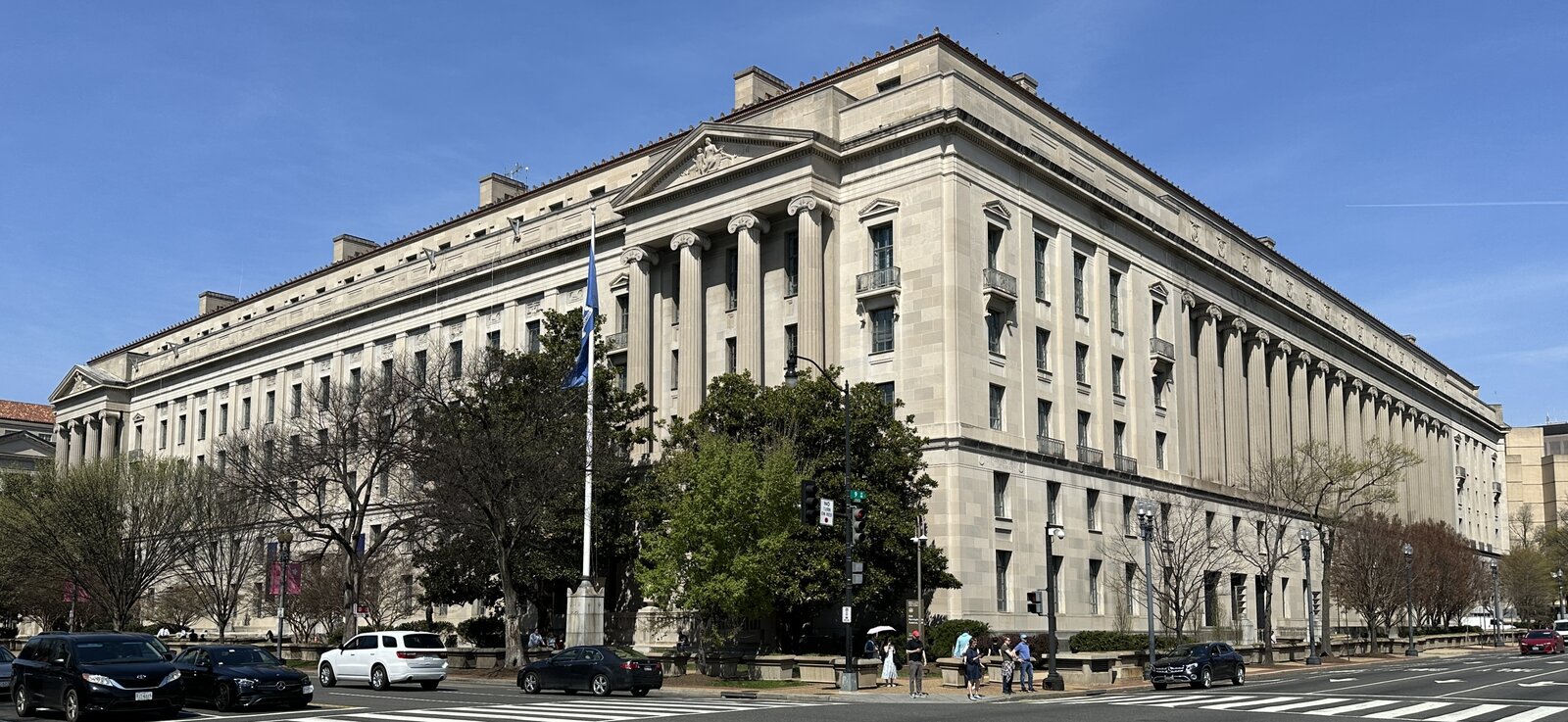
The Investigative Journal’s daily review of Department of Justice enforcement activity. Cases noted as “alleged” or “indicted” remain pending; defendants are presumed innocent unless and until proven guilty.
The Day in Federal Enforcement
The Justice Department closed the most recent reporting cycle with one of its broadest single-week pushes since the stand-up of the new National Fraud Enforcement Division (NFED) on April 7, 2026. Records released by the Office of Public Affairs and U.S. Attorneys’ offices document enforcement actions tied to nearly $1 billion in fraud losses, a multi-court denaturalization sweep targeting accused terrorists and a former U.S. ambassador-turned-Cuban spy, and a 12.5-year sentence for the U.S.-side ringleader of a $27 million elder-fraud operation. Filings indicate the cadence reflects new resourcing announced under the Trump administration’s Task Force to Eliminate Fraud, chaired by Vice President J.D. Vance.
Below is The Investigative Journal’s roundup of the week’s most consequential federal enforcement actions, each linked to the primary DOJ source. Several warrant follow-on reporting and are flagged at the bottom of this digest.
1. Former U.S. Rep. Sheila Cherfilus-McCormick — $5.7M Disaster-Fund Indictment
The Department of Homeland Security on May 1 confirmed it has indefinitely suspended former U.S. Rep. Sheila Cherfilus-McCormick (D-Fla.) and several associates from federal disaster contracting after a federal grand jury in the Southern District of Florida returned an indictment alleging the diversion of approximately $5.7 million in pandemic-era disaster funds. According to DHS’s notice, the suspension covers her family’s healthcare company, Trinity Healthcare Services, which records show held a 2021 contract to register Floridians for COVID-19 vaccinations.
The indictment, returned earlier this year, alleges the funds were used for personal enrichment and illegal campaign contributions. The House Ethics Committee in March separately found the former congresswoman guilty of 25 ethics violations tied to the same scheme, and she resigned from Congress on April 21 ahead of a likely expulsion vote. The case is one of the highest-profile public-corruption matters of the year and tests the post-pandemic accountability framework for emergency disbursements.
Source: DHS announcement, May 1, 2026.
2. Joel Rufus French — 196 Months for $197M Medicare and CHAMPVA Fraud
Former NFL player Joel Rufus French, 47, of Amory, Mississippi, was sentenced on May 7 to 196 months — over 16 years — in federal prison for orchestrating what court filings describe as a yearslong scheme to defraud Medicare and the Civilian Health and Medical Program of the Department of Veterans Affairs (CHAMPVA) out of nearly $200 million. He was ordered to pay $110,753,619 in restitution and to forfeit roughly $17 million seized from bank accounts and assets.
According to evidence presented at trial, French worked with overseas telemarketing call centers that pressured elderly Americans and the families of disabled veterans to accept medically unnecessary orthotic braces. Records indicate the call centers in some instances altered call recordings to fabricate patient consent. French paid kickbacks to sham telemedicine companies for signed doctors’ orders from physicians who had never examined the patients, and concealed his beneficial ownership of eight durable medical equipment suppliers through straw owners. He was convicted in February of conspiracy to commit healthcare fraud, wire fraud, money laundering, and kickback offenses.
Source: DOJ Office of Public Affairs, May 8, 2026.
3. Zhao “Oscar” Wang — 12.5 Years for $27M Multinational Elder Fraud
Zhao Wang, 41, a Chinese national operating out of Las Vegas under the alias “Oscar,” was sentenced on May 8 to 151 months in prison for leading a $27 million fraud and money-laundering operation that prosecutors say targeted approximately 2,000 elderly Americans. Court documents describe a scheme in which India-based call centers initiated technical-support, bank-impersonation, and refund scams; Wang’s U.S.-based crew then collected victim cash sent via express mail using fake IDs at retail receiving locations.
Filings indicate Wang laundered roughly 82 percent of the proceeds back to foreign-based co-conspirators via cryptocurrency, retaining a cut of up to 18 percent. U.S. District Judge Robert S. Huie called the scope of the fraud “staggering” and the targeting of elderly victims “100 percent reprehensible.” The case is part of a broader transnational scam-center initiative; a separate coordinated takedown announced April 29 resulted in at least 276 arrests across the FBI, Dubai Police, and the Chinese Ministry of Public Security.
Source: U.S. Attorney, Southern District of California, May 8, 2026.
4. Denaturalization Sweep — 12 Defendants Across 10 Districts
On May 8, the Justice Department’s Office of Immigration Litigation, Affirmative Litigation Unit, filed civil denaturalization complaints against 12 individuals in U.S. district courts ranging from Arizona to the District of Columbia. The cases allege concealment of histories that include material support to Al-Qaeda and al-Shabaab, war-crimes participation, sexual abuse of a minor, sham-marriage immigration fraud, straw-purchase firearms trafficking to Bolivian cartels, and — in one case — three decades of espionage on behalf of the Republic of Cuba.
The most prominent defendant is Victor Manuel Rocha, 75, a Colombian-born former U.S. State Department official who served as director of inter-American affairs at the National Security Council in the 1990s and later as U.S. ambassador to Bolivia. Rocha pleaded guilty in 2024 to acting as an unregistered agent of Cuba; the new filing alleges his espionage relationship with Havana began in 1973, five years before he naturalized. Other defendants include Khalid Ouazzani, who pleaded guilty in 2010 to providing material support to Al-Qaeda within a year of obtaining citizenship, and Baboucarr Mboob, a former Gambian military police officer who admitted before The Gambia’s Truth, Reconciliation, and Reparations Commission to participating in the 1994 extrajudicial execution of six fellow officers. The claims in the complaints are allegations only and have not been adjudicated.
Source: DOJ Office of Public Affairs, May 8, 2026.
5. Poul Thorsen — Autism-Research Fugitive Extradited After 14 Years
Danish researcher Poul Thorsen, 65, was arraigned May 8 in the Northern District of Georgia on federal wire-fraud and money-laundering charges, ending a nearly 14-year fugitive run. Thorsen — long featured on the Health and Human Services Office of Inspector General’s top-ten most-wanted list — was arrested in Passau, Germany, in June 2025 on an INTERPOL Red Notice tied to a 2011 indictment and was extradited to the United States this month.
The indictment alleges that between 2004 and 2008, while administering more than $11 million in CDC grant funds awarded to Danish agencies for autism, cerebral palsy, and fetal-alcohol research, Thorsen submitted at least a dozen fraudulent invoices bearing the forged signature of a CDC laboratory section chief. Aarhus University allegedly transferred hundreds of thousands of dollars into CDC Federal Credit Union accounts that, records suggest, Thorsen personally controlled. Prosecutors say proceeds went to a home in Atlanta, a Harley-Davidson motorcycle, and Audi and Honda vehicles. Thorsen is held without bail pending trial; he is presumed innocent.
Source: U.S. Attorney, Northern District of Georgia, May 8, 2026.
6. $522 Million Genetic-Testing Fraud — Two Sentenced
In a case the Fraud Division identified as one of its largest health-care prosecutions of the cycle, two defendants were sentenced May 4 to 151 months and 36 months in prison, respectively, for their roles in submitting over $522 million in fraudulent claims for medically unnecessary genetic tests to Medicare, Medicaid, and private insurers. Court records describe a kickback-driven scheme in which seniors were enrolled in cancer-genomic and pharmacogenomic testing they did not need, often through telemarketing and tele-health fronts.
The sentences underscore the Fraud Division’s stated focus on lab-based billing schemes — an enforcement vector that the Department of Health and Human Services Office of Inspector General has flagged repeatedly as a concentrated source of Medicare loss. According to DOJ data cited in the announcement, the Health Care Fraud Strike Force Program has now charged more than 6,200 defendants billing federal programs and private insurers more than $45 billion since 2007.
Source: DOJ Office of Public Affairs, May 4, 2026.
7. $84 Million U.S. Treasury Check-Theft Conspiracy — Four Guilty Pleas, Including Two Ex-USPS Workers
Four defendants, including two former U.S. Postal Service employees, pleaded guilty in the Eastern District of Pennsylvania to conspiracy to steal an estimated $84 million in U.S. Treasury checks. Court filings indicate the conspirators removed thousands of envelopes containing Treasury checks from mail-sorting machines and sold the haul to buyers across the country who then negotiated or otherwise monetized the instruments.
The case is one of several active prosecutions involving insider mail-stream theft from the U.S. Postal Service. A separate New York indictment unsealed the same week charges six defendants in Buffalo with opening bank accounts under stolen-check payees’ names using fraudulent identification, and an Atlanta-area indictment names two former postal carriers, a bank manager, and a convicted felon in a roughly $5 million bank-fraud and mail-theft scheme. Taken together, the cases suggest filings indicate a systemic vulnerability in mail-stream handling of federal-payment instruments that warrants further oversight scrutiny.
Source: U.S. Attorney, Eastern District of Pennsylvania, May 2026.
8. Texas Physician Convicted for Illegal Distribution of Over One Million Pills
A federal jury in the Southern District of Texas on May 4 convicted a Texas physician for unlawfully distributing more than one million pills of opioids and other Schedule II controlled substances outside the bounds of legitimate medical practice. The case forms part of a multi-district push by the Drug Enforcement Administration and U.S. Attorneys’ offices to target high-volume prescribers operating clinics that prosecutors characterize as “pill mills.” Sentencing is pending.
Source: DOJ Office of Public Affairs, May 4, 2026.
Cases Warranting Deeper TIJ Investigation
Two case clusters merit standalone investigative follow-up. First, the Cherfilus-McCormick disaster-fund matter — given the political dimension and the use of a family-owned vendor as the alleged conduit — raises broader questions about FEMA and HHS contracting controls in the closing months of the pandemic emergency declaration. Public records suggest similar single-source no-bid contracts exist across multiple states; TIJ will pursue a comparative review.
Second, the convergence of the Zhao Wang sentencing, the April 29 international scam-center takedown, and ongoing transnational elder-fraud prosecutions implicates a sustained cross-border infrastructure linking Chinese-national U.S. cell operators to India-based call centers and cryptocurrency-laundering rails to the People’s Republic of China. The Department’s willingness to coordinate with the Chinese Ministry of Public Security on a portion of these takedowns is a notable development. TIJ will examine the procurement of remote-desktop tooling used in these schemes and whether U.S.-domiciled retail receiving locations have adequate know-your-customer obligations.
TIJ is also tracking the Department’s Corporate Enforcement Policy, formally extended on March 10 to all criminal cases department-wide. Several practitioners have flagged that the unified self-disclosure framework — combined with NFED’s quasi-litigating-division status — represents the most significant restructuring of federal white-collar enforcement architecture in over a decade.
Notes on Methodology
This digest is compiled from official Department of Justice press releases, U.S. Attorneys’ office announcements, and Department of Homeland Security notices. Allegations from pending indictments are noted as such; only adjudicated outcomes (guilty pleas, jury verdicts, sentencings) are described as findings. Right-of-reply requests may be directed to the U.S. Attorneys’ offices listed in each linked source. Citations link to primary documents on justice.gov and dhs.gov.